Introduction
A builder buys a contiguous 2,000 square metre residential plot in an Indian city and plans to build 32 flats across four small blocks. Under Indian real estate law, a project of this size cannot be advertised, marketed, or sold unless the builder first registers it with the State Real Estate Regulatory Authority (RERA). Registration brings strict duties: depositing 70 percent of homebuyer funds into a dedicated project bank account, publishing sanctioned plans online, declaring a binding completion date, and paying statutory interest for delays.
To dodge these safeguards, some promoters try a paperwork shortcut. They split the 2,000 square metre plot on paper into four pockets of 480 square metres and eight apartments each, claiming that every pocket is too small to require RERA registration.
Can a builder legally escape RERA oversight this way? No. When Parliament enacted the Real Estate (Regulation and Development) Act, 2016 (also accessible on Indian Kanoon), it blocked this tactic in advance. Under Section 3(2)(a) of the RERA Act, 2016, the small-project exemption for land up to 500 square metres or up to 8 apartments applies “inclusive of all phases.” In addition, the Explanation to Section 3(2) states that where a project is developed in phases, every phase is a stand-alone project requiring its own separate registration.
This article explains Section 3, compares lawful phasing with unlawful splitting, examines regulatory and judicial scrutiny, and outlines Section 59 penalties and homebuyer remedies.
Legal Information Notice
Legal information notice: This article is for general educational and informational purposes. It does not constitute legal advice or create an attorney-client relationship.
Overview: Lawful Phased Development Versus Unlawful Project Splitting
Before studying the statutory text, it helps to separate two very different practices: genuine phased construction and artificial project splitting.
1. Why Genuine Housing Projects Are Built in Phases
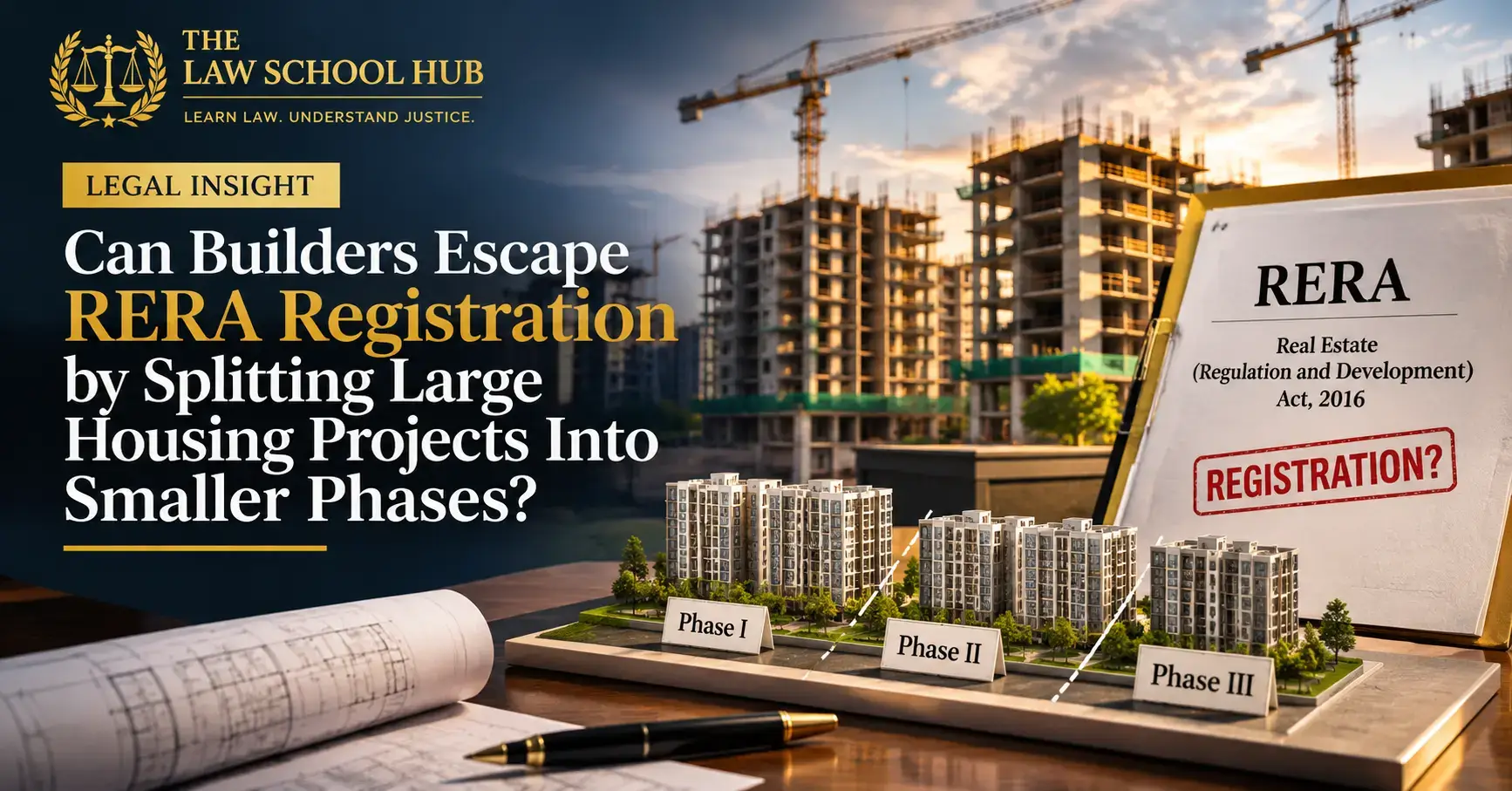
Building a large township or multi-tower housing society takes years and heavy capital. A developer constructing 600 flats across ten acres rarely builds every tower at once. Instead, the builder divides the master plan into sequential stages: Phase I, Phase II, and Phase III.
In genuine phased development, the builder finishes Phase I, secures an occupancy certificate, hands over flats to Phase I buyers, and then launches Phase II with fresh funding. Under RERA, this model is completely legal if the promoter registers each phase separately, discloses the master layout honestly, keeps a separate 70 percent bank account for each phase, and never diverts Phase I buyer funds into future land purchases or Phase II construction.
2. How Artificial Project Splitting Differs From Genuine Phasing
Artificial project splitting has nothing to do with construction planning. Here, a promoter breaks one unified housing project into tiny sub-500 square metre or sub-8-unit slices solely to claim that RERA does not apply at all.
Typical warning signs include a single contiguous parcel divided into adjacent pockets sharing the same entry gate, internal road, water line, sewage plant, or sales brochure. Some builders transfer neighbouring slices to relatives, sister companies, or newly created Limited Liability Partnerships (LLPs) to pretend that unrelated small builders are working side by side. Because RERA is a consumer-protection statute, authorities look behind paper labels to examine the real substance of the project.
The Statutory Architecture of Section 3 of RERA, 2016
Every legal dispute over project splitting turns on Section 3 of the Real Estate (Regulation and Development) Act, 2016, which governs mandatory prior registration and its narrow exemptions.
1. Mandatory Prior Registration Under Section 3(1)
Section 3(1) lays down a strict rule: no promoter can advertise, market, book, sell, offer for sale, or invite people to buy any plot, apartment, or building in a real estate project, or any part of it, in a planning area without first registering the project with the State RERA Authority.
The first proviso extended this mandate to ongoing projects lacking a completion certificate on 1 May 2017, requiring registration within three months. The second proviso empowers the Authority, in the interest of allottees, to direct registration even outside a notified planning area. Without a valid RERA number, even issuing a brochure or taking a booking cheque breaches Section 3(1).
2. The Small-Project Exemption Under Section 3(2)(a) and “Inclusive of All Phases”
To avoid burdening RERA offices with tiny family buildings, Section 3(2)(a) exempts a project where the proposed land area does not exceed 500 square metres or the number of proposed apartments does not exceed 8 inclusive of all phases.
Two parts of this clause defeat evasion:
- “Inclusive of all phases”: A builder cannot measure each phase separately to stay below the limit. If a master layout spans 1,500 square metres or proposes 24 flats across three phases of 8 flats each, the combined total exceeds the threshold and every phase must be registered.
- State power to tighten limits: The proviso to Section 3(2)(a) lets State Governments reduce the threshold below 500 square metres or 8 apartments. States can narrow the exemption, but they cannot widen it.
3. The Explanation to Section 3(2): Every Phase Is a Stand-Alone Project
The Explanation to Section 3(2) states that where a project is developed in phases, every such phase shall be considered a stand-alone real estate project, requiring separate registration for each phase.
Some builders misread this Explanation to claim that a single 450 square metre phase with 6 flats is exempt on its own. That reading fails basic statutory interpretation because an Explanation cannot override the express words “inclusive of all phases” in Section 3(2)(a). Read together, the provisions establish a two-step test:
- Aggregate first: Count total land area and total apartments across all phases combined. If the combined project exceeds 500 square metres or 8 apartments, no exemption applies.
- Register each phase separately: Once registration applies, the builder may still construct in stages, but every phase needs its own RERA registration number, separate 70 percent escrow account, and declared completion timeline.
This prevents Phase I funds from being diverted to Phase III while keeping every part of a large layout under regulatory oversight.
4. The “And” Versus “Or” Debate on the 500 Sq. Metres and 8 Apartments Limit
Frequent disputes focus on the word “or” in Section 3(2)(a). Reading “or” loosely, a builder constructing 16 small flats on 400 square metres might claim exemption by land size, while a developer building 4 villas on 2,000 square metres might claim exemption by unit count.
Because RERA is a remedial consumer-welfare law, State RERA Authorities and Appellate Tribunals largely reject this loophole. To claim exemption, a project must stay within both limits: land area up to 500 square metres and up to 8 apartments inclusive of all phases. Crossing either ceiling triggers mandatory registration across major states.
5. Other Narrow Exemptions Under Section 3(2)(b) and 3(2)(c)
Section 3(2) recognises only two other exemptions:
- Section 3(2)(b) — Prior completion certificate: Projects that received a valid completion certificate before 1 May 2017 do not require registration. If only Phase I had a completion certificate before that date, incomplete Phase II and Phase III still require registration.
- Section 3(2)(c) — Renovation or redevelopment without new sale: Repair, renovation, or redevelopment involving no marketing, advertising, selling, or new allotment is exempt. In society redevelopments, existing-member rehabilitation units may fall outside registration, whereas new free-sale flats offered to the public must be registered once the threshold is crossed.
How Anti-Circumvention Works in Practice: Scrutinising Disguised Project Splits
Promoters rarely admit on paper that they split a project to evade RERA. Instead, they rely on layered corporate structures and staggered approvals. Regulators therefore apply practical anti-circumvention checks to uncover disguised splitting.
1. Common Evasion Tactics Used by Promoters
State RERA Authorities frequently encounter five recurring tactics:
- Paper subdivision of a contiguous plot: Subdividing a 2,400 square metre parcel into five 480 square metre plots and taking separate municipal sanctions for 6 or 7 flats each while developing them together.
- Using relatives, sister companies, or LLPs: Transferring adjoining strips to family members or newly formed LLPs so each pocket appears independent, even though one team builds and markets the whole site.
- Staggered municipal sanctions: Taking municipal permission for 8 flats on one corner of a large plot, selling them unregistered, and applying months later for 8 more flats next door.
- Hiding future phases from early buyers: Registering Phase I while leaving adjoining land vague in brochures to launch unregistered blocks or use extra Floor Space Index (FSI) later.
- Selling residential plots in small batches: Carving a large suburban tract into residential plots under informal agreements without registering the plotted layout.
2. Indicators RERA Authorities Examine to Unmask Artificial Splits
During a complaint or suo motu (own-motion) probe, RERA Authorities look at ground reality rather than paper labels:
- Contiguity and common boundary: Adjoining plots enclosed by one boundary wall or linked by shared internal roads.
- Shared infrastructure: One entry gate, security cabin, water tank, sewage plant, electrical transformer, or basement parking serving multiple blocks.
- Unified branding and sales: Brochures, websites, hoardings, or brokers marketing adjacent blocks under one project name or promising shared amenities.
- Common control under Section 2(zk): Section 2(zk) defines “promoter” broadly to include builders, colonisers, developers, and landowners causing construction for sale. Related entities acting in concert on one integrated layout can be treated as joint promoters.
- Parent title and town-planning history: Original land deeds and master layouts showing one large parcel recently sliced into sub-threshold applications.
3. Mandatory Disclosures Under Section 4 and Consent Rules Under Section 14(2)
Even where Phase I is registered, RERA curbs phase manipulation through Section 4 and Section 14(2).
Under Section 4(2), the promoter must upload authenticated approvals, sanctioned plans, the layout plan of the proposed phase, and the whole project as sanctioned by the competent authority, along with a sworn affidavit confirming title, completion timelines, and compliance with Section 4(2)(l)(D): depositing 70 percent of buyer collections into a separate scheduled bank account strictly for that phase’s land and construction costs.
Under Section 14(2)(ii), once sanctioned plans, layout plans, and common-area specifications are disclosed, the promoter cannot alter or add to the building or common areas without the previous written consent of at least two-thirds of the allottees (excluding the promoter). This stops builders from turning a promised Phase I garden or clubhouse into a surprise Phase II tower unless future development rights were transparently disclosed in the sanctioned layout at booking.
| Parameter | Lawful Phase-Wise RERA Registration | Unlawful Project Splitting to Evade RERA |
|---|---|---|
| Core Objective | Manage construction stages, financing, and handovers across a large township. | Stay artificially below 500 sq. m. or 8 flats to escape RERA rules and escrow controls. |
| Registration Status | Each phase holds its own RERA registration under the Explanation to Section 3(2). | No phase is registered, or adjacent pockets are sold unregistered outside the portal. |
| Master Layout Disclosure | Full sanctioned layout and future phase boundaries are disclosed under Section 4(2). | Master layout is hidden; adjoining land is split on paper or parked in sister LLPs. |
| 70% Escrow Account | Separate audited 70% project bank account maintained for every registered phase. | No statutory 70% escrow lock; buyer money can be diverted freely. |
| Common Areas | Clearly demarcated; later changes require 2/3rd allottee consent under Section 14(2). | Shared gates, roads, or parks are used across blocks, or promised parks become new towers. |
| Legal Outcome | Compliant and transparent for buyers, lenders, and regulators. | Violates Section 3; attracts up to 10% project-cost penalty and up to 3 years jail under Section 59. |
Key Judicial Decisions Shaping RERA Registration and Phased Development
Constitutional courts have consistently interpreted RERA purposively to protect homebuyers and stop technical evasion. Four key judgments anchor the legal framework governing Section 3 and phased projects.
1. Neelkamal Realtors Suburban Pvt. Ltd. v. Union of India (2017)
Facts
Real estate developers challenged the constitutional validity of core RERA provisions before the Bombay High Court, including Section 3 (mandatory registration), Section 4(2)(l)(D) (70 percent escrow account), and Section 18 (refund and delay interest), arguing they violated the right to carry on business under Article 19(1)(g).
Legal Issue
Whether Parliament validly imposed prior registration, separate project accounting, and ongoing-project regulation under RERA.
Court’s Reasoning
In Neelkamal Realtors Suburban Pvt. Ltd. v. Union of India (2017 SCC OnLine Bom 9302), the Bombay High Court noted that chronic delays, diversion of buyer funds, and opaque layouts plagued Indian housing. The Court held that RERA serves a vital public purpose by enforcing transparency and financial discipline, and that regulating ongoing projects under Section 3 is neither arbitrary nor retrospective punishment.
Decision and Significance
The Court upheld Section 3 and RERA’s core regulatory design. In project-splitting disputes, Neelkamal Realtors confirms that prior registration and phase-specific accounting are mandatory public-interest safeguards, not optional paperwork.
2. M/s. Imperia Structures Ltd. v. Anil Patni (2020)
Facts
Homebuyers in a Gurugram housing project faced long construction delays and sought a refund with interest before the National Consumer Disputes Redressal Commission (NCDRC). The builder argued that RERA registration barred parallel consumer complaints.
Legal Issue
Whether RERA extinguishes homebuyers’ remedies under the Consumer Protection Act, and how RERA’s protective scheme should be interpreted.
Court’s Reasoning
In M/s. Imperia Structures Ltd. v. Anil Patni ((2020) 10 SCC 783), the Supreme Court read Sections 79 and 88 together to hold that RERA remedies are in addition to, not in derogation of, consumer law. The Court stressed that RERA is a remedial statute designed to protect homebuyers from delays and unfair practices, and registration technicalities cannot wipe out contractual promises.
Decision and Significance
The Court upheld the refund and interest award. Buyers caught in split or unregistered projects can pursue relief before RERA Authorities or consumer commissions without builders hiding behind procedural excuses.
3. M/s. Newtech Promoters and Developers Pvt. Ltd. v. State of Uttar Pradesh (2021)
Facts
Promoters challenged Uttar Pradesh RERA orders directing refunds with interest in projects launched before 1 May 2017, questioning RERA’s reach over ongoing projects and the Authority’s enforcement powers.
Legal Issue
Whether Section 3 applies retroactively to ongoing projects lacking a completion certificate on 1 May 2017, and what rights allottees hold under Section 18.
Court’s Reasoning
In M/s. Newtech Promoters and Developers Pvt. Ltd. v. State of Uttar Pradesh (2021 SCC OnLine SC 1044), a three-judge Bench of the Supreme Court held that RERA is retroactive: any ongoing project without a completion certificate on 1 May 2017 falls squarely under Section 3. The Court affirmed that RERA’s central object is protecting homebuyers’ savings and held that allottees have an unqualified statutory right under Section 18(1) to seek a refund with interest upon delay.
Decision and Significance
The Court dismissed the builders’ core challenges. For phased developments, Newtech Promoters confirms that incomplete phases lacking a completion certificate cannot claim immunity from Section 3 registration.
4. Mohammed Zain Khan v. Emnoy Properties India Ltd. (2024)
Facts
A dispute reached the Bombay High Court concerning regulatory oversight, jurisdictional boundaries, and statutory obligations under RERA in a contested real estate development.
Legal Issue
How statutory RERA Authorities and courts should approach jurisdictional objections and promoter compliance under the RERA Act, 2016.
Court’s Reasoning
In Mohammed Zain Khan v. Emnoy Properties India Ltd. (Bombay High Court, 25 April 2024), the Bombay High Court examined the statutory scheme of RERA and reinforced that disputes involving real estate project regulation must be handled faithfully within RERA’s protective statutory framework rather than defeated by narrow technical pleas.
Decision and Significance
The decision reflects a consistent judicial approach: courts expect RERA Authorities to exercise active statutory oversight so developers cannot sidestep accountability through technical defences.
Penalties, Enforcement Powers, and Homebuyer Remedies
Parliament backed Section 3 with steep financial penalties, imprisonment for continued defiance, investigative powers for regulators, and direct remedies for homebuyers.
1. Heavy Financial Penalties and Imprisonment Under Section 59
Section 59 punishes non-registration under Section 3 in two escalating tiers:
- First contravention — Section 59(1): A promoter who advertises, books, or sells an unregistered project (including an artificially split layout) faces a penalty of up to 10 percent of the estimated cost of the real estate project. The Authority can assess this 10 percent penalty on the entire integrated project, not just one split pocket.
- Continued default — Section 59(2): If the promoter disobeys orders under Section 59(1) or continues violating Section 3, the promoter faces imprisonment up to three years, or a further fine up to an additional 10 percent of the estimated project cost, or both.
Additionally, Section 60 imposes up to 5 percent penalty for filing false information or hiding phases in a Section 4 application, and Section 61 imposes up to 5 percent penalty for other contraventions such as breaching Section 14(2).
2. Suo Motu Powers and Directions Under Sections 35, 36, and 37
Under Section 35, a State RERA Authority can investigate either on a complaint or suo motu (on its own motion), summoning municipal plans, title deeds, and bank records with civil-court powers. Under Section 36, it can pass interim orders freezing illegal advertisements and bookings. Under Section 37, it can issue binding directions to promoters and agents, and many RERA Authorities also alert Sub-Registrars to block registration of illegal sale agreements in unregistered layouts.
3. Filing a Complaint Under Section 31 and Claiming Relief Under Sections 12 and 18
Builders sometimes falsely tell buyers that RERA cannot hear complaints about unregistered projects. In reality, Section 31 allows any aggrieved homebuyer or allottee association to file a complaint against an unregistered project that ought to have been registered. Buyers can claim two strong statutory remedies:
- Section 12 (False assurances): Buyers misled by false exemption claims, hidden phases, or vanished amenities can withdraw and recover a full refund with prescribed interest and compensation.
- Section 18 (Possession delay): Where possession is delayed, buyers can either withdraw with full refund, interest, and compensation, or stay in the project and collect monthly delay interest until handover.
| RERA Provision | What It Governs | Impact on Artificial Project Splitting |
|---|---|---|
| Section 3(1) | Mandatory prior registration before marketing or selling. | Makes pre-launch sales in an unregistered split project immediately illegal. |
| Section 3(2)(a) | Exemption up to 500 sq. m. or 8 flats “inclusive of all phases.” | Forces aggregation of all phases; blocks paper-splitting of large plots. |
| Explanation to Section 3(2) | Every phase is a stand-alone project for registration. | Mandates separate registration and escrow tracking for each phase. |
| Section 4(2) | Disclosure of sanctioned layout, title, and 70% escrow account. | Exposes hidden phases and locks 70% of receipts inside the registered phase. |
| Section 12 | Liability for false statements in brochures or advertisements. | Grants misled buyers full refund, interest, and compensation. |
| Section 14(2)(ii) | Bar on altering sanctioned plans/common areas without 2/3rd consent. | Stops builders from turning promised Phase I parks into surprise Phase II towers. |
| Section 18 | Refund with interest or monthly delay interest on late handover. | Protects buyers with an unqualified statutory refund or interest right. |
| Section 31 | Right to file complaints before RERA Authority / Adjudicating Officer. | Enables buyers to report unregistered split projects and demand action. |
| Section 59 | Penalties for violating Section 3. | Up to 10% project-cost penalty; up to 3 years jail and/or further 10% fine for continued default. |
Practical Illustrations
These hypothetical examples show how RERA’s anti-circumvention rules work in everyday Indian housing disputes.
Hypothetical Illustration 1: Splitting a 1,800 Sq. Metre Plot Into Four Sub-500 Sq. Metre Blocks
Scenario:
A builder buys a contiguous 1,800 square metre residential plot and subdivides it on paper into four adjacent plots of 450 square metres each. The builder obtains four local permissions for 6 flats per plot (24 flats total) and sells them from one sales office under one name, “Sunrise Residency,” with a single entry gate and shared sewage plant.
Legal Analysis:
Under Section 3(2)(a) of the RERA Act, 2016, the exemption applies only up to 500 square metres or 8 apartments inclusive of all phases. Contiguous land, one gate, shared utilities, and unified branding prove that all four blocks are one integrated project of 1,800 square metres and 24 flats. Paper splitting violates Section 3(1); under the Explanation to Section 3(2), each phase needs its own RERA registration.
Practical Takeaway:
Buyers can file a Section 31 complaint under the unregistered-project category with brochures and payment receipts. RERA can halt sales under Section 36, mandate registration, and levy up to 10 percent of the full 24-flat project’s estimated cost under Section 59(1).
Hypothetical Illustration 2: Using Three Family-Owned LLPs for One Contiguous Enclave
Scenario:
A developer buys a 1,400 square metre plot and transfers three adjoining 465 square metre strips to three new LLPs owned by himself, his spouse, and his brother. Each LLP builds 7 flats, but all three blocks share one internal driveway, security cabin, and marketing website.
Legal Analysis:
Related-party transfers cannot defeat RERA. Under Section 2(zk), “promoter” includes persons acting together to develop and sell apartments, and RERA Authorities can look behind separate LLPs acting in concert. Because the combined enclave covers 1,400 square metres and 21 flats, all three LLPs face joint liability for breaching Section 3(1).
Practical Takeaway:
Before booking in a “small” gated enclave, buyers should inspect the parent title chain and municipal layout. If one large plot was recently sliced among relatives or sister LLPs sharing infrastructure, buyers should demand a valid RERA number before paying any booking amount.
Hypothetical Illustration 3: Turning a Promised Phase I Park Into an Unregistered Phase II Tower
Scenario:
A builder registers Phase I on 1,500 square metres of a 2,500 square metre parcel. The sanctioned Phase I layout and brochure show a permanent landscaped park on the remaining 1,000 square metres with no mention of future towers. Two years after handover, the builder fences off the park and takes informal pre-launch bookings for a 16-flat “Phase II” tower without RERA registration.
Legal Analysis:
This breaches three rules at once: pre-launch sales without Phase II registration violate Section 3(1) and the Explanation to Section 3(2); converting a disclosed common park without two-thirds written consent of Phase I allottees violates Section 14(2)(ii); and misleading Phase I buyers triggers Section 12 liability.
Practical Takeaway:
The Phase I Resident Welfare Association or individual buyers can seek an immediate Section 36 stay before RERA, enforce Section 14(2)(ii) to restore the park, and press for Section 59 penalties.
Practical Checklist for Homebuyers Before Booking in a Phased or “Small” Project
Before paying any booking amount, homebuyers should complete six quick checks:
- Verify the RERA number online: Search the official State RERA portal to confirm sanctioned plans, completion dates, and quarterly updates rather than trusting a printed brochure.
- Check total land and total units across all phases: Inspect the sanctioned municipal master layout. If contiguous land exceeds 500 square metres or total flats exceed 8 across all phases, an “exemption” claim is legally suspect.
- Check lower state thresholds: Confirm whether your State Government has reduced the exemption threshold below 500 square metres or 8 units under Section 3(2)(a).
- Read future-phase clauses carefully: Verify which parks, clubhouses, and roads belong exclusively to your phase and which are shared with future phases.
- Verify the 70 percent escrow account: Pay booking cheques only into the RERA-disclosed project bank account, never into an unrelated personal or sister-company account.
- Preserve all brochures and messages: Keep copies of brochures, floor plans, website pages, and WhatsApp assurances as evidence under Sections 12 and 14(2).
Conclusion
Builders in India cannot legally escape RERA registration by carving a large housing project into sub-500 square metre or sub-8-apartment pockets. Section 3(2)(a) of the Real Estate (Regulation and Development) Act, 2016 counts the threshold “inclusive of all phases,” and the Explanation to Section 3(2) requires every phase of a phased project to secure separate registration.
Genuine phased development remains lawful when builders disclose the full master plan under Section 4, honour common-area consent rules under Section 14(2), and register each phase before marketing. Artificial splitting, however, triggers penalties up to 10 percent of total project cost, potential imprisonment up to three years under Section 59, and full refund-with-interest remedies under Sections 12 and 18. Verifying the master layout and RERA portal status before paying the first rupee remains every homebuyer’s strongest safeguard.
Frequently Asked Questions
1. If a builder builds 20 flats across four phases of 5 flats each on one plot, is each phase exempt from RERA?
Answer:
No. Section 3(2)(a) counts the 8-apartment limit “inclusive of all phases.” Because the project has 20 flats overall, no phase is exempt, and each phase must obtain its own RERA registration under the Explanation to Section 3(2).
2. Does a project on 400 square metres with 12 apartments require RERA registration?
Answer:
Yes. Under the prevailing consumer-protective interpretation across Indian states, crossing either 500 square metres of land or 8 apartments triggers mandatory registration. Both limits must be satisfied to claim exemption.
3. Can a builder avoid RERA by splitting a 2,000 square metre plot among four relatives or LLPs?
Answer:
No. Where adjoining parcels share a common layout, gate, utilities, branding, or promoter control, RERA Authorities can treat related entities as joint promoters under Section 2(zk) and penalise them under Section 59.
4. Can a homebuyer file a RERA complaint against an unregistered project?
Answer:
Yes. Under Section 31, any aggrieved buyer or allottee association can complain to the State RERA Authority against an unregistered project that legally requires registration under Section 3.
5. Can a builder turn a promised Phase I park into a new Phase II tower without buyer consent?
Answer:
No. Under Section 14(2)(ii), altering disclosed sanctioned plans or common areas requires prior written consent of at least two-thirds of allottees, unless future development was transparently disclosed in the sanctioned layout at booking.
6. What penalties apply when a builder illegally splits a project to evade RERA?
Answer:
Section 59(1) allows a penalty up to 10 percent of the entire project’s estimated cost. Continued violation or disobedience under Section 59(2) attracts up to three years’ imprisonment, a further fine up to 10 percent, or both.
7. If Phase I received a completion certificate before 1 May 2017, are Phase II and Phase III also exempt?
Answer:
No. The Section 3(2)(b) exemption covers only the completed phase. Incomplete or future phases lacking a completion certificate on 1 May 2017 require separate RERA registration, as reinforced in Newtech Promoters.
Legal References
- Real Estate (Regulation and Development) Act, 2016 (India Code) — Official statutory text governing real estate project registration, promoter disclosures, allottee remedies, and penalties, available at India Code — Real Estate (Regulation and Development) Act, 2016.
- Real Estate (Regulation and Development) Act, 2016 (Indian Kanoon) — Complete statutory text including Sections 2(zk), 4, 12, 14, 18, 31, 35, 36, 37, and 59, available at Indian Kanoon — Real Estate (Regulation and Development) Act, 2016.
- Section 3, Real Estate (Regulation and Development) Act, 2016 — Mandatory prior registration of real estate projects, the 500 square metre / 8 apartment threshold (“inclusive of all phases”), and the Explanation on phased development, available at Indian Kanoon — Section 3, RERA Act, 2016.
- Neelkamal Realtors Suburban Pvt. Ltd. v. Union of India, 2017 SCC OnLine Bom 9302 — Bombay High Court decision upholding the constitutional validity of RERA and explaining the regulatory object of Section 3, available at Indian Kanoon — Neelkamal Realtors Suburban Pvt. Ltd. v. Union of India.
- M/s. Imperia Structures Ltd. v. Anil Patni, (2020) 10 SCC 783 — Supreme Court judgment affirming RERA’s consumer-protective purpose and clarifying concurrent homebuyer remedies, available at Indian Kanoon — M/s. Imperia Structures Ltd. v. Anil Patni.
- M/s. Newtech Promoters and Developers Pvt. Ltd. v. State of Uttar Pradesh, 2021 SCC OnLine SC 1044 — Supreme Court three-judge Bench ruling on retroactive application of Section 3 to ongoing projects and unqualified refund rights under Section 18, available at Indian Kanoon — M/s. Newtech Promoters and Developers Pvt. Ltd. v. State of Uttar Pradesh.
- Mohammed Zain Khan v. Emnoy Properties India Ltd., Bombay High Court (25 April 2024) — Bombay High Court decision addressing RERA regulatory jurisdiction and statutory oversight over real estate disputes, available at Indian Kanoon — Mohammed Zain Khan v. Emnoy Properties India Ltd..
For more clear, source-verified explainers on Indian property law, consumer protection, and landmark judicial decisions, explore The Law School Hub.