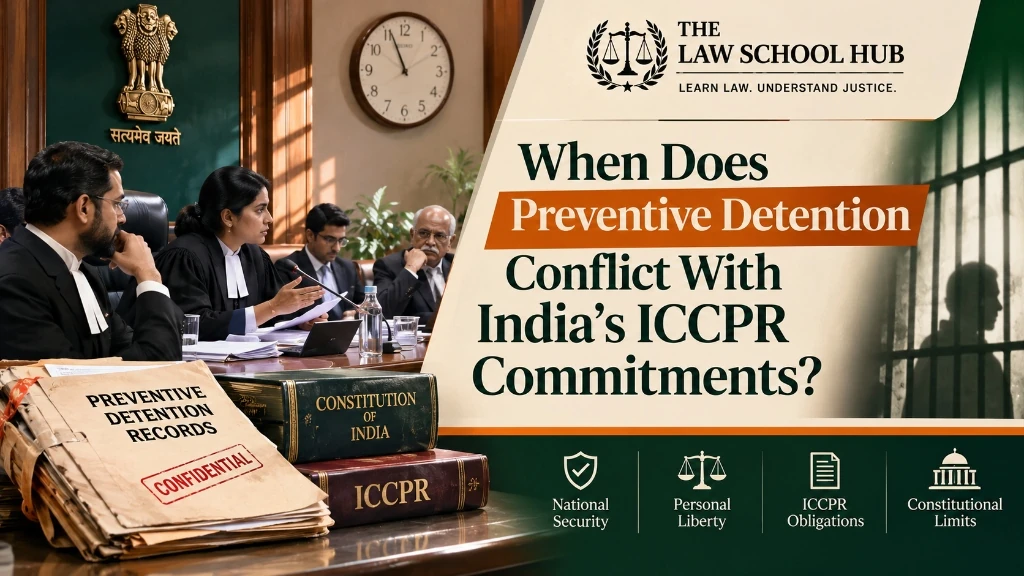
Preventive detention in India is one of the most extraordinary powers known to constitutional law: it allows executive officials—such as a District Magistrate or Police Commissioner—to imprison a person without a criminal charge, without a trial, and without proof beyond reasonable doubt, solely on the executive’s “subjective satisfaction” that the person may commit future acts harmful to public order or national security. Unlike most democratic constitutions that restrict detention without trial to declared wartime emergencies, Article 22(3)–(7) of the Constitution of India explicitly authorises peacetime preventive detention.
At the same time, India is a State Party to the International Covenant on Civil and Political Rights (ICCPR), whose Article 9 guarantees the right to liberty and security of person, prohibits arbitrary arrest or detention, and mandates prompt judicial review before an independent court. Preventive detention in India conflicts directly with these international human rights commitments whenever authorities treat detention without trial as a routine shortcut around bail and criminal trials, rely on vague or stale allegations, withhold essential facts, or delay reviewing a detainee’s representation.
1. Constitutional Architecture: Article 22 and the “Unhappy Necessity” Doctrine
Article 22 of the Constitution is split into two sharply contrasting halves. Clauses (1) and (2) protect ordinary criminal arrestees by guaranteeing immediate information on grounds of arrest, the right to consult and be defended by a lawyer of choice, and mandatory production before the nearest Judicial Magistrate within 24 hours. Clause (3)(b), however, strips both of those protections away from any person held under a preventive detention law.
1.1 Constitutional Safeguards Under Article 22(4)–(7)
In place of ordinary criminal due process, Article 22(4)–(7) creates a narrower set of procedural guardrails:
- Three-Month Advisory Board Cap (Article 22(4)): No preventive detention law may authorise detention beyond three months unless an Advisory Board—consisting of persons who are, have been, or are qualified to be High Court Judges—reports before three months expire that sufficient cause exists for continued detention.
- Communication of Grounds & Right of Representation (Article 22(5)): The detaining authority must communicate the grounds of detention “as soon as may be” in a language the detainee understands and afford the “earliest opportunity” to submit a representation against the order.
- Public-Interest Non-Disclosure Exception (Article 22(6)): Authorities need not disclose facts whose disclosure they consider “against the public interest”—a clause that significantly limits a detainee’s ability to rebut secret allegations.
1.2 The National Security Act, 1980 and A.K. Roy v. Union of India (1982)
India’s flagship central preventive detention statute—the National Security Act, 1980 (NSA)—empowers the Central Government, State Governments, and authorised District Magistrates or Police Commissioners (Section 3) to detain individuals for up to 12 months to prevent acts prejudicial to India’s defence, foreign relations, security, public order, or essential supplies. Numerous states also operate parallel “Goonda Acts” and Public Safety Acts.
In A.K. Roy v. Union of India, (1982) 1 SCC 271, a five-judge Constitution Bench upheld the NSA’s constitutional validity as an “unhappy necessity” permitted by Article 22, but stressed strict humanitarian limits: preventive detention must never become punitive, detainees should ordinarily be held near their home so family can visit, and although a detainee has no automatic right to legal counsel before the Advisory Board (unless the government itself uses a lawyer), the detainee has the right to be assisted by a “friend” and to present rebuttal evidence.
2. India’s International Obligations Under ICCPR Article 9 and General Comment No. 35
Article 9 of the UDHR and Article 9 of the ICCPR enshrine the universal ban on arbitrary arrest and detention. When acceding to the ICCPR in 1979, India lodged an interpretive declaration stating that Article 9 would be applied in consonance with Article 22(3)–(7) of the Indian Constitution, and noting that Indian law did not recognise an enforceable statutory right to compensation under Article 9(5) (a position Indian courts later transformed through public-law compensation under Articles 32 and 226).
2.1 What UN General Comment No. 35 (2014) Demands of Security Detention
In its authoritative General Comment No. 35 on Article 9 (UN Doc. CCPR/C/GC/35, 2014)—which also governs immigration detention under ICCPR Article 9 standards—the UN Human Rights Committee directly addressed preventive security detention outside criminal trials. While not declaring administrative detention per se unlawful in all circumstances, paragraph 15 imposes an extraordinarily high threshold:
- Present, Direct, and Imperative Threat: Authorities must demonstrate a concrete, imminent threat that cannot be addressed through ordinary criminal prosecution and bail conditions.
- Strict Necessity and Increasing Burden of Proof: Detention must be strictly proportional and last no longer than absolutely necessary; the longer detention continues, the heavier the State’s burden to justify it.
- Prompt, Independent Judicial Review (Article 9(4)): Every detainee must have rapid access to an independent court—with the power to order release—not merely an administrative Advisory Board operating in closed proceedings.
- Access to Legal Counsel & Disclosure of Evidence: Detainees must be guaranteed prompt access to independent legal counsel and disclosure of at least the essence of the evidence so they can mount a real defence.
- Enforceable Right to Compensation (Article 9(5)): Victims of arbitrary or unlawful detention must have an enforceable remedy for compensation.
3. Five Flashpoints Where Preventive Detention Conflicts With ICCPR Norms
| Flashpoint | ICCPR Article 9 / GC No. 35 Standard | Indian Preventive Detention Practice |
|---|---|---|
| Bypassing Bail & Ordinary Trials | Strictly forbidden; preventive detention cannot substitute for criminal justice | Frequent use of NSA and State Goonda Acts immediately after courts grant bail |
| Law and Order vs. Public Order | Requires grave, imperative threat to community security | Routine individual crimes often mislabelled as “public order” threats |
| Legal Representation | Prompt right to a lawyer of choice at review hearings | Barred before Advisory Boards under NSA s. 11(4) unless the State engages a lawyer |
| Judicial Review Speed | Prompt court review “without delay” (Art. 9(4)) | Advisory Board report takes up to 3 months; High Court habeas corpus writs often take months |
| Secret Grounds & Severability | Essence of evidence must be disclosed; tainted orders fail | Article 22(6) allows withholding facts; NSA s. 5A saves orders even if some grounds are vague or invalid |
4. Judicial Pushback: Ameena Begum v. State of Telangana (2023)
Indian constitutional courts have increasingly bridged the gap between Article 22 and international anti-arbitrariness norms by reading Article 21 strictly into preventive detention review. In Ameena Begum v. State of Telangana, (2023) 9 SCC 587, the Supreme Court issued a landmark warning against the routine, mechanical invocation of preventive detention laws.
4.1 The Public Order vs. Law and Order Boundary
Reaffirming Ram Manohar Lohia v. State of Bihar (1966), the Supreme Court in Ameena Begum (2023) stressed that every breach of criminal law disturbs “law and order,” but only acts that subvert the even tempo of community life disturb “public order.” Where ordinary criminal statutes and bail cancellation mechanisms can deal with an accused, invoking preventive detention is an unconstitutional abuse of power. The Court laid down a comprehensive ten-point judicial review checklist requiring courts to verify whether the detaining authority applied its mind independently, relied on proximate live material rather than stale FIRs, supplied legible translated documents, and decided representations without unexplained delay.
5. Practical Illustrations
5.1 Example 1: Preventive Detention Signed Immediately After Bail Is Granted
Scenario: A Sessions Court grants regular bail to a local trader accused in two individual cheating and assault FIRs. To prevent his release, the District Magistrate passes a 12-month preventive detention order the very next morning citing “public order,” without explaining why seeking bail cancellation was insufficient.
Legal Position: Under Ameena Begum v. State of Telangana (2023) and ICCPR General Comment No. 35, individual offences belong to “law and order,” not “public order,” and deploying preventive detention to defeat judicial bail is arbitrary and unconstitutional.
Practical Point: The detainee’s family should file an immediate writ of habeas corpus before the High Court under Article 226 highlighting the absence of public-order nexus and the misuse of detention to circumvent bail.
5.2 Example 2: Unexplained Delay in Deciding a Representation Under Article 22(5)
Scenario: A detainee submits a timely written representation challenging his NSA detention order within five days of receiving the grounds. The State Government takes 42 days to reject it, offering no convincing administrative explanation.
Legal Position: Unexplained delay in considering a representation violates the mandatory constitutional command of “earliest opportunity” under Article 22(5) and renders continued custody arbitrary under ICCPR Article 9(1) and 9(4), automatically vitiating the detention order.
Practical Point: Counsel should build a day-by-day chronology of detention date, supply of translated grounds, representation dispatch, Advisory Board hearing, and final decision—procedural lapses are the strongest ground for swift release.
5.3 Example 3: Reliance on Stale Incidents With No “Live Link”
Scenario: Authorities detain a community organiser under the NSA based on three minor protest FIRs registered four years earlier, with no fresh unlawful activity in the intervening years—bypassing ordinary police notice-of-appearance and investigation procedures.
Legal Position: Because preventive detention requires a “live and proximate link” between past conduct and an imminent future threat, relying on stale events fails both Indian Supreme Court precedent and ICCPR General Comment No. 35’s requirement of a present, direct threat.
Practical Point: Demonstrating a snapped temporal link between old cases and the detention order routinely leads High Courts to quash preventive detention orders in habeas corpus proceedings.
6. Statutory Timelines, Severability, and a Reform Roadmap for ICCPR Compliance
Because preventive detention strips a citizen of liberty without a criminal charge or trial, Indian constitutional courts treat procedural timelines under Article 22(4)–(5) and the National Security Act, 1980 as strict mandatory safeguards rather than technical formalities. Even a short, unexplained executive lapse at any link in the statutory chain can render continued detention unlawful.
6.1 Mandatory Procedural Milestones Under the NSA, 1980
- Supply of Grounds (Section 8, NSA): The detaining authority must communicate the grounds of detention—along with every relied-upon document in a language the detainee actually understands—as soon as may be, ordinarily within 5 days (and in exceptional circumstances recorded in writing, not later than 10 days).
- State Government Approval (Section 3(4), NSA): Where a District Magistrate or Police Commissioner passes a detention order, it automatically lapses after 12 days unless approved in writing by the State Government (extendable to 15 days only if grounds were supplied after 5 days).
- Reference to the Advisory Board (Section 10, NSA): Within 3 weeks from the date of detention, the appropriate government must place the detention order, grounds, and the detainee’s representation before the Advisory Board.
- Advisory Board Report (Section 11, NSA): The Advisory Board must hear the detainee (if requested) and submit its report within 7 weeks from the date of detention. If the Board finds no sufficient cause, the government is legally bound to revoke the order and release the detainee forthwith.
6.2 The Section 5A Severability Problem and Aligning With ICCPR Article 9
One of the sharpest structural conflicts between Indian preventive detention statutes and UN General Comment No. 35 (2014) lies in Section 5A of the NSA, 1980 (and similar severability clauses in State Goonda Acts). Normally, because preventive detention rests on the executive officer’s “subjective satisfaction,” if even one relied-upon ground is vague, non-existent, or irrelevant, a court cannot guess whether the officer would still have detained the citizen without that tainted ground. Section 5A overrides that logic by declaring every ground to be a separate detention order—so the detention survives even if four out of five grounds are found fabricated or unlawful.
Bringing India’s framework into genuine harmony with ICCPR Article 9 and Ameena Begum v. State of Telangana (2023) does not require weakening national security; it requires five targeted parliamentary and judicial reforms: (1) repealing or narrowing Section 5A severability so sloppy or mala fide orders are quashed; (2) guaranteeing a statutory right to legal counsel of choice before Advisory Boards; (3) mandating fast-track High Court habeas corpus adjudication within 14 days so judicial review under Article 9(4) is genuinely “without delay”; (4) expressly barring preventive detention orders triggered solely to neutralise a judicial bail order; and (5) enforcing automatic public-law compensation whenever a detention order is quashed as arbitrary or mala fide.
6.3 Practical Habeas Corpus Checklist for Families and Defence Counsel
- Build a Day-by-Day Chronology: Record exact dates of arrest, detention order service, supply of translated documents, State Government approval, representation dispatch, and Advisory Board hearing to spot any statutory breach immediately.
- Submit Dual Representations Promptly: File detailed written representations to both the Detaining Authority/State Government and the Central Government (under NSA Section 14) so any unexplained delay by either authority becomes an independent ground for quashing.
- Audit Every Relied-Upon Document: Check for missing bail applications, illegible photocopies, untranslated pages, or non-supply of bail orders that were in force on the date of detention—non-application of mind to existing bail conditions routinely invalidates orders.
- Challenge the Public-Order Nexus: Demonstrate under Ameena Begum (2023) that the alleged FIRs involve ordinary “law and order” disputes addressable through regular criminal trials or bail-cancellation petitions.
- Move the High Court Immediately Under Article 226: Do not wait for the Advisory Board’s three-month window to expire before filing a habeas corpus writ; constitutional courts can grant urgent interim listing and quash patently illegal orders immediately.
7. State Detention Laws, Humanitarian Conditions, India’s 1979 Declaration, and Ten Quashing Grounds
While public debate often centres on the National Security Act, 1980 (NSA), the vast majority of preventive detentions in India each year occur under a sprawling patchwork of State-level preventive detention statutes—popularly known as “Goonda Acts” or Prevention of Anti-Social Activities Acts. Understanding how these laws operate alongside Article 22 and ICCPR Article 9 reveals why judicial vigilance has become the primary lifeline for personal liberty.
7.1 Beyond the NSA: India’s Patchwork of State Preventive Detention Statutes
Under Entry 3 of the Concurrent List (Seventh Schedule of the Constitution), both Parliament and State Legislatures can enact preventive detention laws for maintaining public order or essential supplies. Over the decades, numerous states have enacted broad preventive detention statutes targeting categories such as “bootleggers,” “dangerous persons,” “drug offenders,” “slum grabbers,” “video pirates,” “sand offenders,” and “cyber-law offenders.” Because District Magistrates and Police Commissioners—who simultaneously oversee local policing—are delegated authority to pass detention orders, these State laws are frequently deployed as an administrative shortcut when police struggle to secure convictions or oppose bail in regular criminal courts.
This routine invocation directly undermines both Ameena Begum v. State of Telangana (2023) and UN General Comment No. 35 (2014). When a citizen accused of ordinary property disputes, bootlegging, or commercial fraud is locked up for twelve months without trial under a Goonda Act, preventive detention ceases to be an exceptional shield against imminent community collapse and becomes an unchecked parallel criminal-punishment system stripped of presumption of innocence, cross-examination, and bail.
7.2 Conditions of Preventive Detention: Non-Punitive Standards Under A.K. Roy and ICCPR Article 10
Both Indian constitutional law and international human rights law insist on a fundamental humanitarian distinction: a preventive detainee has not been convicted of any offence. In A.K. Roy v. Union of India, (1982) 1 SCC 271, the Constitution Bench warned that preventive detention must never be allowed to degenerate into punitive imprisonment. Detainees must be kept in dignified living conditions separate from convicted criminals, ordinarily lodged in a facility close to their home so family members can visit regularly, permitted reasonable access to books, newspapers, correspondence, and home-cooked food or medical care, and never subjected to humiliating or retaliatory treatment.
This domestic mandate aligns directly with ICCPR Article 10(1) and 10(2)(a), which require all persons deprived of liberty to be treated with humanity and respect for inherent dignity, and require unconvicted persons to be segregated from convicted prisoners and given separate treatment appropriate to their unconvicted status. In practice, transferring preventive detainees to remote high-security prisons hundreds of kilometres from their families and lawyers—making family visits and timely legal instructions nearly impossible—violates both A.K. Roy (1982) and India’s binding obligations under Article 21 and the ICCPR.
7.3 India’s 1979 ICCPR Declaration Under International Treaty Law
When India acceded to the ICCPR in 1979, it attached a declaration stating that Article 9 would be applied “so as to be in consonance with” Article 22(3)–(7) of the Indian Constitution, and that Indian law did not recognise an enforceable right to compensation under Article 9(5). Under international treaty law (reflected in the Vienna Convention on the Law of Treaties), however, a State’s reservation or interpretive declaration cannot be incompatible with the object and purpose of the Covenant—nor can it immunise arbitrary, bad-faith, or indefinite peacetime detention from international scrutiny.
In its periodic reviews of India and in General Comment No. 35, the UN Human Rights Committee has repeatedly urged India to review its 1979 declaration, repeal or strictly narrow peacetime preventive detention laws, and guarantee prompt judicial review before an independent court rather than an executive-appointed Advisory Board. Tellingly, Indian constitutional courts have already outgrown the second half of India’s 1979 declaration: through landmark public-law decisions under Articles 32 and 226, the Supreme Court has squarely recognised an enforceable constitutional right to monetary compensation for unlawful or arbitrary detention—bringing domestic remedies closer to ICCPR Article 9(5) even without formal parliamentary withdrawal of the 1979 declaration.
7.4 Judicial Review Matrix: Ten Constitutional Grounds That Quash Preventive Detention Orders
Synthesising Ameena Begum v. State of Telangana (2023) and five decades of Supreme Court habeas corpus precedent, Indian High Courts routinely quash preventive detention orders whenever any one of ten fatal defects appears on the record:
- Law-and-Order vs. Public-Order Confusion: Treating ordinary individual crimes (assault, cheating, property disputes) as threats to “public order” when they do not disturb the even tempo of community life.
- Bypassing Regular Bail Mechanisms: Invoking preventive detention merely to prevent an accused from walking out on court-granted bail, without explaining why applying for bail cancellation under ordinary criminal law was inadequate.
- Snapped “Live and Proximate Link”: Relying on stale FIRs from months or years earlier, or delaying execution of a detention order without credible explanation, thereby disproving any imminent future threat.
- Unexplained Delay in Deciding a Representation: Failing to consider and decide the detainee’s Article 22(5) representation with utmost urgency—even an unexplained delay of two to three weeks has repeatedly proved fatal.
- Non-Supply of Translated or Legible Documents: Serving relied-upon FIRs, witness statements, or bail orders in a language the detainee cannot read, or supplying blurred, unreadable photocopies that cripple the right of effective representation.
- Suppression of Vital Exculpatory Material: Failing to place a crucial bail order, discharge order, or acquittal in a relied-upon FIR before the detaining authority—vitiating subjective satisfaction for non-application of mind.
- Mechanical Copy-Paste Satisfaction: Reproducing police sponsorship memos verbatim without independent evaluation of whether less restrictive measures would suffice.
- Breach of Mandatory Statutory Timelines: Missing the 5/10-day window for communicating grounds, the 12-day window for State Government approval, the 3-week Advisory Board reference deadline, or the 7-week Advisory Board report cap under the NSA.
- Denial of Advisory Board Hearing Safeguards: Refusing the detainee’s request to be assisted by a “friend” or to examine rebuttal witnesses before the Advisory Board, contrary to A.K. Roy (1982).
- Mala Fide or Collateral Purpose: Passing a detention order out of political vendetta, retaliation for lawful dissent, or to punish a citizen rather than prevent a concrete future threat—violating both UDHR Article 9 and ICCPR Article 9(1).
8. Frequently Asked Questions
1. Is preventive detention completely banned under the ICCPR?
Answer: No, but UN Human Rights Committee General Comment No. 35 treats security-based detention without trial as an extreme measure allowed only when there is a present, direct, imperative threat, no ordinary criminal alternative, and prompt independent judicial review under Article 9(4).
2. Did India enter a reservation or declaration to ICCPR Article 9?
Answer: Yes. Upon acceding in 1979, India declared that Article 9 would be applied in consonance with Article 22(3)–(7) of the Indian Constitution. The UN Human Rights Committee has repeatedly urged India to review that declaration and curb peacetime preventive detention.
3. What is the maximum detention period under the National Security Act, 1980?
Answer: Under the NSA, 1980, detention cannot exceed three months without Advisory Board approval and may extend up to a maximum of 12 months from the date of detention (unless fresh facts arise).
4. Can a detainee hire a lawyer to argue before an NSA Advisory Board?
Answer: Under Section 11(4) of the NSA, 1980, a detainee has no automatic right to legal representation before the Advisory Board (unless the government itself uses a lawyer), though A.K. Roy (1982) recognised the right to assistance by a “friend.” However, detainees have a full right to legal counsel when filing a High Court habeas corpus petition.
5. What is the difference between “law and order” and “public order”?
Answer: As reaffirmed in Ameena Begum v. State of Telangana (2023), ordinary crimes affecting specific individuals are “law and order” matters handled by normal criminal trials, whereas “public order” involves acts that seriously disrupt the even tempo of community life.
6. What happens if one ground in a preventive detention order is vague or invalid?
Answer: Under Section 5A of the NSA, 1980, grounds of detention are treated as severable—meaning an order survives if another independent ground is valid. Critics note this severability rule sits uneasily with strict ICCPR anti-arbitrariness standards.
7. How can an illegally detained person seek release and compensation?
Answer: The detainee or family can submit an immediate representation under Article 22(5), challenge the order before the Advisory Board, and file a writ of habeas corpus before the High Court (Article 226) or Supreme Court (Article 32) seeking immediate release and public-law compensation for unlawful detention.
8. Can a citizen challenge a preventive detention order even before being arrested (at the pre-execution stage)?
Answer: Yes, though Indian courts exercise pre-execution review sparingly. Under settled Supreme Court jurisprudence, a High Court or the Supreme Court may quash a preventive detention order before execution where the order is patently passed under the wrong Act, directed against the wrong person, issued for a wrong or mala fide purpose, based on vague, extraneous, or irrelevant grounds, or passed by an authority completely lacking jurisdiction.
9. What happens if the State Government fails to approve a District Magistrate’s NSA detention order within 12 days?
Answer: Under Section 3(4) of the National Security Act, 1980, a detention order passed by a District Magistrate or Police Commissioner automatically ceases to remain in force after 12 days unless approved in writing by the State Government (extendable to 15 days only where grounds were communicated after 5 days for recorded exceptional reasons). Continuing to hold a citizen after the 12-day statutory clock expires is patently illegal detention entitling the detainee to immediate release.
10. Why does non-supply of a translated copy of relied-upon documents invalidate preventive detention?
Answer: Article 22(5) guarantees the detainee an effective earliest opportunity to submit a representation against detention. If the grounds of detention or relied-upon FIRs and bail orders are served in English or an official state language that the detainee does not read or understand—or are supplied as illegible photocopies—the constitutional right of representation becomes an empty formality, automatically vitiating the entire detention order.
11. Can the government pass a fresh preventive detention order after a High Court quashes the first one?
Answer: Under Section 14(2) of the NSA, 1980, a revoked or expired order does not bar a fresh order only if genuinely fresh facts have arisen after the revocation or expiry; where no fresh facts exist, the total period cannot exceed the original 12-month ceiling. Passing a repetitive “revolving-door” detention order on the exact same old grounds after a High Court quashes detention is a blatant abuse of power that violates Article 21 and ICCPR Article 9(1).
12. Why does the UN Human Rights Committee criticise Advisory Boards under ICCPR Article 9(4)?
Answer: ICCPR Article 9(4) guarantees every detained person the right to take proceedings before an independent court so that the court may decide “without delay” on the lawfulness of detention and order release. Under UN General Comment No. 35 (2014), an executive-constituted Advisory Board operating behind closed doors—without an automatic right to legal counsel and taking up to seven weeks to report—does not substitute for prompt, open, adversarial judicial review.
13. Are preventive detainees entitled to family visits, medical treatment, and dignified conditions?
Answer: Absolutely. In A.K. Roy v. Union of India (1982), the Constitution Bench stressed that preventive detention is never punitive: detainees must be separated from convicted prisoners, ordinarily housed near their home district so families and lawyers can visit, and guaranteed humane living conditions, medical care, and reading materials—mirroring ICCPR Article 10(1) and 10(2)(a).
14. Can a preventive detention order be passed while a person is already in judicial custody for an ordinary criminal case?
Answer: Under settled Supreme Court precedent reaffirmed in Ameena Begum v. State of Telangana (2023), passing a preventive detention order against someone already in jail requires strict “triple satisfaction”: the detaining authority must record explicit awareness that the person is already in custody, cite concrete, cogent material showing an imminent likelihood of release on bail, and explain why ordinary bail-opposition or bail-cancellation remedies cannot prevent future prejudicial acts. Mechanical orders lacking this triple satisfaction are routinely quashed.
15. What role does the Central Government play when a State Government detains someone under the NSA, 1980?
Answer: Under Section 3(5) of the National Security Act, 1980, a State Government must report every approved detention order to the Central Government within seven days along with the grounds and relevant facts, and under Section 14(1) the Central Government holds independent statutory power to revoke a State detention order at any time. Accordingly, detainees enjoy an independent right to send a representation to the Central Government, and any unexplained delay by the Centre in deciding it can independently invalidate the detention.
9. Conclusion
Preventive detention conflicts with India’s ICCPR commitments whenever executive convenience displaces strict necessity, prompt judicial scrutiny, legal representation, and real disclosure of grounds. Honoring both the Supreme Court’s warning in Ameena Begum (2023) and ICCPR Article 9 requires treating detention without trial as an extraordinary last resort—never a routine tool to sidestep bail and fair criminal trials.
Legal References
- Constitution of India — Article 22 — Safeguards on Arrest and Preventive Detention.
- Constitution of India — Article 21 — Protection of Life and Personal Liberty.
- The National Security Act, 1980 (Act No. 65 of 1980) — Parliament of India (Sections 3, 5A, 10–14).
- A.K. Roy v. Union of India, (1982) 1 SCC 271 — Supreme Court of India (Constitution Bench).
- Ameena Begum v. State of Telangana, (2023) 9 SCC 587 — Supreme Court of India (judicial review checklist and public-order threshold).
- International Covenant on Civil and Political Rights (ICCPR), 1966 — Article 9 — United Nations Treaty Series, Vol. 999, p. 171.
- UN Human Rights Committee, General Comment No. 35 on Article 9: Liberty and Security of Person (UN Doc. CCPR/C/GC/35, 2014) — United Nations.
- Universal Declaration of Human Rights (UDHR), 1948 — Article 9 — United Nations General Assembly.
Legal information notice: This article is for general educational and informational purposes and does not constitute legal advice or create an attorney-client relationship.