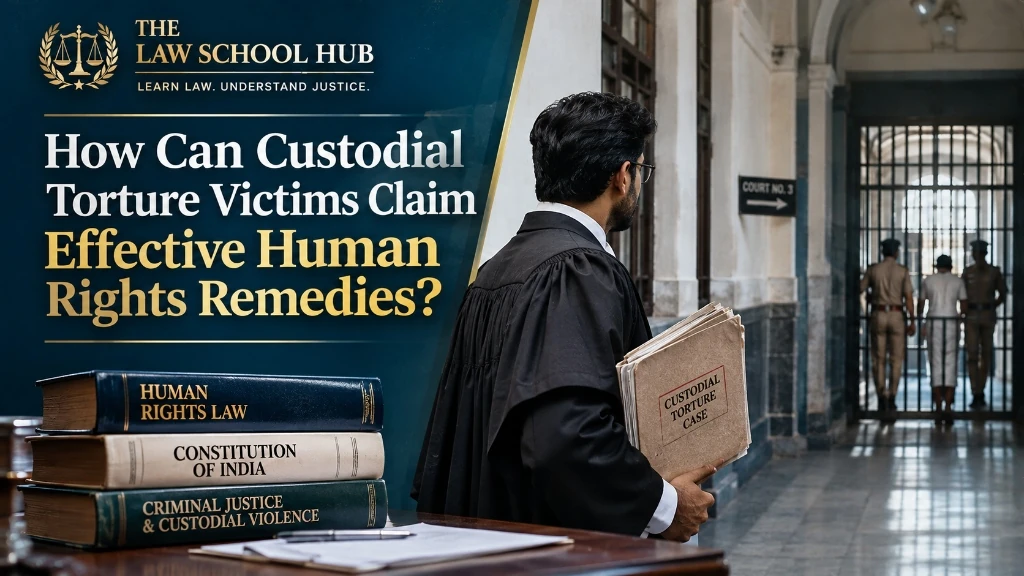
Custodial torture remedies protect one of the very few absolute, non-derogable rules in both international law and Indian constitutional jurisprudence: no war, public emergency, terrorism threat, or serious criminal charge can ever justify beating, humiliating, or inflicting third-degree violence upon a person in police or judicial custody. Yet when custodial violence occurs behind closed station doors, survivors and grieving families often struggle to navigate the overlapping maze of criminal courts, constitutional writs, human rights commissions, medical documentation, and CCTV preservation.
Grounded in Article 21 of the Constitution of India, Articles 2(3) and 7 of the International Covenant on Civil and Political Rights (ICCPR), and the global redress architecture of the UN Convention against Torture (UNCAT), this guide explains step by step how custodial torture victims and their families can secure urgent evidence, claim public-law compensation without sovereign immunity, trigger independent investigations, and hold perpetrator officials criminally accountable.
1. The Absolute International Prohibition on Torture and the Right to Redress
Under international law, the prohibition of torture enjoys jus cogens (peremptory norm) status—binding every nation on earth regardless of whether it has ratified a particular treaty. Article 5 of the Universal Declaration of Human Rights (1948) and Article 7 of the ICCPR (binding on India since 1979) forbid torture and cruel, inhuman, or degrading treatment without exception, even during states of emergency (ICCPR Article 4(2)). Meanwhile, ICCPR Article 2(3) obliges India to provide an effective domestic remedy even when violations are committed by police or security officials acting in an official capacity.
1.1 India’s Status Under UNCAT and the Five Pillars of General Comment No. 3
India signed the UNCAT in 1997 but has not yet ratified it or enacted a standalone domestic Anti-Torture Act—a reform repeatedly urged by the Law Commission of India and UN treaty bodies. Even so, UNCAT Article 14 and the UN Committee against Torture’s General Comment No. 3 (UN Doc. CAT/C/GC/3, 2012) define the international gold standard for what “effective redress” truly requires:
- Restitution: Restoring the victim’s liberty, legal standing, employment, and property as closely as possible to their pre-violation position.
- Fair and Adequate Monetary Compensation: Covering physical and psychological injury, medical bills, lost earnings, legal costs, and moral harm—never limited to token ex-gratia payouts.
- Full Rehabilitation: Long-term medical, surgical, and trauma-informed psychological care provided without financial burden to the survivor.
- Satisfaction (Truth & Criminal Accountability): Prompt, impartial investigation, disclosure of truth, disciplinary sanctions, and criminal prosecution of responsible officials—monetary payouts can never buy impunity.
- Guarantees of Non-Repetition: Institutional reforms such as mandatory station CCTV, independent custody oversight, and judicial magistrate inquiries to stop recurring abuse.
Notably, international protection against torture also bars States from expelling or extraditing anyone to a country where they face torture—a principle closely connected to non-refoulement review under international human rights law.
2. Constitutional Public-Law Remedies in India: Compensation & Accountability
Because ordinary civil tort suits can take over a decade, the Supreme Court of India built a powerful constitutional public-law remedy directly under Articles 32 and 226.
2.1 Nilabati Behera v. State of Orissa (1993): Strict Liability & No Sovereign Immunity
In Nilabati Behera v. State of Orissa, (1993) 2 SCC 746, a 22-year-old man was taken into police custody and found dead with multiple injuries on a railway track the next day. Awarding constitutional compensation to his mother, the Supreme Court established two enduring rules: first, when a detainee suffers injury or unnatural death in State custody, the burden shifts onto the State to explain how those injuries occurred; second, the old colonial defence of sovereign immunity has zero application to fundamental-rights violations under Article 21.
2.2 D.K. Basu v. State of West Bengal (1997): Mandatory Arrest & Custody Safeguards
In D.K. Basu v. State of West Bengal, (1997) 1 SCC 416, the Supreme Court condemned custodial torture as a “naked violation of human dignity” and issued eleven binding preventive directives—now largely codified in Indian criminal procedure—including visible officer name tags, an arrest memo attested by a family member or local witness, immediate notification to a relative or friend, an “inspection memo” recording pre-existing injuries at arrest, mandatory medical examination every 48 hours, and access to legal counsel during interrogation. The Court explicitly held that non-compliance exposes officers to both departmental action and contempt of court, and confirmed that public-law compensation is an additional remedy alongside criminal prosecution and civil damages.
2.3 Paramvir Singh Saini v. Baljit Singh (2020): Mandatory Police-Station CCTV Evidence
Historically, custodial torture cases collapsed because only police officers were present inside lock-ups. In Paramvir Singh Saini v. Baljit Singh, (2021) 1 SCC 184, the Supreme Court closed that evidentiary black hole by ordering every police station—as well as central agencies including the CBI, ED, NIA, NCB, DRI, and SFIO—to install night-vision CCTV cameras with audio recording covering all entry/exit points, reception areas, corridors, lock-ups, and interrogation rooms, with footage stored for at least 18 months. Crucially, the Court held that anyone alleging custodial force may immediately approach the State Human Rights Commission or District Human Rights Court to summon and preserve CCTV footage before it can be tampered with or erased.
3. Criminal, Statutory, and Institutional Forums Under BNS, BNSS, and PHRA
Because custodial abuse often begins during unrecorded questioning, knowing your legal rights when called for police questioning or issued a notice of appearance—and understanding international limits on arbitrary detention—helps establish an evidentiary trail from hour one. Once abuse occurs, victims can activate four parallel legal forums:
| Forum | Statutory / Constitutional Basis | Key Remedies Available |
|---|---|---|
| High Court (Art. 226) / Supreme Court (Art. 32) | Article 21; Nilabati Behera (1993); D.K. Basu (1997) | Urgent writ of habeas corpus, public-law compensation, CCTV preservation, transfer of probe to independent agency/CBI |
| Criminal Courts & Judicial Magistrates | Bharatiya Nyaya Sanhita, 2023 (BNS) & Bharatiya Nagarik Suraksha Sanhita, 2023 (BNSS) | FIR for voluntarily causing hurt/grievous hurt to extort confession, wrongful confinement, murder/culpable homicide; mandatory Judicial Magistrate inquiry in custodial deaths |
| NHRC & State Human Rights Commissions | Protection of Human Rights Act, 1993 (ss. 12, 17, 18) | Independent inquiry, summoning medical/CCTV records, recommending interim compensation and disciplinary/criminal action |
| District Human Rights Courts | Section 30, Protection of Human Rights Act, 1993; Paramvir Singh Saini (2020) | Speedy criminal trial of human rights offences and urgent preservation of station CCTV footage |
3.1 Navigating Prosecution Sanction Hurdles
A common obstacle in prosecuting guilty police officers is the statutory requirement of prior government sanction for acts done in the discharge of “official duty” under the BNSS 2023 (successor to Section 197 CrPC). However, the Supreme Court has repeatedly clarified that torturing a detainee or fabricating custody records can never form part of a public servant’s “official duty”—meaning courts can refuse to shield egregious custodial violence behind sanction barriers.
4. Practical Step-by-Step Illustrations
4.1 Example 1: Suspect Beaten Overnight in a Police Station Before Remand
Scenario: A young worker is picked up informally for questioning, beaten with batons overnight to force a confession, and produced before a Judicial Magistrate the next afternoon with threats to stay silent.
Legal Position: Custodial assault to extort a confession violates Article 21, D.K. Basu (1997), and ICCPR Article 7, and constitutes a serious criminal offence under the BNS 2023. The Magistrate is legally bound to ask the arrestee directly about ill-treatment, record visible injuries, and order an independent medical examination by a government doctor.
Practical Point: Immediately inform the Judicial Magistrate in open court (not in front of arresting officers), request a detailed medico-legal certificate (MLC) documenting injury age and colour, and file an urgent application under Paramvir Singh Saini (2020) to freeze and seal the police station’s CCTV hard drive.
4.2 Example 2: Family Seeking Justice After a Suspicious Custodial Death
Scenario: A healthy detainee dies inside a police lock-up. Local officers claim he suffered a sudden heart attack and pressure the family to cremate the body quickly without an independent autopsy.
Legal Position: Under the BNSS 2023 and mandatory NHRC guidelines, every custodial death requires an independent Judicial Magistrate inquiry (in addition to police inquest) and a videographed post-mortem conducted by a panel of doctors. Under Nilabati Behera (1993), the burden lies on the State to explain custodial injuries, and sovereign immunity cannot bar compensation.
Practical Point: File an urgent mention before the High Court under Article 226 requesting a videographed medical-board autopsy, immediate seizure of station CCTV and general diary entries, transfer of the criminal probe outside local police control, and interim public-law compensation.
4.3 Example 3: Simultaneous NHRC Complaint and Constitutional Writ
Scenario: A custodial torture survivor files a complaint with the State Human Rights Commission within two weeks of release, receives a recommendation for ₹5 lakh interim compensation, and also seeks criminal prosecution and higher rehabilitation damages.
Legal Position: Under Section 18 of the Protection of Human Rights Act, 1993 and UNCAT General Comment No. 3 standards, interim Commission compensation does not extinguish criminal liability or bar a High Court writ enforcing full compensation, medical rehabilitation, and FIR registration.
Practical Point: Always submit dated photographs of injuries, hospital discharge summaries, arrest memos, and witness affidavits to the NHRC/SHRC within the statutory one-year limitation window (Section 36(2) PHRA).
5. Evidence Preservation, Redress Gaps, and Why UNCAT Ratification Matters
In custodial torture litigation, the legal principles laid down in Nilabati Behera (1993), D.K. Basu (1997), and Paramvir Singh Saini (2020) are overwhelmingly clear—yet cases still succeed or fail based on what happens in the first 48 to 72 hours. Bruises fade, station CCTV drives overwrite or suffer convenient “technical faults,” and informal witnesses face pressure unless families and lawyers lock down objective evidence immediately.
5.1 The Decisive First 48 Hours: Locking Down Forensic and Digital Proof
Under Indian criminal procedure (BNSS, 2023) and D.K. Basu (1997), every arrested person must be produced before a Judicial Magistrate within 24 hours and medically examined. That first remand hearing is the single most critical safeguard against torture: if the detainee reports ill-treatment, the Magistrate must record the complaint verbatim, inspect visible injuries, and direct an independent medical examination at a government hospital—explicitly recording the estimated age, dimensions, and nature of every injury so it can be matched against the exact hours spent in police custody.
Simultaneously, counsel should invoke Paramvir Singh Saini (2020) to file an urgent application before the Magistrate, District Human Rights Court, or High Court seeking immediate seizure and forensic mirroring of the police station’s CCTV hard drive (covering corridors, reception, lock-ups, and interrogation rooms) alongside certified copies of the Station House General Diary, lock-up register, and arrest memo. Where a station claims its cameras were “non-functional” during the exact hours of alleged abuse, courts can draw a strong adverse inference against the custodians.
5.2 Quantifying Redress and Closing India’s Anti-Torture Statutory Gap
While Indian High Courts and the Supreme Court routinely award constitutional compensation ranging from several lakhs to substantial family relief in custodial death cases, awards still vary widely across states and rarely include structured long-term medical and psychological rehabilitation as mandated by UNCAT General Comment No. 3 (2012). Moreover, although the Bharatiya Nyaya Sanhita, 2023 punishes voluntarily causing hurt or grievous hurt to extort a confession, India still lacks a standalone statutory definition of “torture” covering severe mental or psychological suffering, strict command responsibility for supervising officers who turn a blind eye, and statutory protection for whistleblowers and witnesses.
Ratifying the UN Convention against Torture (UNCAT) and enacting a dedicated Prevention of Torture Act—as recommended by the Law Commission of India—would harmonise India’s domestic criminal justice system with its binding obligations under ICCPR Articles 7 and 2(3), strengthen international extradition cooperation (where foreign courts sometimes scrutinise custodial safeguards), and ensure uniform, prompt, and comprehensive redress in every district.
5.3 Practical Six-Step Action Checklist for Survivors and Families
- Report Injuries at the First Magistrate Production: Inform the Judicial Magistrate directly about any custodial assault or threats and request an immediate court-ordered medico-legal certificate (MLC) at an independent government hospital.
- Freeze Police-Station CCTV Footage Immediately: File an urgent written petition under Paramvir Singh Saini (2020) before the Magistrate, District Human Rights Court, or State Human Rights Commission to summon and seal CCTV footage and General Diary logs.
- Document Independent Medical and Photographic Evidence: Upon release or bail, obtain thorough follow-up medical and psychological evaluations, keeping dated, clear photographs of injuries and all hospital bills.
- Demand FIR Registration and Independent Investigation: File a written criminal complaint against responsible officers under the BNS 2023; if local police refuse to register an FIR, escalate immediately to the Superintendent of Police and the Judicial Magistrate under the BNSS 2023.
- File a Timely NHRC/SHRC Complaint: Lodge a documented complaint under the Protection of Human Rights Act, 1993 well within the one-year limitation window under Section 36(2), seeking interim relief and independent inquiry.
- Approach the High Court Under Article 226: Where custodial death, severe torture, or local police cover-up occurs, seek a constitutional writ for transfer of investigation to an independent agency, strict public-law compensation under Nilabati Behera (1993), and witness protection.
6. Medical Jurisprudence, Judicial Magistrate Inquiries, Psychological Torture, and Officer Accountability
Securing genuine justice for custodial torture victims requires understanding not just broad constitutional declarations, but the forensic, procedural, and institutional mechanisms that either expose custodial abuse or bury it. Four operational pillars—independent medical documentation, mandatory Judicial Magistrate inquiries, recognition of psychological torture, and personal accountability of erring officers—determine whether remedies under Article 21 and ICCPR Articles 7 and 2(3) work in real life.
6.1 Medical Jurisprudence and International Documentation Standards
In custodial violence trials, the medico-legal certificate (MLC) is often the single most decisive piece of evidence. Yet routine pre-remand medical check-ups frequently fail survivors when doctors examine detainees in the physical presence of the very police officers accused of beating them, resulting in cursory one-line “no fresh external injury” notes. International forensic standards—anchored in the UN Manual on the Effective Investigation and Documentation of Torture (widely known as the Istanbul Protocol) and reinforced by D.K. Basu v. State of West Bengal (1997)—establish clear benchmarks for trustworthy custody medicine:
- Private, Police-Free Examination: The examining government doctor must inspect the detainee out of the earshot and direct intimidation of custodial officers so the survivor can report internal pain, beatings on the soles of the feet, or threats without fear of immediate retaliation.
- Detailed Injury Mapping and Age Estimation: Every bruise, abrasion, swelling, or burn must be measured, plotted on an anatomical diagram, photographed, and accompanied by a clinical estimate of its age (for instance, colour progression of bruises) so courts can match injuries to the exact window of police custody.
- Screening for Non-Visible and Psychological Trauma: Modern custodial abuse frequently uses methods designed to leave minimal surface marks—such as stress positions, sleep deprivation, or blunt blows over clothing. Independent doctors must document tenderness, internal bruising, hearing loss, and acute trauma symptoms, referring survivors for specialist psychological evaluation.
- Panel Videographed Autopsies in Custodial Deaths: Where a detainee dies in custody, a multi-doctor forensic board must conduct a full videographed post-mortem examination preserving viscera and histopathology slides, with copies supplied promptly to the Judicial Magistrate, the NHRC/SHRC, and the bereaved family.
6.2 Mandatory Judicial Magistrate Inquiries in Custodial Deaths and Disappearances
Historically, custodial deaths were investigated by local police or Executive Magistrates—officials structurally aligned with the district administration—leading to routine “suicide” or “natural heart attack” closure reports. Parliament reformed Indian criminal procedure (originally through Section 176(1A) CrPC and carried forward under the Bharatiya Nagarik Suraksha Sanhita, 2023) to mandate an independent inquiry by a Judicial Magistrate in addition to any police investigation whenever a person dies, disappears, or alleges rape while in police or judicial custody.
This Judicial Magistrate inquiry is a non-negotiable statutory safeguard. The Magistrate is empowered to summon witnesses independently, inspect the lock-up and Station House General Diary, seize CCTV hard drives under Paramvir Singh Saini (2020), examine forensic doctors, and record statements of family members without police interference. Families and counsel have a vital role here: they should actively participate in the Judicial Magistrate’s inquiry, submit written affidavits, press for independent forensic opinions, and demand copies of the Magistrate’s findings so any subsequent criminal trial or High Court writ under Nilabati Behera (1993) rests on a judicially verified evidentiary foundation.
6.3 Psychological Torture, Incommunicado Detention, and Vulnerable Detainees
Both UNCAT Article 1 and ICCPR Article 7 explicitly define torture to include severe mental pain or suffering—not only physical beatings. Prolonged sleep deprivation, mock execution threats, threats to arrest or harm a detainee’s spouse or children, verbal humiliation, sensory deprivation, and keeping a suspect in unrecorded “informal custody” (incommunicado detention without an arrest memo) all constitute prohibited ill-treatment under international human rights law and violate human dignity under Article 21.
Heightened legal safeguards apply to vulnerable detainees. Women cannot ordinarily be arrested after sunset and before sunrise except in exceptional circumstances with prior Judicial Magistrate permission and in the presence of female police officers; juveniles must be produced promptly before Juvenile Justice Boards rather than held in adult police lock-ups; and detainees with disabilities or chronic medical conditions must receive uninterrupted medication and reasonable accommodation. Violating these protective protocols itself constitutes actionable cruelty and triggers immediate constitutional and NHRC intervention.
6.4 Command Responsibility, Witness Protection, and Financial Accountability of Erring Officers
One of the deepest structural weaknesses in India’s response to custodial violence is the gap between paying compensation from public tax funds and holding individual perpetrators accountable. When a High Court orders a State Government to pay ₹10 lakh to a torture survivor’s family out of the general exchequer—while the responsible Station House Officer remains on active duty or quietly receives a transfer—the taxpayer pays the price and institutional impunity survives intact.
To fulfil the five pillars of UNCAT General Comment No. 3 (2012)—especially satisfaction and guarantees of non-repetition—courts and policymakers must enforce four decisive accountability measures: (1) salary and pension recovery, empowering States to recover constitutional compensation directly from guilty officers after fair departmental inquiry, as expressly contemplated in D.K. Basu (1997); (2) mandatory immediate suspension and transfer of investigation outside the accused officers’ district or state police force to prevent evidence tampering and witness intimidation; (3) robust witness and survivor protection against retaliatory false FIRs under the BNS, 2023 and BNSS, 2023; and (4) codified command responsibility in a standalone Prevention of Torture Act so supervising officers who knowingly permit or cover up lock-up brutality face criminal liability alongside junior constables—honouring UDHR Article 5 and India’s constitutional commitment to the rule of law.
7. Frequently Asked Questions
1. Can the State claim sovereign immunity to avoid paying compensation for custodial torture?
Answer: No. In Nilabati Behera v. State of Orissa (1993) and D.K. Basu v. State of West Bengal (1997), the Supreme Court decisively ruled that sovereign immunity has no application to public-law remedies for Article 21 fundamental-rights violations.
2. How can a victim prevent police from deleting station CCTV footage?
Answer: Under Paramvir Singh Saini v. Baljit Singh (2020), victims can urgently petition the State Human Rights Commission, District Human Rights Court, or High Court to summon and preserve station CCTV footage (which must be retained for at least 18 months).
3. Has India ratified the UN Convention against Torture (UNCAT)?
Answer: India signed the UNCAT in 1997 but has not yet ratified it or enacted a standalone domestic Anti-Torture Act. Nevertheless, India is legally bound by ICCPR Articles 7 and 2(3) and by the peremptory (jus cogens) international prohibition against torture.
4. Does accepting compensation stop criminal prosecution of guilty officers?
Answer: No. Both D.K. Basu (1997) and UN Committee against Torture General Comment No. 3 emphasise that financial compensation is distinct from—and never replaces—independent criminal investigation, prosecution, and disciplinary accountability.
5. What is the time limit for filing a complaint with the NHRC or State Human Rights Commission?
Answer: Under Section 36(2) of the Protection of Human Rights Act, 1993, Commissions cannot ordinarily inquire into matters after the expiry of one year from the date on which the alleged human rights violation was committed—so victims should file promptly.
6. Is a confession extracted through custodial torture admissible in court?
Answer: No. Both Indian evidence law (under the Bharatiya Sakshya Adhiniyam, 2023, continuing the bar on police confessions) and ICCPR Article 14(3)(g) strictly exclude coerced confessions obtained through torture or ill-treatment.
7. Who bears the burden of proof when a detainee suffers injuries in police custody?
Answer: Once it is established that a healthy person entered police custody and emerged injured or dead, Nilabati Behera (1993) shifts the burden onto the State and custodial officers to provide a credible, lawful explanation.
8. What should a family do immediately if a relative is picked up informally by police without an arrest memo?
Answer: Unrecorded “informal custody” is the highest-risk window for custodial torture. Family members should immediately note the exact time, place, vehicle numbers, and officers’ names or badge numbers, send urgent written complaints by email/SMS to the District Superintendent of Police, the Chief Judicial Magistrate, and the State Human Rights Commission to create a timestamped paper trail, and file an urgent writ of habeas corpus before the High Court under Article 226 seeking immediate production and CCTV preservation under Paramvir Singh Saini (2020).
9. Do police officers need prior government sanction before being prosecuted for custodial torture?
Answer: Statutory sanction provisions under the BNSS, 2023 (continuing Section 197 CrPC) protect public servants only for acts done in the bona fide discharge of “official duty.” The Supreme Court has repeatedly held that beating, torturing, or killing a detainee in custody—or fabricating custody records—bears no reasonable nexus to official duty, meaning courts can reject sanction shields and proceed with criminal prosecution against erring officials.
10. What happens if a police station claims its CCTV cameras were “not working” during an alleged custodial assault?
Answer: Under Paramvir Singh Saini v. Baljit Singh (2020), Station House Officers and State Oversight Committees bear an affirmative legal duty to keep CCTV cameras and audio recording operational at all times and report faults immediately for repair. If a police station conveniently claims cameras malfunctioned during the exact hours a detainee suffered unexplained lock-up injuries, courts and Human Rights Commissions can draw a strong adverse inference against the custodians, order departmental and contempt action, and rely on medico-legal reports and witness testimony under Nilabati Behera (1993).
11. Are NHRC and State Human Rights Commission compensation recommendations legally enforceable?
Answer: Under Section 18 of the Protection of Human Rights Act, 1993, Commissions recommend interim or final compensation, disciplinary action, and prosecution, and governments must report action taken within one month. While Commissions themselves are recommendatory bodies, High Courts across India have repeatedly enforced reasoned NHRC/SHRC compensation awards through writ petitions under Article 226 unless the State successfully challenges the award on valid legal grounds.
12. Can a survivor claim both constitutional writ compensation and a civil tort suit for damages?
Answer: Yes. In Nilabati Behera (1993) and D.K. Basu (1997), the Supreme Court clarified that public-law compensation awarded under Article 32 or Article 226 is an immediate, strict-liability constitutional remedy that does not extinguish a victim’s right to file a regular civil suit for higher private-law damages (with the constitutional award simply adjusted against the final civil decree so there is no double recovery).
13. How does a Judicial Magistrate inquiry differ from a police inquest in a custodial death?
Answer: A routine police inquest is conducted by police officers themselves, creating an obvious conflict of interest when fellow officers are accused of custodial violence. Under the BNSS, 2023 (carrying forward Section 176(1A) CrPC), a Judicial Magistrate—who is completely independent of the police and district executive—must conduct a mandatory parallel inquiry into every custodial death, custodial disappearance, or allegation of custodial rape, independently examining doctors, lock-up registers, CCTV footage, and family witnesses.
14. Can the State recover custodial torture compensation directly from the guilty police officers?
Answer: Yes. In D.K. Basu v. State of West Bengal (1997), the Supreme Court explicitly observed that while the State is vicariously liable to pay constitutional compensation to the victim promptly, the State remains fully entitled to recover that amount from the personal salaries or pensions of the erring officers after following due departmental procedure—reinforcing personal deterrence and fulfilling UNCAT General Comment No. 3’s call for guarantees of non-repetition.
15. Does the absolute prohibition against torture apply equally to central agencies like the CBI, ED, NIA, and NCB?
Answer: Yes, without any exception. Article 21 of the Constitution and ICCPR Article 7 bind every agency of the Union and the States alike. In Paramvir Singh Saini v. Baljit Singh (2020), the Supreme Court explicitly extended mandatory night-vision CCTV and audio-recording directives—with minimum 18-month storage—to the interrogation rooms and offices of the CBI, Enforcement Directorate (ED), National Investigation Agency (NIA), Narcotics Control Bureau (NCB), Directorate of Revenue Intelligence (DRI), and Serious Fraud Investigation Office (SFIO).
16. Can a victim seek medical and psychological rehabilitation costs as part of constitutional compensation?
Answer: Yes. Both High Courts under Article 226 and the Supreme Court under Article 32 have wide remedial jurisdiction to mould relief beyond token payouts—including directing free specialised surgical treatment, trauma-informed psychological counselling, and structured rehabilitation support for survivors and dependent family members, directly reflecting the rehabilitation pillar of UN Committee against Torture General Comment No. 3 (2012).
17. What if local police threaten a custodial torture survivor with false criminal cases after release?
Answer: Retaliatory intimidation and fabricated counter-FIRs are grave obstructions of justice that violate Article 21 and ICCPR Article 2(3). Survivors and witnesses should immediately document every threat, move the High Court under Article 226 for formal witness protection and transfer of investigation to an independent agency outside local police control, and notify the NHRC or State Human Rights Commission so urgent protective directions can be issued without delay.
8. Conclusion
Effective custodial torture remedies depend on swift action—documenting injuries before a Judicial Magistrate, freezing mandatory police-station CCTV footage under Paramvir Singh Saini, invoking public-law compensation under Nilabati Behera and D.K. Basu, and pursuing independent criminal prosecution alongside NHRC/SHRC oversight. While ratifying the UNCAT and enacting a standalone Anti-Torture Act remain vital legislative priorities, constitutional and international human rights law already equip victims with concrete, enforceable pathways to justice.
Legal References
- D.K. Basu v. State of West Bengal, (1997) 1 SCC 416 — Supreme Court of India (mandatory arrest and custody safeguards).
- Nilabati Behera v. State of Orissa, (1993) 2 SCC 746 — Supreme Court of India (public-law compensation without sovereign immunity).
- Paramvir Singh Saini v. Baljit Singh, (2021) 1 SCC 184 — Supreme Court of India (mandatory police-station CCTV directions).
- Protection of Human Rights Act, 1993 (Act No. 10 of 1994) — Parliament of India (NHRC, SHRC, and District Human Rights Courts).
- Bharatiya Nyaya Sanhita, 2023 (Act No. 45 of 2023) and Bharatiya Nagarik Suraksha Sanhita, 2023 (Act No. 46 of 2023) — Parliament of India.
- Constitution of India — Article 21 — Fundamental Right to Life, Personal Liberty, and Human Dignity.
- International Covenant on Civil and Political Rights (ICCPR), 1966 — Articles 2(3), 4(2), and 7 — United Nations Treaty Series, Vol. 999, p. 171.
- Convention against Torture and Other Cruel, Inhuman or Degrading Treatment or Punishment (UNCAT), 1984 — Article 14 — United Nations Treaty Series, Vol. 1465, p. 85.
- UN Committee against Torture, General Comment No. 3 on Implementation of Article 14 (UN Doc. CAT/C/GC/3, 2012) — United Nations.
Legal information notice: This article is for general educational and informational purposes and does not constitute legal advice or create an attorney-client relationship.