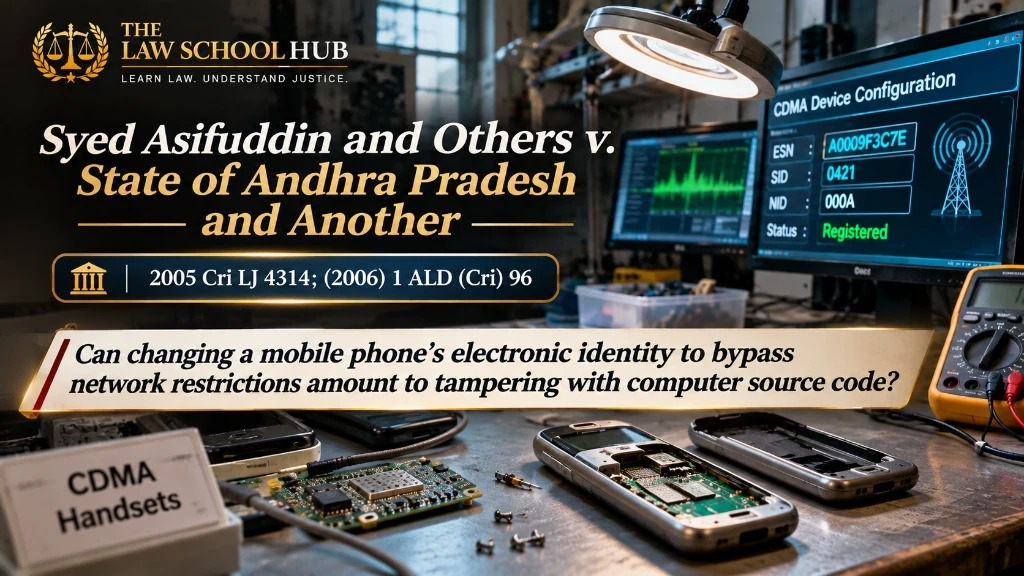
Is an ordinary mobile phone legally a “computer”? And if someone tampers with a phone’s internal programming to switch it to a rival telecom network, is that a cybercrime? On 29 July 2005, the Andhra Pradesh High Court answered both questions with a resounding “yes” in Syed Asifuddin & Ors. v. State of Andhra Pradesh & Anr., 2005 Cri LJ 4314—one of India’s earliest and most famous decisions interpreting Section 65 of the Information Technology Act, 2000.
Case Details
| Field | Details |
|---|---|
| Full Case Name | Syed Asifuddin & Ors. v. The State of Andhra Pradesh & Anr. |
| Citation | 2005 Cri LJ 4314; 2006 (1) ALD (Cri) 96; 2005 CLC 1685 (AP) |
| Court | High Court of Andhra Pradesh |
| Bench | Justice V.V.S. Rao |
| Date of Decision | 29 July 2005 |
| Key Statutes | Sections 2(1)(i) and 65 of the Information Technology Act, 2000; Section 63 of the Copyright Act, 1957; Sections 409, 420, and 120B of the IPC, 1860 |
| Core Legal Subject | Definition of “computer,” tampering with computer source code (Section 65 IT Act), and software copyright |
Background
In the early 2000s, India’s mobile telecom market was booming, and rival CDMA operators like Tata Teleservices (Tata Indicom) and Reliance Infocomm competed fiercely for subscribers. Because CDMA handsets were expensive, Tata Indicom offered subsidised Samsung handsets exclusively locked to its own network through a built-in programming code called the Electronic Serial Number (ESN) and System Identification Code (SID).
When employees of a rival telecom operator began luring Tata Indicom customers and reprogramming their locked handsets to work on Reliance’s network, a fierce legal clash erupted over whether hacking a mobile phone’s internal code violated Section 65 of the Information Technology Act, 2000.
Facts Of The Case
Tata Teleservices Ltd. (operating as Tata Indicom) supplied CDMA mobile handsets to subscribers in Andhra Pradesh under a promotional scheme. Each handset was electronically programmed with a unique 32-bit Electronic Serial Number (ESN) and a 15-bit System Identification Code (SID) so that the phone worked exclusively on Tata Indicom’s network.
Tata Indicom discovered that several sales staff and associates working for Reliance Infocomm—including Syed Asifuddin and others—were approaching Tata Indicom subscribers, taking their locked handsets, and altering the internal ESN/SID programming so the phones would run on Reliance Infocomm’s network instead.
Tata Indicom lodged a criminal complaint, and the CID Police in Hyderabad registered Crime No. 20 of 2003 under Sections 409 (criminal breach of trust), 420 (cheating), and 120B (criminal conspiracy) of the Indian Penal Code, Section 65 of the Information Technology Act, 2000 (tampering with computer source documents), and Section 63 of the Copyright Act, 1957. The accused filed petitions under Section 482 of the CrPC before the Andhra Pradesh High Court seeking to quash the entire FIR.
Issues Before The Court
- Whether a mobile telephone handset qualifies as a “computer” or “computer system” under Section 2(1)(i) of the Information Technology Act, 2000.
- Whether altering the programmed ESN and SID inside a locked CDMA handset amounts to tampering with “computer source code” under Section 65 of the IT Act, 2000 and copyright infringement under Section 63 of the Copyright Act, 1957.
- Whether the IPC charges of criminal breach of trust (Section 409), cheating (Section 420), and conspiracy (Section 120B) were made out on the facts of the FIR.
Arguments By The Parties
Senior counsel for Syed Asifuddin and the other petitioners argued that a cell phone handset is simply a telephone—not a “computer” or “computer system” under the Information Technology Act, 2000. Even if a phone contained software, they claimed no law in force required Tata Indicom to maintain the handset’s ESN as a “computer source code,” so Section 65 of the IT Act could not apply.
The petitioners also contended that the IPC charges were completely baseless. There was no entrustment of property to support criminal breach of trust under Section 409, and no dishonest deception inducing Tata Indicom to hand over property under Section 420, because subscribers themselves had bought the handsets.
In response, the State of Andhra Pradesh and Tata Teleservices argued that a modern cell phone contains microprocessors, memory, and stored computer programmes that process digital signals—fitting squarely within the broad statutory definition of a “computer” under Section 2(1)(i) of the IT Act.
They further argued that the ESN and SID were protected computer source codes required to be maintained under telecom licensing regulations, and that unauthorised reprogramming of the handset’s proprietary software directly violated both Section 65 of the IT Act and Section 63 of the Copyright Act, 1957.
Judgment Of The Court
On 29 July 2005, Justice V.V.S. Rao delivered a split-relief order in Syed Asifuddin & Ors. v. State of Andhra Pradesh & Anr., 2005 Cri LJ 4314 that carefully sifted the IPC offences from the cyber and copyright offences.
First, the Court quashed the FIR under Sections 409, 420, and 120B of the IPC. It agreed with the petitioners that neither criminal breach of trust nor cheating was made out because the accused were never entrusted with Tata Indicom’s property, nor had they deceived Tata Indicom into delivering the handsets.
Second, however, the Court refused to quash the investigation under Section 65 of the IT Act, 2000 and Section 63 of the Copyright Act, 1957. Holding that a cell phone is indeed a “computer” programmed to perform logical, arithmetic, and memory functions, the Court ruled that altering the unique ESN/SID programming of a locked handset prima facie amounts to tampering with “computer source code” under Section 65 of the IT Act and infringing software copyright under Section 63 of the Copyright Act. The Court directed the CID Police to complete the investigation and file a final report within three months.
Ratio Decidendi
Ratio decidendi is the core legal rule necessary to decide the dispute. In Syed Asifuddin & Ors. v. State of Andhra Pradesh & Anr., 2005 Cri LJ 4314, the Andhra Pradesh High Court established three vital principles:
- A Mobile Phone Is a “Computer”: Because a cell phone contains a microprocessor and stored software that processes digital data, it falls squarely within the definition of a “computer” under Section 2(1)(i) of the IT Act, 2000.
- Unauthorised Reprogramming Triggers Section 65 IT Act: Knowingly altering a handset’s programmed Electronic Serial Number (ESN) or System Identification Code (SID)—which must be maintained under telecom rules—prima facie constitutes tampering with computer source documents under Section 65.
- Software Alteration Also Engages Copyright Law: Computer programmes embedded inside electronic devices are protected as “literary works” under the Copyright Act, 1957, so unauthorised alteration can attract Section 63 copyright liability.
Legal Principles Explained
What Is “Computer Source Code” Under Section 65? Under the Explanation to Section 65 of the Information Technology Act, 2000, “computer source code” means the listing of programmes, computer commands, design and layout, and programme analysis of a computer resource in any form. Crucially, Section 65 applies when that source code is required to be kept or maintained by law—and in Syed Asifuddin, telecom licensing and identification mandates satisfied that requirement.
Current Legal Position Today: Although CDMA networks have largely given way to 4G/5G GSM smartphones and Mobile Number Portability (MNP) now lets subscribers switch networks legally without hacking handsets, the core principle of Syed Asifuddin & Ors. v. State of Andhra Pradesh & Anr., 2005 Cri LJ 4314 is more relevant than ever. Today, smartphones, smartwatches, IoT devices, and connected cars are all treated as “computers” under the IT Act, 2000—meaning IMEI tampering, unauthorised firmware flashing, and hacking mobile devices can attract prosecution under Sections 65, 66, and 43 of the IT Act alongside early cybercrime rulings like State of Tamil Nadu v. Suhas Katti (2004).
Importance Of The Case
Syed Asifuddin & Ors. v. State of Andhra Pradesh & Anr., 2005 Cri LJ 4314 was a breakthrough ruling because it stopped cybercrime law from being trapped inside desktop PCs. By recognising in 2005—years before modern smartphones existed—that a mobile phone is legally a “computer,” the Andhra Pradesh High Court future-proofed the IT Act, 2000.
The decision also drew an important boundary in criminal pleading: courts will not let complainants pile on inapplicable IPC charges like Section 409 or Section 420 when the real legal wrong lies in specialised cyber and copyright statutes.
For law students and cyber-law practitioners, the case remains the leading Indian authority explaining how Section 2(1)(i) (“computer”) and Section 65 (“tampering with computer source documents”) operate in practice.
Critical Analysis
Justice V.V.S. Rao’s technological foresight in classifying mobile handsets as “computers” under Section 2(1)(i) of the IT Act has aged remarkably well. Modern smartphones are far more powerful than the desktop computers of 2000, and treating mobile firmware manipulation as a serious digital offence is essential for telecom security and anti-theft enforcement.
At the same time, legal scholars note that stretching Section 65—which requires source code to be “kept or maintained by law”—to cover every commercial software lock must be applied with care so ordinary consumer repair rights are not criminalised. The Court’s balanced approach of quashing the overbroad IPC charges while letting the focused IT Act and Copyright Act inquiry proceed struck a sensible middle ground.
Illustrations And Examples
1. Tampering With a Stolen Smartphone’s IMEI Number
Scenario: A repair shop uses specialised flashing software to erase and rewrite the unique IMEI identification code of stolen smartphones so police cannot trace them on mobile networks.
Legal Position: Following Syed Asifuddin & Ors. v. State of Andhra Pradesh & Anr., 2005 Cri LJ 4314, a smartphone is a “computer” under the IT Act, and intentionally altering legally mandated device identification code attracts Section 65 of the IT Act, 2000 (carrying up to three years’ imprisonment and/or ₹2 lakh fine).
Practical Point: Unauthorised alteration of device identifiers is a serious statutory cybercrime, not a minor technical tweak.
2. Overcharging Routine Cyber Disputes Under IPC/BNS Breach of Trust
Scenario: A software vendor files an FIR alleging both IT Act source-code tampering and criminal breach of trust against a competitor who never had any fiduciary entrustment of the vendor’s property.
Legal Position: Just as in Syed Asifuddin v. State of Andhra Pradesh (2005), a High Court can quash the inapplicable breach-of-trust or cheating charges while allowing the proper IT Act and Copyright Act investigation to continue.
Practical Point: Defence counsel should examine each statutory ingredient separately rather than challenging an entire FIR on an all-or-nothing basis.
Key Takeaways
| Point | Summary |
|---|---|
| Phone = Computer | A mobile handset is legally a “computer” under Section 2(1)(i) of the IT Act, 2000. |
| Section 65 IT Act | Altering a handset’s programmed ESN/SID code prima facie amounts to tampering with computer source documents. |
| Copyright Protection | Unauthorised modification of embedded handset software can trigger Section 63 of the Copyright Act, 1957. |
| IPC Charges Quashed | Sections 409, 420, and 120B IPC were quashed because entrustment and cheating were absent on the facts. |
Conclusion
Syed Asifuddin & Ors. v. State of Andhra Pradesh & Anr., 2005 Cri LJ 4314 remains a landmark pillar of Indian cyber law. By holding that a mobile phone is a “computer” and that unauthorised tampering with embedded identification software violates Section 65 of the IT Act and Section 63 of the Copyright Act, the Andhra Pradesh High Court ensured that Indian cyber legislation kept pace with the mobile revolution.
Frequently Asked Questions
1. Is a mobile phone considered a “computer” under Indian cyber law?
Answer: Yes. In Syed Asifuddin & Ors. v. State of Andhra Pradesh & Anr., 2005 Cri LJ 4314, the Andhra Pradesh High Court clearly held that a cell phone performs logical, arithmetic, and memory functions through embedded software and therefore qualifies as a “computer” under Section 2(1)(i) of the IT Act, 2000.
2. What offence was upheld against the accused in Syed Asifuddin v. State of Andhra Pradesh (2005)?
Answer: The High Court refused to quash the investigation under Section 65 of the Information Technology Act, 2000 (tampering with computer source documents) and Section 63 of the Copyright Act, 1957, while quashing the IPC charges under Sections 409, 420, and 120B.
3. What is the punishment under Section 65 of the Information Technology Act, 2000?
Answer: Section 65 punishes knowingly or intentionally concealing, destroying, or altering computer source code required to be kept by law with imprisonment up to three years, or a fine up to ₹2 lakh, or both.
4. Why did the Court quash the IPC cheating and breach-of-trust charges in this case?
Answer: Because the handsets had been sold to subscribers—not entrusted to the rival company’s employees—there was neither criminal breach of trust (Section 409) nor fraudulent inducement of Tata Indicom to deliver property (Section 420).
Legal References
- Syed Asifuddin & Ors. v. State of Andhra Pradesh & Anr., 2005 Cri LJ 4314 — High Court of Andhra Pradesh (29 July 2005, Justice V.V.S. Rao; also reported at 2006 (1) ALD (Cri) 96).
- Section 65, Information Technology Act, 2000 — Tampering with computer source documents.
- Information Technology Act, 2000 (Act No. 21 of 2000) — Parliament of India (including Section 2(1)(i) definition of “computer”).
At The Law School Hub, we simplify case laws, legal acts, and legal concepts for law students and legal readers. Want to read more useful legal blogs? Visit The Law School Hub for more such informational blogs.