Introduction
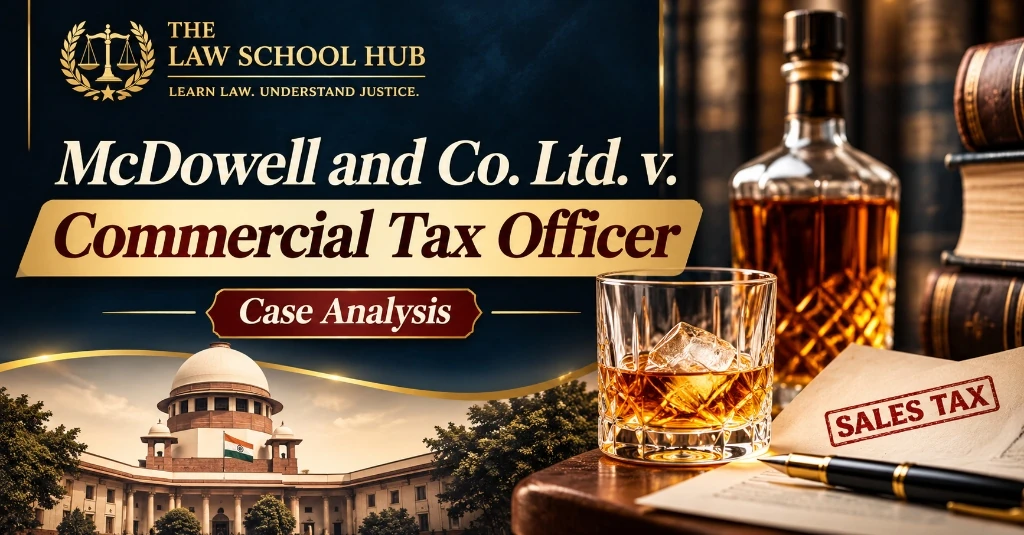
McDowell and Company Limited v. Commercial Tax Officer, (1985) 3 SCC 230 is a five-judge Constitution Bench judgment of the Supreme Court of India on sales tax turnover and tax avoidance. McDowell and Company Limited, a licensed liquor manufacturer in Hyderabad, arranged for buyers to pay excise duty directly to excise authorities and kept that duty off its taxable turnover under Section 2(s) of the Andhra Pradesh General Sales Tax Act, 1957.
The Supreme Court dismissed the appeal, overruled McDowell and Company Limited v. Commercial Tax Officer, (1977) 1 SCC 441, and held that buyer-paid excise duty forms part of taxable turnover. The majority also ruled that lawful tax planning is valid, but colourable devices are not—a rule later clarified by the Court and codified in India’s General Anti-Avoidance Rules (GAAR).
Case Details Table
| Detail | Information |
|---|---|
| Case Name | McDowell and Company Limited v. Commercial Tax Officer |
| Citations | (1985) 3 SCC 230; AIR 1986 SC 649; 1985 SCR (3) 791; (1985) 154 ITR 148 (SC); (1985) 59 STC 277 (SC) |
| Court | Supreme Court of India (5-Judge Constitution Bench) |
| Year / Date | 17 April 1985 |
| Bench / Judges | Chief Justice Y.V. Chandrachud, Justice D.A. Desai, Justice O. Chinnappa Reddy, Justice E.S. Venkataramiah, Justice Ranganath Misra |
| Legal Area | Taxation Law (Sales Tax, Excise Duty, Tax Avoidance) |
| Main Issue | Whether buyer-paid excise duty enters taxable turnover under Section 2(s) of the A.P. General Sales Tax Act, 1957 |
| Final Decision | Appeal dismissed; McDowell and Company Limited v. Commercial Tax Officer, (1977) 1 SCC 441 overruled |
| Important Legal Principle | Excise duty is the manufacturer’s primary liability and enters turnover; lawful tax planning is valid, colourable devices are barred |
Background
In Andhra Pradesh, Indian liquor attracted two levies: state excise duty on manufacture under the Andhra Pradesh Excise Act, 1968, and sales tax on a dealer’s “turnover” (total sale consideration) under Section 2(s) of the Andhra Pradesh General Sales Tax Act, 1957.
Earlier, distillers had buyers deposit excise duty directly with excise officers and left that duty off sale bills. In McDowell and Company Limited v. Commercial Tax Officer, (1977) 1 SCC 441, a two-judge bench sided with the distiller because buyer-paid duty never entered its “common till.” Andhra Pradesh then amended Rules 76 and 79(1) of the Andhra Pradesh Distillery Rules from 4 August 1981, making the D-2 licensee primarily liable for excise duty before removing liquor.
Facts Of The Case
McDowell and Company Limited operated a Hyderabad distillery under a D-2 licence issued under the Andhra Pradesh Excise Act, 1968. After the 4 August 1981 amendments to Rules 76 and 79(1) of the Andhra Pradesh Distillery Rules, the company kept requiring buyers to deposit excise duty directly before taking delivery and omitted that duty from its sale invoices.
For 1982–83, the Commercial Tax Officer issued a notice to include Rs. 4,49,09,532.40 of buyer-paid excise duty in the company’s taxable turnover under Section 2(s) of the Andhra Pradesh General Sales Tax Act, 1957. The Andhra Pradesh High Court dismissed the company’s writ petition, holding that the 1981 amendments fixed primary liability on the distiller. The company appealed to the Supreme Court, which referred the matter to a five-judge Constitution Bench.
Issues Before The Court
- Whether Rs. 4,49,09,532.40 of excise duty paid directly by buyers formed part of taxable “turnover” under Section 2(s) of the Andhra Pradesh General Sales Tax Act, 1957, after the 1981 amendments to Rules 76 and 79(1).
- Whether McDowell and Company Limited v. Commercial Tax Officer, (1977) 1 SCC 441 was rightly decided, and whether routing duty through buyers was valid tax planning.
Arguments By The Parties
McDowell and Company Limited cited McDowell and Company Limited v. Commercial Tax Officer, (1977) 1 SCC 441 to argue that “turnover” covers only sums actually received by the seller. Because buyers deposited excise duty directly with excise authorities, the money never entered the company’s common till.
The company added that the 1981 rule amendments did not change the Excise Act’s scheme allowing duty payment at removal. Relying on traditional English tax principles, it contended that taxpayers may lawfully arrange business dealings to minimise tax.
The Commercial Tax Officer and the State of Andhra Pradesh countered that excise duty is a levy on manufacture, so primary liability always rests on the D-2 manufacturer. Amended Rules 76 and 79(1) expressly required the licensee to pay duty before liquor could leave the distillery.
The State argued that buyers paying duty directly were discharging the manufacturer’s own statutory obligation to obtain the liquor. That payment formed part of the real sale consideration, and excluding it from invoices was an artificial device to avoid sales tax.
Judgment Of The Court
On 17 April 1985, the five-judge Constitution Bench unanimously dismissed the appeal. Justice Ranganath Misra wrote the majority judgment for Chief Justice Y.V. Chandrachud, Justice D.A. Desai, Justice E.S. Venkataramiah, and himself. Justice O. Chinnappa Reddy wrote a concurring opinion.
What the Court Decided
Excise duty is a levy on manufacture, and under the Andhra Pradesh Excise Act, 1968, and amended Rules 76 and 79(1), primary legal liability rests on the D-2 manufacturer. When buyers pay that duty directly under an arrangement with the distiller, they discharge the distiller’s statutory obligation as part of the sale price. Therefore, Rs. 4,49,09,532.40 formed part of taxable “turnover” under Section 2(s) of the Andhra Pradesh General Sales Tax Act, 1957, and McDowell and Company Limited v. Commercial Tax Officer, (1977) 1 SCC 441 was overruled.
What the Court Rejected
The Court rejected the “common till” test and held that leaving a statutory cost off a bill cannot exclude it from turnover. Justice Ranganath Misra held that tax planning within the framework of law is legitimate, but colourable devices—artificial paper structures disguising real liability—cannot be part of tax planning.
Majority and Concurring Opinions
While Justice Ranganath Misra’s majority preserved lawful tax planning, Justice O. Chinnappa Reddy concurred with a sharp attack on the British Inland Revenue Commissioners v. Duke of Westminster (1936) rule, warning against tax-avoidance schemes in a welfare state.
Ratio Decidendi
Ratio decidendi is the binding legal rule necessary to decide a case. The majority ratio in McDowell and Company Limited v. Commercial Tax Officer, (1985) 3 SCC 230 establishes two rules:
- When primary statutory liability for excise duty rests on the manufacturer, direct payment by buyers discharges the manufacturer’s obligation and forms part of sale consideration and taxable “turnover.”
- Tax planning within the framework of law is valid, but colourable devices and dubious methods are not.
By contrast, Justice O. Chinnappa Reddy’s sweeping remarks condemning all tax avoidance and questioning the Duke of Westminster rule were separate concurring observations (obiter dicta—non-binding judicial remarks), not the majority’s binding ratio.
Legal Principles Explained
Three practical rules flow from the decision: statutes—not private billing contracts—fix primary tax liability; “turnover” reflects total real consideration paid for goods; and courts look past colourable devices while respecting lawful tax planning.
Current Legal Status
The majority holding in McDowell and Company Limited v. Commercial Tax Officer, (1985) 3 SCC 230 remains good law. Although Goods and Services Tax (GST) replaced most state sales taxes in 2017, alcoholic liquor for human consumption stays outside GST and under state excise and sales tax laws, where this turnover rule still applies. On tax avoidance, Justice Ranganath Misra’s majority standard governs alongside the General Anti-Avoidance Rules (GAAR) in Chapter X-A of the Income-tax Act, 1961.
Subsequent Legal Developments
For years, tax officers cited Justice O. Chinnappa Reddy’s concurrence to challenge routine tax planning. In Union of India v. Azadi Bachao Andolan, (2004) 10 SCC 1, the Supreme Court clarified that Justice Ranganath Misra’s majority judgment—not Justice Chinnappa Reddy’s broader remarks—is the binding ratio, and legitimate tax planning remains lawful.
In Vodafone International Holdings B.V. v. Union of India, (2012) 6 SCC 613, a three-judge bench affirmed that there is no conflict between the 1985 majority opinion and Union of India v. Azadi Bachao Andolan, (2004) 10 SCC 1: courts must “look at” transactions as a whole and reject only sham or colourable devices lacking commercial substance.
Parliament later codified anti-avoidance rules through GAAR in Chapter X-A of the Income-tax Act, 1961 (available on the Income Tax Department portal), effective 1 April 2017, targeting impermissible avoidance arrangements lacking commercial substance.
Importance Of The Case
McDowell and Company Limited v. Commercial Tax Officer, (1985) 3 SCC 230 changed how Indian courts read tax arrangements. By prioritising statutory obligation over invoice form, the Supreme Court closed a major loophole for shrinking taxable turnover.
The judgment also framed India’s enduring distinction between lawful tax planning and impermissible colourable devices. Tax advisers and revenue authorities still test corporate structures against this standard.
For law students and exam candidates, it is a classic lesson in distinguishing a binding majority ratio from a strongly worded concurring opinion.
Critical Analysis
Justice Ranganath Misra’s majority judgment stands on firm statutory ground. Once amended Rules 76 and 79(1) placed primary excise liability on the D-2 distiller, routing payments through buyers could not disguise that excise duty was part of the liquor’s real price. Overruling McDowell and Company Limited v. Commercial Tax Officer, (1977) 1 SCC 441 aligned sales tax with statutory reality.
However, the sharper tone of Justice O. Chinnappa Reddy’s concurrence sparked years of litigation by blurring lawful planning with evasion. In The Law School Hub’s explanatory view, Union of India v. Azadi Bachao Andolan, (2004) 10 SCC 1, Vodafone International Holdings B.V. v. Union of India, (2012) 6 SCC 613, and statutory GAAR restored commercial certainty while keeping strong tools against sham schemes.
Illustrations And Examples
Hypothetical Example 1: Buyer-Paid Statutory Duty
Scenario:
A licensed distiller asks its wholesale buyer to deposit state excise duty directly with excise officers and invoices only the base liquor price to cut state sales tax.
Legal Position:
Under McDowell and Company Limited v. Commercial Tax Officer, (1985) 3 SCC 230, because primary liability rests on the distiller, the buyer’s direct payment discharges the distiller’s obligation and counts as taxable turnover.
Practical Point:
Splitting an invoice cannot exclude a seller’s statutory duty from taxable turnover.
Hypothetical Example 2: Tax Planning vs. Colourable Device
Scenario:
Company A builds a genuine factory in a notified zone to claim a statutory tax holiday. Company B sets up an empty paper shell company solely to book artificial losses.
Legal Position:
Under the 1985 majority ratio, Vodafone International Holdings B.V. v. Union of India, (2012) 6 SCC 613, and GAAR under the Income-tax Act, 1961, Company A engages in valid tax planning, while Company B uses a colourable device lacking commercial substance.
Practical Point:
Real commercial substance separates lawful tax planning from impermissible avoidance.
Key Takeaways Table
| Key Point | Explanation |
|---|---|
| Main Issue | Whether buyer-paid excise duty enters taxable turnover under Section 2(s) of the A.P. General Sales Tax Act, 1957 |
| Holding | Yes; Rs. 4,49,09,532.40 entered turnover, appeal dismissed, McDowell and Company Limited v. Commercial Tax Officer, (1977) 1 SCC 441 overruled |
| Ratio Decidendi | Buyer payment of a manufacturer’s excise liability is sale consideration; lawful tax planning is valid, colourable devices are barred |
| Important Doctrine | Substance over artificial billing; boundary between tax planning and colourable devices |
| Later Development | Clarified in Union of India v. Azadi Bachao Andolan, (2004) 10 SCC 1 and Vodafone International Holdings B.V. v. Union of India, (2012) 6 SCC 613; GAAR codified in Chapter X-A of the Income-tax Act, 1961 |
| Current Position | Good law; majority standard operates with GAAR (from 1 April 2017) and state liquor sales tax |
| Practical Significance | Stops sham paper schemes while protecting genuine business structuring |
Conclusion
McDowell and Company Limited v. Commercial Tax Officer, (1985) 3 SCC 230 established two lasting tax rules: a distiller cannot keep its primary excise liability out of sales turnover by routing payment through buyers, and colourable devices cannot qualify as legitimate tax planning. Later rulings in Union of India v. Azadi Bachao Andolan, (2004) 10 SCC 1 and Vodafone International Holdings B.V. v. Union of India, (2012) 6 SCC 613, alongside GAAR in the Income-tax Act, 1961, cemented this balanced framework.
FAQs
1. What was the core dispute in McDowell and Company Limited v. Commercial Tax Officer, (1985) 3 SCC 230?
Answer:
Whether Rs. 4,49,09,532.40 of excise duty paid directly by buyers had to be included in the company’s 1982–83 taxable turnover under Section 2(s) of the Andhra Pradesh General Sales Tax Act, 1957.
2. Why did the Court overrule McDowell and Company Limited v. Commercial Tax Officer, (1977) 1 SCC 441?
Answer:
The 1977 bench excluded buyer-paid duty because it bypassed the seller’s “common till.” In 1985, the Constitution Bench held that primary excise liability rests on the manufacturer under amended Rules 76 and 79(1), making buyer payment part of sale consideration.
3. Did the 1985 judgment ban all tax planning in India?
Answer:
No. Justice Ranganath Misra’s majority judgment expressly affirmed that tax planning within the law is legitimate; only colourable devices and dubious methods are impermissible.
4. How did Justice O. Chinnappa Reddy’s opinion differ from the majority?
Answer:
While agreeing to dismiss the appeal, Justice O. Chinnappa Reddy strongly criticised the British Duke of Westminster rule and condemned tax avoidance broadly. Later benches confirmed that Justice Ranganath Misra’s majority judgment is the binding ratio.
5. How did later Supreme Court judgments clarify the 1985 ruling?
Answer:
Union of India v. Azadi Bachao Andolan, (2004) 10 SCC 1 and Vodafone International Holdings B.V. v. Union of India, (2012) 6 SCC 613 confirmed that genuine commercial planning within the law is valid, while only sham or colourable devices lacking commercial substance can be struck down.
6. How does GAAR relate to this judgment today?
Answer:
The General Anti-Avoidance Rules (GAAR) in Chapter X-A of the Income-tax Act, 1961, effective 1 April 2017, codify the rule against colourable devices by letting tax authorities disregard impermissible avoidance arrangements lacking commercial substance.
At The Law School Hub, we simplify case laws, legal acts, and legal concepts for law students and legal readers. Want to read more useful legal blogs? Visit The Law School Hub for more such informational blogs.
Legal References
- McDowell and Company Limited v. Commercial Tax Officer, (1985) 3 SCC 230 — Supreme Court of India, 5-Judge Constitution Bench, 17 April 1985 (also reported as AIR 1986 SC 649; 1985 SCR (3) 791; (1985) 154 ITR 148 (SC); (1985) 59 STC 277 (SC)).
- McDowell and Company Limited v. Commercial Tax Officer, (1977) 1 SCC 441 — Supreme Court of India, 2-Judge Bench (also reported as (1977) 1 SCR 914; overruled in 1985).
- Union of India v. Azadi Bachao Andolan, (2004) 10 SCC 1 — Supreme Court of India, clarifying the majority ratio on legitimate tax planning.
- Vodafone International Holdings B.V. v. Union of India, (2012) 6 SCC 613 — Supreme Court of India, 3-Judge Bench, reaffirming the distinction between genuine structures and colourable devices.
- The Income-tax Act, 1961 (Chapter X-A — General Anti-Avoidance Rule) — Parliament of India (Indian Kanoon full text).
- Income-tax Act, 1961 — Official Portal — Income Tax Department, Government of India.