

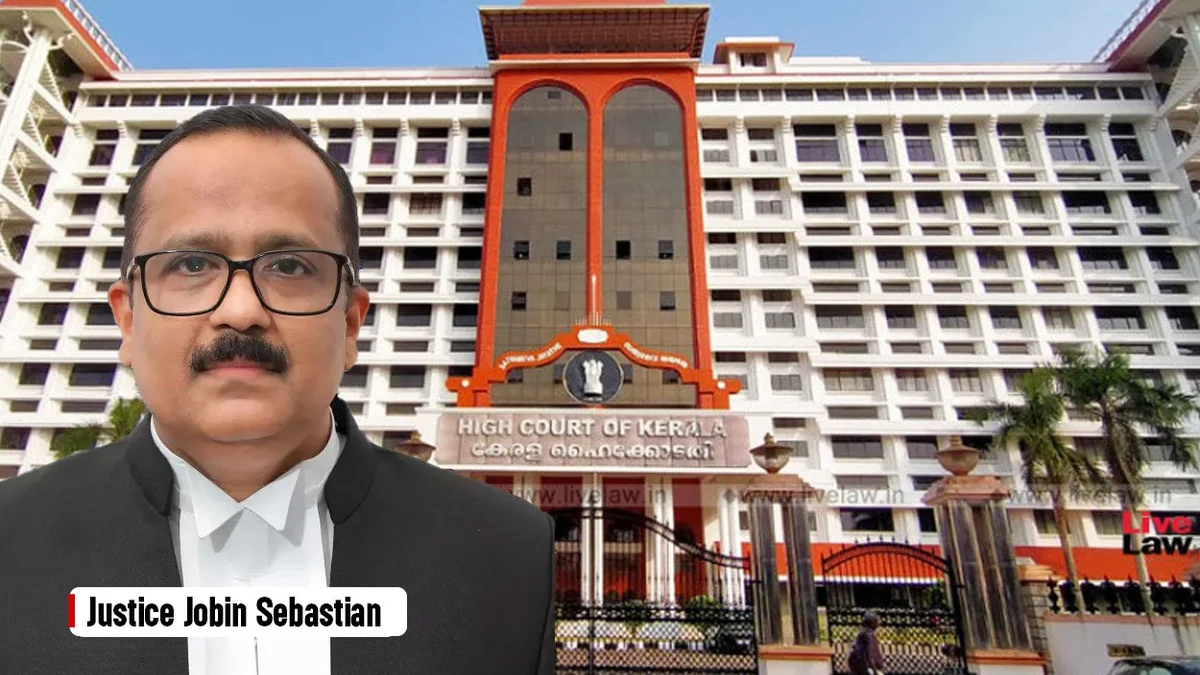
Safeguarding constitutional protection against self-incrimination in the digital era, the Kerala High Court has held that investigating agencies cannot invoke Section 94 of the Bharatiya Nagarik Suraksha Sanhita, 2023 (BNSS) to compel an accused person to produce his mobile phone or any other item that may incriminate him.
Delivering the ruling reported as 2026 LiveLaw (Ker) 645 in late November 2026, Justice Jobin Sebastian examined the scope of police powers under Section 94(1) BNSS, which empowers an officer in charge of a police station or a court to issue a written order requiring the production of any document, electronic communication, or thing considered necessary for an investigation or trial.
Drawing a direct statutory parallel with settled criminal jurisprudence under the repealed Code of Criminal Procedure, 1973, Justice Sebastian observed that Section 94(1) of the BNSS corresponds to Section 91(1) of the CrPC and carries the same constitutional boundaries. In State of Gujarat v. Shyamlal Mohanlal Choksi (1965), a Constitution Bench of the Supreme Court had authoritatively ruled that Section 94 CrPC (the predecessor to Section 91 CrPC) does not apply to an accused person, because compelling an accused to produce incriminating material violates the fundamental right against testimonial compulsion under Article 20(3) of the Constitution.
Applying that enduring constitutional principle to modern smartphone investigations, the Kerala High Court clarified that a mobile phone—containing personal messages, call logs, location history, photographs, and financial records—cannot be extracted from an accused through a coercive Section 94 BNSS notice. While Parliament expressly added “electronic communication, including communication devices, which is likely to contain digital evidence” to the text of Section 94 BNSS, that legislative expansion does not override Article 20(3) or convert the provision into a tool to force an accused to incriminate himself.
Criminal-defence practitioners across Kerala welcomed 2026 LiveLaw (Ker) 645 as a vital check against routine police notices threatening accused persons with penal consequences for not surrendering personal phones or passwords. Investigating officers retain statutory authority to conduct lawful searches and seizures in accordance with BNSS safeguards when legally justified, but they cannot bypass constitutional protections by compelling self-incriminating production directly from the accused.
As criminal investigations increasingly revolve around smartphones, encrypted messaging apps, and cloud-synced records, police forces across India have frequently issued notices under Section 91 CrPC—and now Section 94 BNSS—directing suspects to appear at police stations and surrender their mobile phones. Justice Jobin Sebastian’s ruling in 2026 LiveLaw (Ker) 645 draws an unmistakable constitutional boundary around that practice.
Under Article 20(3) of the Constitution of India, no person accused of any offence shall be compelled to be a witness against himself. Because Section 94(1) BNSS is a verbatim successor to Section 91(1) CrPC with updated references to electronic communication devices, the Constitution Bench ratio of Shyamlal Mohanlal Choksi (1965) continues to govern: an accused cannot be ordered under Section 94 BNSS to produce documents or devices that tend to incriminate him.
At the same time, the Kerala High Court’s ruling preserves legitimate investigative avenues: police officers may still seek judicial search warrants or conduct lawful seizures in strict compliance with the BNSS without coercing testimonial or documentary self-incrimination from the accused.
Trial courts and magistrates in Kerala reviewing police applications or notices under Section 94 BNSS must now enforce this constitutional boundary strictly, ensuring that investigative convenience never overrides an accused person’s fundamental protection against compelled self-incrimination under Article 20(3).
By harmonising BNSS digital-evidence powers with Article 20(3), the Kerala High Court has provided clear guidance for police and trial courts alike.
Constitutional self-incrimination protections apply fully to smartphone production notices.
Official Sources
Official Primary Document: Kerala High Court Ruling on Section 94 BNSS and Self-Incrimination (Official Record), issued by Kerala High Court on Verified Date. Direct link:
THE LAW SCHOOL HUB — LEARN LAW. UNDERSTAND JUSTICE. Read more verified national and international legal news reports at https://thelawschoolhub.com.


