Introduction
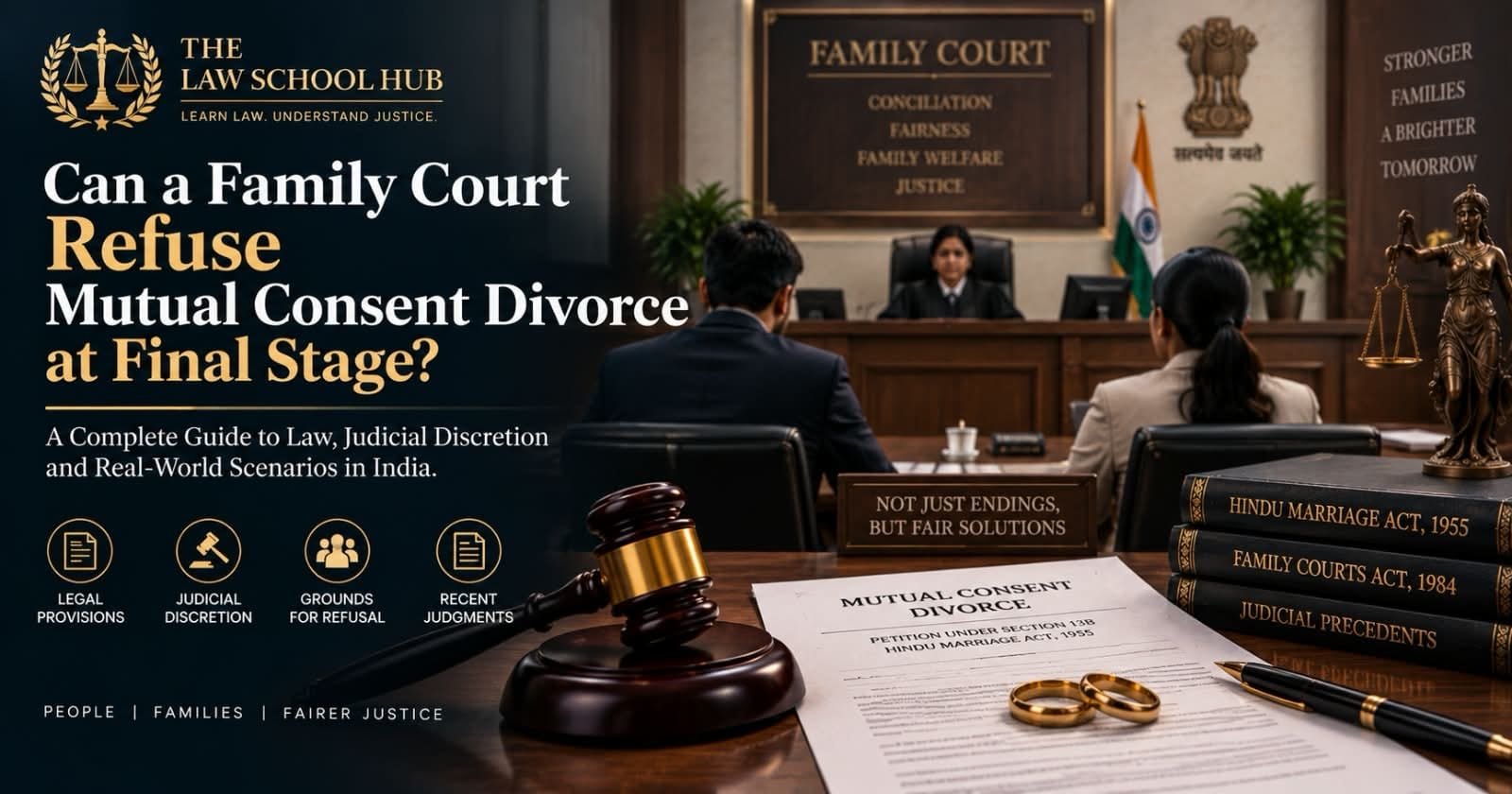
Many couples who file for a mutual consent divorce in India assume that once both spouses sign the initial petition, the final divorce decree is automatic. That belief is legally wrong. Under Indian family law, a Family Court not only has the power to refuse a mutual consent divorce at the final stage, but in several situations it has a strict legal duty to do so.
A Family Court judge is never a rubber stamp. Because marriage affects legal status, financial rights, and minor children, Parliament built an active judicial check into the final stage—known as the Second Motion. Before dissolving a marriage, the judge must verify that both spouses still freely want the divorce on the final hearing date, that nobody was forced or tricked, and that every statutory condition has been met.
This article explains how mutual consent divorce works under Section 13B of the Hindu Marriage Act, 1955 and Section 28 of the Special Marriage Act, 1954, sets out the exact grounds on which a Family Court must refuse a final decree, analyses the governing Supreme Court judgments, and clarifies the legal remedies when a spouse backs out in bad faith.
Legal Information Notice
Legal information notice: This article is for general educational and informational purposes. It does not constitute legal advice or create an attorney-client relationship.
How Mutual Consent Divorce Works Under Indian Law
Unlike a contested divorce—where one spouse must prove a legal fault such as cruelty or desertion—a mutual consent divorce rests on shared agreement. Because there is no fault-based trial, the law requires a two-step court process separated by a statutory waiting period.
1. Section 13B of the Hindu Marriage Act, 1955
For Hindus, Buddhists, Jains, and Sikhs, mutual consent divorce is governed by Section 13B of the Hindu Marriage Act, 1955, inserted by the Marriage Laws (Amendment) Act, 1976. It creates two courtroom stages.
At the First Motion under Section 13B(1), both spouses jointly file a petition stating three mandatory facts:
- They have been living separately for one year or more immediately before filing;
- They have not been able to live together; and
- They have mutually agreed to dissolve the marriage.
After recording their First Motion statements, the court pauses the case. Under Section 13B(2), the couple must wait at least six months and not more than eighteen months from the First Motion filing date. This cooling-off period gives both spouses time to reflect calmly and explore reconciliation. Once it ends, both spouses must jointly return for the Second Motion. Only after hearing them and making a proper inquiry can the court pass a divorce decree.
2. Parallel Framework Under Section 28 of the Special Marriage Act, 1954
Couples married under the Special Marriage Act, 1954 (covering civil and inter-faith marriages) follow the same two-stage process under Section 28. Section 28(1) requires one year of separate living, inability to live together, and mutual agreement. Section 28(2) requires the same six-to-eighteen-month waiting window before the Second Motion. Similarly, Section 34(1)(bb) of that Act mirrors Section 23(1)(bb) of the Hindu Marriage Act by requiring the court to check that consent is free from force, fraud, or undue influence.
3. First Motion Versus Second Motion
Spouses often confuse the First Motion with the actual divorce. The comparison table below shows why the Second Motion is the decisive legal stage.
| Feature | First Motion (Initial Stage) | Second Motion (Final Stage) |
|---|---|---|
| Statutory Basis | Section 13B(1) HMA, 1955 / Section 28(1) SMA, 1954 | Section 13B(2) & Section 23(1)(bb) HMA, 1955 / Section 28(2) SMA, 1954 |
| Timing | After at least 1 year of living separately | Between 6 and 18 months from First Motion (unless waived) |
| Judicial Check | Basic check of marriage, 1-year separation, jurisdiction, and initial consent | Full inquiry into continuing free consent, absence of coercion or fraud, and child welfare |
| Right to Withdraw | Either spouse may decline before statements are recorded | Either spouse may withdraw consent at any moment before the decree is passed |
| Effect on Marriage | Marriage stays fully valid; neither spouse can remarry | Court dissolves marriage if satisfied, or refuses divorce if conditions fail |
Why a Family Court Can and Must Refuse Mutual Consent Divorce at the Final Stage
When a couple returns for the Second Motion, the Family Court judge must test whether every legal requirement still holds true. If any mandatory condition fails, the court must refuse the divorce even if the First Motion was smooth and a settlement deed was signed earlier.
1. Unilateral Withdrawal of Consent by Either Spouse Before the Decree
The most common reason a Family Court refuses divorce at the final stage is that one spouse changes their mind. Under Section 13B(2) of the Hindu Marriage Act, 1955, consent is not a one-time signature—it must continue without interruption until the judge signs the final decree.
In Smt. Sureshta Devi v. Om Prakash, (1991) 2 SCC 25, the Supreme Court held that if either spouse unilaterally withdraws consent before the decree, mutual consent ceases to exist and the Family Court loses jurisdiction to grant a divorce under Section 13B. Later, in Hitesh Bhatnagar v. Deepa Bhatnagar, (2011) 5 SCC 234, the Supreme Court confirmed that a spouse can withdraw consent at any point before the decree is actually passed, even after the eighteen-month period has expired. Because the cooling-off period exists to allow second thoughts, First Motion consent can never be treated as irreversible.
2. Coercion, Fraud, or Undue Influence Under Section 23(1)(bb)
Even if both spouses verbally say “yes” at the Second Motion, Section 23(1)(bb) of the Hindu Marriage Act, 1955 forbids the court from granting a decree unless it is satisfied that consent was not obtained by force, fraud, or undue influence.
Family Court judges watch closely for hidden pressure during personal questioning, including:
- Coercion: Threatening to block access to children, withhold personal documents, or harm a spouse’s career unless they sign the Second Motion;
- Fraud: Tricking a spouse into signing by promising a fake remarriage later, hiding major assets during alimony talks, or lying about the meaning of court papers; and
- Undue influence: Dominating a financially dependent or vulnerable spouse so they feel unable to express an independent choice.
Whenever the judge detects that consent is not genuinely free and voluntary, the court must refuse the decree.
3. Non-Appearance at Second Motion or Expiry of the 18-Month Window
Section 13B(2) requires the Second Motion to be moved “on the motion of both the parties”. One spouse cannot move the Second Motion alone and ask the court to treat the other spouse’s silence or absence as implied consent. If one spouse stops attending court and refuses to sign the Second Motion affidavit, the Family Court cannot dissolve the marriage.
Similarly, Section 13B(2) sets an outer limit of eighteen months from the First Motion date to move the Second Motion. If eighteen months expire without a joint Second Motion, the court can dismiss the petition. While courts occasionally condone technical delays when both spouses still genuinely consent and appear together, no decree can be passed once joint consent or active participation disappears.
4. Non-Compliance With the One-Year Separation Requirement
Living separately for at least one full year immediately before filing the First Motion is a mandatory jurisdictional rule under Section 13B(1). In Smt. Sureshta Devi v. Om Prakash, the Supreme Court clarified that “living separately” means not living as husband and wife—even if the couple stays under the same roof for financial or practical reasons. However, if the judge discovers at the Second Motion that the spouses actually lived together as husband and wife within the year before First Motion, or fabricated their separation date, the court can refuse the decree because the basic statutory condition was never met.
5. Unresolved or Unconscionable Terms Affecting Minor Children’s Welfare
When minor children are involved, the Family Court exercises parens patriae jurisdiction—acting as the ultimate legal guardian of the child’s best interests. Even if both parents eagerly agree to a settlement that leaves a minor child without fair financial support, creates unsafe custody rules, or trades away the child’s maintenance for a quick divorce, the judge can refuse to pass the decree until lawful, child-protective terms are incorporated. Adults may voluntarily waive their own alimony, but they cannot bargain away a minor child’s statutory right to maintenance and care.
The Judge’s Mandatory Inquiry Under Section 13B(2) and Section 23(1)(bb)
Litigants are sometimes surprised when a Family Court judge asks detailed personal questions at the Second Motion. Those questions are not an arbitrary hurdle; they are required by statute.
1. What Happens Inside the Courtroom at the Second Motion
At the final hearing, both spouses appear before the judge (or through court-approved video conferencing in genuine hardship cases). The judge verifies identity documents, checks the certified First Motion order, and reviews the signed settlement agreement. Both spouses then record their Second Motion statements on oath, confirming that they have lived separately, honoured agreed financial and stridhan terms, resolved linked disputes, and consented freely. If a spouse looks fearful or hesitant, the judge may ask others to step out and speak to that spouse privately in chambers.
When a spouse lives overseas or cannot travel due to serious medical or employment hardship, Indian courts increasingly allow appearance through verified video conferencing alongside a properly executed Special Power of Attorney for filing and signing procedural papers. Even in virtual hearings, however, the judge still interacts directly with the absent spouse on camera, verifies their identity, and confirms that no one else is coaching or pressuring them in the room. If technical or identity doubts prevent the judge from verifying free consent, the court can postpone or refuse the Second Motion.
2. Statutory Duty to Attempt Reconciliation
Under Section 23(2) of the Hindu Marriage Act, 1955 and Section 9 of the Family Courts Act, 1984, the Family Court must make a sincere initial effort to help the couple reconcile, often through court-attached counsellors or mediators. The judge cannot force unwilling spouses to stay married, but the court must confirm that reconciliation has genuinely failed before ending the marriage.
3. Judicial Satisfaction Versus Mechanical Approval
Section 13B(2) requires the court to pass a decree only “on being satisfied, after hearing the parties and after making such inquiry as it thinks fit.” In law, “satisfied” demands an active, reasoned judicial finding based on evidence and personal observation—never mechanical rubber-stamping.
Landmark Supreme Court Judgments Governing Final-Stage Refusal and Exceptions
Four landmark Supreme Court judgments define the exact powers and limits of Family Courts in mutual consent divorce cases.
1. Smt. Sureshta Devi v. Om Prakash (1991) 2 SCC 25
Facts
In Smt. Sureshta Devi v. Om Prakash, (1991) 2 SCC 25, a couple filed a joint petition under Section 13B. Before the Second Motion, the wife stated that her initial consent had been obtained under pressure and withdrew it. The District Judge dismissed the petition, but the High Court reversed that order and granted divorce, holding that First Motion consent could not be withdrawn unilaterally.
Legal Issue
Whether a spouse can unilaterally withdraw consent after the First Motion and before a final decree is passed under Section 13B.
Court’s Reasoning
The Supreme Court held that Parliament created the six-to-eighteen-month waiting period specifically for reflection and reconciliation. If initial consent were irrevocable, Section 13B(2) would become pointless. The Court also clarified that “living separately” means not living as husband and wife, even if sharing the same house.
Decision
The Supreme Court set aside the High Court’s decree and restored the dismissal of the divorce petition.
Importance
This ruling established the core rule that mutual consent must continue until the final decree; unilateral withdrawal immediately ends the Family Court’s power to grant a Section 13B divorce.
2. Hitesh Bhatnagar v. Deepa Bhatnagar (2011) 5 SCC 234
Facts
In Hitesh Bhatnagar v. Deepa Bhatnagar, (2011) 5 SCC 234, the couple filed a joint Section 13B petition, but the wife withdrew her consent before any decree was passed. The husband argued that because eighteen months had already elapsed, the court should still dissolve the marriage.
Legal Issue
Whether a spouse can withdraw consent even after eighteen months if no decree has been passed, and whether a lower court can grant divorce despite that withdrawal.
Court’s Reasoning
The Supreme Court ruled that consent can be withdrawn at any moment until the decree is actually passed, regardless of whether eighteen months have expired. It stressed that Family Courts and High Courts have no power under Section 13B to dissolve a marriage without continuing mutual consent; only the Supreme Court holds extraordinary constitutional power under Article 142.
Decision
The Court dismissed the husband’s appeal and refused to grant divorce, noting the wife’s genuine wish to save the marriage for their daughter.
Importance
It drew a clear boundary: a Family Court can never override a spouse’s withdrawal of consent under Section 13B.
3. Amardeep Singh v. Harveen Kaur (2017) 8 SCC 746
Facts
In Amardeep Singh v. Harveen Kaur, (2017) 8 SCC 746, spouses separated for over eight years settled all alimony, custody, and litigation issues and asked to waive the six-month cooling-off period under Section 13B(2).
Legal Issue
Whether the six-month waiting period under Section 13B(2) is mandatory or directory, and whether a Family Court can waive it.
Court’s Reasoning
The Supreme Court held that Section 13B(2) aims to prevent hasty divorces, not prolong misery when reconciliation is impossible and every dispute is settled. Therefore, the six-month period is directory, not mandatory.
Decision
The Court empowered Family Courts to waive the six-month period if four strict conditions are met, upon an application filed at least one week after the First Motion.
Importance
It allowed Family Courts to waive the waiting period in genuinely settled cases, while confirming that judges must refuse a waiver whenever any of the four conditions is missing.
4. Shilpa Sailesh v. Varun Sreenivasan (2023 SCC OnLine SC 544)
Facts
In Shilpa Sailesh v. Varun Sreenivasan, 2023 SCC OnLine SC 544, a five-judge Constitution Bench examined the scope of the Supreme Court’s powers under Article 142(1) of the Constitution of India in matrimonial cases, including waiving the cooling-off period and dissolving irretrievably broken marriages.
Legal Issue
Whether the Supreme Court can use Article 142 to dispense with Section 13B(2) timelines and grant divorce on irretrievable breakdown even if one spouse opposes it.
Court’s Reasoning
The Constitution Bench held that Article 142 allows the Supreme Court to do complete justice in exceptional cases where a marriage is completely dead, weighing separation duration, mediation attempts, financial equity, and child welfare. However, this extraordinary power belongs solely to the Supreme Court and cannot be claimed as a matter of right.
Decision
The Bench affirmed that the Supreme Court can dispense with the six-month waiting period and grant divorce for irretrievable breakdown under Article 142, subject to fair financial and child-welfare safeguards.
Importance
It preserved strict statutory discipline in Family Courts while confirming a constitutional safety valve against bad-faith obstruction in dead marriages.
Waiver of the Six-Month Cooling-Off Period and Article 142 Remedies
Two practical issues frequently arise around the final stage: when can a Family Court refuse to waive the six-month wait, and what happens when a spouse takes settlement money and then backs out?
1. The Four Conditions for Waiving the Cooling-Off Period
Under Amardeep Singh v. Harveen Kaur, a Family Court may waive the six-month cooling-off period only if all four conditions are satisfied:
- Total separation completed: The statutory period of six months under Section 13B(2), in addition to the initial one-year separation under Section 13B(1), has already elapsed before the First Motion (at least 18 months total separation);
- Reconciliation exhausted: All mediation and conciliation efforts—including under Section 23(2) HMA and Section 9 of the Family Courts Act—have failed with no chance of reunion;
- All ancillary disputes settled: The parties have genuinely settled permanent alimony, child custody, visitation, stridhan, and property division; and
- Waiting would prolong agony: Insisting on another six months would only extend mental suffering.
If any condition is unmet—such as incomplete alimony payment or less than eighteen months of separation—the Family Court can properly refuse the waiver.
2. Bad-Faith Withdrawal After Accepting Settlement Benefits
Sometimes a spouse receives lump-sum alimony, jewellery, property, or quashing of criminal complaints under a court-recorded First Motion settlement and then withdraws consent at the Second Motion to extract more money. While the Family Court still cannot pass a Section 13B decree without continuing consent, the law does not reward bad faith. High Courts regularly initiate civil contempt proceedings for breaching a court undertaking and order restitution so the backing-out spouse must return every benefit received. In severe cases of dead marriages and abusive obstruction, the aggrieved spouse may also seek relief from the Supreme Court under Article 142 per Shilpa Sailesh.
3. Family Court Powers Versus Supreme Court Article 142 Powers
The table below contrasts what a Family Court can do with what only the Supreme Court of India can do.
| Legal Issue | Family Court (Section 13B HMA / Section 28 SMA) | Supreme Court of India (Article 142) |
|---|---|---|
| Source of Power | Strictly statutory under the Hindu Marriage Act or Special Marriage Act | Extraordinary constitutional power to do complete justice |
| Waiving 6-Month Cooling-Off | Allowed only if all four Amardeep Singh conditions are met | Broader discretion to dispense with waiting period in deserving cases |
| Divorce After Consent Withdrawn | Not permitted — must refuse Section 13B decree | Permitted in exceptional irretrievable breakdown cases under Shilpa Sailesh |
| Bad-Faith Breach of Settlement | Dismisses petition; restitution and High Court contempt address breach | Can mould complete relief, enforce restitution, and dissolve marriage |
Practical Consequences: What Happens After a Family Court Refuses Divorce?
A final-stage refusal has immediate legal consequences that both spouses must understand before taking any next step.
1. Legal Status of the Marriage
When a Family Court refuses or dismisses a Section 13B petition, the marriage remains completely valid. Neither spouse is free to remarry; doing so renders the second marriage void and exposes the person to prosecution for bigamy.
2. Legal Options for the Aggrieved Spouse
Depending on why the decree was refused, the aggrieved spouse may:
- File a contested divorce petition: Approach the Family Court under Section 13(1) of the Hindu Marriage Act (or Section 27 of the Special Marriage Act) on applicable fault grounds such as cruelty or desertion;
- Seek restitution and contempt action: Recover money or property transferred under a failed court-recorded settlement and move the High Court if a formal undertaking was breached;
- Cure curable defects: Complete the statutory separation period or revise unfair child-welfare terms and re-approach the court jointly; or
- Appeal to the High Court: Challenge an erroneous refusal under Section 19 of the Family Courts Act, 1984 if both spouses genuinely consented and satisfied every statutory rule.
3. Second Motion Preparation Checklist
To prevent avoidable refusals, couples should verify their truthful one-year separation timeline, structure major alimony payments so the bulk is handed over at the Second Motion statement rather than entirely upfront, write clear and fair child-custody and maintenance clauses, and attend court personally with original IDs and certified First Motion copies.
Spouses should also double-check territorial jurisdiction under Section 19 of the Hindu Marriage Act, 1955 before the final stage. A mutual consent petition can only be heard by the Family Court within whose local limits the marriage was solemnized, where the parties last resided together, where the respondent resides, or where the wife resides on the date of presenting the petition. If the judge discovers at the Second Motion that neither spouse had a valid jurisdictional link to that city—for example, when address proofs were temporary or inaccurate—the court can refuse the decree and return the petition for filing in the proper jurisdiction.
Practical Illustrations
These hypothetical illustrations show how Family Courts apply Section 13B and Section 23(1)(bb) in practice.
Hypothetical Illustration 1: Genuine Change of Mind Before the Final Hearing
Scenario:
Rohan and Meera live separately for two years and complete their First Motion under Section 13B smoothly. During the six-month cooling-off period, counselling helps Meera realise she wants to save the marriage. At the Second Motion hearing, Meera tells the judge she withdraws her consent. Rohan argues the judge must grant divorce because Meera signed the First Motion papers.
Legal Analysis:
Under Section 13B(2) and the Supreme Court’s rulings in Smt. Sureshta Devi v. Om Prakash and Hitesh Bhatnagar v. Deepa Bhatnagar, mutual consent must continue until the final decree is passed. Once Meera withdraws consent, the Family Court loses jurisdiction under Section 13B and must dismiss the petition.
Practical Takeaway:
A First Motion statement is never an irrevocable contract to divorce. If Rohan still seeks divorce, he must file a separate contested petition on statutory grounds.
Hypothetical Illustration 2: Hidden Coercion Detected Under Section 23(1)(bb)
Scenario:
Vikram and Ananya appear for their Second Motion. Their settlement states that Ananya waives all alimony and gives full custody of their five-year-old child to Vikram. Noticing Ananya trembling, the judge speaks to her privately in chambers. Ananya reveals that Vikram threatened to send private photos to her employer unless she signed away custody and maintenance.
Legal Analysis:
Under Section 23(1)(bb), a Family Court is barred from passing a mutual consent decree unless satisfied that consent is free from force, fraud, or undue influence. Because Ananya’s consent was coerced and the custody clause harms the child’s welfare, the judge must refuse the decree immediately.
Practical Takeaway:
The judge’s personal inquiry at the Second Motion protects vulnerable spouses. Anyone facing threats should inform the judge candidly in chambers.
Hypothetical Illustration 3: Bad-Faith Withdrawal After Taking Settlement Money
Scenario:
Under a court-recorded First Motion settlement, Karan pays Priya Rs. 15 lakh upfront and withdraws a civil property suit, with Rs. 5 lakh due at the Second Motion. Six months later, Priya refuses to appear for the Second Motion and demands an extra Rs. 10 lakh.
Legal Analysis:
The Family Court cannot pass a Section 13B decree without Priya’s continuing consent. However, Priya cannot keep Rs. 15 lakh taken under a failed court undertaking. Karan can seek restitution of the money, initiate High Court contempt proceedings for breach of undertaking, and—if the marriage is wholly dead—seek Article 142 relief from the Supreme Court per Shilpa Sailesh.
Practical Takeaway:
Stagger settlement payments so the main lump sum is handed over at the Second Motion statement, and record all terms as explicit undertakings to the court.
Key Takeaways
- Consent must continue until decree: A Family Court must refuse a Section 13B divorce if either spouse withdraws consent before the final order is signed.
- Active scrutiny under Section 23(1)(bb): Judges must verify that consent is completely free from force, fraud, or undue influence.
- Joint Second Motion is mandatory: Non-appearance of a spouse or expiry of the 18-month window prevents the court from granting a mutual consent decree.
- Child welfare comes first: Courts can withhold divorce if settlement terms leave minor children financially unprotected or unsafe.
- Cooling-off waiver is conditional: Under Amardeep Singh (2017), waiver requires meeting all four strict criteria.
- Bad faith has consequences: Backing out after pocketing settlement benefits invites restitution orders, contempt proceedings, and potential Article 142 intervention.
Conclusion
A Family Court in India can—and frequently must—refuse a mutual consent divorce at the final stage. The Second Motion under Section 13B(2) of the Hindu Marriage Act, 1955 and Section 28(2) of the Special Marriage Act, 1954 is an active judicial safeguard, not a rubber stamp. Whenever consent is withdrawn, coercion or fraud appears under Section 23(1)(bb), a spouse fails to appear within eighteen months, the one-year separation rule was not met, or minor children’s welfare is harmed, the judge must withhold the decree.
At the same time, Amardeep Singh v. Harveen Kaur empowers Family Courts to waive the six-month wait in genuinely settled cases, and Shilpa Sailesh v. Varun Sreenivasan preserves the Supreme Court’s Article 142 power to deliver complete justice against bad-faith obstruction. To explore more plain-English guides on Indian family law, statutory provisions, and landmark judgments, visit The Law School Hub.
Frequently Asked Questions
1. Can a Family Court refuse mutual consent divorce even if both spouses say yes at the Second Motion?
Answer:
Yes. The judge must still refuse the decree if consent was obtained by force, fraud, or undue influence under Section 23(1)(bb), if the mandatory one-year separation rule was violated, or if settlement clauses harm minor children’s welfare.
2. What happens if one spouse does not appear for the Second Motion hearing?
Answer:
Section 13B(2) requires a joint motion by both spouses. If one spouse stops appearing and does not participate via court-approved video conferencing, the Family Court cannot grant a mutual consent divorce and will dismiss the petition.
3. Can a spouse withdraw consent after the six-month cooling-off period has ended?
Answer:
Yes. Under Smt. Sureshta Devi v. Om Prakash and Hitesh Bhatnagar v. Deepa Bhatnagar, either spouse may unilaterally withdraw consent at any moment before the Family Court actually passes the final decree, even after six or eighteen months.
4. Must a spouse return alimony paid at First Motion if they withdraw consent at Second Motion?
Answer:
Generally, yes. When money or property was handed over under a court-recorded mutual consent settlement and the recipient backs out in bad faith, the paying spouse can seek restitution and initiate High Court contempt proceedings for breaching an undertaking.
5. Can a Family Court refuse to waive the six-month cooling-off period?
Answer:
Yes. Waiver under Amardeep Singh v. Harveen Kaur is discretionary. If the couple has not lived separately for at least eighteen months total before First Motion, has not tried reconciliation, or has unsettled alimony or custody terms, the court can refuse the waiver.
6. What happens if 18 months pass after the First Motion without filing the Second Motion?
Answer:
Section 13B(2) sets an eighteen-month outer limit. If that period expires without a joint Second Motion, the Family Court can dismiss the petition, requiring a fresh joint petition if both spouses still want a mutual divorce later.
7. Can a Family Court grant divorce for irretrievable breakdown if one spouse withdraws consent?
Answer:
No. Irretrievable breakdown of marriage is not a statutory ground available to Family Courts or High Courts. As clarified in Shilpa Sailesh v. Varun Sreenivasan, only the Supreme Court of India can dissolve a marriage on that ground under Article 142 of the Constitution.
Legal References
- The Hindu Marriage Act, 1955 — Sections 13B, 23(1)(bb), and 23(2) governing mutual consent divorce, judicial scrutiny of free consent, and mandatory reconciliation duties.
- Smt. Sureshta Devi v. Om Prakash, (1991) 2 SCC 25 — Supreme Court judgment establishing that mutual consent must continue until the passing of the final decree and defining “living separately” under Section 13B(1).
- Hitesh Bhatnagar v. Deepa Bhatnagar, (2011) 5 SCC 234 — Supreme Court ruling reaffirming that either spouse may withdraw consent at any time before the decree is passed, even after eighteen months, and clarifying the jurisdictional limits of Family Courts.
- Amardeep Singh v. Harveen Kaur, (2017) 8 SCC 746 — Supreme Court decision holding that the six-month cooling-off period under Section 13B(2) is directory rather than mandatory and laying down four conditions for waiver.
- Shilpa Sailesh v. Varun Sreenivasan, 2023 SCC OnLine SC 544 — Five-judge Constitution Bench judgment defining the Supreme Court’s Article 142 power to dispense with the waiting period and grant divorce on irretrievable breakdown of marriage.
- Constitution of India, Article 142 — Constitutional provision empowering the Supreme Court of India to pass decrees or orders necessary for doing complete justice in any cause or matter pending before it.
- The Law School Hub — Indian legal education publication offering plain-English explainers on statutory law, Supreme Court judgments, and courtroom procedure.