Can a Bank Freeze Only the Disputed Amount in an Online Fraud Case?

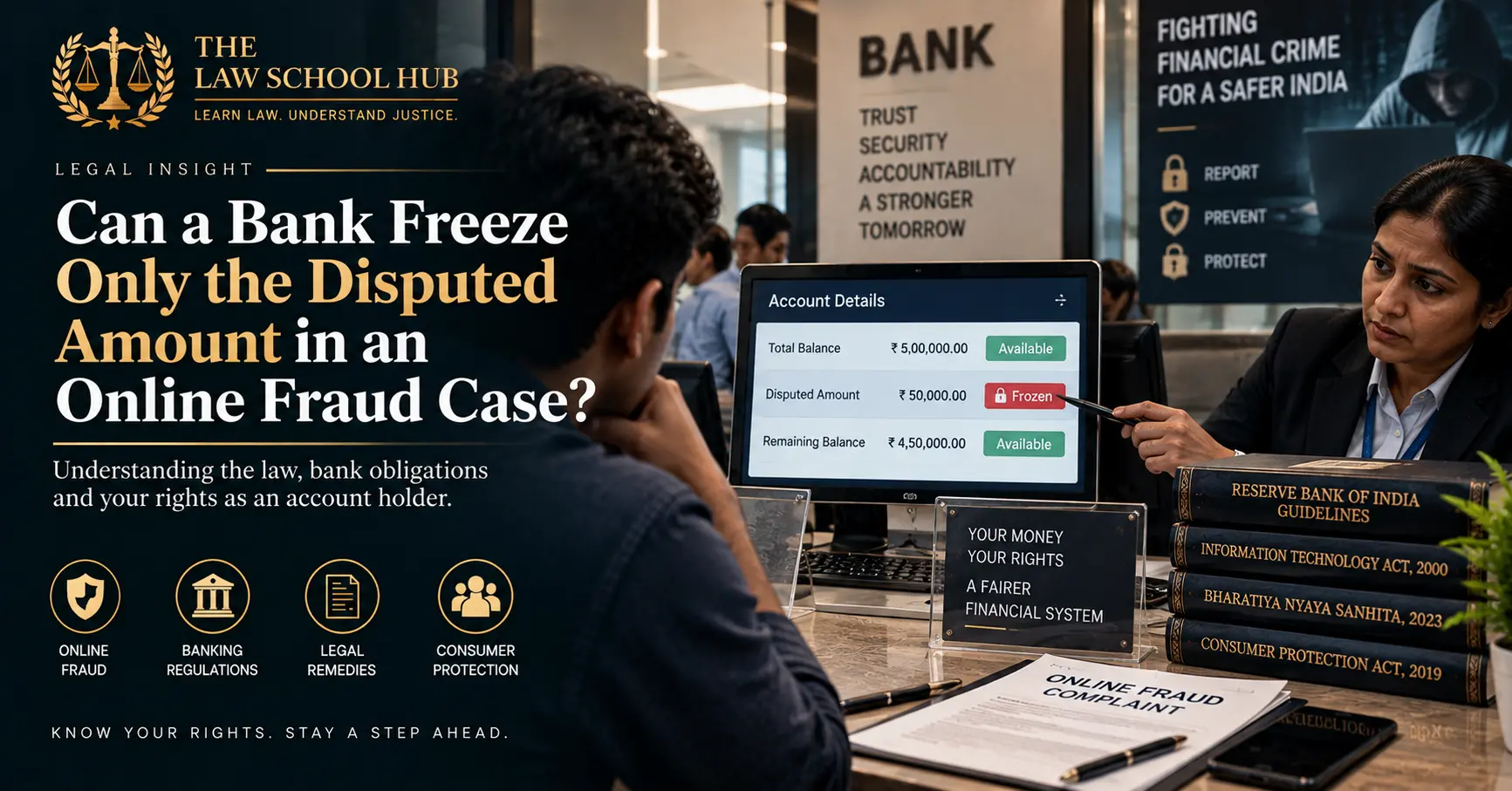
Table of Contents
Introduction
A sudden block on your hard-earned money can cause immediate panic. Many honest citizens find their bank accounts completely locked because a small amount of suspicious money entered their account. This usually happens when the police investigate an online scam. The most important question these citizens ask is whether the law allows the bank to block their entire life savings, or if the bank should only hold the specific suspected money.
The law requires fairness. According to multiple High Court judgments, the police and the banks should only freeze the specific disputed amount. Blocking a person’s entire legitimate business capital or monthly salary over a minor disputed transaction is legally wrong.
This guide explains the exact legal rules behind a bank freeze disputed amount. It breaks down the new Indian criminal laws, explains how courts protect innocent account holders, and provides clear steps to help you release your legitimate money.
Legal Information Notice
Legal information notice: This article is for general educational and informational purposes. It does not constitute legal advice or create an attorney-client relationship.
Overview of the Topic
To understand why your money is suddenly blocked, you must first understand how modern digital criminals operate and how the police try to catch them.
When a victim is cheated online, they usually call the 1930 cyber helpline or file a complaint on the National Cyber Crime Reporting Portal. This portal is often called the NCRP.
Criminals do not keep stolen money in one place. They instantly transfer the money through five or ten different bank accounts to hide their tracks. This fast transferring process is called layering.
When the police start their investigation, they trace this money trail. They send automated electronic notices to the banks of every single account that touched the stolen money. The police order the banks to stop the funds from moving any further.
The main problem happens at the bank level. The police order usually mentions a specific transaction amount. However, instead of placing a hold only on that specific suspected amount, the bank’s software often applies a blanket debit freeze. A blanket debit freeze means the account holder cannot withdraw any money at all, even if 99 percent of the money in the account is their own clean, legitimate income. This extreme action hurts innocent people who had nothing to do with the original crime.
Detailed Explanation
The law gives the police the power to secure evidence and seize stolen property. In India, a bank account balance is legally considered property. Therefore, the police have the right to freeze it. However, this police power is not absolute. It must be balanced against a normal citizen’s basic right to live peacefully and run their business.
1. How the Freeze Mechanism Actually Works
When a police officer traces stolen funds to a specific bank account, they issue a formal order to the bank’s Nodal Officer. The Nodal Officer is the specific bank employee whose job is to communicate with the police and law enforcement agencies.
The police order usually highlights a particular transaction ID and a very specific amount of money. For example, the police might write that ₹10,000 received on a Tuesday morning is suspected stolen money.
The bank is a private business. It does not investigate the crime itself. It simply obeys the police order to avoid legal trouble. Because it is technically easier and faster for the bank’s computer systems to lock the entire account, banks apply a full debit freeze. Under a debit freeze, money can still come into your account, but absolutely no money can go out. You cannot withdraw cash from an ATM, you cannot write cheques, your automatic loan EMIs will bounce, and you cannot make UPI payments.
2. The Rule of Proportionality
Indian law operates on a very important standard called proportionality. Proportionality means that the government’s action must fit the exact size of the problem.
If the cyber police are looking for ₹10,000, freezing a bank account that contains ₹15,00,000 is not proportionate. It is excessive. It causes extreme, unnecessary pain to the account holder. High Courts across India have clearly stated that the correct and legal action is for the bank to place a lien on the account.
A lien means a temporary legal hold on a specific, exact amount of money. If a lien of ₹10,000 is placed on an account containing ₹50,000, the account holder cannot touch the ₹10,000. However, they are completely free to use the remaining ₹40,000 for their daily life, business, and family needs.
3. The Problem for Innocent Third Parties
Most people facing a frozen account are not the actual scammers or hackers. They are usually innocent third-party receivers.
For example, a scammer might steal money from a victim and then use that stolen money to buy a television from a legitimate electronics shop. The shopkeeper receives the money in good faith. The shopkeeper has no idea the money is tied to a cyber crime. When the police freeze the shopkeeper’s entire business account, it harms an innocent citizen who was just doing their job. The law requires special protection for these innocent third parties so their businesses are not destroyed.
Key Legal Provisions
To challenge an unfair bank freeze, a person must clearly understand the laws that give the police their power. On July 1, 2024, India replaced its old criminal procedure laws with new ones. Understanding these new laws is essential.
1. Section 106 of the Bharatiya Nagarik Suraksha Sanhita, 2023
This is the most important law regarding bank account freezes in India today. It replaced Section 102 of the old Code of Criminal Procedure.
Section 106(1) BNSS: This sub-section gives any police officer the legal power to seize any property which is suspected to have been stolen, or which is found under circumstances creating suspicion of a crime. The Supreme Court of India has officially confirmed that money inside a bank account qualifies as property. Therefore, the police can legally freeze an account under this section.
Section 106(3) BNSS: This is the most crucial protection for citizens. This sub-section has a very strict rule. It says that the police officer must immediately report the seizure to the local Magistrate. A Magistrate is the local judge. The police cannot just freeze your account and forget about you. If the police freeze the account but fail to inform the Magistrate quickly, the freeze becomes legally defective. You can use this failure to ask the court to lift the freeze.
2. Section 94 of the Bharatiya Nagarik Suraksha Sanhita, 2023
This section replaced Section 91 of the old CrPC.
Section 94 BNSS: This law allows a court or a police officer to issue a written summons ordering a person to produce a document or a thing. In cybercrime cases, police properly use this section to ask the bank for your account statements and your KYC documents.
However, the police absolutely cannot use Section 94 to freeze your money. Section 94 is only meant for collecting documents for the investigation. If a bank freezes your account based only on a Section 94 notice from the police, the bank is making a serious legal mistake.
3. Article 21 of the Constitution of India
Article 21: This fundamental right guarantees the right to life and personal liberty to every person in India.
The Supreme Court has clearly expanded this rule. They have stated that the right to life includes the right to a livelihood. You need money to live. If a person cannot access their own salary to buy food, pay rent, or buy necessary medicine because of a disproportionate bank freeze, it is a direct violation of Article 21.
4. Article 19(1)(g) of the Constitution of India
Article 19(1)(g): This Article guarantees every Indian citizen the fundamental right to practice any profession, or to carry on any occupation, trade, or business.
When a bank completely freezes a company’s entire working capital over a tiny disputed amount, the business cannot pay its employees, pay its taxes, or buy supplies. This forces the business to shut down. Freezing a whole business account for a small dispute violates the citizen’s fundamental right to do business under Article 19(1)(g).
5. Article 300A of the Constitution of India
Article 300A: This article states that no person shall be deprived of their property save by authority of law.
Because a bank balance is your property, the government cannot take away your access to it without strictly following the correct legal procedure. An arbitrary, oversized freeze that ignores the rule of proportionality violates your constitutional right to property.
Important Case Laws
When police and banks act unfairly, citizens go to court. High Courts across India have repeatedly protected citizens from disproportionate bank freezes. The following cases explain exactly how senior judges view this problem.
1. Dr. Sajeer v. Reserve Bank of India
Facts: Several different people approached the Kerala High Court. Their bank accounts had been completely frozen by their banks. The banks acted on instructions from police in different states who were investigating online financial fraud. The people whose accounts were frozen were not accused of the actual fraud. The stolen money had simply passed through their accounts during the layering process. The banks froze their entire life savings.
Legal Issue: Was the bank legally allowed to place a total freeze on a customer’s account when the police were only investigating a specific, small transaction amount?
Arguments: The people argued that freezing their entire accounts caused extreme daily hardship. They could not survive or run their businesses. They argued it was deeply unfair to punish them completely for a single suspicious transaction they knew nothing about. The banks argued they were simply obeying police notices.
Court’s Reasoning: The Kerala High Court stated clearly that there is no valid legal reason to keep an entire bank account frozen if the disputed amount is a known, specific number. The Court recognised that police must investigate crimes to catch hackers, but they must do so without destroying the financial lives of innocent account holders.
Decision: The Court ordered the banks to limit the freeze strictly to the specific amounts mentioned in the police orders. The rest of the money had to be made available to the account holders immediately so they could live normally.
Importance: This case established a very strong rule that a blanket debit freeze is usually illegal if the police are only looking for a specific sum. It forces banks to use a specific lien rather than a total block.
2. Mohammed Saifullah v. Reserve Bank of India
Facts: A person’s bank account was frozen after a cybercrime complaint was filed on the national portal. The police sent an order to the bank. The bank completely blocked the account, even though the suspected fraud amount was a specific, easily identifiable number. The account contained a large amount of legitimate, clean money that had no connection to the crime.
Legal Issue: Does freezing an entire bank account, which contains mostly clean money, violate the legal principle of proportionality?
Arguments: The person argued that while the police can secure the suspected money, blocking all the clean money is an unfair punishment before any trial has even started.
Court’s Reasoning: The Madras High Court heavily focused on proportionality. The judge noted that the police power to seize property is meant only to secure evidence for the trial. It is not meant to punish innocent people. Taking away a citizen’s access to all their untainted, clean money is an excessive and totally unjustified action.
Decision: The Court ordered the bank to unfreeze the account immediately. The bank was allowed to keep a hold only on the exact disputed amount, allowing the person to use the rest of their money normally for their daily expenses.
Importance: This ruling strongly reinforces that banks and police cannot use the excuse of a cyber investigation to act blindly. They must separate the suspected dirty money from the clean money.
3. Archana v. State of Madhya Pradesh
Facts: A business held a current account containing over ₹2.5 Crores. Someone filed a complaint on the national cyber portal. The police issued a notice regarding a highly suspicious transaction of just ₹980. Because of this tiny ₹980 dispute, the bank completely froze the entire ₹2.5 Crore account. The business was forced to stop operating instantly because they could not pay anyone.
Legal Issue: Does a minor disputed transaction of ₹980 justify freezing a massive business account under the criminal procedure laws?
Arguments: The business owner argued that stopping a multi-crore business over ₹980 was completely illogical and violated their constitutional right to do business under Article 19(1)(g).
Court’s Reasoning: The Madhya Pradesh High Court heavily criticised the police and bank action. The Court explained that while police have the power to stop the operation of bank accounts, they must use their common sense. Freezing huge amounts of clean business capital over a tiny, negligible dispute is entirely arbitrary and violates the Constitution.
Decision: The Court intervened to protect the business, ordering that the massive freeze could not continue over such a small dispute. The court ensured the business could operate its clean funds.
Importance: This judgment is a powerful example of how courts view extreme police and bank actions. It proves that the law requires a sense of balance. You cannot burn down an entire house just to catch one mouse.
Practical Examples and Illustrations
To understand how these legal rules apply in your daily life, consider the following clear hypothetical situations.
1. Hypothetical Example 1: The Innocent Shopkeeper
Scenario: Rahul owns a mobile phone shop. A customer visits the shop and buys a phone for ₹20,000, paying through a UPI scanner. Two days later, Rahul’s entire bank account, which contains ₹5,00,000 of his hard-earned business savings, is completely frozen. He learns that the customer used money stolen in a cyber fraud to pay for the phone.
Legal Position: Rahul is an innocent third party. He provided a genuine product for the money. The police are investigating the ₹20,000. Under the law and High Court rulings, the police and the bank absolutely do not have the right to freeze Rahul’s entire ₹5,00,000. The bank must apply the rule of proportionality.
Practical Point: Rahul should contact the bank and the investigating police officer immediately. He must provide his shop invoice and CCTV footage to prove it was a legitimate sale. He should formally request that they limit the freeze to a lien of ₹20,000 and release the remaining ₹4,80,000 so he can run his shop.
2. Hypothetical Example 2: The Cryptocurrency Trader
Scenario: Priya legally sells cryptocurrency on a peer-to-peer crypto platform. A buyer sends ₹50,000 to her bank account, and she transfers the digital crypto to them. The buyer’s money was actually stolen from someone else through a phishing scam. Priya’s bank account, which holds ₹2,00,000, is placed under a complete debit freeze by her bank.
Legal Position: Priya is caught in the layering process. The police have the legal authority under Section 106 BNSS to secure the ₹50,000 that is suspected to be stolen. However, they cannot legally block her remaining ₹1,50,000 because that money is clean.
Practical Point: Priya must show the police her crypto trade history, platform receipts, and chat logs to prove she received the money through a normal, legal trade. She has the strong legal right to demand the bank convert the full freeze into a specific ₹50,000 hold.
2. Hypothetical Example 3: The Shared Dinner Bill
Scenario: Amit receives his monthly salary of ₹60,000 in his main bank account. A friend transfers him ₹1,500 to split the cost of a restaurant bill. The friend’s account is later flagged by the cyber cell for an unrelated fraud. The police trace the ₹1,500 to Amit. The bank freezes Amit’s entire salary account. Amit cannot pay his rent or buy groceries.
Legal Position: Freezing a ₹60,000 salary account over a ₹1,500 dispute is highly disproportionate. It directly violates Amit’s right to livelihood under Article 21 of the Constitution because it starves him of his basic living funds.
Practical Point: Amit can immediately approach the local Magistrate court under Section 503 of the BNSS to seek relief, as the total freeze on his salary is a direct threat to his daily survival.
Practical Consequences / What This Means in Real Life
When your account is frozen, the real-world impact is immediate, painful, and severe.
Financial Damage: Your given cheques will bounce. Your SIP mutual fund investments will fail. Your home and car EMIs will be missed. Your credit score will drop significantly, making it hard to get loans in the future.
Because of this severe damage, it is crucial to know the practical steps to take. If you discover your account is frozen, you should take the following steps:
1. Request Written Proof: Do not just talk to customer care on the phone. Visit your home branch in person. Ask the bank manager to provide the official email or notice they received from the police. You need to know the name of the police station, the state, the NCRP complaint number, and the exact disputed amount.
2. Identify the Transaction: Look closely at your bank statement. Find the specific incoming money transfer that caused the problem.
3. Gather Evidence: Collect any proof that shows exactly why you received that money. This could be a GST invoice, a WhatsApp chat, a business contract, or a UPI screenshot. You need to prove you are an innocent receiver who did nothing wrong.
4. Contact the Investigating Officer: Send an email and a physical registered letter to the police officer who issued the notice. Attach your evidence. Formally request them to unfreeze the account or limit the freeze strictly to the disputed amount.
5. Approach the Court: If the police ignore you, or if they refuse to help, you cannot wait forever. You will need to hire a local lawyer. Under Section 503 of the BNSS, your lawyer can file an application before the local Magistrate asking for the property to be released. If the freeze is massively disproportionate, you can also file a Writ Petition in the High Court under Article 226 of the Constitution.
Important Exceptions or Limitations
The general rule is that only the disputed amount should be frozen. However, there are exceptions where the police are legally justified in freezing the entire account. A full freeze may be legal if:
The Account is a Shell Account: If the police discover that the bank account was opened using fake identity documents just to receive stolen money, they will freeze the entire account because the account itself is illegal.
The Person is the Main Accused: If the police evidence strongly suggests that the account holder is the actual mastermind of the fraud, and all the money in the account is likely stolen, the police can legally block the entire balance.
The Clean Money Cannot Be Separated: If the stolen money was mixed so heavily with other funds, and massive amounts of money are moving in and out every single minute to confuse the police, the police may temporarily freeze the whole account until they can calculate the exact stolen amount.
Difference Between Old Law and New Law
| Legal Action | Old Law | New Law | What It Means |
| Notice for Documents | Section 91 CrPC | Section 94 BNSS | Used by police to ask banks for statements. Cannot be used to freeze money. |
| Power to Seize Property | Section 102 CrPC | Section 106 BNSS | The correct law used to freeze a bank account connected to a crime. |
| Reporting to Judge | Section 102(3) CrPC | Section 106(3) BNSS | Police must immediately tell the Magistrate that they have frozen the account. |
Full Debit Freeze vs. Disputed Amount Lien
| Feature | Full Debit Freeze | Disputed Amount Lien |
| What happens to the account? | All outgoing money is completely blocked. | Only a specific amount is blocked. |
| Can you use the rest of your money? | No. | Yes. The rest of the balance works normally. |
| Is it legal for third parties? | Usually considered illegal by High Courts. | Considered the correct, legal method by courts. |
| Impact on a business | Stops all business operations immediately. | Allows the business to keep running safely. |
Key Takeaways
- Bank Account as Property: A bank account balance is considered property and can be frozen by the police under Section 106 of the BNSS.
- Innocent Victims: Most people whose accounts are frozen are innocent third parties caught in a complex chain of transactions.
- High Court Rulings: High Courts have ruled strongly that a blanket freeze on an entire account is illegal if the police are only investigating a specific, small amount.
- Proportionality: The bank and police must apply the rule of proportionality. They should place a lien only on the disputed funds.
- Constitutional Rights: A total freeze violates the fundamental rights to livelihood and business under Article 21 and Article 19(1)(g) of the Constitution.
- Legal Action: If your account is frozen, you must gather solid evidence showing the legitimate source of the funds and approach the Investigating Officer or a Magistrate court for relief.
Conclusion
The massive rise in online fraud requires strong, fast action from the police. Tracing stolen money quickly is absolutely necessary to catch digital criminals. However, the law does not allow the police or the banks to cause severe financial damage to innocent citizens in the process.
As confirmed by various High Courts across India, the power to freeze a bank account must be used carefully and fairly. A bank should only freeze the specific disputed amount involved in the reported crime. Locking an entire account containing someone’s monthly salary or business capital over a minor suspicious transaction is highly disproportionate and legally wrong. If an account holder faces a sudden blanket freeze, they have strong legal grounds to challenge the action in court and demand that their legitimate, clean money be released immediately.
FAQs
1. Can a bank freeze my entire account after a cyber-fraud complaint?
Answer: A bank may place restrictions on an account after receiving a valid direction, but freezing the entire balance for a small disputed amount is legally disproportionate and wrong according to multiple High Courts.
2. What is the difference between a total debit freeze and a lien?
Answer: A total debit freeze stops all outgoing transactions so you cannot withdraw anything, while a lien only blocks a specific amount, allowing you to freely use the remaining balance in your account.
3. Under what law do police freeze bank accounts today?
Answer: As of July 1, 2024, the police use Section 106 of the Bharatiya Nagarik Suraksha Sanhita, 2023, which replaced the older Section 102 of the CrPC for seizing property.
4. Can the bank unfreeze my account if I just explain the situation to them?
Answer: Usually no, because the bank acts as a custodian following police orders, so you must get a clearance email from the Investigating Officer or a formal order from a court to lift the freeze.
5. What documents may help me challenge the freeze?
Answer: The relevant documents include records showing ownership of the account, clear transaction history, business invoices, WhatsApp chats confirming a sale, and official communications from the bank.
6. Do I have to travel to another state to unfreeze my account?
Answer: Not always immediately, as you should first try sending your evidence and a legal request via email and registered post to the police officer in that state, but if they ignore you, you may eventually need a local lawyer.
7. Can Section 94 of the BNSS be used to freeze my money?
Answer: No, Section 94 of the BNSS is only meant for asking a person or bank to produce documents like bank statements, and it does not give the police the legal power to seize or freeze money.
Legal References
- The Constitution of India, 1950: Article 19 and Article 21
- The Bharatiya Nagarik Suraksha Sanhita, 2023: Section 94 and Section 106
- Kerala High Court: Dr. Sajeer v. Reserve Bank of India & Ors., [2024 (1) KLT 826]
- Madras High Court: Mohammed Saifullah v. Reserve Bank of India & Ors., WP No. 25631/2024
- Madhya Pradesh High Court: Archana v. State of Madhya Pradesh, WP-29117-2026
At The Law School Hub, we simplify case laws, legal acts, and legal concepts for law students and legal readers. Want to read more useful legal blogs? Visit The Law School Hub.
Building a community around law, learning, and legal awareness through The Law School Hub.
I’m Yash Yogitta Joshi. Join me on LinkedIn → Click to view my Profile