How Should India Handle Stateless Persons Under Human Rights Law?

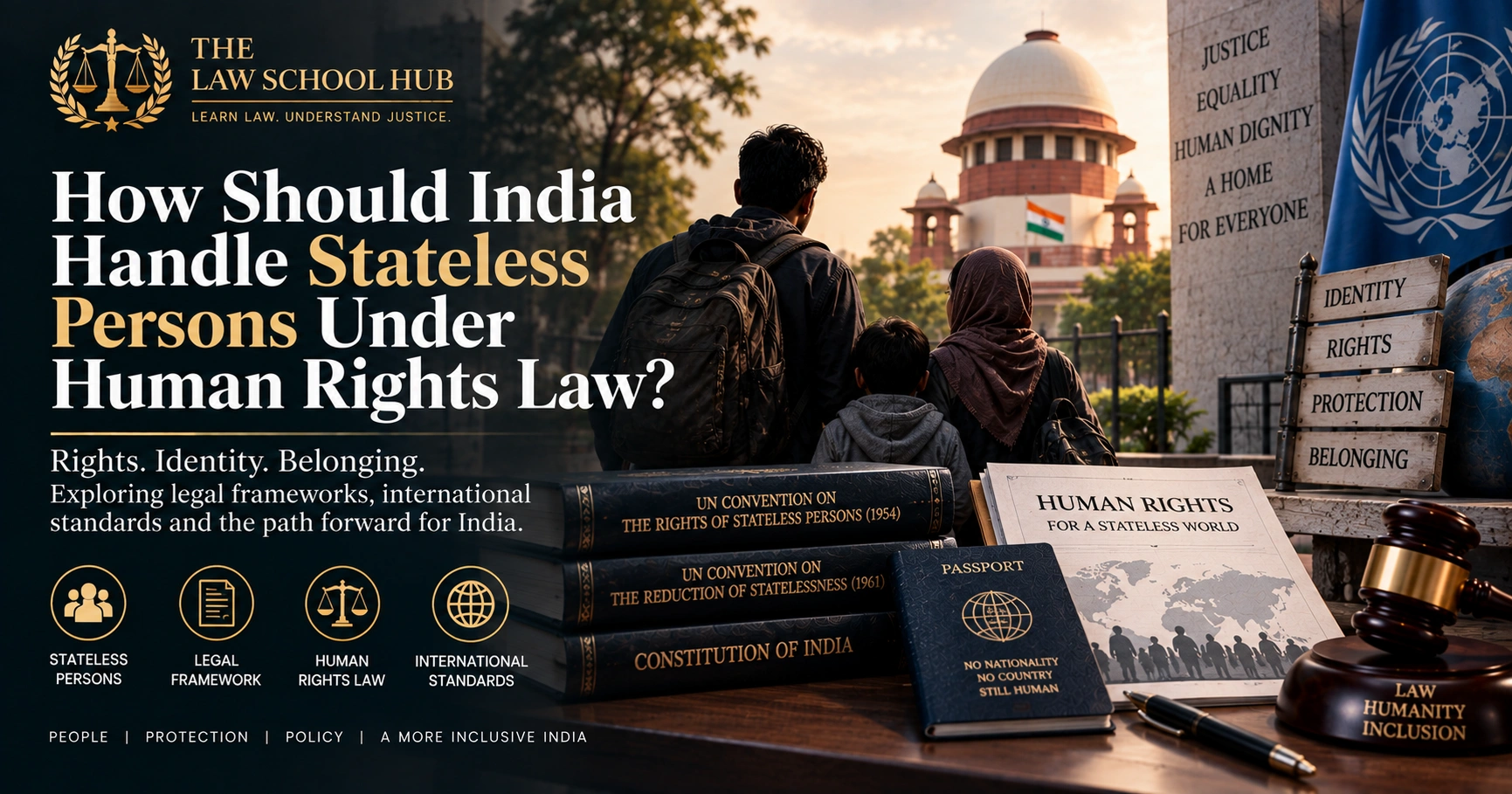
Table of Contents
Introduction
Imagine living in a country, but the government says you do not belong there. You have no passport, no voter ID card, and no official identity. You cannot legally work, travel, or even open a basic bank account. This is the reality for stateless persons. A stateless person is someone who is not considered a citizen by any country in the world. They are legally invisible. In India, handling stateless people is a massive legal challenge. India shares borders with many countries and has seen massive migrations throughout history. However, India does not have a specific national law to deal with refugees or people without a state.
Because there is no specific law, the government usually treats stateless people as illegal migrants. This creates a direct clash between national security and basic human rights. The central legal question is how a democratic country should treat people who have no legal identity. Should they be thrown in jail, deported, or protected under human rights? The Supreme Court of India has consistently stepped in to say that even if a person is not an Indian citizen, they are still a human being. They have the basic right to life and dignity.
This guide will explain exactly how Indian law deals with people who have no citizenship. We will look at the strict laws the government uses, the powerful rights the Constitution provides, and the important court decisions that balance national security with human kindness.
Legal Information Notice
Legal information notice: This article is for general educational and informational purposes. It does not constitute legal advice or create an attorney-client relationship.
Overview of the Topic
To understand the law, we first need to understand the problem. A citizen belongs to a country. The country gives the citizen rights, like the right to vote or the right to get a passport. In return, the country protects the citizen. But a stateless person has no country to call home.
In India, the problem is very complicated. India has hosted millions of people fleeing danger from neighbouring countries, such as Tibet, Bangladesh, Sri Lanka, and Myanmar. Many of these people do not have citizenship in their home countries anymore, and India has not given them Indian citizenship. This leaves them stuck in the middle.
The Indian government relies on very old and strict laws, mostly the Foreigners Act of 1946, to manage these people. Under this old law, the government has almost total power to arrest, restrict, or deport anyone who is not an Indian citizen. However, international human rights law says that you cannot simply throw people away just because they lack paperwork. The Indian legal system tries to find a middle ground. It allows the government to protect its borders, but it uses the Constitution of India to ensure that stateless people are not tortured or left to die.
Detailed Explanation
To understand how India should handle this issue, we must break down the different legal categories, the international rules, and the actual Indian laws that apply on the ground.
1. The Difference Between Legal Categories
Before we look at the laws, we must understand that the law treats different types of non-citizens differently. Mixing up these terms causes a lot of legal confusion.
A Refugee: This is a person who has run away from their home country because they face terrible danger, such as war or religious persecution. They might still technically be a citizen of their home country, but their home country is trying to hurt them.
An Illegal Migrant: This is a person who crosses the border into India secretly without a visa or passport, usually looking for a better job or a better life.
A Stateless Person: This is a person who legally belongs nowhere. No government in the world recognizes them as a citizen. They might have been born in a refugee camp, or their home country might have cancelled their citizenship.
The Indian Problem: The biggest legal problem in India is that domestic Indian law does not legally separate these three groups. Whether you are a stateless person, a frightened refugee, or someone looking for work, Indian statutes officially label you all as “foreigners” or “illegal migrants.”
2. How People Become Stateless
People do not choose to become stateless. It usually happens because of major historical or political disasters.
Border Changes and Partition: When countries split apart or draw new borders, people living on the edges can suddenly lose their citizenship. The Partition of India in 1947 created massive confusion about who belonged where.
Discriminatory Laws: Some countries pass unfair laws that strip citizenship away from specific religious or ethnic groups. For example, Myanmar passed a law that effectively took citizenship away from the Rohingya people, making hundreds of thousands of them stateless overnight.
Lack of Birth Registration: If a child is born to stateless parents, or born in a remote refugee camp without a birth certificate, that child grows up without any proof of where they belong. They inherit statelessness.
3. International Human Rights Law
The world recognized the horror of statelessness after World War II. International law tries to force countries to protect people without a country.
The Universal Declaration of Human Rights (UDHR): This is the most famous human rights document in the world. Article 15 of the UDHR clearly says that everyone has the right to a nationality, and no one should be arbitrarily deprived of their nationality.
The 1954 UN Convention: The United Nations created the 1954 Convention relating to the Status of Stateless Persons. This treaty tells countries how to treat stateless people, saying they should be given basic rights like housing, education, and identity papers.
The 1961 UN Convention: The United Nations also created the 1961 Convention on the Reduction of Statelessness. This treaty gives rules to prevent people from becoming stateless in the first place, especially children.
India’s Position on International Treaties: This is a very crucial point. India is not a signatory to the 1954 Convention, the 1961 Convention, or the famous 1951 Refugee Convention. This means India has not officially promised the world that it will follow these specific treaties. Because India did not sign them, Indian judges cannot directly force the government to follow them. Instead, judges must rely on India’s own Constitution.
4. The Principle of Non-Refoulement
This is one of the most important concepts in international human rights law.
What it means: Non-refoulement is a strict rule that says a country cannot push, force, or deport a person back to a place where their life or freedom would be in serious danger.
How it applies in India: Even though India did not sign the international refugee treaties, human rights lawyers strongly argue that non-refoulement is a part of customary international law. This means it is a rule so basic that every civilized country must follow it, whether they signed a treaty or not. Indian courts have sometimes agreed with this, ruling that sending a stateless person back to be killed violates their basic right to life under the Indian Constitution.
Key Legal Provisions
Because India does not have a specific “Stateless Persons Act,” the legal position is decided by reading the Constitution and general immigration laws together.
1. Article 21 of the Constitution of India
What it says: No person shall be deprived of his life or personal liberty except according to procedure established by law.
What it means for stateless persons: This is the ultimate shield for anyone living in India. The Constitution carefully uses the word “person,” not the word “citizen.” The Supreme Court has ruled that the fundamental right to life and basic human dignity applies to every single human being on Indian soil. Even if a stateless person has crossed the border illegally, the government cannot torture them, starve them, or kill them. Any action taken against them must be fair and follow a legal procedure.
2. Article 14 of the Constitution of India
What it says: The State shall not deny to any person equality before the law or the equal protection of the laws within the territory of India.
What it means for stateless persons: Just like Article 21, this equality right applies to all “persons.” It means the Indian legal system must treat a stateless person fairly in a courtroom. The government cannot make completely arbitrary or completely unfair rules just to punish them.
3. The Foreigners Act, 1946
What it says: This law gives the Central Government the power to make orders to restrict the movement of foreigners, require them to live in certain places, or force them to leave India.
What it means for stateless persons: This is the weapon the government uses to control borders. Because the law does not recognize “stateless persons,” they are simply treated as foreigners who do not have a valid visa. Under Section 3 of this Act, the government has massive, almost absolute power to arrest and deport them. Human rights lawyers constantly fight to limit this harsh power by using Article 21 of the Constitution.
4. The Citizenship Act, 1955
What it says: This law defines who is an Indian citizen by birth, descent, registration, or naturalization. It also defines an “illegal migrant” as a foreigner who enters India without valid travel documents.
What it means for stateless persons: Section 2(1)(b) of this Act is very strict. It clearly labels anyone without papers as an illegal migrant. More importantly, an illegal migrant is generally not allowed to acquire Indian citizenship, no matter how long they live here. This creates a permanent legal trap for stateless people. They are stuck in India with no papers, but the law prevents them from ever becoming legal citizens.
Important Case Laws
The real law is made in the courtrooms. When the strict Foreigners Act clashes with human rights, the Supreme Court of India has to decide what happens.
1. National Human Rights Commission v. State of Arunachal Pradesh (1996)
Facts: Thousands of Chakma and Hajong refugees fled religious persecution in East Pakistan (which is now Bangladesh) in the 1960s. They settled in the state of Arunachal Pradesh in India. They were essentially stateless. Years later, local political groups threatened them and tried to force them out of the state by cutting off their supplies and threatening their lives. The state government did nothing to stop the threats. The National Human Rights Commission filed a case in the Supreme Court to protect them.
Legal Issue: Does a stateless person or refugee have a fundamental right to life under Article 21, and must the state government protect them from mob violence even if they are not citizens?
Court’s Reasoning: The Supreme Court delivered a very powerful human rights judgment. The Court stated that the government is the protector of every human being inside its borders. It does not matter if the person is a citizen or a foreigner. Article 21 is a basic human right. If a stateless person’s life is in danger, the police must protect them just like they would protect an Indian citizen.
Decision: The Supreme Court ordered the State of Arunachal Pradesh to protect the lives and liberty of the Chakma refugees. The Court also ordered the government to process their applications for citizenship fairly, rather than just threatening to throw them out.
Importance: This is the absolute landmark case for the rights of stateless people in India. It firmly established that non-citizens enjoy the fundamental right to life and cannot be physically harmed or chased out by mobs.
2. Nandita Haksar v. State of Manipur (2021)
Facts: Seven refugees fled from Myanmar into India because the military took over their country. They feared they would be killed if they stayed. They wanted to travel to New Delhi to apply for official refugee status with the United Nations High Commissioner for Refugees (UNHCR). However, they were hiding in the state of Manipur, and they feared the local police would arrest them and instantly deport them back to Myanmar under the strict Foreigners Act. A human rights lawyer filed a case to help them.
Legal Issue: Should the court allow fleeing refugees to reach the United Nations office, or should the government be allowed to immediately deport them under the Foreigners Act?
Court’s Reasoning: The High Court of Manipur recognized the clash between the government’s power to deport foreigners and the human right to life. The Court noted that sending these people back to Myanmar would likely result in their death or torture. The Court held that the principle of non-refoulement is tied to the right to life under Article 21. Protecting someone from being murdered is a basic constitutional duty.
Decision: The High Court granted the refugees safe passage to travel to New Delhi so they could officially register with the United Nations. The police were forbidden from deporting them while they sought help.
Importance: This case is a modern example of Indian courts using the Constitution to provide a temporary, humanitarian shield against harsh immigration laws.
3. Dongh Lian Kham v. Union of India (2015)
Facts: A refugee from Myanmar was arrested in India for not having a valid passport or visa. He was thrown in jail. He argued that he was not a common criminal, but a person fleeing persecution, and that he had applied for a refugee certificate from the United Nations.
Legal Issue: Can a person who is seeking asylum be kept in jail indefinitely like a criminal just because they crossed the border without papers?
Court’s Reasoning: The Delhi High Court looked at the human rights aspect. The Court stated that while the government has the right to secure its borders, jailing a genuine asylum seeker for years is unfair. The Court recognized that people running for their lives do not usually have time to get proper visas.
Decision: The Court allowed the person to be released from jail while the United Nations examined his case, noting that keeping him locked up violated basic human dignity.
Importance: This shows that courts try to apply a sympathetic approach to stateless persons, treating them differently from ordinary criminals, even though the statute book does not officially make a difference.
The Assam NRC and the Fear of Statelessness
Any legal discussion about statelessness in India must mention the National Register of Citizens (NRC) in the state of Assam. This is the biggest citizenship legal exercise in modern history.
Assam shares a border with Bangladesh. For decades, there have been political tensions over illegal migration. To solve this, the Supreme Court ordered the government to update a massive list called the NRC. To get their name on the list, every single person in Assam had to show old documents proving that they or their ancestors lived in India before midnight on March 24, 1971.
When the final list was published in 2019, over 1.9 million people were left off the list. Because they could not find the right documents, the government said they were not Indian citizens. However, Bangladesh also does not accept them as citizens.
This creates a massive legal crisis. If these 1.9 million people lose their appeals in the special Foreigners Tribunals, they will become legally stateless. India cannot deport them because no other country will take them. They face the terrifying possibility of being placed in detention camps. The NRC situation proves that statelessness is not just a historical problem; it is a current, ongoing crisis caused by strict documentation laws.
Practical Examples and Illustrations
To understand how these complex human rights laws work in everyday life, let us look at some clear examples.
Hypothetical Example 1: The Fleeing Family
Scenario: A family escapes a violent war in a neighboring country. Their home government has collapsed, and their passports are destroyed. They cross the border into an Indian state. The local police find them and want to immediately push them back across the border into the warzone under the Foreigners Act.
Legal Position: Pushing the family back into a warzone where they will be killed violates the principle of non-refoulement. Even though India did not sign the refugee treaties, the Supreme Court has ruled that Article 21 of the Indian Constitution protects the basic right to life of all persons.
Practical Point: A human rights lawyer can file a Writ Petition in the High Court under Article 226, asking the judge to stop the police from deporting the family, citing the threat to their lives.
Hypothetical Example 2: The Person Born Without Papers
Scenario: A man is born in a very poor, remote border village in India. His parents died when he was a baby. He has no birth certificate, no school records, and no land documents. During a government citizenship check, he cannot prove he is Indian. The government declares him a foreigner.
Legal Position: Because he has no documents, the strict wording of the Citizenship Act allows the government to classify him as an illegal migrant. If no other country claims him, he legally becomes a stateless person inside his own country.
Practical Point: The man must appeal to a Foreigners Tribunal to try and prove his identity using indirect evidence, like witnesses from his village, because without a legal identity, he will lose his right to work, vote, and travel freely.
Hypothetical Example 3: The Arbitrary Arrest
Scenario: A recognized stateless person is living peacefully in a city, working as a daily wage laborer. The local police arrest him simply because he looks different and has no passport. They keep him in the police lock-up for a month without producing him before a judge, claiming that foreigners do not have legal rights.
Legal Position: The police action is completely illegal. Article 14 (Equality before the law) and Article 21 (Right to life and liberty) apply to everyone on Indian soil. The police must follow the strict rules of the criminal procedure code, which requires bringing any arrested person before a magistrate within 24 hours.
Practical Point: The person’s friends or a legal aid lawyer can file a Habeas Corpus petition in the High Court, forcing the police to release him from the illegal detention.
Practical Consequences / What This Means in Real Life
When a person is legally stateless in India, the real-world consequences are devastating. It is a life of permanent uncertainty.
For Daily Survival: A stateless person cannot legally get an Aadhaar card or a PAN card. Without these basic documents, they cannot open a bank account, buy a SIM card for a mobile phone, or rent a house legally. They are forced to work in the shadows, usually doing dangerous jobs for very little money because they cannot complain to the police if they are cheated.
For Children: The children of stateless people usually inherit the problem. Without identity documents, it is incredibly difficult to enroll children in good government schools or colleges, cutting off their chance for a better future.
For Freedom: Stateless people live in constant fear of the police. Because the Foreigners Act is so strict, a simple traffic stop can result in them being arrested, sent to a detention center, and held indefinitely because they have no country to be deported to.
Important Exceptions or Limitations
While human rights are powerful, the law clearly limits how much protection a stateless person can get in India.
No Absolute Right to Stay: The Supreme Court has clearly said that while stateless people have a right to life (Article 21), they absolutely do not have a fundamental right to reside and settle in India. The right to permanently settle (Article 19) belongs only to Indian citizens. The government still holds the ultimate power to deport them if a safe country is found.
National Security Threats: If the government has clear intelligence that a stateless person is involved in terrorism, spying, or anti-national activities, human rights arguments will fail. The courts will always prioritize the security of the nation over the liberty of a foreign national. The government can and will lock them up or deport them.
How Indian Law Treats Different Groups
| Category | Legal Definition in India | Does Article 21 (Life) Apply? | Does Article 19 (Settle) Apply? |
| Indian Citizen | A person holding legal nationality under the Citizenship Act. | Yes | Yes, they can live anywhere. |
| Stateless Person | Not legally defined. Treated as a foreigner without papers. | Yes, courts protect their basic life. | No, the government can restrict their movement. |
| Refugee | Not legally defined. Treated as an illegal migrant. | Yes, protected from being sent to their death. | No, they have no right to settle permanently. |
The Clash of Laws
| Legal Source | What It Says About Stateless Persons | What It Means Practically |
| The Foreigners Act, 1946 | The government can arrest and deport anyone who is not a citizen. | Very dangerous for stateless people; gives police massive power. |
| Article 21 of the Constitution | No person shall be deprived of life or personal liberty without a fair procedure. | The shield used by courts to stop unfair arrests and torture. |
| UN Treaties (1954/1961) | Stateless people must be given basic rights and identity papers. | India did not sign them, so courts cannot strictly enforce them. |
Key Takeaways
- No Specific Law: India does not have a dedicated national law for refugees or stateless persons. They are managed under the strict Foreigners Act, 1946.
- The Power of Article 21: The Supreme Court uses Article 21 (Right to Life and Personal Liberty) to protect stateless people from torture, arbitrary arrest, and mob violence.
- Not International Signatories: India has not signed the major United Nations treaties regarding statelessness or refugees, relying instead on its own Constitution.
- No Right to Settle: While stateless people have the right to basic life, they do not have the constitutional right to permanently reside or settle in India.
- The NRC Crisis: Strict documentation checks, like the Assam NRC, highlight the modern danger of citizens accidentally becoming stateless because they lack historical paperwork.
Conclusion
Handling stateless persons is a delicate balancing act for India. On one side, a sovereign country must have strict laws, like the Foreigners Act and the Citizenship Act, to protect its borders, manage its population, and ensure national security. On the other side, a democratic nation cannot ignore basic human dignity.
Because the Indian Parliament has not passed a specific law to handle this complex issue, the burden falls entirely on the courts. The Supreme Court and High Courts have consistently ruled that while the government has the right to deport foreigners, it cannot do so if it means sending a person to their death or locking them in a cage forever without a fair hearing. Under human rights law and Article 21 of the Constitution, India must treat stateless persons not merely as illegal border crossers, but as human beings entitled to basic safety, equality, and natural justice. Until India creates a clear, modern legal framework to identify and manage stateless people, the tension between strict border control and human rights will continue.
FAQs
1. Can a stateless person be arrested in India simply for not having a passport?
Answer: Yes, under the Foreigners Act, the police have the power to arrest anyone who enters or stays in India without valid travel documents, which is why stateless people live in constant legal danger.
2. Does India provide citizenship to people who have lived here as refugees for decades?
Answer: The law does not automatically grant citizenship based on time; refugees must apply through standard naturalization processes, but being classified as an “illegal migrant” usually blocks them from getting citizenship.
3. If India did not sign the UN refugee treaties, why do courts still protect stateless people?
Answer: Indian courts protect them because the Indian Constitution, specifically Article 21, guarantees the basic right to life and liberty to every “person” on Indian soil, regardless of what international treaties say.
4. Can a stateless person buy property or start a formal business in India?
Answer: No, because they lack legal identity documents like an Aadhaar card, a PAN card, or a valid passport, it is legally impossible for them to buy registered property or open a formal company.
5. What is the principle of non-refoulement, and does India follow it?
Answer: Non-refoulement is the international rule against sending a person back to a country where they will be killed or tortured, and Indian courts often enforce this principle by tying it to the constitutional right to life.
6. What happens to someone if they are excluded from the Assam NRC?
Answer: If they lose their final appeals in the Foreigners Tribunals, they are declared foreigners, and if no other country accepts them, they effectively become stateless and risk being placed in detention centers.
Legal References
- The Constitution of India, 1950, Article 14 and Article 21.
- The Foreigners Act, 1946, Section 3.
- The Citizenship Act, 1955, Section 2(1)(b).
- Universal Declaration of Human Rights, 1948, Article 15.
- Supreme Court of India: National Human Rights Commission v. State of Arunachal Pradesh, (1996) 1 SCC 742.
- High Court of Manipur: Nandita Haksar v. State of Manipur, W.P.(Crl.) No. 6 of 2021.
- High Court of Delhi: Dongh Lian Kham v. Union of India, 226 (2016) DLT 208.
At The Law School Hub, we simplify case laws, legal acts, and legal concepts for law students and legal readers. Want to read more useful legal blogs? Visit The Law School Hub.
Building a community around law, learning, and legal awareness through The Law School Hub.
I’m Yash Yogitta Joshi. Join me on LinkedIn → Click to view my Profile