
How Should India Handle Stateless Persons Under Human Rights Law?

Introduction Imagine living in a country, but the government says you do not belong there. You have no passport, no voter ID card, and no official identity. You cannot legally work, travel, or even…
Know More
Cadila Healthcare Case: Why Trademark Rules for Medicines Are Stricter in India
Introduction In the world of business, when two competing companies sell completely different products with similar names, the result is usually mild consumer confusion. If a shopper accidentally…
Know More
Indira Nehru Gandhi v. Raj Narain (1975): Free Elections, the Emergency, and How the Basic Structure Doctrine Saved Indian Democracy
Introduction In the history of any democracy, there are rare moments when a single court case decides the fate of the entire nation. The case of Indira Nehru Gandhi v. Raj Narain is perhaps the most…
Know More
Kesavananda Bharati v. State of Kerala (1973): The Most Important Constitutional Case India Has Ever Seen
Introduction In the history of global constitutional law, very few judicial decisions have actually saved a democracy. The case of His Holiness Kesavananda Bharati Sripadagalvaru v. State of Kerala…
Know More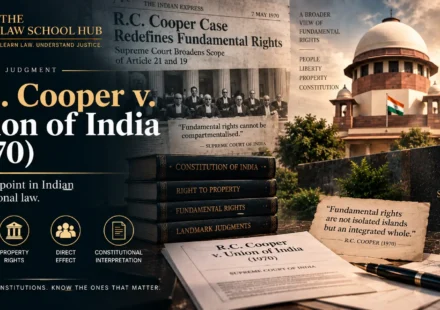
R.C. Cooper v. Union of India (1970): The Bank Nationalisation Case That Shook India’s Economic Constitution
Introduction In the history of Indian constitutional law, few judgments have shaped the relationship between state economic power and individual fundamental rights quite as dramatically as R.C.…
Know More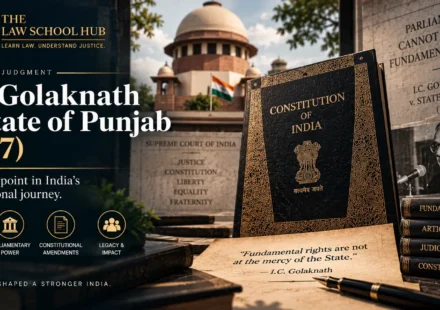
I.C. Golaknath v. State of Punjab (1967): The Historic Ruling That Said Parliament Cannot Touch Your Fundamental Rights
Introduction In the constitutional history of India, few legal battles have been as fierce as the fight between the Indian Parliament and the Supreme Court over the power to change the Constitution.…
Know More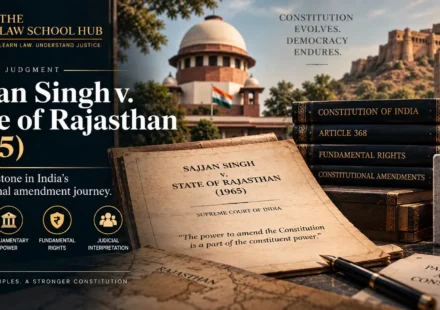
Sajjan Singh v. State of Rajasthan (1965): Parliament’s Power to Amend the Constitution — What the Supreme Court Ruled
Introduction The history of the Indian Constitution is essentially a story of a long power struggle between two great institutions: the Indian Parliament and the Supreme Court of India. The case of…
Know More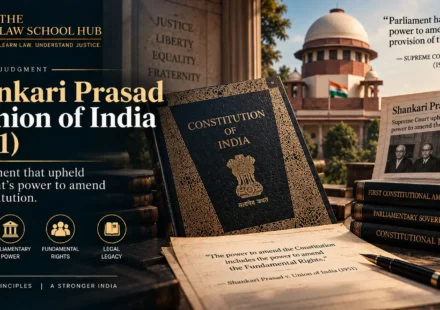
Shankari Prasad v. Union of India (1951): Can Parliament Amend Fundamental Rights? Here Is What India’s Supreme Court Said
Introduction The Indian Constitution is the supreme law of the country. But a very big question arose almost immediately after it was written: Does the Parliament have the power to change or take…
Know More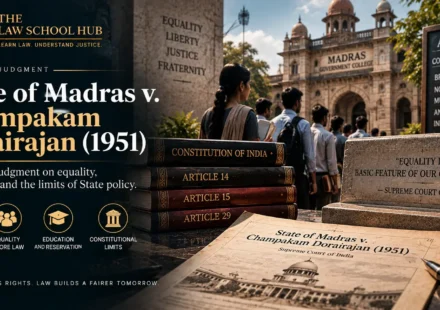
State of Madras v. Champakam Dorairajan (1951): The Landmark Case That Changed India’s Reservation Law Forever
Introduction When the Constitution of India came into force in 1950, it made two massive promises to the people. First, it promised complete equality and guaranteed that the government would not…
Know More