Table of Contents
Introduction
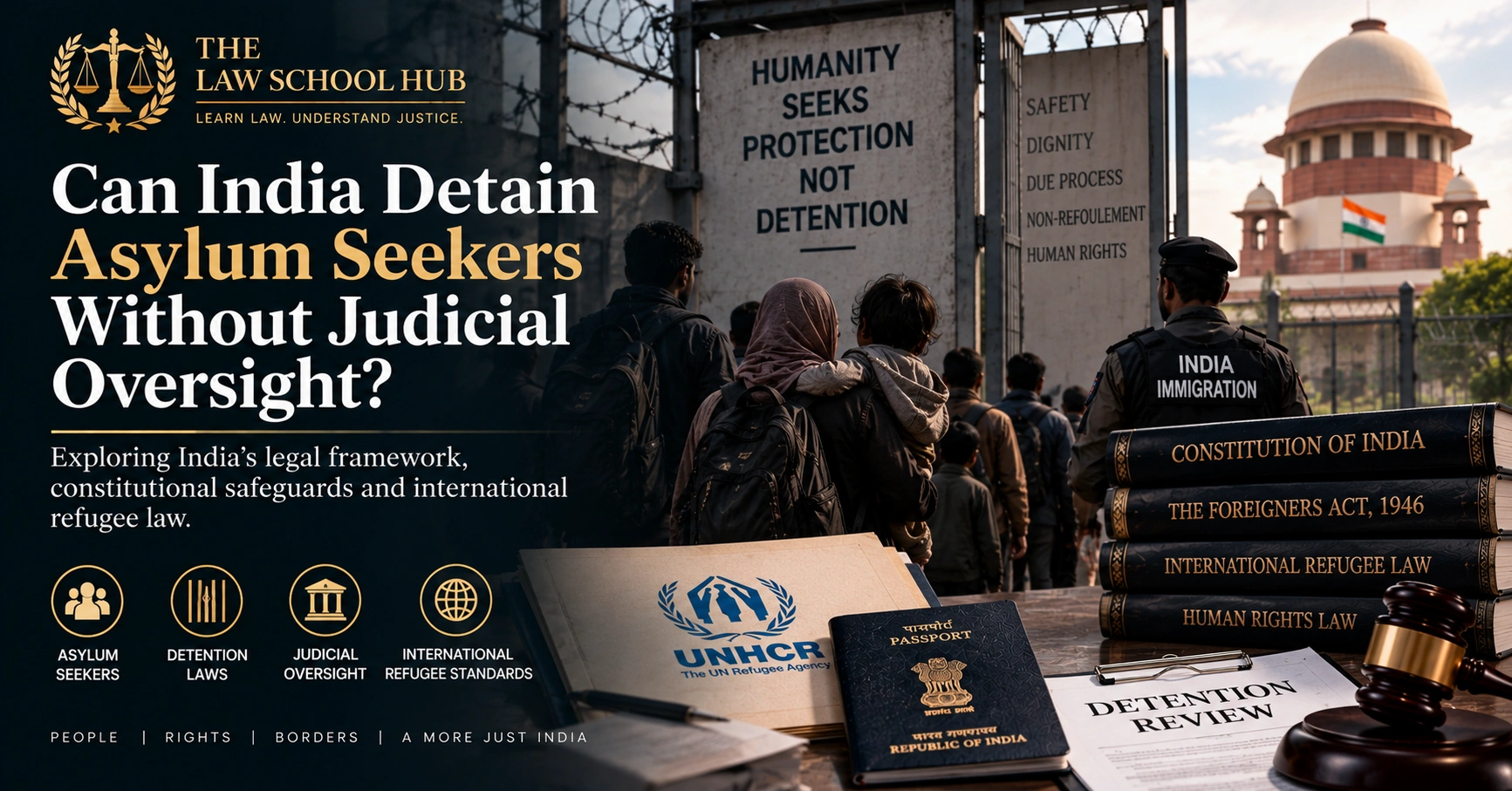
When people run away from terrible danger in their home countries, they often cross international borders searching for safety. These people are known as asylum seekers. They hope the new country will protect them. However, when an asylum seeker crosses the border into India without a valid passport or visa, they face a very strict legal reality. The Indian government frequently arrests them and places them in detention centres. The biggest legal question that human rights lawyers ask is whether the government can detain asylum seekers indefinitely without getting permission from a judge.
In a normal criminal case, the police must bring an arrested person before a local judge within twenty-four hours. This is called judicial oversight. It stops the police from locking people up unfairly. But immigration law works differently. Because India does not have a specific law for refugees, asylum seekers are simply treated as illegal foreigners. The government uses old, powerful laws to control them.
This creates a massive conflict between border security and basic human rights. Does a person running for their life lose their right to freedom? Can the government keep them in a camp forever? In this guide, we will explore exactly how the law works. We will look at the massive power of the government, the basic rights protected by the Indian Constitution, and how the highest courts in the country try to find a balance to protect human life.
Legal Information Notice
Legal information notice: This article is for general educational and informational purposes. It does not constitute legal advice or create an attorney-client relationship.
Overview of the Topic
To understand why this issue is so complicated, we must first understand the difference between criminal law and immigration law in India.
When a citizen commits a crime, the police arrest them under criminal laws. The citizen has clear rights. A judge must review the arrest. The citizen can apply for bail. However, when a foreigner enters India without papers, the government usually acts under immigration laws. The primary goal of the government is not always to punish them, but to restrict their movement and eventually deport them back to their home country.
The problem is that the home country often refuses to accept these people, or returning them would mean certain death. Because India cannot deport them, and does not want them moving freely inside the country, the government places them in holding camps. This civil detention can sometimes last for many years.
Because India never signed the famous international treaties that protect refugees, the government claims it has the total power to detain asylum seekers until they are removed. Human rights defenders argue that locking up innocent people for years without a fair trial violates the basic human right to life. The Indian legal system relies on the Constitution of India to solve this painful problem.
Detailed Explanation
To fully understand how India handles this situation, we need to break down the legal rules step by step. We must look at who these people are, what power the government holds, and how the courts try to help.
1. The Missing Refugee Law in India
The most important fact about this topic is what India does not have. India does not have a national Refugee Act. India is also not a part of the 1951 United Nations Refugee Convention.
Because there is no specific law for refugees, the Indian legal system does not officially recognise the word asylum seeker. In the eyes of Indian statutes, a person fleeing war is treated exactly the same as a person who crossed the border secretly to find a better paying job. Both are legally labelled as illegal migrants or foreigners. This lack of a specific legal category is the root cause of the detention problem.
2. The Executive Power to Detain
The government uses executive power to control foreigners. Executive power means actions taken by government officers, the police, and immigration departments, rather than decisions made by a judge in a courtroom.
Under Indian law, the Central Government has almost total control over the entry, stay, and departure of foreigners. When the border police or local police find a person without valid travel documents, they register a case. The government officer in charge, often called the Foreigners Regional Registration Officer, has the authority to order that the foreigner must not leave a specific area. This specific area is usually a guarded detention centre.
This process often happens without a formal trial. The government argues that this is not a criminal punishment, but simply a security measure to make sure the foreigner does not disappear into the local population before they can be deported.
3. What Does Judicial Oversight Mean?
Judicial oversight: means that a neutral judge looks at what the government is doing and decides if it is legal and fair.
In the context of asylum seekers, judicial oversight is not automatic. When a foreigner is put in a detention camp waiting for deportation, a magistrate does not visit the camp every week to check on them. The executive government controls the timeline. This is why many people argue that India can detain asylum seekers without oversight.
However, this is only half the truth. While the oversight is not automatic, the doors of the court are never fully closed. If a detention becomes unfair or lasts too long, the person can ask a higher court for help.
4. How Courts Exercise Their Oversight
When a foreigner is trapped in indefinite detention, their family members or human rights lawyers can approach the High Court or the Supreme Court. They usually file a specific type of legal case called a Writ of Habeas Corpus.
Habeas Corpus: is a Latin legal phrase that means to produce the body. It is an order from a judge demanding that the police bring the detained person to court and explain exactly why they are being kept in a cage.
Through these writ petitions, the Indian courts exercise their judicial oversight. The judges examine whether the government is trying to deport the person quickly, or if the government has simply forgotten about them. If the court finds that the detention is endless and unfair, the judge has the power to order the government to release the asylum seeker. Therefore, while initial detention might happen without a judge, long-term detention is always subject to judicial review if a lawyer brings the case to court.
Key Legal Provisions
To argue a case in court, lawyers rely on very specific laws. Here are the main legal rules that control how India can detain asylum seekers.
1. The Foreigners Act, 1946
What the law says: Section 3 of this Act gives the Central Government the absolute power to make orders restricting the movements of foreigners. Specifically, Section 3(2)(e) allows the government to force a foreigner to reside in a particular place, and Section 3(2)(g) allows the government to arrest and detain them.
What it means in simple English: This is the main weapon used by the government. It was written before India gained independence, originally to control foreigners during a world war. Today, the government uses these exact sections to legally justify locking asylum seekers in detention camps. The law gives the executive branch almost complete freedom to do this without asking a judge first.
2. Article 21 of the Constitution of India
What the law says: No person shall be deprived of his life or personal liberty except according to procedure established by law.
What it means in simple English: This is the most powerful right in India, and it acts as the ultimate shield for asylum seekers. The Constitution uses the word person, not citizen. This means every human being standing on Indian soil has the right to basic liberty. While the Foreigners Act gives the government the procedure to detain people, Article 21 requires that this procedure must be fair, just, and reasonable. Keeping someone locked up for five years just because their home country refuses to accept them is not considered fair by the courts.
3. Article 14 of the Constitution of India
What the law says: The State shall not deny to any person equality before the law or the equal protection of the laws within the territory of India.
What it means in simple English: Like Article 21, this right to equality belongs to all persons, including foreigners. It means the government cannot make completely arbitrary or crazy decisions. If the government decides to detain asylum seekers, it must have a logical, legal reason. The government cannot treat them worse than animals just because they lack an Indian passport.
4. The Passport (Entry into India) Act, 1920
What the law says: This law requires all persons entering India to possess a valid passport. It also gives the police the power to arrest anyone who breaks this rule without needing a warrant from a magistrate.
What it means in simple English: When a terrified family runs across the border without stopping at an official checkpoint to show a passport, they break this law instantly. This gives the local police the immediate legal right to arrest them the moment they are found inside India.
Important Case Laws
Because the written laws are very strict, we must look at how the Supreme Court and High Courts have actually decided these disputes in real life.
1. Ana Parveen v. Union of India (2022)
Facts: A foreign national was arrested and convicted for living in India without a valid visa. He served his complete prison sentence for the crime. However, after his sentence ended, his home country did not immediately take him back. Because he had nowhere to go, the Indian government kept him locked inside a detention centre for several more years. His lawyer approached the Supreme Court.
Legal Issue: Can the government continuously detain a foreigner who has already finished their legal punishment, simply because deportation is taking too long?
Court’s Reasoning: The Supreme Court relied heavily on Article 21. The judges stated that even a foreigner has the fundamental right to liberty. While the government has the right to deport him, it cannot keep him in a cage indefinitely while waiting for the paperwork to clear. Indefinite detention without a clear end date destroys human dignity.
Decision: The Supreme Court ordered that the foreigner must be released from the detention centre. The Court said he could live in a specific local area with certain reporting conditions until his deportation was finally arranged.
Importance: This is a massive victory for judicial oversight. It proves that the government’s power under the Foreigners Act is not absolute. Courts will intervene and stop the government if detention becomes endless.
2. Mohammad Salimullah v. Union of India (2021)
Facts: Thousands of Rohingya people fled massive violence in Myanmar and sought shelter in India. The Indian government considered them illegal immigrants and a potential threat to national security. The government ordered their arrest and deportation back to Myanmar. Human rights activists rushed to the Supreme Court, arguing that sending them back would mean sending them to their deaths.
Legal Issue: Does the right to life under Article 21 prevent the Indian government from deporting asylum seekers back to a dangerous country?
Court’s Reasoning: The Supreme Court took a very strict view in this case. The Court noted that India is not a part of the international refugee conventions. The Court also clearly stated that the right to reside and settle in India (under Article 19) belongs only to Indian citizens, not to foreigners. The Court gave heavy importance to the government’s claim that the massive influx of migrants was a threat to the nation.
Decision: The Supreme Court refused to stop the deportations. The Court ruled that the government could deport the asylum seekers, provided they followed the correct legal procedure.
Importance: This case shows the limits of judicial help. When the government argues strongly about national security, the courts will often allow the executive to use its strict powers under the Foreigners Act, even if human rights are at risk.
3. Nandita Haksar v. State of Manipur (2021)
Facts: After a military takeover in Myanmar, several people ran across the border into the Indian state of Manipur to save their lives. They wanted to travel to New Delhi to apply for official refugee status with the United Nations. However, they were hiding from the local police, fearing they would be detained and instantly pushed back across the border.
Legal Issue: Should the court allow fleeing people to reach the United Nations office, or should the government be allowed to arrest and push them back?
Court’s Reasoning: The High Court of Manipur showed great sympathy. The judge recognised the international principle of non-refoulement, which means you cannot push a person back into a fire. The Court ruled that protecting these people from being murdered back home was a basic constitutional duty under Article 21.
Decision: The High Court granted the asylum seekers safe passage. The Court ordered the state government not to detain them or push them back, allowing them to travel to New Delhi to seek official help.
Importance: This is a beautiful example of a court using the Indian Constitution to provide a temporary shield of protection for asylum seekers against the strict, blind power of the immigration police.
4. Dongh Lian Kham v. Union of India (2015)
Facts: A young man fleeing persecution in Myanmar was caught in India without a visa. He was thrown into a criminal jail. He had already applied for a refugee certificate from the United Nations office in India, but the police kept him locked up as an ordinary criminal.
Legal Issue: Can a genuine asylum seeker be kept in a criminal jail simply for lacking entry documents?
Court’s Reasoning: The Delhi High Court looked at the reality of the situation. The judge noted that people running for their lives do not have the time to stop and apply for proper visas. Treating them like common thieves or murderers is completely unfair.
Decision: The Court ordered the release of the asylum seeker from the criminal jail. The judge said he should be allowed to stay free while the United Nations processed his refugee application.
Importance: This case confirms that courts try to separate genuine asylum seekers from ordinary criminals, providing judicial relief from harsh executive detention.
Practical Examples and Illustrations
To see how these complicated laws apply to real people, let us look at some clear examples.
1. Example 1: The Fleeing Family
Scenario: A family escapes a sudden civil war in their home country. Their home is bombed, and their passports are burnt. They cross into an Indian border state at midnight. The border police catch them immediately. The police use the Foreigners Act to place them in a secure holding camp because they have no legal identity.
Legal Position: The initial detention by the border police is legally valid under the Foreigners Act. The police have the executive power to restrict their movement to protect the border. The government does not need a judge’s permission on the very first day to hold them in a camp.
Practical Point: To get out of the camp, the family cannot just wait. A social worker or lawyer must file a petition in the High Court, asking the judge to use Article 21 to release them based on humanitarian grounds.
2. Example 2: The Expired Visa
Scenario: A university student from a neighbouring country is studying legally in India. Suddenly, a violent revolution happens in his home country. If he returns, he will be targeted and killed. His Indian student visa expires. He overstays in India to stay alive. The local immigration police arrest him for overstaying and order his detention.
Legal Position: Even though his entry was legal, his overstay is a violation of the law. The government will label him an illegal migrant. However, because his life is in clear danger back home, pushing him back violates the basic human right to life.
Practical Point: The student must immediately approach a court and show proof of the danger in his home country. The court can stop the deportation and order the government to grant him a temporary long-term visa to save his life.
Practical Consequences / What This Means in Real Life
When India uses executive power to detain asylum seekers, the real-world results are very harsh for the people involved.
1. Families Separated: When groups cross the border, men, women, and children are sometimes separated and sent to different detention camps or jails. Because they have no money and no phones, they can lose contact with their loved ones for years.
2. Endless Waiting: Civil detention has no fixed end date. A criminal knows their sentence is three years. An asylum seeker in a detention centre does not know if they will be released tomorrow or in ten years. This uncertainty causes massive mental trauma.
3. Lack of Legal Help: If an Indian citizen is arrested for theft, the state must provide them with a free lawyer if they are poor. Foreigners in immigration detention camps often do not have access to free legal aid. Because they do not know Indian law, they cannot file the writ petitions required to get judicial oversight. They rely completely on charities to rescue them.
Important Exceptions or Limitations
While the Constitution protects the right to life, the Supreme Court has created very clear limitations on how much help an asylum seeker can get.
1. No Right to Settle: The courts have repeatedly clarified that Article 21 only protects basic life and liberty. It does not give a foreigner the right to permanently live, buy property, or settle in India. That specific right belongs only to Indian citizens under Article 19. The government always retains the ultimate power to deport them to a safe third country if possible.
2. National Security Threats: This is the biggest exception. If the intelligence agencies provide a secret report to the court saying that a specific group of asylum seekers contains terrorists or spies, the human rights arguments will fail instantly. The courts will always choose the safety of the Indian nation over the liberty of a foreigner. In such cases, the court will allow the government to detain or deport them without interference.
1. Criminal Arrest vs. Immigration Detention
| Feature | Criminal Arrest of a Citizen | Immigration Detention of an Asylum Seeker |
| Primary Law Used | Bharatiya Nagarik Suraksha Sanhita (BNSS) | The Foreigners Act, 1946 |
| Automatic Judge Review? | Yes, within 24 hours by a Magistrate. | No, the executive controls the detention. |
| Maximum Time | Fixed by the criminal sentence. | Can be indefinite while waiting for deportation. |
| How to Get Out | Apply for regular bail. | File a Writ Petition in a High Court. |
2. How Different Rights Apply
| Constitutional Right | Does it apply to Asylum Seekers? | What does it mean? |
| Article 21 (Life and Liberty) | Yes, applies to all persons. | They cannot be tortured or held in endless, unfair detention. |
| Article 14 (Equality) | Yes, applies to all persons. | The government must have a logical reason for its actions. |
| Article 19 (Right to Reside) | No, strictly for citizens only. | They cannot demand permanent settlement in India. |
Key Takeaways
- No Refugee Law: India has no specific laws for asylum seekers, meaning they are treated legally as illegal foreigners.
- Executive Control: Under the Foreigners Act, the government has massive power to restrict movement and place foreigners in detention centres.
- No Automatic Oversight: Unlike a criminal arrest, immigration detention does not require automatic, immediate approval from a local magistrate.
- The Power of Article 21: The Supreme Court uses Article 21 to ensure that even foreigners are treated with basic human dignity and are not locked up forever.
- Habeas Corpus: The primary way judicial oversight happens is when lawyers file writ petitions in higher courts demanding the release of detained asylum seekers.
- National Security First: If the government proves a threat to the nation, courts will generally step back and allow the government to detain or deport the foreigners.
Conclusion
The question of whether India can detain asylum seekers without judicial oversight does not have a simple yes or no answer. It is a mix of strong government power and careful court intervention.
On paper, the Foreigners Act gives the Indian executive branch the immense, almost absolute power to arrest, detain, and restrict the movement of anyone who is not a citizen. The government does not need to ask a judge before placing an undocumented foreigner into a border camp. However, this power is not a blank cheque. India is a constitutional democracy. The Supreme Court of India has firmly ruled that the fundamental right to life and liberty under Article 21 belongs to every human being, regardless of their passport.
While the initial detention might bypass a judge, indefinite or cruel detention will always trigger judicial oversight if brought to the attention of a High Court. Through writ petitions, Indian judges act as the final safety net, ensuring that people fleeing war are not treated worse than criminals. Until India decides to create a modern, specific legal framework for refugees, this delicate balancing act between strict border police and sympathetic judges will continue to decide the fate of thousands of vulnerable people.
FAQs
1. Can the government detain an asylum seeker forever without a trial? Answer: No, while the government can detain them initially to prepare for deportation, the Supreme Court has ruled that keeping a person in a detention centre indefinitely violates their fundamental right to life under Article 21.
2. Do asylum seekers have to be presented to a magistrate within 24 hours? Answer: No, because immigration detention under the Foreigners Act is generally treated as an executive civil action to restrict movement, not a standard criminal arrest that requires immediate magistrate oversight.
3. Does India follow the international rule against sending people back to danger? Answer: Even though India never signed the international refugee treaties, Indian courts often stop the government from pushing people back to a violent country by using the constitutional right to life as a shield.
4. How can a detained asylum seeker ask a judge for help? Answer: Because there is no automatic review, their friends or a human rights lawyer must file a Writ of Habeas Corpus in the High Court or Supreme Court to demand their release from the camp.
5. Can an asylum seeker demand the right to live and work in India permanently? Answer: No, the Supreme Court has clearly stated that the constitutional right to permanently reside and settle anywhere in India is strictly reserved for Indian citizens, not foreigners.
6. Will the court always release an asylum seeker from detention? Answer: No, if the government provides evidence that the detained person or their group is a threat to India’s national security, the court will usually refuse to release them.
Legal References
- The Constitution of India, 1950, Article 14, Article 19, and Article 21.
- The Foreigners Act, 1946, Section 3.
- The Citizenship Act, 1955, Section 2(1)(b).
- The Passport (Entry into India) Act, 1920.
- Supreme Court of India: Ana Parveen v. Union of India, W.P. (Crl.) No. 182 of 2022.
- Supreme Court of India: Mohammad Salimullah v. Union of India, I.A. No. 38048 of 2021 in W.P. (C) No. 793 of 2017.
- Supreme Court of India: National Human Rights Commission v. State of Arunachal Pradesh, (1996) 1 SCC 742.
- High Court of Manipur: Nandita Haksar v. State of Manipur, W.P. (Crl.) No. 6 of 2021.
- High Court of Delhi: Dongh Lian Kham v. Union of India, 226 (2016) DLT 208.
At The Law School Hub, we simplify case laws, legal acts, and legal concepts for law students and legal readers. Want to read more useful legal blogs? Visit The Law School Hub.
Building a community around law, learning, and legal awareness through The Law School Hub.
I’m Yash Yogitta Joshi. Join me on LinkedIn → Click to view my Profile