R.C. Cooper v. Union of India (1970): The Bank Nationalisation Case That Shook India’s Economic Constitution

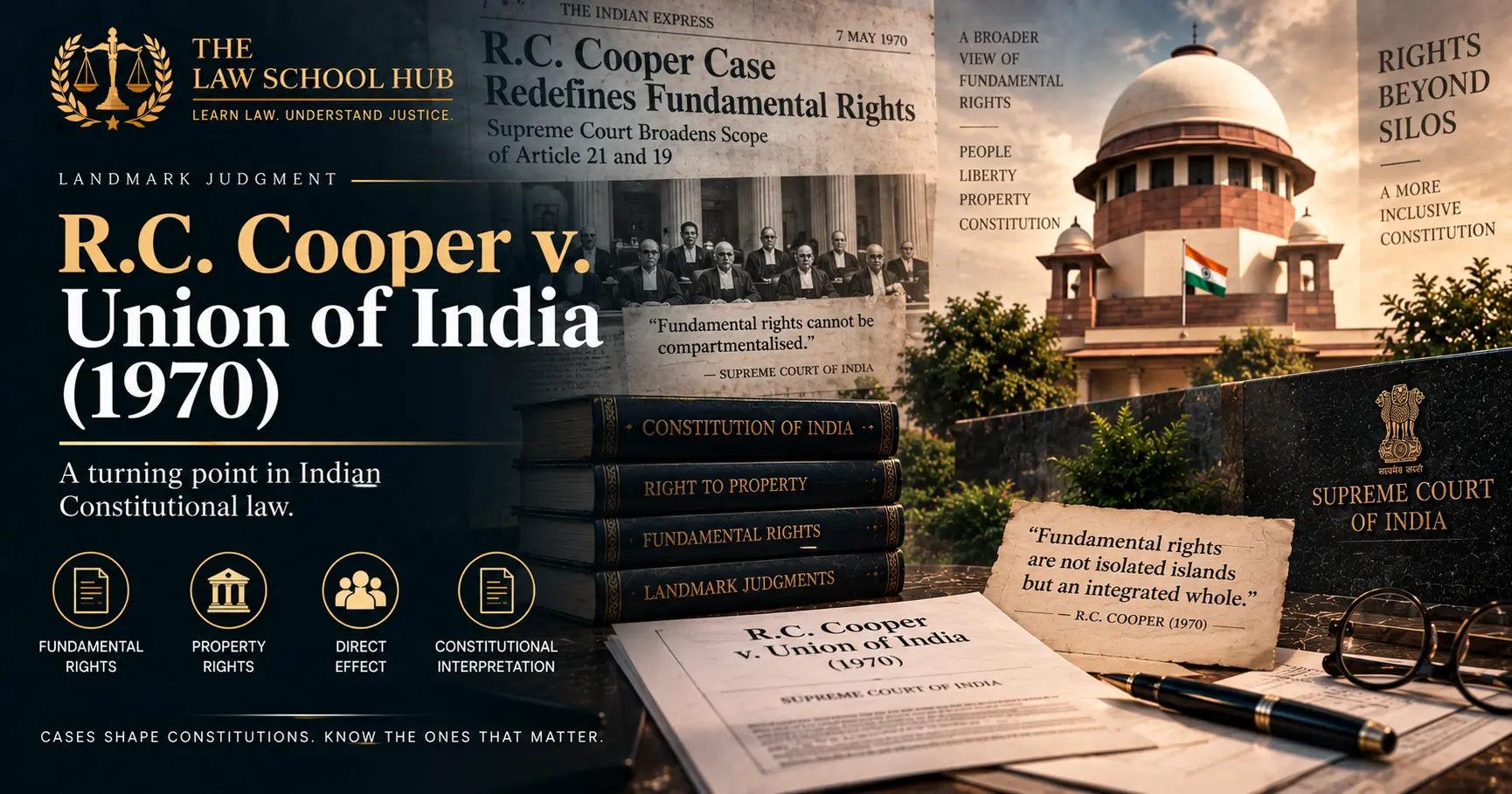
Table of Contents
Introduction
In the history of Indian constitutional law, few judgments have shaped the relationship between state economic power and individual fundamental rights quite as dramatically as R.C. Cooper v. Union of India. Decided in 1970 by an 11-judge bench of the Supreme Court of India, this landmark dispute is widely known as the Bank Nationalisation case. The central question before the Court was whether the Indian Parliament could pass a law taking over major commercial banks to serve public economic goals, and how that takeover affected the fundamental rights of shareholders and bank owners.
The dispute arose when the Central Government, led by Prime Minister Indira Gandhi, rushed through an ordinance and subsequently an Act to nationalise 14 of India’s largest commercial banks. The government argued that concentrating banking power in private hands was harming the poor and that state control was necessary to direct funds toward agriculture and small industries. Rustom Cavasjee Cooper, a prominent shareholder, director, and account holder in one of the affected banks, challenged the law, arguing that it violated his fundamental rights to equality, property, and freedom to carry on trade.
In a resounding 10:1 majority decision, the Supreme Court struck down key parts of the nationalisation statute while affirming the government’s general power to nationalise industries. Crucially, the Court dismantled the old legal theory that different fundamental rights operated in separate, airtight compartments. The judges ruled that a law affecting property or business must be tested against multiple fundamental rights simultaneously, including the right to equality under Article 14 and the right to compensation under Article 31. This decision enraged the political leadership, setting off a fierce constitutional battle between the judiciary and the executive that would soon lead to sweeping constitutional amendments.
Legal information notice: This case summary is for general educational and informational purposes. It does not constitute legal advice or create an attorney-client relationship.
Last legally reviewed: September 2026
Case Details
| Detail | Information |
| Case Name | Rustom Cavasjee Cooper v. Union of India |
| Court | Supreme Court of India |
| Year | 1970 (Judgment delivered on February 10, 1970) |
| Bench/Judges | 11-Judge Constitution Bench: Chief Justice M. Hidayatullah, Justice J.C. Shah, Justice K.S. Hegde, Justice A.N. Grover, Justice A.N. Ray, Justice P. Jagamohan Reddy, Justice I.D. Dua, Justice G.K. Mitter, Justice K.K. Mathew, Justice S.M. Sikri, Justice R.S. Bachawat |
| Legal Area | Constitutional Law, Fundamental Rights, Corporate Rights, State Nationalisation |
| Main Issue | Whether the Banking Companies (Acquisition and Transfer of Undertakings) Act, 1969, violated the fundamental rights of bank shareholders and directors under Articles 14, 19, and 31. |
| Final Decision | The Supreme Court struck down the nationalisation statute for hostile discrimination and failing to provide adequate compensation, while recognizing the government’s sovereign authority to nationalise trade and commerce. |
| Important Legal Principle | The interconnectedness of fundamental rights (rejecting the isolated compartments theory) and the requirement of fair compensation for state acquisition of property. |
Background
To understand the intense political and economic drama behind the R.C. Cooper case, we must look at the economic philosophy of India during the late 1960s.
The Socialist Push and Economic Stagnation
Following independence, India adopted a mixed economy with a strong emphasis on socialist planning. By the late 1960s, the ruling Congress Party faced severe economic challenges, including widespread poverty, agricultural droughts, and industrial stagnation. The political leadership believed that the country’s financial wealth was trapped in private hands. Major commercial banks were controlled by large industrial business houses, and critics argued that these banks lent money almost exclusively to big corporations while ignoring poor farmers and small-scale business owners.
Prime Minister Indira Gandhi decided that radical state intervention was necessary. She wanted the government to take direct control of the banking sector so that public savings could be channeled into priority sectors like farming and rural development.
The Legislative Route and the Ordinance Drama
In July 1969, just days before Parliament was scheduled to convene, President V.V. Giri promulgated an ordinance titled the Banking Companies (Acquisition and Transfer of Undertakings) Ordinance, 1969. This emergency order instantly transferred the ownership, assets, and management of 14 of India’s largest commercial banks—each holding deposits exceeding 50 crores of rupees—to newly formed government companies.
Within weeks, Parliament replaced the ordinance by passing the Banking Companies (Acquisition and Transfer of Undertakings) Act, 1969. The statute effectively locked the private banks out of the banking business, allowing them to exist only as non-banking companies, while forbidding them from ever using the word “bank” in their names again.
Facts of the Case
Rustom Cavasjee Cooper was a multi-faceted personality. He was a well-known chartered accountant, a shareholder, a director, and a depositor in several of the targeted commercial banks, including the Central Bank of India and the Bank of Baroda. He was also a taxpayer and an active participant in public life.
Deeply concerned by the sudden government takeover, Cooper decided to challenge the constitutional validity of both the presidential ordinance and the subsequent 1969 Act. He filed a writ petition directly in the Supreme Court of India under Article 32 of the Constitution.
Cooper argued that the law directly harmed him as an individual and as a shareholder. He pointed out that the government takeover destroyed the value of his shares, deprived him of his voting rights as a director, and stripped him of his professional income as an advisor to those financial institutions. Furthermore, he argued that the compensation mechanism set up by the government was completely arbitrary and failed to pay the true market value of the seized properties.
Simultaneously, a few other petitions were filed in the Supreme Court challenging the nationalisation, including one by Balram Mehta and another by the Bank of Baroda itself. The Supreme Court clubbed these matters together and assigned the case to a massive 11-judge Constitution Bench.
Issues Before the Court
The 11-judge bench had to resolve several complex and interrelated constitutional questions:
- Whether a shareholder or director has the legal standing to challenge a law that takes over the property and business of a company in which they hold shares.
- Whether the Banking Companies Act of 1969 violated the fundamental right to equality guaranteed under Article 14 by singling out certain banks while exempting foreign banks and smaller domestic banks.
- Whether the law violated the fundamental freedoms guaranteed under Article 19, including the right to practice any profession or carry on any occupation, trade, or business.
- Whether the law violated Article 31 by failing to provide “compensation” for the acquired property.
- Whether Parliament had the legislative competence under the Constitution to pass such a sweeping nationalisation law.
Arguments by the Parties
What the Petitioners Argued
The legal team representing Rustom Cavasjee Cooper argued that the Indian Constitution was designed to protect private citizens from arbitrary state power.
They submitted that the state cannot bypass fundamental rights simply by claiming it is pursuing a socialist economic goal. They argued that when the government takes over a bank, it destroys the shareholder’s property—namely, the shares and dividends. Therefore, the shareholder has every right to knock on the doors of the Supreme Court under Article 32.
On the issue of equality, the petitioners pointed out that the law was discriminatory. It targeted 14 specific Indian banks while leaving foreign banks operating in India and smaller Indian banks completely untouched. They argued this created an uneven playing field.
Furthermore, they argued that the compensation offered by the government was an illusion. The statute used rigid and arbitrary formulas that ignored the actual market value of the buildings, goodwill, and assets of the banks, violating the clear constitutional mandate of Article 31, which required fair compensation for acquired property.
What the Respondents Argued
The Union of India, represented by top government law officers, strongly defended the nationalisation statute.
The government argued that the primary purpose of the law was to serve the public good by reducing economic inequality and ensuring that public savings reached rural areas and agricultural sectors. They argued that banking is a public utility service, and the state has an absolute sovereign right to regulate or nationalise trade and commerce to build a socialist society.
On the technical issue of standing, the government argued that a company is a distinct legal person separate from its shareholders. They maintained that if a company’s property is taken away, only the company can sue, not an individual shareholder or director.
Finally, the government argued that matters of economic policy and the adequacy of compensation are legislative decisions best left to elected representatives in Parliament, and courts should not interfere with executive economic planning.
Judgment of the Court
On February 10, 1970, the Supreme Court delivered a landmark judgment. By a massive 10:1 majority (with only Justice A.N. Ray dissenting), the Court ruled in favour of the petitioners and struck down key portions of the Bank Nationalisation Act.
What the Court Decided: Shareholder Standing
First, the Court rejected the government’s technical objection regarding shareholder standing. The bench held that when the state impairs the rights of a company, it often directly impairs the rights of the shareholders and directors. Therefore, a shareholder can maintain a writ petition if the state action infringes upon their fundamental rights alongside the company’s rights.
What the Court Decided: The Interconnectedness of Fundamental Rights
The most significant intellectual breakthrough of the judgment was the rejection of the “mutually exclusive” theory of fundamental rights. In earlier cases, the Supreme Court had held that each fundamental right stood in a separate compartment. For example, if a law dealt with property, it could only be tested under Article 31, and a petitioner could not invoke Article 19 or Article 14.
The R.C. Cooper bench completely overruled this narrow view. The Court held that fundamental rights are not separate, watertight compartments. A single state action can violate multiple fundamental rights at the same time. A law acquiring property must respect the right to equality under Article 14, the freedom to carry on trade under Article 19, and the compensation rules under Article 31.
What the Court Decided: Striking Down the Statute
The Court struck down the Banking Companies Act of 1969 on two main substantive grounds:
- Hostile Discrimination: The law was found to violate Article 14 because it prohibited the 14 nationalised banks from carrying on any banking business while allowing other Indian and foreign banks to continue operating freely. The Court ruled this classification was arbitrary and hostile.
- Illusory Compensation: The Court held that Article 31 mandated that when private property is acquired by the state, the owner must be paid “compensation”—which the Court interpreted to mean the true equivalent value of the property in money. Because the statutory formulas failed to account for the real value of the assets and goodwill, the compensation was illusory and unconstitutional.
What the Court Did Not Decide
Crucially, the Court did not say that the government has no power to nationalise industries. The majority explicitly acknowledged that the state possesses the sovereign authority to nationalise trade, commerce, and industry to achieve social and economic welfare. The Court’s objection was not to the goal of nationalisation, but to the discriminatory and unfair method by which it was executed.
Ratio Decidendi
Ratio decidendi means the core legal reasoning and rule necessary for the Court to reach its decision.
The primary ratio decidendi of the R.C. Cooper case is twofold:
First, fundamental rights under the Constitution are overlapping and cumulative, not mutually exclusive. A legislative measure or executive action that deprives a person of property or business must be tested for its validity against all relevant fundamental rights guarantees—such as Articles 14, 19, and 31—simultaneously.
Second, where the state acquires private property under statutory authority, the law must provide for true compensation that represents the equivalent value of the property. Compensation cannot be arbitrary, illusory, or insulated from judicial review by legislative fiat.
Legal Principles Explained
The R.C. Cooper judgment rests on several foundational constitutional doctrines that redefined Indian jurisprudence.
The Rejection of the Compartment Theory
Before 1970, the Supreme Court in cases like A.K. Gopalan v. State of Madras (1950) had adopted a literal approach, ruling that each fundamental right dealt with a specific subject. If a law deprived someone of personal liberty under a preventive detention act, the Court looked only at Article 21 and refused to test it against the freedoms in Article 19.
The R.C. Cooper case shattered this approach. The 11-judge bench established that fundamental rights protect the citizen’s freedoms comprehensively. If a law restricts a citizen’s freedom to carry on a business by taking away their property, the Court must examine whether that law respects both the freedom to trade (Article 19) and the right to property (Article 31). This principle paved the way for future expansive interpretations of fundamental rights, most notably in the Maneka Gandhi v. Union of India (1978) case.
Corporate Rights and Shareholder Protection
The judgment established that artificial corporate entities and the human beings who invest in them are entitled to constitutional protection. While a company is legally separate from its shareholders, the state cannot hide behind corporate structures to violate the constitutional rights of the individuals who own and run the business.
Current Legal Status
While the R.C. Cooper case remains a monumental milestone in constitutional law, its specific holdings regarding property rights and compensation are now historical.
The right to property was fundamentally altered shortly after this judgment. Infuriated by the Supreme Court’s rulings in R.C. Cooper and the Kesavananda Bharati case, Parliament passed the 44th Constitutional Amendment Act in 1978. This amendment deleted the Right to Property as a Fundamental Right under Article 31 and Article 19(1)(f), moving it to a ordinary constitutional right under Article 300A. Furthermore, the word “compensation” in Article 31 was replaced with the word “amount” in various land acquisition contexts to prevent courts from striking down economic laws on the grounds of inadequate compensation.
Therefore, while the doctrine of interconnected fundamental rights remains excellent and active law, the specific property and compensation holdings must be read in their historical 1970 context.
Current legal position verified as of September 2026.
Subsequent Legal Developments
The R.C. Cooper judgment triggered an immediate and intense political backlash, leading to massive constitutional changes.
The 25th Constitutional Amendment (1971)
To directly overcome the Supreme Court’s ruling on “compensation,” Indira Gandhi’s government rushed through the 25th Constitutional Amendment in 1971. This amendment replaced the word “compensation” in Article 31(2) with the word “amount.” It explicitly stated that the law could fix an “amount” to be paid for acquired property, and no court could question whether that amount was adequate compensation. This was a direct legislative strike at the heart of the R.C. Cooper ruling.
The Bank Nationalisation (Second) Act (1970)
Undeterred by the Supreme Court striking down the 1969 Act, the government immediately enacted a new law—the Banking Companies (Acquisition and Transfer of Undertakings) Act, 1970—designed to cure the technical defects identified by the Court. This new Act removed the discriminatory clauses against the 14 banks and re-established the nationalisation framework legally, which the banks no longer challenged.
Maneka Gandhi v. Union of India (1978)
The expansive philosophy of R.C. Cooper—treating fundamental rights as an interconnected web rather than isolated silos—was fully embraced and magnified by a 7-judge bench in Maneka Gandhi v. Union of India (1978). In that case, the Supreme Court formally welded Articles 14, 19, and 21 together, creating the modern “golden triangle” of Indian fundamental rights jurisprudence.
Importance of the Case
The importance of R.C. Cooper v. Union of India spans constitutional theory, economic history, and institutional power dynamics.
For constitutional scholars, the case represents the moment the Supreme Court firmly asserted its role as the ultimate guardian of fundamental rights against aggressive executive overreach. It destroyed the mechanical reading of the Constitution and introduced a holistic, rights-conscious method of interpretation.
For law students, it is an essential textbook case for understanding the doctrine of shareholder standing, the evolution of fundamental rights, and the historic tension between Directive Principles of State Policy (socialist welfare) and Fundamental Rights (individual protections).
For the Indian banking sector, the case marked the definitive turning point toward state-dominated banking, a structure that defined India’s financial landscape for the next three decades until economic liberalisation began in 1991.
Critical Analysis
While the R.C. Cooper judgment is celebrated for expanding civil liberties and protecting fundamental rights, it was subject to severe contemporary criticism by political leaders and socialist legal scholars.
At the time, the ruling government argued that the Supreme Court was acting as a conservative roadblock, protecting the interests of elite capitalists and wealthy industrialists at the expense of millions of impoverished citizens who desperately needed banking reform. Critics pointed out that by insisting on market-value compensation and striking down nationalisation, the judiciary was effectively tying the hands of an elected government trying to alleviate poverty.
Legal analysts also note the institutional fallout. The judgment deeply embittered Prime Minister Indira Gandhi, leading directly to the supersession of senior Supreme Court judges, the appointment of a more pliable Chief Justice, and the stormy constitutional confrontations of the mid-1970s.
However, looking back with historical perspective, The Law School Hub analysis suggests that the Court’s core legal reasoning was sound. The Court did not ban nationalisation; it insisted that even when the state pursues noble socialist goals, it must follow constitutional rules, respect equality, and operate within the framework of law rather than through arbitrary executive decrees.
Illustrations and Examples
To clearly understand how the principles established in R.C. Cooper operate in practice, consider these practical scenarios.
Hypothetical Example 1: The Multi-Right Violation
Scenario: A state government passes an emergency law taking over all private printing presses to print government textbooks, explicitly forbidding those specific presses from ever engaging in commercial printing again while allowing other printing companies to operate freely.
Legal Position: Under the ruling in R.C. Cooper, the affected printing press owners can challenge the law simultaneously under Article 14 (for arbitrary and discriminatory treatment compared to other presses) and Article 19(1)(g) (for violating their freedom to carry on their own trade). The state cannot defend the law by claiming that property and trade rights are in separate compartments.
Practical Point: Modern constitutional law requires courts to test state economic actions against all relevant fundamental rights simultaneously, ensuring the government cannot bypass equality protections through narrow statutory categorization.
Hypothetical Example 2: Shareholder Standing in Corporate Takeovers
Scenario: The central government nationalises a major private aviation company, canceling its operating licenses and transferring its aircraft to a state-run airline. A major institutional shareholder holding 30% of the company’s shares files a writ petition claiming financial destruction.
Legal Position: Following the R.C. Cooper doctrine, the shareholder has the legal standing to challenge the state action because the direct destruction of the company’s assets severely impairs the shareholder’s proprietary and voting rights.
Practical Point: The state cannot claim immunity from shareholder lawsuits simply because the primary target of the acquisition was the corporate entity rather than the individual investor.
Hypothetical Example 3: Economic Policy and Judicial Review
Scenario: Parliament passes a regulatory tax law adjusting corporate tax rates from 25% to 35% for all manufacturing companies to boost government welfare funds. A corporation challenges the tax in court, claiming it violates their fundamental rights.
Legal Position: The Supreme Court will dismiss the challenge. As clarified in R.C. Cooper, while the Court protects fundamental rights against arbitrary state takeover and discrimination, it does not act as a super-legislature to interfere with general economic policy, taxation rates, or regulatory governance.
Practical Point: There is a clear legal boundary between unconstitutional property deprivation or hostile discrimination, and ordinary, valid economic regulation by the state.
Key Takeaways
| Key Point | Explanation |
| Main Issue | Did the Bank Nationalisation Act violate the fundamental rights of shareholders and property owners? |
| Holding | Yes. The Court struck down the statute for hostile discrimination and failing to provide fair compensation. |
| Ratio Decidendi | Fundamental rights are interconnected; state action must be tested against multiple rights simultaneously, and property acquisition requires real compensation. |
| Important Doctrine | Rejection of the “mutually exclusive” compartments theory of fundamental rights. |
| Later Development | Parliament responded by passing the 25th Constitutional Amendment and later the 44th Amendment, which removed the Right to Property as a fundamental right. |
| Current Position | The property compensation rules are historical, but the doctrine of interconnected fundamental rights remains foundational today. |
| Practical Significance | It established the Supreme Court’s power to review economic legislation and safeguard constitutional rights against arbitrary state actions. |
Conclusion
The Supreme Court’s judgment in R.C. Cooper v. Union of India (1970) stands as a watershed moment in the constitutional history of independent India. Faced with a powerful executive attempting rapid socialist transformation through a sweeping banking takeover, an 11-judge bench drew a firm constitutional line.
By ruling that fundamental rights are cumulative and interconnected, and that state acquisition of private assets requires fair compensation and non-discriminatory treatment, the Court protected individual liberties from executive overreach. Although the political fallout led to massive constitutional amendments—including the eventual removal of the right to property as a fundamental right—the core jurisprudential philosophy of R.C. Cooper endures. It permanently shaped how Indian courts review state economic power, ensuring that even when the government acts in the name of social welfare, it remains bound by the rule of law.
FAQs
- What was the primary purpose of the Bank Nationalisation case?
Answer: The case challenged the constitutional validity of the Banking Companies (Acquisition and Transfer of Undertakings) Act, 1969, through which the government seized control of 14 major commercial banks in India.
- Did the Supreme Court ban the government from nationalising banks?
Answer: No. The Supreme Court explicitly recognized that the state has the sovereign right to nationalise trade and commerce to achieve social welfare goals. It struck down the law because of hostile discrimination and inadequate compensation mechanisms, not because nationalisation itself was illegal.
- What is the “mutually exclusive” theory of fundamental rights?
Answer: It was an older legal theory which held that each fundamental right operated in a separate, airtight compartment (for example, a property law could only be tested under property provisions). The R.C. Cooper case completely rejected this theory, establishing that state actions must be tested against multiple fundamental rights simultaneously.
- Who was Rustom Cavasjee Cooper?
Answer: Rustom Cavasjee Cooper was a prominent chartered accountant, shareholder, director, and account holder in several affected commercial banks who filed a historic writ petition in the Supreme Court challenging the bank nationalisation ordinance and Act.
- How did the government react to this judgment?
Answer:
The government was deeply angered by the ruling. It responded by enacting a revised nationalisation statute (the 1970 Act) and passing the 25th Constitutional Amendment in 1971, which replaced the word “compensation” with “amount” to strip courts of the power to review compensation adequacy.
- Is the Right to Property still a fundamental right today?
Answer: No. Following the political battles of the 1970s, Parliament passed the 44th Constitutional Amendment in 1978, which removed the Right to Property from the chapter on Fundamental Rights and placed it under Article 300A as an ordinary constitutional right.
- How many judges heard the R.C. Cooper case?
Answer: The case was heard by a massive 11-judge Constitution Bench of the Supreme Court of India, resulting in a 10:1 majority decision.
- What connection does this case have with the Maneka Gandhi case?
Answer: The holistic, interconnected approach to fundamental rights established in R.C. Cooper directly laid the intellectual foundation for the famous 7-judge bench ruling in Maneka Gandhi v. Union of India (1978), which formally welded Articles 14, 19, and 21 together.
- Can a shareholder challenge the nationalisation of their company?
Answer: Yes. One of the key procedural holdings of R.C. Cooper was that a shareholder or director has the legal standing to challenge state action against a company if that action directly impairs their own fundamental and proprietary rights.
- Why is this case often called the Bank Nationalisation case?
Answer: Because it directly challenged the central government’s legislative action nationalising 14 of India’s largest commercial banks in July and August of 1969.
Legal References
- Rustom Cavasjee Cooper v. Union of India, (1970) 1 SCC 248 — Supreme Court of India
- A.K. Gopalan v. State of Madras, AIR 1950 SC 27 — Supreme Court of India
- Maneka Gandhi v. Union of India, (1978) 1 SCC 248 — Supreme Court of India
- Constitution of India, Articles 14, 19, and 31 — Legislative Department, Government of India
- The Banking Companies (Acquisition and Transfer of Undertakings) Act, 1969 — Ministry of Finance, Government of India
- The Constitution (Twenty-Fifth Amendment) Act, 1971 — Government of India
- The Constitution (Forty-Fourth Amendment) Act, 1978 — Government of India
At The Law School Hub, we simplify case laws, legal acts, and legal concepts for law students and legal readers. Want to read more useful legal blogs? Visit The Law School Hub The Law School Hub for more such informational blogs.
Building a community around law, learning, and legal awareness through The Law School Hub.
I’m Yash Yogitta Joshi. Join me on LinkedIn → Click to view my Profile