Kesavananda Bharati v. State of Kerala (1973): The Most Important Constitutional Case India Has Ever Seen

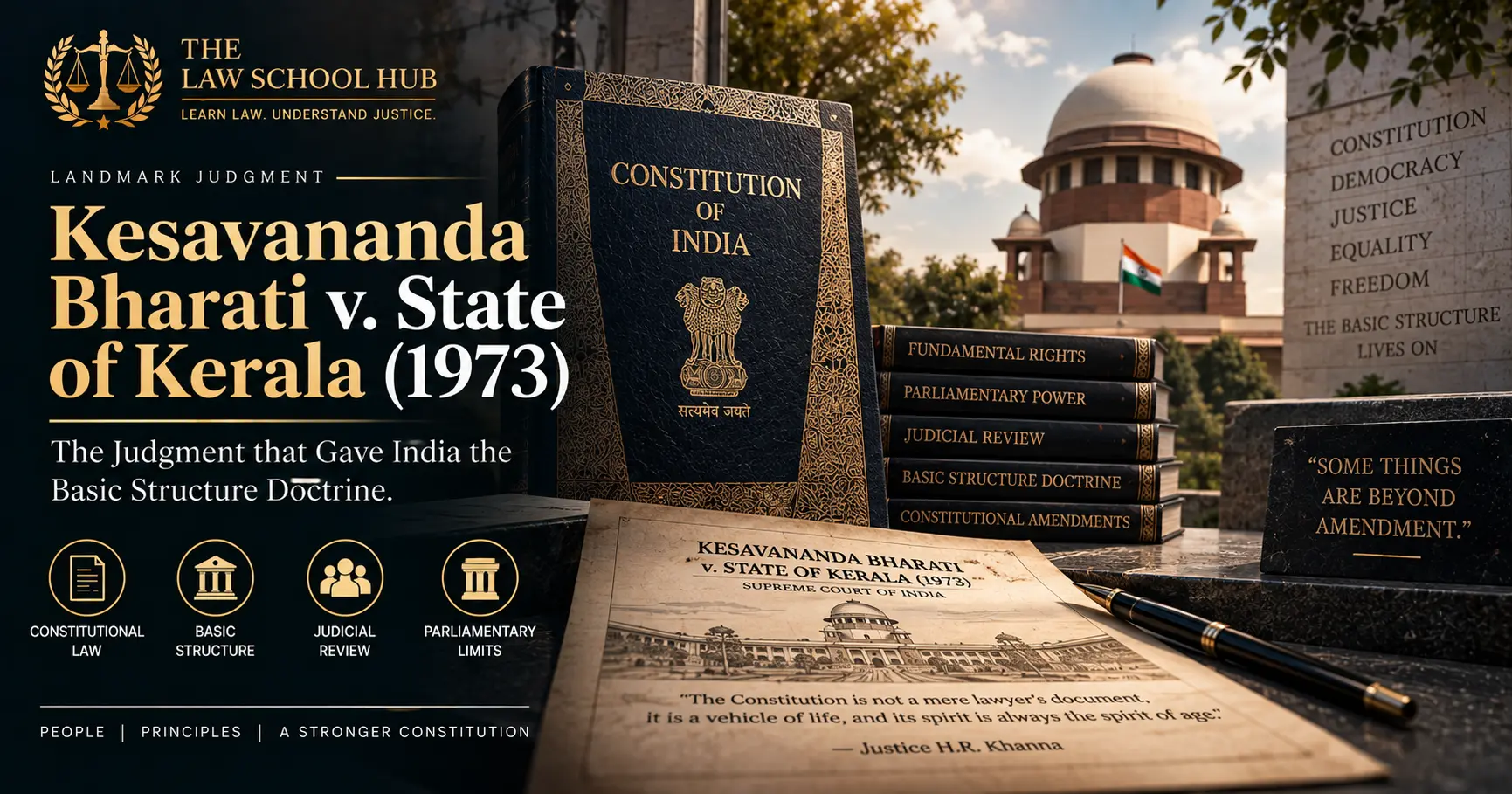
Table of Contents
Introduction
In the history of global constitutional law, very few judicial decisions have actually saved a democracy. The case of His Holiness Kesavananda Bharati Sripadagalvaru v. State of Kerala is widely celebrated as the most important legal judgment in India’s history. Decided in 1973 by the largest bench ever formed in the Supreme Court of India, this case tackled the ultimate question of political power: Can the government use its majority in Parliament to rewrite the entire Constitution and take away the fundamental rights of the citizens?
The dispute began over a religious leader’s property rights in Kerala, but it rapidly transformed into a massive constitutional war between the Supreme Court and the Central Government. The government argued that Parliament was supreme and could amend or destroy any part of the Constitution.
In a razor-thin 7:6 majority decision, the Supreme Court ruled that while Parliament has vast powers to amend the Constitution, it does not have the power to destroy its “Basic Structure.” The Court declared that certain fundamental features—like democracy, the rule of law, secularism, and judicial review—are the very soul of the Constitution. Parliament cannot touch them. This judgment established the Basic Structure Doctrine, creating a permanent legal shield that continues to protect the Indian democratic republic today.
Legal information notice: This case summary is for general educational and informational purposes. It does not constitute legal advice or create an attorney-client relationship.
Last legally reviewed: September 2026
Case Details
| Detail | Information |
| Case Name | His Holiness Kesavananda Bharati Sripadagalvaru and Ors. v. State of Kerala and Anr. |
| Court | Supreme Court of India |
| Year | 1973 (Judgment delivered on April 24, 1973) |
| Bench/Judges | 13-Judge Constitution Bench: Chief Justice S.M. Sikri, Justice J.M. Shelat, Justice K.S. Hegde, Justice A.N. Grover, Justice B. Jaganmohan Reddy, Justice D.G. Palekar, Justice H.R. Khanna, Justice A.K. Mukherjea, Justice Y.V. Chandrachud, Justice A.N. Ray, Justice K.K. Mathew, Justice M.H. Beg, Justice S.N. Dwivedi |
| Legal Area | Constitutional Law, Amending Power, Fundamental Rights |
| Main Issue | What is the extent of Parliament’s power to amend the Constitution under Article 368? Can Parliament amend Fundamental Rights? |
| Final Decision | Parliament can amend any part of the Constitution, including Fundamental Rights, provided that the amendment does not alter or destroy the “Basic Structure” of the Constitution. |
| Important Legal Principle | The Basic Structure Doctrine, which limits the amending power of the Parliament and preserves the core identity of the Constitution. |
Background
To understand why this case required a 13-judge bench and a hearing that lasted 68 days, we must look at the intense power struggle between the Indian Parliament and the Supreme Court that occurred in the late 1960s and early 1970s.
The Early Years and Property Rights
When the Indian Constitution was adopted in 1950, it guaranteed the Right to Property as a Fundamental Right under Article 19(1)(f) and Article 31. However, the newly formed Indian government wanted to bring about massive social and economic changes. They wanted to take large amounts of land from wealthy landlords and distribute it to poor farmers.
When the government passed laws to take over this land, the landlords went to the courts. The courts frequently struck down these land reform laws because they violated the fundamental right to property. To bypass the courts, India’s first Prime Minister, Jawaharlal Nehru, introduced the First Constitutional Amendment in 1951. This amendment created the “Ninth Schedule.” Any law placed inside this special Ninth Schedule was legally protected and could not be challenged in court, even if it violated fundamental rights.
In early cases like Shankari Prasad (1951) and Sajjan Singh (1965), the Supreme Court sided with the government. The Court ruled that Parliament had the absolute power to amend the Constitution, including the power to take away fundamental rights.
The Golaknath Earthquake (1967)
Everything changed in 1967 with the famous case of I.C. Golaknath v. State of Punjab. An 11-judge bench of the Supreme Court completely reversed its earlier decisions. The Court ruled that Fundamental Rights are sacred and untouchable. They declared that Parliament has absolutely no power to amend or take away any Fundamental Right.
This judgment infuriated the political leadership. The government felt that the Supreme Court was stopping them from helping the poor and creating an equal society.
The Clash with Indira Gandhi’s Government
By the early 1970s, Prime Minister Indira Gandhi was in power. She attempted to pass aggressive socialist policies, including nationalising major private banks and taking away the traditional pensions (privy purses) of former royal kings.
The Supreme Court struck down both of these actions in the Bank Nationalisation case (1970) and the Privy Purses case (1970). The government felt the judiciary was acting as a roadblock to progress.
In response, Indira Gandhi called for national elections, asking the public for a massive majority to change the Constitution. She won a landslide victory. Armed with this massive power in Parliament, her government passed a series of aggressive Constitutional Amendments between 1971 and 1972:
- The 24th Amendment: This directly attacked the Golaknath judgment. It changed Article 13 and Article 368 to explicitly state that Parliament has the power to amend any part of the Constitution, including Fundamental Rights, and the President is forced to sign the amendment.
- The 25th Amendment: This severely restricted the right to property. It allowed the government to acquire private property for an amount determined by the government, which the courts could not question. Most dangerously, it inserted a new Article 31C. This article said that if the government passes a law to achieve certain social goals, that law cannot be challenged even if it violates the fundamental rights to equality (Article 14) or freedom (Article 19). Furthermore, it stated that if the government simply declares that the law is for social goals, no court can even look at it.
- The 29th Amendment: This amendment placed two land reform laws passed by the State of Kerala into the protective Ninth Schedule, meaning no one could challenge them in court.
This was the explosive political and legal environment when a quiet religious monk from Kerala decided to go to court.
Facts of the Case
Swami Kesavananda Bharati was the head (pontiff) of the Edneer Mutt, a Hindu religious institution located in the Kasaragod district of Kerala. The Mutt owned large areas of agricultural land, which provided the income needed to run the institution and conduct its religious and charitable activities.
The State Government of Kerala passed the Kerala Land Reforms Act, 1963. Under this Act, the government began taking over the lands owned by the Edneer Mutt.
In February 1970, Kesavananda Bharati filed a writ petition directly in the Supreme Court of India under Article 32 of the Constitution. He argued that the Kerala government’s actions violated his fundamental rights. He specifically relied on Article 25 (Right to practice and propagate religion), Article 26 (Right to manage religious affairs and own property for religious purposes), and Article 31 (Right to property).
While his case was still pending in the Supreme Court, the central government passed the 24th, 25th, and 29th Constitutional Amendments. The 29th Amendment specifically took the Kerala Land Reforms Act (the very law Kesavananda Bharati was fighting against) and placed it inside the protective Ninth Schedule.
Realising that his original case was now blocked by these new constitutional amendments, Kesavananda Bharati’s lawyer, the legendary Nani Palkhivala, changed the strategy. He requested the Court’s permission to amend the petition.
The case was no longer just about a religious leader losing a piece of land in Kerala. It became a direct legal attack challenging the constitutional validity of the 24th, 25th, and 29th Amendments.
Because this case involved the correctness of the 11-judge decision in Golaknath, the Supreme Court had to form a larger bench. Chief Justice S.M. Sikri formed a bench of 13 judges—the largest in the history of the Supreme Court—to settle the issue of Parliament’s amending power once and for all.
Issues Before the Court
The 13-judge bench had to decide several monumental constitutional questions:
- Was the Golaknath judgment (which stated Parliament cannot amend Fundamental Rights) correct?
- What is the true scope and limit of Parliament’s power to amend the Constitution under Article 368?
- Is the 24th Constitutional Amendment (which gave Parliament unlimited amending power) legally valid?
- Is the 25th Constitutional Amendment (which restricted property rights and tried to prevent courts from reviewing certain laws) legally valid?
- Is the 29th Constitutional Amendment (which protected the Kerala land laws) legally valid?
Arguments by the Parties
The hearing lasted for a record-breaking 68 working days. The arguments presented by both sides represent some of the highest levels of legal philosophy ever discussed in an Indian courtroom.
What the Petitioners Argued (Nani Palkhivala)
Nani Palkhivala, leading the legal team for Kesavananda Bharati, argued brilliantly for the protection of human freedoms.
His main argument was based on the concept of “implied limitations.” He argued that while Article 368 gives Parliament the power to amend the Constitution, the word “amend” means to improve or adjust, not to destroy. You can amend a document, but you cannot replace it with a completely different document.
He argued that the Constitution of India has a core identity. If Parliament uses its amending power to turn a democracy into a dictatorship, or a secular state into a religious state, that is not an “amendment”—that is a destruction of the Constitution.
Palkhivala famously argued that Parliament is merely a “creature” of the Constitution. The Constitution is the master. A creature cannot have the absolute power to destroy its own master. Therefore, even though there are no explicit words in Article 368 stopping Parliament, there are implied, invisible boundaries that Parliament cannot cross.
What the Respondents Argued (State of Kerala and Union of India)
The government was represented by Attorney General Niren De and the legendary constitutional lawyer H.M. Seervai. They strongly defended the absolute power of Parliament.
They argued that the Constitution does not contain any “implied limitations.” Article 368 is a complete code, and it gives Parliament unlimited, absolute power to amend, change, or remove any part of the Constitution, including fundamental rights.
They argued that Parliament represents the will of the people. If the people, through their elected representatives, decide that fundamental rights (like the right to property) are standing in the way of removing poverty and helping the nation progress, Parliament must have the power to change those rights.
The government warned that if the Supreme Court tried to invent invisible boundaries to stop Parliament, it would be undemocratic. They argued that the Court would become a “super-legislature,” blocking the will of the millions of poor citizens who needed urgent social reforms.
Judgment of the Court
On April 24, 1973, the last working day before Chief Justice S.M. Sikri retired, the Supreme Court delivered its judgment. The judgment was massive, spanning hundreds of pages, with 11 separate opinions written by the judges.
The Court was deeply divided, resulting in a 7:6 majority decision.
What the Court Decided: Overruling Golaknath
First, the entire bench unanimously overruled the 1967 Golaknath judgment. The Court agreed with the government that the Golaknath ruling was too strict. The Court held that Parliament absolutely has the power to amend Fundamental Rights. Fundamental Rights are not entirely untouchable.
What the Court Decided: The Amending Power
The crucial split happened on the limit of the amending power.
Six judges (led by Chief Justice Sikri) agreed completely with Nani Palkhivala. They held that Parliament’s amending power is limited and cannot destroy the core framework of the Constitution.
Six other judges (led by Justice A.N. Ray) agreed completely with the government. They held that Parliament has unlimited power to amend the Constitution, and there are no boundaries.
The tie-breaking vote was cast by Justice H.R. Khanna. He agreed with the government that property rights could be amended. However, he agreed with Chief Justice Sikri’s group on the main constitutional principle. Justice Khanna ruled that while the power to amend is extremely broad, it does not include the power to alter the “Basic Structure” or framework of the Constitution.
Combining Justice Khanna’s vote with the first six judges created a 7:6 majority.
What the Court Did Not Decide (List of Basic Features)
The majority did not provide a final, closed list of what exactly the “Basic Structure” is. Different judges gave different examples. Some of the features mentioned by the majority judges as forming the basic structure included:
- Supremacy of the Constitution
- Republican and Democratic form of government
- Secular character of the Constitution
- Separation of powers between the legislature, executive, and judiciary
- Federal character of the Constitution
The Court decided that the basic structure would be identified on a case-by-case basis in the future.
Validity of the Amendments
The 24th Amendment: The Court upheld this amendment as valid. Parliament does have the power to amend any part of the Constitution, subject to the basic structure test.
The 25th Amendment: The Court upheld the first part of this amendment, allowing the government to restrict property rights. However, the Court struck down the second part (the new Article 31C clause). The Court ruled that Parliament cannot pass a law and tell the judges they are not allowed to look at it. Judicial review is a core part of the Constitution, and Parliament cannot take away the Court’s power to check if a law is valid.
The 29th Amendment: The Court upheld this amendment, meaning the Kerala Land Reforms Act remained in the Ninth Schedule.
Ironically, because the Court upheld the land reform laws, Swami Kesavananda Bharati actually lost his personal property dispute. However, he won the greatest constitutional victory for the citizens of India.
Ratio Decidendi
The ratio decidendi is the legal rule that is binding on all future courts. Because there were 11 different opinions, finding the exact ratio was complex, but it boils down to the specific legal boundary drawn by the majority.
The ratio decidendi of this case is that the power to amend the Constitution under Article 368 is broad, but it does not include the power to alter, destroy, or abrogate the basic structure or framework of the Constitution.
The Court drew a legal distinction between “ordinary legislative power” and “constituent power.” While Parliament uses constituent power to amend the Constitution, it cannot use that power to rewrite a completely new Constitution or destroy its foundational identity. The survival of the Constitution’s core identity is the ultimate legal limit on political power.
Furthermore, the case established the ratio that judicial review is an integral part of the basic structure. Parliament cannot use a constitutional amendment to entirely block the Supreme Court from reviewing the legality of laws.
Legal Principles Explained
The Kesavananda Bharati judgment requires a clear understanding of several complex constitutional principles.
The Basic Structure Doctrine
Before 1973, constitutional law around the world generally believed that if a parliament had the required majority (like a two-thirds vote), it could legally change anything. This case invented a new legal philosophy.
The Basic Structure Doctrine says that a Constitution is like a house. The Parliament has the power to repaint the walls, change the windows, or build a new room. This is the amending power. However, Parliament does not have the power to destroy the foundation or tear down the main pillars that hold the house together. If you destroy the pillars, the house collapses, and it is no longer the same house.
In India, democracy, equality, secularism, and the independence of the courts are those foundational pillars.
Difference Between Constituent and Legislative Power
The Court clearly explained the difference between two types of power. When Parliament makes ordinary laws (like the Motor Vehicles Act or the Indian Penal Code), it exercises “legislative power.”
When Parliament amends the Constitution, it exercises a much higher power called “constituent power.” The government argued that constituent power is supreme and has no limits. The Supreme Court clarified that while constituent power is higher than legislative power, it is still subject to the Constitution itself. The Constitution is supreme, not the Parliament.
Judicial Review
Judicial review is the power of the courts to examine the actions of the government and Parliament to ensure they follow the Constitution.
By striking down the portion of the 25th Amendment that tried to stop courts from reviewing certain laws, the Supreme Court declared that judicial review is non-negotiable. Without judicial review, the Constitution is just a piece of paper, because the government could break the rules with no one to stop them.
Current Legal Status
The Basic Structure Doctrine created in this case is the supreme, unquestionable law of India today. It is currently the most powerful tool the Supreme Court possesses. Every constitutional amendment passed by Parliament today is automatically subject to the basic structure test. If an amendment damages the basic structure, the Supreme Court will strike it down as unconstitutional.
Current legal position verified as of September 2026.
Subsequent Legal Developments
The birth of the Basic Structure Doctrine was followed by a massive political war, leading to several critical subsequent developments.
Indira Nehru Gandhi v. Raj Narain (1975)
Just two years after Kesavananda, Prime Minister Indira Gandhi was found guilty of election misconduct by the Allahabad High Court. To save her job, Parliament passed the 39th Constitutional Amendment, which stated that the Prime Minister’s election could never be challenged in any court.
The Supreme Court used the Kesavananda Bharati Basic Structure Doctrine for the very first time to strike down this amendment. The Court ruled that “free and fair elections” and “equality” are part of the basic structure, and Parliament cannot destroy them to protect one person.
The 42nd Amendment (1976)
During the national Emergency, Indira Gandhi’s government attempted to permanently destroy the Basic Structure Doctrine. They passed the massive 42nd Amendment, which added a new clause to Article 368 stating that Parliament’s amending power is absolute and there can be no limitation on it whatsoever.
Minerva Mills Ltd. v. Union of India (1980)
When the 42nd Amendment was challenged, the Supreme Court in Minerva Mills struck down the government’s attempt to give itself unlimited power. The Court ruled that Parliament’s limited amending power is itself a basic feature of the Constitution. A limited power cannot be used to enlarge itself into an absolute power. This judgment permanently cemented the Basic Structure Doctrine into Indian law.
I.R. Coelho v. State of Tamil Nadu (2007)
For decades, the government continued to use the Ninth Schedule to hide laws from judicial review. In the I.R. Coelho case, a 9-judge bench ruled that the Ninth Schedule cannot be used as a black hole to destroy fundamental rights. The Court held that any law put into the Ninth Schedule after April 24, 1973 (the exact date of the Kesavananda Bharati judgment) is fully open to judicial review and will be struck down if it violates the basic structure.
Importance of the Case
It is impossible to overstate the importance of this case. It is the bedrock of modern Indian democracy.
For the nation, this case prevented India from legally sliding into a dictatorship. If the Supreme Court had accepted the government’s argument that Parliament has unlimited amending power, the government during the 1975 Emergency could have legally passed a constitutional amendment declaring that elections were permanently cancelled and Indira Gandhi was Prime Minister for life. The Basic Structure Doctrine was the only legal shield that prevented this.
For constitutional scholars globally, Kesavananda Bharati represents a unique innovation. Unlike the USA or the UK, India found a middle path. It allowed the Constitution to be flexible and change with the times, but it protected the core human values from the temporary passions of powerful politicians.
For law students and lawyers, this case is the ultimate textbook on constitutional interpretation. It teaches that laws cannot be read merely by looking at the dictionary meaning of words (like the word “amend”). Laws must be interpreted by looking at the history, the philosophy, and the ultimate purpose of the document.
Critical Analysis
While Kesavananda Bharati is worshipped today, it was highly controversial at the time and is still subject to academic debate.
The most famous controversy surrounding the judgment is how the ratio decidendi was actually recorded. Because the 11 opinions were thousands of pages long and very complicated to read, Chief Justice Sikri prepared a short “Summary of Findings” document on the day of the judgment. This one-page summary clearly stated that Article 368 does not enable Parliament to alter the basic structure.
However, only 9 out of the 13 judges signed this summary. Four of the dissenting judges (including Justice Ray, who supported the government) refused to sign it, arguing it was an inaccurate summary of the complex opinions. Despite this drama, the “Summary of Findings” became accepted as the binding law of the land.
The political backlash was immediate and brutal. Just hours after the judgment was delivered, the government broke decades of tradition. They punished three senior judges who had ruled against the government (Shelat, Grover, and Hegde) by skipping over them and appointing Justice A.N. Ray (who had ruled in favour of the government) as the new Chief Justice of India. This move severely damaged the independence of the judiciary for years.
Academically, some constitutional experts criticize the Basic Structure Doctrine as being too vague. Critics point out that the Constitution does not define what the “basic structure” is. This gives unelected judges the subjective power to strike down laws passed by the elected representatives of millions of people simply by claiming it violates a “basic feature.” They argue this allows judicial overreach, where judges act like politicians.
However, The Law School Hub notes that time has proven the defenders of the doctrine correct. Over the last fifty years, the Supreme Court has used the doctrine very carefully. It has not used it to stop normal economic or social policies. It has only used it in extreme cases to stop governments from destroying judicial independence or manipulating elections. The doctrine successfully created a balance of power where Parliament makes the laws, but the Constitution remains the ultimate master.
Illustrations and Examples
To clearly understand how the Basic Structure Doctrine operates in practice, consider these practical scenarios.
Hypothetical Example 1: Altering the Democratic Framework
Scenario: A political party wins 90% of the seats in the Lok Sabha. They decide that holding elections every five years is too expensive. They pass a Constitutional Amendment stating that the current Parliament will remain in power for the next 25 years without any elections.
Legal Position: Under the strict rule of the Kesavananda Bharati case, the Supreme Court will immediately strike down this Constitutional Amendment as legally void.
Practical Point: Even though the political party had the required two-thirds majority to pass an amendment, “democracy” and “free elections” are core pillars of the Basic Structure. Parliament cannot use its amending power to destroy democracy.
Hypothetical Example 2: The Republic and the Monarchy
Scenario: Parliament passes a Constitutional Amendment declaring that the office of the President of India is abolished, and India will now be ruled by a King, establishing a permanent royal family.
Legal Position: The Supreme Court will strike down this amendment.
Practical Point: The Preamble of the Constitution declares India to be a “Republic” (where the head of state is elected, not hereditary). The republican character is a foundational pillar. Parliament’s power to “amend” does not include the power to convert a Republic into a Monarchy.
Hypothetical Example 3: Changing Ordinary Economic Policies
Scenario: The government wants to increase the tax on corporate profits from 20% to 40%. They pass a law to do this. A rich corporation challenges the law in the Supreme Court, claiming that taking their money damages the “basic structure” of their business.
Legal Position: The Supreme Court will dismiss the corporation’s case and uphold the tax law.
Practical Point: The Basic Structure Doctrine only applies to Constitutional Amendments that destroy fundamental democratic features. It does not apply to ordinary economic laws, tax rates, or commercial regulations. The right to property or business profits is not part of the basic structure.
Key Takeaways
| Key Point | Explanation |
| Main Issue | Does Parliament have absolute power to amend any part of the Constitution? |
| Holding | No. Parliament has broad powers, but it cannot alter or destroy the Basic Structure of the Constitution. |
| Ratio Decidendi | The word “amend” in Article 368 implies preserving the original identity of the document. Constituent power is not the power to destroy. |
| Important Doctrine | The Basic Structure Doctrine was created in this case. |
| Later Development | In Minerva Mills (1980), the Court stopped Parliament’s attempt to overturn this ruling, locking the doctrine into permanent law. |
| Current Position | The judgment is the supreme law of India. Every constitutional amendment must pass the basic structure test. |
| Practical Significance | It established judicial review over constitutional amendments and permanently saved India from parliamentary dictatorship. |
Conclusion
The Supreme Court’s judgment in Kesavananda Bharati v. State of Kerala is the defining moment of Indian constitutional law. Faced with an incredibly powerful government that demanded absolute authority, a divided Supreme Court managed to forge a brilliant legal compromise.
By overruling Golaknath, the Court allowed the government the flexibility it needed to pass socio-economic reforms and amend fundamental rights. However, by establishing the Basic Structure Doctrine, the Court drew an invisible line in the sand that no politician can ever cross. The principal legal rule established is that Parliament is a creature of the Constitution, and its amending power cannot be used to destroy the democratic, secular, and republican identity of its master.
Today, fifty years later, this judgment stands as a monumental shield. It guarantees that regardless of how massive a majority any future government commands in Parliament, the foundational freedoms of the Indian Republic remain safe, protected by the independent power of judicial review.
FAQs
- What is the Basic Structure Doctrine?
Answer: The Basic Structure Doctrine is a legal rule created by the Supreme Court in 1973. It states that the Parliament can amend the Constitution, but it cannot destroy its core, foundational features (like democracy, secularism, and judicial independence).
- Did Kesavananda Bharati win his personal property case?
Answer: No, he actually lost his personal case. The Supreme Court upheld the 29th Amendment, which meant the Kerala land reform laws that took away his Mutt’s property were legally valid. However, his case created the law that saved the entire Constitution.
- How many judges heard this case?
Answer: The case was heard by a 13-judge Constitution Bench. This is the largest bench ever formed in the history of the Supreme Court of India.
- What was the final vote count among the judges?
Answer: The judgment was decided by an extremely narrow margin of 7 to 6. Seven judges voted in favour of creating the Basic Structure Doctrine, while six judges voted against it, arguing Parliament should have unlimited power.
- Who was the crucial “swing vote” in the judgment?
Answer: Justice H.R. Khanna is widely considered the crucial swing vote. He agreed with the government that property rights could be amended, but he agreed with the other six majority judges that the basic framework of the Constitution cannot be destroyed.
- Why did the government amend the Constitution before this case?
Answer: The government passed the 24th, 25th, and 29th Amendments to bypass earlier Supreme Court judgments (like Golaknath) which had stopped the government from changing fundamental rights and implementing socialist economic policies.
- Is the Right to Property part of the basic structure?
Answer: No, the Supreme Court specifically clarified that the right to own property is not a part of the basic structure of the Constitution. This allowed the government to proceed with land reforms.
- Where is the list of “Basic Structure” features written in the Constitution?
Answer: The Constitution itself does not mention the term “Basic Structure,” nor does it provide a list. It is a judicially created doctrine, and the Supreme Court identifies basic features on a case-by-case basis.
- Can the Parliament pass a new law today to overturn this judgment?
Answer: No. During the Emergency, Parliament tried to overturn this judgment by passing the 42nd Amendment, but the Supreme Court struck that attempt down in the Minerva Mills case. The doctrine is now permanently cemented in Indian law.
- Why is Nani Palkhivala famous for this case?
Answer: Nani Palkhivala was the lead lawyer for Kesavananda Bharati. His brilliant oral arguments over several months convinced the Court that the Constitution has “implied limitations,” successfully preventing the government from acquiring absolute, dictatorial power.
Legal References
- Kesavananda Bharati v. State of Kerala, (1973) 4 SCC 225 — Supreme Court of India
- I.C. Golaknath v. State of Punjab, AIR 1967 SC 1643 — Supreme Court of India
- Minerva Mills Ltd. v. Union of India, (1980) 3 SCC 625 — Supreme Court of India
- Indira Nehru Gandhi v. Raj Narain, 1975 Supp SCC 1 — Supreme Court of India
- I.R. Coelho v. State of Tamil Nadu, (2007) 2 SCC 1 — Supreme Court of India
- Constitution of India, Article 368 — Legislative Department, Government of India
- The Constitution (Twenty-Fourth Amendment) Act, 1971 — Government of India
- The Constitution (Twenty-Fifth Amendment) Act, 1971 — Government of India
- The Constitution (Twenty-Ninth Amendment) Act, 1972 — Government of India
At The Law School Hub, we simplify case laws, legal acts, and legal concepts for law students and legal readers. Want to read more useful legal blogs? Visit The Law School Hub The Law School Hub for more such informational blogs.
Building a community around law, learning, and legal awareness through The Law School Hub.
I’m Yash Yogitta Joshi. Join me on LinkedIn → Click to view my Profile