Indira Nehru Gandhi v. Raj Narain (1975): Free Elections, the Emergency, and How the Basic Structure Doctrine Saved Indian Democracy

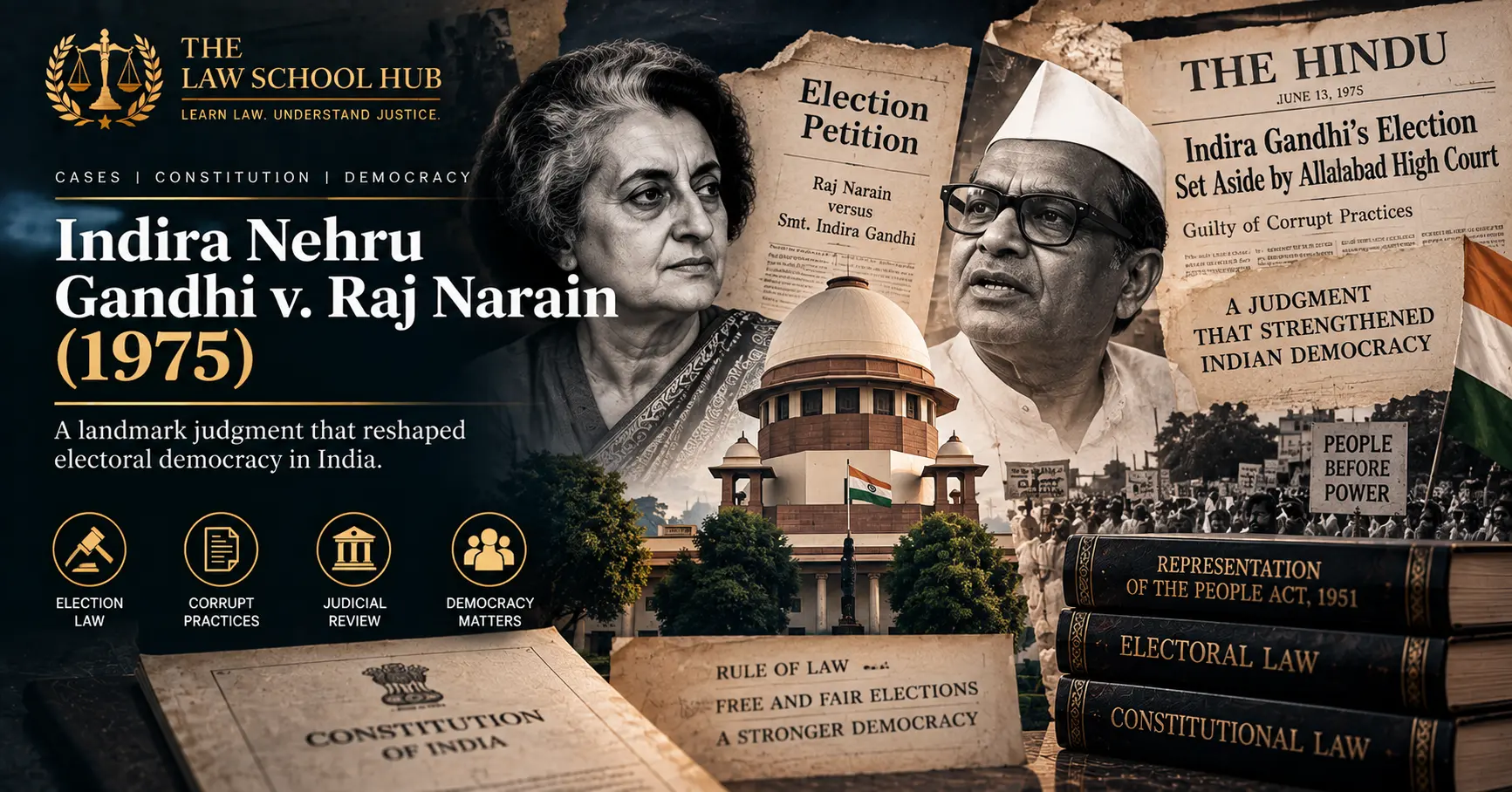
Table of Contents
Introduction
In the history of any democracy, there are rare moments when a single court case decides the fate of the entire nation. The case of Indira Nehru Gandhi v. Raj Narain is perhaps the most dramatic and important legal battle ever fought in India. It is a story of political rivalry, a shocking court conviction, a national state of Emergency, and a desperate attempt to rewrite the Constitution to save one person’s job.
Decided by the Supreme Court of India in 1975, this case asked a fundamental question: Can the Parliament change the Constitution to place the Prime Minister above the law? When Prime Minister Indira Gandhi was found guilty of election misconduct by a lower court, her government passed the 39th Constitutional Amendment. This amendment essentially wiped out her court case and declared that her election could never be challenged before any judge. The Supreme Court had to decide if this extreme use of government power was legal.
In a historic judgment, the Supreme Court struck down this constitutional amendment. The Court boldly declared that free and fair elections, the rule of law, and the separation of powers are part of the “basic structure” of the Indian Constitution. No government, no matter how powerful, can destroy these fundamental pillars. This case proved that in India, the Constitution is supreme, and no single person—not even the Prime Minister—is above the law.
Legal information notice: This case summary is for general educational and informational purposes. It does not constitute legal advice or create an attorney-client relationship.
Last legally reviewed: September 2026
Case Details Table
| Detail | Information |
|---|---|
| Case Name | Smt. Indira Nehru Gandhi v. Shri Raj Narain and Anr. |
| Court | Supreme Court of India |
| Year | 1975 (Judgment delivered on November 7, 1975) |
| Bench/Judges | Chief Justice A.N. Ray, Justice H.R. Khanna, Justice K.K. Mathew, Justice M.H. Beg, Justice Y.V. Chandrachud |
| Legal Area | Constitutional Law, Election Law, Basic Structure Doctrine |
| Main Issue | Whether Clause (4) of Article 329A, inserted by the 39th Amendment to protect the Prime Minister’s election from judicial review, violated the Basic Structure of the Constitution. |
| Final Decision | The Court struck down Clause (4) of Article 329A as unconstitutional. However, the Court upheld Indira Gandhi’s election based on separate, retrospective changes made to ordinary election laws. |
| Important Legal Principle | Free and fair elections, the rule of law, and the separation of powers are essential parts of the Basic Structure of the Constitution and cannot be destroyed by a constitutional amendment. |
Background
To understand this massive legal earthquake, we must look at the political background of the early 1970s and the rules that govern Indian elections.
In 1971, India held its general elections for the Lok Sabha (the lower house of Parliament). Prime Minister Indira Gandhi was riding a massive wave of popularity with her famous “Garibi Hatao” (Eradicate Poverty) campaign. She contested the election from the Rae Bareli constituency in Uttar Pradesh. Her main political opponent in that constituency was a fierce socialist leader named Raj Narain.
Indira Gandhi won the election by a huge margin. However, Raj Narain refused to accept defeat. Under Indian law, if a candidate cheats or uses illegal methods to win an election, their victory can be challenged in a High Court through an “election petition.”
Raj Narain filed an election petition before the Allahabad High Court. He accused Indira Gandhi of committing several “corrupt practices” under the Representation of the People Act, 1951. This is the main law that creates the rules for how elections must be fought in India. He alleged that she used government officers to help her campaign, used state police to build stages for her speeches, and spent more money than the law allowed.
For four years, the trial continued in the Allahabad High Court. Indira Gandhi even became the first sitting Prime Minister of India to appear in a courtroom and give evidence in the witness box.
Then, on June 12, 1975, Justice Jagmohanlal Sinha of the Allahabad High Court delivered a bombshell judgment. He found Indira Gandhi guilty of two corrupt practices. Because she was found guilty, the judge declared her 1971 election completely void (invalid). Even worse, under the election law, she was disqualified from holding any elected office for six years. This meant she legally had to step down as Prime Minister.
The country was stunned. Indira Gandhi immediately appealed to the Supreme Court. The Supreme Court was on summer vacation, so a “vacation judge” (Justice V.R. Krishna Iyer) heard her urgent request. He gave a conditional order: she could remain the Prime Minister and speak in Parliament, but she could not vote in Parliament until the full Supreme Court heard her final appeal.
Facing immense political pressure and calls for her resignation from across the country, Indira Gandhi’s government took drastic action. On June 25, 1975, the President of India, acting on her advice, declared a national state of Emergency. Opposition leaders, including Raj Narain, were arrested and thrown into prison. Press censorship was imposed.
While the opposition was in jail, the government quickly passed new laws and constitutional amendments to ensure Indira Gandhi would win her Supreme Court case. The most important of these was the Constitution (Thirty-Ninth Amendment) Act, 1975. This is the background that set the stage for the most important constitutional battle in Indian history.
Facts of the Case
The legal facts of this case are divided into two parts: what happened during the election, and what the government did after the Allahabad High Court judgment.
The Election Misconduct
During the Allahabad High Court trial, Raj Narain successfully proved two specific facts against Indira Gandhi:
First, she used the services of a government officer named Yashpal Kapoor. Kapoor was a Gazetted Officer in the Government of India. He worked as her election agent. The law strictly forbids candidates from taking election help from government servants. Indira Gandhi claimed he had resigned before helping her, but the court found that he started doing election work for her before his resignation was officially accepted.
Second, she used the Uttar Pradesh state government machinery. State police and officials arranged loudspeakers, built high rostrums (stages), and provided electricity for her election rallies. The High Court ruled this was a corrupt practice because she was using her power as Prime Minister to use state resources for her personal political campaign.
The Government’s Response
When the case reached the Supreme Court in August 1975, the government had already changed the rules of the game. They did two very important things:
- Changing the Ordinary Law: The government passed the Election Laws (Amendment) Act, 1975. This law changed the definitions of “corrupt practices” in the Representation of the People Act. More importantly, they made these changes “retrospective.” This means the new rules applied backwards in time. The new law specifically stated that the resignation of a government officer is valid from the date it is submitted (saving Yashpal Kapoor), and that arrangements made by state police for the Prime Minister’s security do not count as election help. By passing this law, Parliament effectively erased the specific crimes Indira Gandhi was convicted of.
- Changing the Constitution: Just to be absolutely safe, the government passed the 39th Constitutional Amendment. This amendment inserted a new Article 329A into the Constitution. Clause (4) of Article 329A was the most dangerous part. It stated that the election of the Prime Minister and the Speaker of the Lok Sabha can never be questioned in any court of law. It explicitly stated that any pending court cases (like Indira Gandhi’s appeal in the Supreme Court) were immediately closed, and any previous court judgments (like the Allahabad High Court order) were completely legally void.
When the Supreme Court finally sat to hear the appeal, they were not just looking at election facts. They were looking at a constitutional amendment that told the Supreme Court: “You have no power to hear this case anymore. The Prime Minister is innocent by constitutional command.”
Issues Before the Court
The five-judge Constitution Bench of the Supreme Court had to decide several massive legal and constitutional questions:
- Whether Clause (4) of Article 329A of the Constitution (inserted by the 39th Amendment) was legally valid, or whether it destroyed the “Basic Structure” of the Constitution.
- Whether a constitutional amendment can be used to decide a specific, individual election dispute and declare a winner, thereby taking away the judicial power of the courts.
- Whether the retrospective changes made to the ordinary election laws (the Representation of the People Act) were valid.
- Whether the Parliament session that passed these laws was legally valid, considering that many opposition Members of Parliament had been illegally arrested and locked in jail during the Emergency.
Arguments by the Parties
What the Respondent Argued (Raj Narain)
Raj Narain’s case was argued by the brilliant lawyer Shanti Bhushan. He launched a massive attack on the 39th Amendment.
His primary argument was based on the “Basic Structure Doctrine.” Just two years earlier, in the famous 1973 case of Kesavananda Bharati v. State of Kerala, the Supreme Court had ruled that Parliament can amend any part of the Constitution, but it cannot destroy its “basic structure” or core identity.
Shanti Bhushan argued that Clause (4) of Article 329A completely destroyed the basic structure. He argued that democracy requires free and fair elections. If the Prime Minister’s election cannot be challenged in any court, even if they use massive fraud or violence to win, then elections are a sham, and democracy is dead.
He also argued that the amendment destroyed the “Rule of Law” and the right to “Equality.” The Constitution says every citizen is equal. But this amendment created a special, superior category for one person—the Prime Minister—placing her entirely above the law that applies to all other politicians.
Finally, he argued against the concept of a “legislative judgment.” He said deciding whether someone cheated in an election is a judicial task. It requires looking at facts and evidence. Parliament cannot simply pass a law declaring that a specific person won an election. That is Parliament stealing the power of the judges, which violates the “separation of powers.”
What the Appellant Argued (Indira Gandhi and the State)
Indira Gandhi’s lawyers, along with the Attorney General of India (representing the government), strongly defended the amendments.
They argued that the power to amend the Constitution (known as constituent power) is supreme and absolute. They claimed that when Parliament amends the Constitution, it represents the supreme will of the people, and the courts have no right to interfere.
They attempted to argue that the Kesavananda Bharati ruling only applied to fundamental rights like property, not to election disputes. They stated that the Constitution can easily create special forums for important offices like the Prime Minister to protect them from unnecessary lawsuits.
Regarding the ordinary election laws, they argued that Parliament has the absolute right to change election laws retrospectively. If Parliament realizes a law is too strict, it can change it and apply it to past elections.
Judgment of the Court
The Supreme Court faced an incredibly difficult situation. The country was under a strict Emergency. Political opponents were in jail. The government had massive power. Yet, the five judges of the Supreme Court delivered a remarkable judgment that carefully balanced legal survival with constitutional integrity.
What the Court Decided on the 39th Amendment (Article 329A)
The Supreme Court unanimously struck down Clause (4) of Article 329A. All five judges agreed that the 39th Amendment was unconstitutional, although they gave slightly different reasons for their decisions.
The Court declared that Parliament had gone too far. Parliament had used its power to amend the Constitution not to create a general rule for the country, but to act as a judge in one specific case and declare Indira Gandhi the winner. The Court ruled this was a severe violation of the Constitution.
What the Court Decided on the Ordinary Election Laws
However, the Court upheld the retrospective changes made to the Representation of the People Act. The judges noted that the Basic Structure Doctrine only applies to Constitutional Amendments, not to ordinary laws passed by Parliament.
Because Parliament has the power to define what a “corrupt practice” is, Parliament also has the power to change that definition and apply it to the past. Since the new ordinary law erased the specific crimes Indira Gandhi was accused of, the Supreme Court ruled that under the new rules, she was not guilty.
The Final Result
The final result was a paradox. Indira Gandhi won her appeal. The Supreme Court reversed the Allahabad High Court judgment and declared her election valid, allowing her to legally remain Prime Minister. But she won only because the ordinary laws were changed.
On the grand constitutional level, she suffered a massive defeat. Her attempt to rewrite the Constitution to place herself permanently above judicial review was completely crushed by the Court.
Ratio Decidendi
The ratio decidendi is the central legal reasoning that was necessary for the Court to decide the case.
The ratio decidendi of this case is that Clause (4) of Article 329A is unconstitutional because it destroys the basic structure of the Constitution.
Specifically, the Court ruled that Parliament’s amending power cannot be used to take over judicial power and decide a specific dispute between two parties without applying any pre-existing law.
Furthermore, the Court established that the concept of free and fair elections, the rule of law, and the separation of powers are essential pillars of the Basic Structure Doctrine. Any constitutional amendment that attempts to damage these pillars is legally void and will be struck down by the courts.
Legal Principles Explained
The judgments delivered by the five judges were long and complex. To understand the law, we must look at the specific legal principles explained by the leading judges on the bench.
The Basic Structure Doctrine and Free Elections
Justice H.R. Khanna, who was a legendary judge known for his independence, focused on the concept of democracy. He explained that a democracy can only survive if elections are free and fair. If there is a dispute about an election, there must be an independent authority (like a court) to resolve it.
By passing Article 329A(4), the government wiped out the election petition entirely, without replacing it with any other independent forum. Justice Khanna ruled that abolishing the only method to challenge a Prime Minister’s election destroys the democratic setup of the Constitution, which is a core part of its basic structure.
Separation of Powers and Legislative Judgments
Justice K.K. Mathew delivered a brilliant philosophical judgment focused on the “separation of powers.” In a healthy democracy, power is divided into three branches: the Legislature (Parliament) makes the laws, the Executive (Government) implements the laws, and the Judiciary (Courts) interprets the laws and decides disputes.
Justice Mathew explained that Article 329A(4) was a “legislative judgment.” Parliament did not just make a law; it looked at a specific court case, wiped out the judge’s decision, and declared its own winner. He ruled that even a sovereign Parliament cannot decide a dispute without applying a specific law. Because Parliament acted like a court without following judicial procedures, it violated the basic structure.
Equality and the Rule of Law
Justice Y.V. Chandrachud focused heavily on the principle of Equality, which is guaranteed by Article 14 of the Constitution. He noted that the amendment created an unfair classification. If an ordinary Member of Parliament cheats in an election, they can be taken to court. But if the Prime Minister cheats, the amendment said they cannot be touched.
He ruled that the “Rule of Law” means that the law applies equally to everyone, from the poorest farmer to the Prime Minister. Elevating one person completely above the law destroys the core identity of the Indian republic.
Retrospective Legislation
While striking down the constitutional amendment, the Court explained the principle of retrospective legislation regarding ordinary laws. The Court clarified that the legislature has broad powers to pass laws that apply backwards in time. Unless a retrospective law violates a specific fundamental right (like Article 20, which prevents retrospective criminal punishment), it is generally valid in civil and election matters.
Current Legal Status
The core legal principle established in this case—that free elections and the rule of law are part of the basic structure—remains absolute, binding, and foundational law in India today.
As for the specific Article 329A that caused the trouble, it is no longer part of the Constitution. After the Emergency ended and Indira Gandhi’s government was voted out of power, the new Morarji Desai government passed the Constitution (44th Amendment) Act in 1978. This amendment completely removed Article 329A from the Constitution, restoring the normal power of the courts to hear election petitions against the Prime Minister.
Subsequent Legal Developments
This case had a profound and lasting impact on the evolution of Indian constitutional law.
The most immediate development occurred in the 1980 case of Minerva Mills Ltd. v. Union of India. During the Emergency, the government passed the 42nd Amendment, which tried to declare that Parliament’s amending power was completely unlimited, essentially trying to overrule the Basic Structure doctrine entirely. The Supreme Court in Minerva Mills used the exact reasoning from the Indira Gandhi case to strike down that part of the 42nd Amendment. The Court firmly locked the Basic Structure doctrine into place forever, confirming that Parliament is a creature of the Constitution and cannot become its master.
Later, in the 1992 case of Kihoto Hollohan v. Zachillhu, the Supreme Court dealt with the anti-defection law (the Tenth Schedule). The government had tried to include a clause saying that the Speaker’s decision on disqualifying an MP could not be challenged in court. Relying heavily on the principles of the Indira Gandhi case, the Supreme Court struck down that clause, reaffirming that judicial review of election-related disqualifications is a basic feature of the Constitution.
Importance of the Case
The importance of Indira Nehru Gandhi v. Raj Narain cannot be overstated. It is widely considered the case that saved Indian democracy during its darkest hour.
For constitutional scholars, it was the first time the Basic Structure Doctrine (created in 1973) was actually used as a weapon to strike down a constitutional amendment. Before this case, the doctrine was just a theory. This judgment proved it had real teeth.
For the political system, it established a permanent boundary. It sent a clear message to all future governments that a super-majority in Parliament does not give you the right to change the fundamental rules of democracy or appoint yourself as a dictator by constitutional amendment.
For the citizens of India, the case reinforced the absolute supremacy of the Rule of Law. It proved that the Supreme Court, even under the intense pressure of a national Emergency and mass arrests, was willing to stand up and declare that the Prime Minister is not a king or queen, but a citizen subject to the law.
Critical Analysis
When critically analyzing this judgment, one must appreciate the incredible tightrope walk performed by the five Supreme Court judges. The political context of 1975 was explosive. The Prime Minister had declared an Emergency, suspended fundamental rights, and jailed her opponents.
Many legal historians point out that the Supreme Court made a highly pragmatic, strategic decision. If the Court had entirely ruled against Indira Gandhi and removed her from the Prime Minister’s office, the government might have completely shut down the Supreme Court or entirely dismantled the judicial system using Emergency powers.
Instead, the Court adopted a brilliant middle path. By upholding the retrospective changes to the ordinary election laws (the Representation of the People Act), the Court allowed Indira Gandhi to win her personal case and remain in power. This pacified the government and avoided an immediate institutional war.
However, by striking down the 39th Constitutional Amendment (Article 329A), the Court saved the Constitution for the future. They essentially told the Prime Minister: “You win this election because you changed the ordinary rules, but you cannot permanently destroy the Constitution to protect yourself.”
Some critics argue that the Court should not have allowed the retrospective changes to the ordinary election laws, as it allowed the government to legally cheat its way out of a conviction. They argue that changing the rules of a game after the game is over, simply to declare the loser a winner, is inherently immoral.
Despite this valid criticism regarding the ordinary laws, The Law School Hub notes that the Court’s decision on the constitutional front was universally praised. By refusing to accept Clause (4) of Article 329A, the Supreme Court prevented India from legally transitioning into an absolute parliamentary dictatorship. The judgment successfully preserved the power of judicial review for future generations.
Illustrations and Examples
To clearly understand the complex constitutional concepts discussed in this case, consider the following practical scenarios.
Hypothetical Example 1: The Legislative Judgment
Scenario: Two businessmen, Mr. A and Mr. B, are fighting over a massive piece of land in court. The trial is ongoing. Mr. A is good friends with the ruling political party. To help him, Parliament passes a special Constitutional Amendment that says: “The land dispute between Mr. A and Mr. B is hereby closed. The land belongs to Mr. A. No court can hear this case ever again.”
Legal Position: Under the strict principles laid down in the Indira Gandhi case, the Supreme Court would immediately strike down this amendment.
Practical Point: Parliament has committed a “legislative judgment.” Parliament has the power to make general laws about how land is owned, but it does not have the power to act like a judge and decide a specific private dispute. Taking away the court’s power to hear the dispute violates the separation of powers.
Hypothetical Example 2: Retrospective Ordinary Laws
Scenario: In 2020, the speed limit on a national highway was 80 km/h. Rahul drove at 90 km/h and was issued a heavy traffic fine. He goes to court to challenge the fine. While his court case is pending in 2022, the government changes the traffic law. The new law says: “The speed limit on that highway is 100 km/h, and this rule applies retroactively starting from the year 2019.”
Legal Position: Because the new law applies retroactively to a time before Rahul drove on the highway, his action of driving at 90 km/h is no longer illegal under the new rules. The court will dismiss his fine.
Practical Point: This is exactly how Indira Gandhi won her personal case. Parliament changed the ordinary election rules backwards in time, meaning the specific actions she took with her government officers and state police in 1971 were retroactively made legal. The Supreme Court allowed this because it was a change to an ordinary law, not the Constitution.
Hypothetical Example 3: The Basic Structure Shield
Scenario: A political party wins 95% of the seats in Parliament. Because they have a massive super-majority, they pass a Constitutional Amendment stating: “From now on, there will be no more elections in India. The current ruling party will rule permanently for the next 50 years.”
Legal Position: Even though the party followed the exact legal procedure for amending the Constitution, the Supreme Court will declare the amendment completely void and unconstitutional.
Practical Point: The Indira Gandhi case firmly established that “free and fair elections” and “democracy” are part of the Basic Structure. Parliament’s power to amend the Constitution is not a power to destroy it.
Key Takeaways
| Key Point | Explanation |
|---|---|
| Main Issue | Could Parliament pass a constitutional amendment to place the Prime Minister’s election above judicial review? |
| Holding | No. The Supreme Court struck down the 39th Amendment (Article 329A Clause 4) as unconstitutional. |
| Ratio Decidendi | Parliament cannot use its amending power to decide a specific legal dispute. Democracy, rule of law, and free elections are basic features. |
| Important Doctrine | The Basic Structure Doctrine was actively applied for the first time to strike down an amendment. |
| Later Development | The 44th Constitutional Amendment (1978) officially removed Article 329A from the Constitution entirely. |
| Current Position | The judgment remains highly authoritative. The Prime Minister’s election is fully subject to normal judicial review like any other citizen. |
| Practical Significance | The case firmly established the supremacy of the Constitution and saved the independence of the Indian judiciary. |
Conclusion
The Supreme Court’s judgment in Indira Nehru Gandhi v. Raj Narain is a monumental chapter in the story of Indian democracy. When faced with an aggressively powerful government and a state of Emergency, the Court had to decide whether the Constitution was a sacred document or merely a piece of paper that Parliament could rewrite at will.
The Court’s decision to strike down the 39th Amendment sent a permanent message: in India, the Constitution is supreme. The principal legal rule established is that free and fair elections, the rule of law, and the separation of powers are non-negotiable elements of the Basic Structure. Parliament cannot use its amending power to act as a judge, and it cannot elevate any individual, not even the Prime Minister, above the law.
While Indira Gandhi survived the immediate legal challenge due to retrospective changes in ordinary legislation, her attempt to alter the fundamental nature of the Republic failed. Today, this judgment stands as a powerful, permanent shield. It guarantees that no matter how large a majority a government commands, the core democratic identity of India remains protected by the independent power of judicial review.
FAQs
1. What was the main reason the Allahabad High Court convicted Indira Gandhi?
Answer: The Allahabad High Court found her guilty of two corrupt election practices: taking help from a government officer (Yashpal Kapoor) for her election campaign, and using state government resources (like police and electricity) to organize her election rallies.
2. What did the 39th Constitutional Amendment try to do?
Answer: The 39th Amendment inserted Article 329A, which basically stated that the election of the Prime Minister could not be challenged in any court. It also stated that all previous court decisions against her (like the Allahabad High Court judgment) were legally wiped out and invalid.
3. If the Supreme Court struck down the amendment, why didn’t Indira Gandhi lose her job?
Answer: She kept her job because the government also passed retrospective changes to the ordinary election law (the Representation of the People Act). These new rules applied backwards in time and made her previous campaign actions legal. The Supreme Court accepted the changes to the ordinary law, so she won her appeal.
4. What is the Basic Structure Doctrine mentioned in this case?
Answer: The Basic Structure Doctrine is a legal rule created by the Supreme Court in 1973. It says that while Parliament can amend the Constitution, it cannot change or destroy its core, fundamental pillars (like democracy, equality, and judicial review).
5. What is a “legislative judgment”?
Answer: A legislative judgment is when the Parliament (the legislature) steps out of its proper role of making general laws and instead tries to act like a court by deciding a specific dispute between two people. The Supreme Court ruled this is illegal because it violates the separation of powers.
6. Did Justice H.R. Khanna support Indira Gandhi in this case?
Answer: Justice H.R. Khanna ruled against the government regarding the constitutional amendment. He strongly held that free and fair elections are a part of the basic structure, and that Clause (4) of Article 329A was entirely unconstitutional.
7. Can Parliament pass retrospective laws today?
Answer: Yes, Parliament generally has the power to pass retrospective laws in civil and election matters, meaning the laws apply to past events. However, they cannot pass retrospective criminal laws that punish people for things that were not crimes when they were committed.
8. Is Article 329A still a part of the Indian Constitution?
Answer: No, it is not. After the Emergency ended, the new government passed the 44th Constitutional Amendment Act in 1978, which completely deleted Article 329A from the Constitution, restoring normal rules.
9. Why is this case important for law students today?
Answer: It is crucial because it was the very first time the Supreme Court actually used the Basic Structure Doctrine to strike down a Constitutional Amendment, proving that judicial review is a real and powerful tool to protect democracy.
10. Could a similar amendment be passed by the government today?
Answer: No. Because of the powerful precedent set by this exact case, any future government attempting to pass a similar amendment to protect a specific politician from court scrutiny would see that amendment immediately struck down by the Supreme Court.
Legal References
- Smt. Indira Nehru Gandhi v. Shri Raj Narain and Anr., 1975 Supp SCC 1 — Supreme Court of India
- Kesavananda Bharati v. State of Kerala, (1973) 4 SCC 225 — Supreme Court of India
- Minerva Mills Ltd. v. Union of India, (1980) 3 SCC 625 — Supreme Court of India
- Kihoto Hollohan v. Zachillhu, 1992 Supp (2) SCC 651 — Supreme Court of India
- Constitution of India, Article 14, Article 329A (repealed) — Legislative Department, Government of India
- The Constitution (Thirty-Ninth Amendment) Act, 1975 — Government of India
- The Constitution (Forty-Fourth Amendment) Act, 1978 — Government of India
- Representation of the People Act, 1951 — Legislative Department, Government of India
- Election Laws (Amendment) Act, 1975 — Government of India
At The Law School Hub, we simplify case laws, legal acts, and legal concepts for law students and legal readers. Want to read more useful legal blogs? Visit The Law School Hub The Law School Hub for more such informational blogs.
Building a community around law, learning, and legal awareness through The Law School Hub.
I’m Yash Yogitta Joshi. Join me on LinkedIn → Click to view my Profile