Shankari Prasad v. Union of India (1951): Can Parliament Amend Fundamental Rights? Here Is What India’s Supreme Court Said

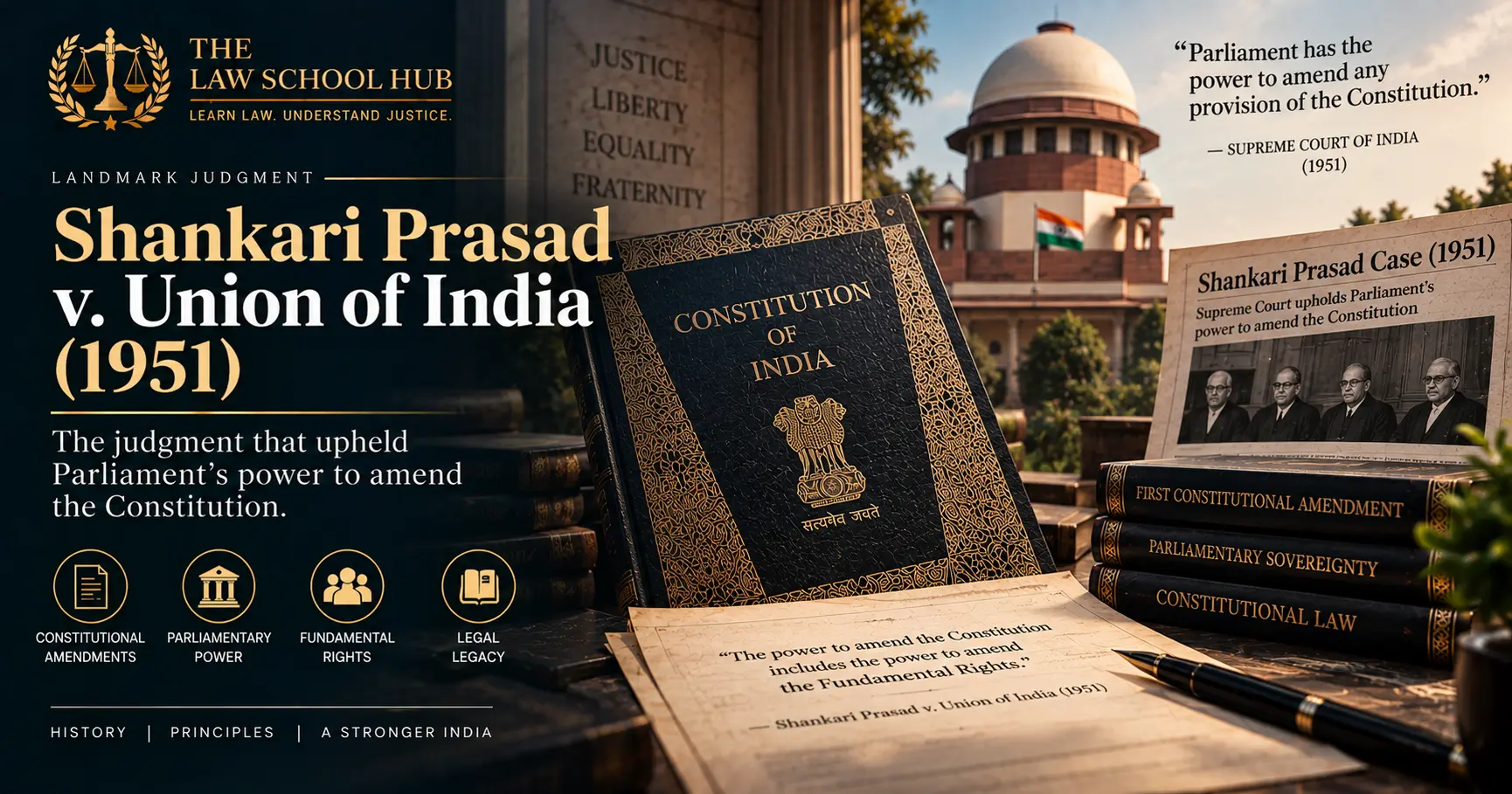
Table of Contents
Introduction
The Indian Constitution is the supreme law of the country. But a very big question arose almost immediately after it was written: Does the Parliament have the power to change or take away the Fundamental Rights guaranteed by this very Constitution? The famous case of Shankari Prasad Singh Deo v. Union of India (1951) was the very first time the Supreme Court of India had to answer this massive question.
In 1951, the Indian government passed the First Constitutional Amendment. This amendment was created to protect the government’s new land reform laws, which took extra land away from rich landlords to give to poor farmers. To do this, the amendment placed limits on the Fundamental Right to Property. Angry landlords, including Shankari Prasad, went to the Supreme Court. They argued that under Article 13(2) of the Constitution, the government was banned from making any “law” that took away Fundamental Rights, and therefore, the constitutional amendment was illegal.
In a unanimous decision, the Supreme Court ruled in favour of the government. The Court declared that a constitutional amendment is a special type of supreme rule, not an ordinary “law.” Therefore, Parliament did have the power to amend and reduce Fundamental Rights. This case is historically vital because it saved India’s land reform movement, birthed the powerful “Ninth Schedule,” and started a thirty-year legal war between the Supreme Court and the Parliament over who truly controls the Constitution.
Legal information notice: This case summary is for general educational and informational purposes. It does not constitute legal advice or create an attorney-client relationship.
Last legally reviewed: September 2026
Case Details
| Detail | Information |
| Case Name | Shankari Prasad Singh Deo v. Union of India |
| Court | Supreme Court of India |
| Year | 1951 (Judgment delivered on October 5, 1951) |
| Bench/Judges | 5-Judge Constitution Bench: Chief Justice H.J. Kania, Justice M. Patanjali Sastri, Justice B.K. Mukherjea, Justice S.R. Das, Justice N. Chandrasekhara Aiyar |
| Legal Area | Constitutional Law, Amendment Power, Fundamental Rights |
| Main Issue | Whether the Constitution (First Amendment) Act, 1951 was legally valid, and whether Parliament can amend Fundamental Rights. |
| Final Decision | The Supreme Court upheld the First Amendment, ruling that Parliament’s amending power under Article 368 includes the power to change Fundamental Rights. |
| Important Legal Principle | The word “law” in Article 13(2) refers only to ordinary legislative laws, not to constitutional amendments made using constituent power. |
Background
To truly understand the Shankari Prasad case, we must look at the painful social and economic realities of India right after independence in 1947, and the panic that gripped the first Indian government.
The Zamindari System and Extreme Poverty
During British rule, agricultural land was mostly controlled by wealthy landlords known as Zamindars. They owned massive estates, while millions of actual farmers worked as poor, landless labourers. When India became independent, the new government, led by Prime Minister Jawaharlal Nehru, promised to end this unfair system. They wanted to build a fair, socialist society where land was distributed equally among the people who actually ploughed it.
To achieve this, state governments (like Bihar, Uttar Pradesh, and Madhya Pradesh) started passing “Zamindari Abolition Acts” and “Land Reform Acts.” These state laws allowed the government to legally seize the massive estates of the rich landlords, pay them a small amount of compensation, and distribute the land to the poor.
The Clash with the Original Constitution
There was a massive legal roadblock to this noble plan: the original Constitution of India.
When the Constitution was adopted on January 26, 1950, it contained Article 19(1)(f) and Article 31. These articles gave every citizen a strong Fundamental Right to own, hold, and dispose of property. Furthermore, the Constitution stated that the government could not take away private property without paying completely fair and equal compensation.
The rich landlords were not going to give up their land easily. They hired top lawyers and immediately went to the High Courts. They argued that the state land reform laws were unconstitutional because they violated their Fundamental Right to Property.
The Panic in the Government
The landlords started winning. In a major shock to the government, the Patna High Court ruled in the famous Kameshwar Singh case that the Bihar Land Reforms Act was unconstitutional. Other High Courts also started issuing orders stopping the government from taking over the lands.
Prime Minister Nehru and the central government were terrified. If the courts kept blocking the land reforms, the government’s entire plan to solve rural poverty would fail. A failure of this size could have led to a violent peasant revolution in the country.
The Creation of the First Amendment
The government realised that if the Constitution was protecting the landlords, they had to change the Constitution itself. In 1951, the government introduced the Constitution (First Amendment) Bill in Parliament.
This amendment was bold and aggressive. It added two new powerful tools to the Constitution: Article 31A and Article 31B.
Article 31A specifically stated that laws meant to abolish the Zamindari system could not be challenged in court for violating the rights to equality or property.
Article 31B created the famous Ninth Schedule. This was a special list attached to the end of the Constitution. The rule was simple: if Parliament took any land reform law and placed it inside the Ninth Schedule, the courts were completely banned from reviewing it or striking it down, even if the law brutally violated Fundamental Rights. Parliament immediately placed 13 state land reform laws into this new Ninth Schedule vault.
Furious that their legal victories in the High Courts had been snatched away by this new amendment, the landlords immediately filed cases directly in the Supreme Court, challenging the First Amendment itself. This became the Shankari Prasad case.
Facts of the Case
The facts of the case do not revolve around a traditional crime or a broken contract. Instead, the facts centre around a massive political and constitutional conflict between wealthy citizens and the newly formed State.
Shankari Prasad Singh Deo and several other individuals were rich Zamindars (landlords) who owned vast amounts of agricultural land in different Indian states.
Under the newly passed state land reform laws, the local state governments began the process of officially seizing their massive estates to redistribute the land to the poor farmers.
The Zamindars were originally fighting these seizures in their local High Courts, arguing that the seizures violated their Fundamental Right to Property guaranteed by Part III of the Constitution.
However, before the legal battles could finish, the central government passed the Constitution (First Amendment) Act in 1951. Because of this amendment, the specific state laws that were harming Shankari Prasad and the other landlords were suddenly locked inside the new Ninth Schedule. Because they were in the Ninth Schedule, the local High Courts were no longer allowed to help the landlords.
Realising that their property was about to be taken and that normal courts could no longer hear their complaints, the landlords joined together. They filed “writ petitions” directly in the Supreme Court of India under Article 32 of the Constitution. Article 32 is a special power that allows a citizen to go directly to the Supreme Court if their Fundamental Rights are being attacked.
The landlords asked the Supreme Court to declare that the First Amendment itself was unconstitutional, illegal, and void. They wanted the Court to cancel the amendment so they could go back to fighting for their lands in the lower courts.
Issues Before the Court
The 5-judge Constitution Bench of the Supreme Court had to decide several highly complex legal questions. The future of India’s economy depended on the answers.
- Whether the “Provisional Parliament” (the temporary Parliament that existed before the first general elections) had the legal power to amend the Constitution at all.
- Whether a constitutional amendment passed under Article 368 qualifies as a “law” under the definition provided in Article 13(2).
- Whether Parliament has the power to amend Part III of the Constitution to take away or reduce the Fundamental Rights of citizens.
- Whether the First Amendment was legally valid.
Arguments by the Parties
What the Petitioners (The Landlords) Argued
The legal team for the landlords, led by brilliant lawyers, presented two main arguments to the Supreme Court.
Their first argument was technical and historical. They pointed out that India had not yet held its first general elections (which would happen in 1951-1952). The Parliament operating at that time was a “Provisional Parliament.” It only had one single house, formed by the members of the old Constituent Assembly. Article 368 of the Constitution clearly stated that a constitutional amendment must be passed by both Houses of Parliament (the Lok Sabha and the Rajya Sabha). The landlords argued that since there was only one house, the Provisional Parliament simply did not have the legal right or the correct structure to use Article 368.
Their second argument was far more powerful and touched the core of the Constitution. They relied on Article 13(2). Article 13(2) contains a very strict command: “The State shall not make any law which takes away or abridges the rights conferred by this Part and any law made in contravention of this clause shall, to the extent of the contravention, be void.” The landlords argued that Fundamental Rights are sacred and cannot be touched by politicians. They argued that a constitutional amendment is passed by Parliament just like any other law. Therefore, an amendment is a “law.” Because the First Amendment reduced the Fundamental Right to Property, it violated the strict command of Article 13(2) and was completely void.
What the Respondents (Union of India) Argued
The government of India, represented by the first Attorney General, M.C. Setalvad, strongly defended the First Amendment.
First, regarding the Provisional Parliament, the Attorney General pointed to Article 379 of the Constitution. This article explicitly gave the Provisional Parliament all the powers of the regular Parliament until fresh elections could be held. He argued that this included the power to amend the Constitution.
Second, he answered the Article 13(2) argument by explaining the difference between two types of power. He argued that there is “ordinary legislative power” (used to make normal laws like traffic rules or tax laws) and “constituent power” (the supreme power used to write or change the Constitution). He argued that the word “law” in Article 13(2) only applied to ordinary, everyday laws. It did not apply to a constitutional amendment. When Parliament amends the Constitution using Article 368, it is acting with supreme constituent power, and therefore, it is completely free from the limits of Article 13(2).
Finally, the government argued that the Constitution must be a flexible document. If the government cannot amend the Constitution to remove unfair property systems, the country would be stuck in poverty, and the Constitution would become a roadblock to national progress.
Judgment of the Court
On October 5, 1951, the 5-judge bench of the Supreme Court delivered a unanimous judgment. The opinion was written by Justice M. Patanjali Sastri.
The Supreme Court completely agreed with the government, dismissed the petitions of the landlords, and declared that the First Amendment was totally legal and valid.
What the Court Decided Regarding the Provisional Parliament
What the Court Decided: The Court firmly rejected the argument that the Provisional Parliament could not amend the Constitution. The judges read Article 379, which stated that the Provisional Parliament would exercise all the powers and perform all the duties of both Houses of Parliament.
What the Court Rejected: The Court rejected the landlords’ strict literal interpretation. The landlords wanted the Court to rule that because Article 368 required “two Houses,” a one-house Provisional Parliament could never act. The Court said that doing this would mean the Constitution could never be fixed or amended during the crucial first years of the republic. The Court ruled that the Provisional Parliament was fully authorised to pass the First Amendment.
What the Court Decided Regarding Fundamental Rights and Article 13(2)
This was the most important part of the judgment. The Supreme Court had to resolve the massive clash between two different parts of the Constitution: Article 13(2) (which protects Fundamental Rights from being destroyed) and Article 368 (which gives Parliament the power to amend the Constitution).
What the Court Decided: Justice Patanjali Sastri applied a famous legal rule called the “Doctrine of Harmonious Construction.” This rule states that if two parts of a law seem to fight with each other, a judge must interpret them in a way that allows both parts to work peacefully together.
The Court looked closely at the word “law” in Article 13(2). The judges noted that the word “law” usually means normal rules passed by the legislature in its everyday working capacity. However, Article 368 is different. It is a special mechanism. When Parliament uses Article 368, it is not making a normal law; it is altering the foundational rulebook of the nation.
Therefore, the Supreme Court held that the word “law” in Article 13(2) must be understood in a narrow sense. It only includes ordinary legislative laws (like a new tax act or a criminal code). It does not include a constitutional amendment made in the exercise of constituent power.
Because an amendment is not a “law” under Article 13(2), the strict ban does not apply to it. Therefore, Parliament has the absolute power under Article 368 to amend any part of the Constitution, including taking away or reducing the Fundamental Rights in Part III.
Ratio Decidendi
The ratio decidendi (the main legal reasoning essential to the decision) in the Shankari Prasad case is clear and twofold:
First, the word “law” in Article 13(2) refers only to ordinary laws made in the exercise of ordinary legislative power. It does not include constitutional amendments.
Second, Parliament, when acting under Article 368, exercises a supreme “constituent power.” Using this power, Parliament has the absolute authority to amend any part of the Constitution, including the power to take away or abridge Fundamental Rights.
Legal Principles Explained
The judgment in Shankari Prasad established highly important concepts of constitutional law that every student must understand clearly.
Constituent Power vs. Ordinary Legislative Power
This is the foundational idea that won the case for the government. Imagine a school. The “constituent power” is the power of the founders to write the main rulebook for the school (e.g., the school exists to educate, students must wear uniforms). The “legislative power” is the everyday power of the principal to make daily timetables or decide what is served in the cafeteria. The daily rules cannot violate the main rulebook.
The Supreme Court ruled that Article 368 gives Parliament the “constituent power” to open up the main rulebook and rewrite it. When Parliament does this, it is operating at a much higher level than when it passes normal, everyday laws. Because it is a higher power, it cannot be stopped by Article 13(2), which was only designed to stop bad everyday laws.
The Doctrine of Harmonious Construction
When reading a legal document, a court should not read one section in a way that completely destroys another section. In this case, if the Court said Article 13(2) is absolute, then Article 368 becomes useless for Fundamental Rights. If the Court said Article 368 is absolute, Article 13(2) loses its protective power.
Justice Sastri harmonised them by saying: Article 13(2) protects you from bad ordinary laws passed by normal political majorities, while Article 368 gives the nation the ultimate power to change its own foundation if the required special majority agrees. By separating the definition of “law,” both articles were allowed to exist and function.
The Mechanics of Articles 31A and 31B
The case confirmed the legal mechanics of the First Amendment. Article 31A saved laws related to acquiring “estates” (large land holdings) from being challenged under the rights to equality and property. Article 31B created the Ninth Schedule. This operates like an iron shield. Even if a law inside the Ninth Schedule clearly violates a citizen’s basic rights, the courts are legally blind to it. Validating these articles gave the state massive economic power over private citizens.
Current Legal Status
It is extremely important for readers to know that the exact legal rule established in Shankari Prasad is no longer the complete law of India today.
The absolute power given to Parliament in this 1951 case went through massive changes over the next few decades.
Today, under the current legal position (verified as of September 2026), the law is governed by the landmark Kesavananda Bharati (1973) judgment.
The modern position is a compromise. The modern Supreme Court agrees with Shankari Prasad on one technical point: a constitutional amendment is not an ordinary “law” under Article 13(2), and Parliament does have the power to amend Fundamental Rights.
However, the modern Supreme Court completely disagrees with Shankari Prasad on the idea that Parliament’s power is absolute. Today, Parliament cannot use its amending power to destroy the Basic Structure or the core identity of the Constitution. Therefore, while rights can be amended, the foundation of the Constitution (like democracy, secularism, and judicial review) cannot be destroyed.
Subsequent Legal Developments
The Shankari Prasad case was just the opening shot in a historic war between the Parliament and the Supreme Court. Here is how the law developed after 1951.
Sajjan Singh v. State of Rajasthan (1965)
Fourteen years later, Parliament passed the 17th Amendment to put even more land laws into the Ninth Schedule. Landlords challenged it again. In the Sajjan Singh case, the Supreme Court by a 3:2 majority completely supported the Shankari Prasad rule. They confirmed that Parliament has absolute power to amend Fundamental Rights. However, for the first time, two minority judges expressed deep fear about giving politicians unlimited power.
I.C. Golaknath v. State of Punjab (1967)
In 1967, the Supreme Court dramatically changed its mind. In a massive 11-judge bench decision, the Court overruled Shankari Prasad. By a 6:5 majority, the Golaknath Court ruled that Parliament absolutely does not have the power to take away Fundamental Rights. They declared that a constitutional amendment is an ordinary “law” under Article 13(2). This infuriated the government.
The 24th Amendment Act (1971)
To destroy the Golaknath judgment, Prime Minister Indira Gandhi’s government passed the 24th Amendment. This amendment aggressively rewrote both Article 13 and Article 368 to state exactly what Shankari Prasad had said twenty years earlier: that Parliament has absolute, unlimited power to amend anything, and Article 13 does not apply to amendments.
Kesavananda Bharati v. State of Kerala (1973)
This 13-judge bench finally settled the war. The Court overruled Golaknath and validated the 24th Amendment, partially returning to the Shankari Prasad logic (that an amendment is not an ordinary law). But they created the “Basic Structure Doctrine,” acting as a permanent limit on Parliament’s power.
Importance of the Case
The importance of Shankari Prasad cannot be overstated in Indian constitutional history.
First, it saved the Indian social and economic revolution. By upholding the First Amendment, the Supreme Court allowed the government to dismantle the oppressive Zamindari system. If the Court had ruled in favour of the landlords, India’s transition to a modern agricultural economy would have been paralyzed.
Second, it established the early character of the Indian Supreme Court. In the 1950s, the judges were deeply respectful of the Parliament. Many of the politicians in Parliament had been the founding fathers who wrote the Constitution. The Court trusted that these leaders would use their absolute amending power responsibly for the good of the poor.
Third, it birthed the Ninth Schedule. While it was created with good intentions (to save land reforms), validating the Ninth Schedule handed future politicians a dangerous weapon. It proved to be a “constitutional dustbin” where governments would later hide hundreds of unfair laws to escape the eyes of the judges.
Critical Analysis
When examining Shankari Prasad today, legal scholars view the judgment as a product of its time.
From a practical and historical perspective, Justice Patanjali Sastri’s judgment was brilliant and necessary. The country was incredibly poor, and the Constitution had to be interpreted in a way that allowed the State to feed its people and break historical inequalities. By separating “constituent power” from “legislative power,” the Court provided a neat, logical legal theory to solve a massive political crisis. The Court chose the welfare of millions of poor farmers over the property rights of a few rich landlords.
However, from a pure human rights and constitutional perspective, the judgment is heavily criticised today. The Law School Hub notes that the Court’s ruling made Fundamental Rights completely vulnerable. If a political party with a large majority can easily amend the Constitution to take away basic freedoms, then those freedoms are not truly “fundamental”; they are merely gifts from the ruling party.
The judges in 1951 trusted Prime Minister Nehru implicitly. They did not foresee a future where less principled politicians might use the exact same absolute power to attack free speech, lock up political opponents, or destroy democracy itself. The Shankari Prasad judgment was legally sound for land reform, but it left the door wide open for potential constitutional dictatorship—a door that the Supreme Court finally had to lock shut decades later with the Basic Structure doctrine.
Illustrations and Examples
Hypothetical Example 1: The Meaning of “Law”
Scenario: The State government of Karnataka passes a normal, everyday statute called the “State Publishing Act.” This new Act states that newspapers are banned from publishing articles that criticise the Chief Minister. A journalist challenges this under Article 13(2), saying it violates her Fundamental Right to free speech.
Legal Position: Under the rules of Shankari Prasad, the journalist will win. The “State Publishing Act” is an ordinary legislative law passed by normal voting. Therefore, it is a “law” under Article 13(2). Because it takes away a Fundamental Right, the court will declare it void and unconstitutional immediately.
Hypothetical Example 2: The Amending Power
Scenario: Parliament decides that newspapers complain too much. With a massive two-thirds majority in both houses, Parliament passes the “40th Constitutional Amendment Act.” This amendment deletes the right to freedom of the press from Part III of the Constitution entirely. A journalist challenges the amendment in court, saying it violates Article 13(2).
Legal Position: If we apply the pure 1951 law of Shankari Prasad, the journalist will lose. The Supreme Court would say that the 40th Amendment is an exercise of supreme constituent power. It is not an ordinary “law” under Article 13(2). Therefore, Parliament has the absolute legal right to delete the freedom of the press. (Note: Today, this amendment would be struck down under the modern Basic Structure doctrine, but under Shankari Prasad, it was totally legal).
Hypothetical Example 3: The Shield of the Ninth Schedule
Scenario: A state government passes an aggressive law that allows police to seize citizens’ laptops without a warrant. Knowing this violates the right to privacy and property, the central government passes a constitutional amendment to place this new police law directly into the Ninth Schedule.
Legal Position: Under the system validated by Shankari Prasad, the citizens are completely helpless. Once a law is placed inside the Ninth Schedule by a constitutional amendment, the courts are legally blocked from looking at it. The law becomes immune to any challenge based on Fundamental Rights.
Key Takeaways
| Key Point | Explanation |
| Main Issue | Did Parliament have the power to amend Fundamental Rights, and was the First Amendment legal? |
| Holding | Yes. The Supreme Court upheld the First Amendment. |
| Ratio Decidendi | An amendment under Article 368 is an exercise of constituent power, not legislative power. It is not an ordinary “law” limited by Article 13(2). |
| Important Doctrine | Harmonious Construction: Used to ensure that both Article 13(2) and Article 368 could function without destroying each other. |
| Later Development | The absolute power granted here was eventually limited by the Basic Structure Doctrine in Kesavananda Bharati (1973). |
| Current Position | Parliament can amend rights, but it cannot destroy the basic structure of the Constitution. |
| Practical Significance | It saved India’s Zamindari abolition laws, allowing land redistribution, but created the dangerous Ninth Schedule loophole. |
Conclusion
The Shankari Prasad v. Union of India (1951) judgment was the very first major test of the newly born Indian Constitution. By ruling that Parliament possessed the supreme constituent power to amend any part of the Constitution, including Fundamental Rights, the Supreme Court allowed the young Indian government to proceed with urgent socialist land reforms. The Court clearly established that an amendment is a foundational change to the rulebook, not an ordinary everyday law limited by Article 13(2).
While the judgment was necessary to end the oppressive Zamindari system and prevent national chaos, it also exposed a massive vulnerability in the constitutional design. By declaring Parliament’s amending power to be absolute, the Court unintentionally gave future governments the blueprint to bypass judicial review entirely using the Ninth Schedule. The legal principles established in Shankari Prasad dominated India for decades until the Supreme Court was forced to step in and draw permanent boundaries with the Basic Structure doctrine, forever altering the balance of power in the nation.
FAQs
1. What was the main legal question in the Shankari Prasad case?
Answer: The main question was whether the Indian Parliament had the legal power to pass the First Constitutional Amendment, which reduced the Fundamental Right to Property to protect state land reform laws.
2. What did the Supreme Court decide?
Answer: The Supreme Court unanimously decided that Parliament has the absolute power to amend any part of the Constitution, including the Fundamental Rights guaranteed in Part III. Therefore, the First Amendment was perfectly legal.
3. Why did the landlords argue the amendment was illegal?
Answer: The landlords pointed to Article 13(2), which says the State cannot make any “law” that takes away Fundamental Rights. They argued that a constitutional amendment is a type of law, and therefore, an amendment cannot take away their property rights.
4. How did the Court interpret the word “law” in Article 13(2)?
Answer: The Court ruled that the word “law” in Article 13(2) only means ordinary, everyday rules passed by the legislature (like tax or criminal laws). It does not include a constitutional amendment, which is made using a higher, special “constituent power.”
5. What is constituent power?
Answer: Constituent power is the supreme, fundamental power used to write, change, or amend the Constitution itself. The Court said Parliament uses this special power when it acts under Article 368, making it superior to ordinary legislative power.
6. What was the “Provisional Parliament” argument?
Answer: Before the first general elections in 1951-52, India only had a one-house Provisional Parliament. The landlords argued it could not amend the Constitution because Article 368 requires voting by two houses. The Court rejected this, saying the Provisional Parliament had all the powers of a regular Parliament.
7. What is the Ninth Schedule created by the First Amendment?
Answer: The Ninth Schedule is a special list in the Constitution. The First Amendment created a rule that if the government places a law inside this schedule, no court in India can strike that law down for violating Fundamental Rights. It acted as a protective vault for government policies.
8. Is the absolute power given in Shankari Prasad still valid today?
Answer: No. The absolute power rule from Shankari Prasad was eventually modified. Today, under the 1973 Kesavananda Bharati judgment, Parliament can amend Fundamental Rights, but it cannot destroy the “Basic Structure” (the core features) of the Constitution.
9. Why did the government want the First Amendment so badly?
Answer: The government wanted to take massive agricultural estates from rich landlords and give the land to millions of poor, landless farmers. Because the original Constitution protected the right to property, the government had to amend the Constitution to stop the courts from cancelling these land reform laws.
10. What is the Doctrine of Harmonious Construction?
Answer: It is a legal rule used by judges when two parts of a law seem to conflict. Instead of letting one part destroy the other, the judge interprets them in a way that allows both parts to function smoothly. The Court used this to balance Article 13(2) and Article 368.
Legal References
- Shankari Prasad Singh Deo v. Union of India, AIR 1951 SC 458 – Supreme Court of India
- Sajjan Singh v. State of Rajasthan, AIR 1965 SC 845 – Supreme Court of India
- I.C. Golaknath and Ors. v. State of Punjab and Anr., AIR 1967 SC 1643 – Supreme Court of India
- Kesavananda Bharati v. State of Kerala, (1973) 4 SCC 225 – Supreme Court of India
- Constitution of India, Articles 13, 19, 31, 31A, 31B, 368, and 379 – Legislative Department, Government of India
- The Constitution (First Amendment) Act, 1951 – Government of India
- The Constitution (Twenty-Fourth Amendment) Act, 1971 – Government of India
At The Law School Hub, we simplify case laws, legal acts, and legal concepts for law students and legal readers. Want to read more useful legal blogs? Visit The Law School Hub The Law School Hub for more such informational blogs.
Building a community around law, learning, and legal awareness through The Law School Hub.
I’m Yash Yogitta Joshi. Join me on LinkedIn → Click to view my Profile