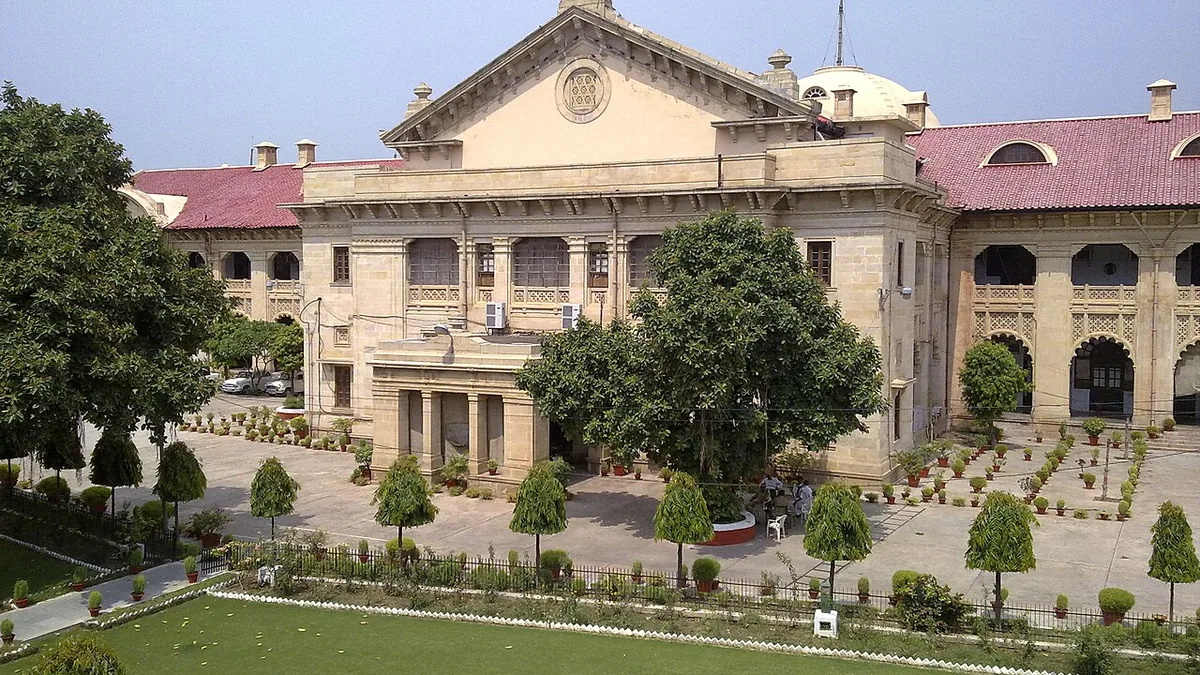
Reaffirming the high standards of probity expected in the subordinate judiciary, the Allahabad High Court on November 24, 2026 dismissed a writ petition challenging the compulsory retirement of a judicial officer, holding that pending departmental enquiries do not preclude a Screening Committee from recommending retirement in the public interest.
The petitioner had assailed his compulsory retirement on the ground that disciplinary proceedings were still pending when the Screening Committee reviewed his case, and that an Internal Committee’s findings had come after the Committee’s meeting. Rejecting the challenge, the Division Bench emphasised that an order of compulsory retirement is not a punitive measure; rather, it is an administrative decision rooted in an overall evaluation of the officer’s entire service record.
To support its conclusion, the High Court relied on the Supreme Court’s decision in High Court of Judicature for Rajasthan v. Bhanwar Lal Lamror and Others, which upheld the compulsory retirement of a judicial officer against whom disciplinary proceedings touching upon integrity were pending. The Bench also invoked its coordinate-bench precedent in Anil Kumar v. State of U.P. and Others—against which a Special Leave Petition had been dismissed on December 13, 2024—holding that even a subsequent exoneration in departmental proceedings does not by itself invalidate a valid compulsory retirement order.
Turning to the factual record before the Screening Committee, the Court noted that the materials considered at the relevant time included complaints lodged by a female judicial officer in August 2018. Thus, even without relying on post-dated Internal Committee findings, the Screening Committee possessed sufficient, relevant material on the officer’s service record to form a bona fide subjective satisfaction that his continuation in service was not conducive to judicial administration.
Finding no arbitrariness, mala fides, or procedural infirmity in the High Court’s administrative recommendation or the consequential State notification, the Bench dismissed the writ petition in full.
Service-law and judicial-administration observers noted that the ruling reinforces institutional autonomy in weeding out deadwood or officers facing serious integrity doubts under Fundamental Rule 56(c) and state judicial service rules. Because compulsory retirement carries no stigma and preserves earned pensionary benefits, courts accord wide latitude to High Court Screening Committees acting on holistic service dossiers.
The November 24, 2026 verdict underscores that judicial officers cannot use the mere pendency of disciplinary proceedings as a shield against public-interest retirement reviews.
District and sessions judges across Uttar Pradesh remain subject to periodic screening assessments aimed at preserving public confidence in the integrity and efficiency of trial courts.
Compulsory retirement in public interest—governed by Fundamental Rule 56(c) and corresponding state judicial service regulations—serves as an essential administrative filter to maintain efficiency, integrity, and public confidence in the judiciary. Unlike dismissal or removal under Article 311 of the Constitution, compulsory retirement does not strip a judicial officer of earned pension or retiral benefits and is therefore not classified as a punishment.
Because the Screening Committee evaluates an officer’s holistic career dossier—including annual confidential remarks, vigilance inputs, and integrity complaints—the mere pendency of a departmental enquiry does not tie the High Court’s hands. As the Allahabad High Court reiterated on November 24, 2026, citing Bhanwar Lal Lamror and Anil Kumar, even a subsequent exoneration in a formal disciplinary proceeding does not automatically vitiate a compulsory retirement decision that was validly grounded on existing adverse material at the time of screening, such as the August 2018 complaints by a female judicial officer.
By dismissing the writ petition on November 24, 2026, the Allahabad High Court reaffirmed that administrative screening of judicial officers under public-interest retirement rules operates independently of formal disciplinary trials, ensuring swift institutional action where overall service records warrant retirement.
Official Sources
Official Primary Document: Writ Petition Challenging Compulsory Retirement of Judicial Officer (Official Record), issued by Allahabad High Court on Verified Date. Direct link:
THE LAW SCHOOL HUB — LEARN LAW. UNDERSTAND JUSTICE. Read more verified national and international legal news reports at https://thelawschoolhub.com.