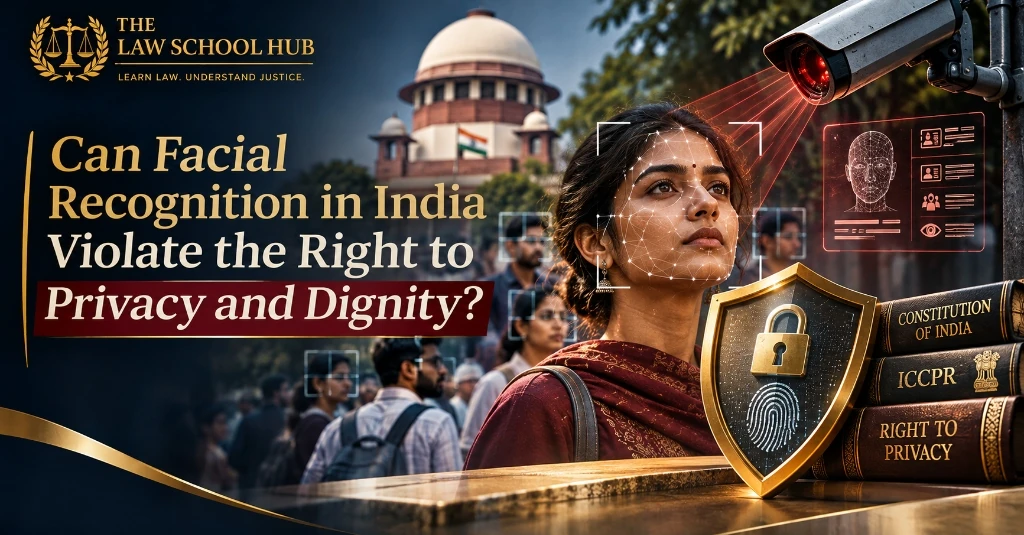
Facial recognition in India has quietly expanded from opt-in airport boarding gates into railway stations, traffic intersections, municipal “smart city” control rooms, welfare verification portals, and live crowd monitoring at public demonstrations. Unlike a traditional closed-circuit television (CCTV) camera that passively records footage for later human inspection, an Automated Facial Recognition System (AFRS) extracts mathematical biometric templates from human faces in real time and cross-matches them against massive watchlists or identity databases in milliseconds.
This technological leap raises a foundational constitutional and international human rights question: can the State—or private actors working with public authorities—scan, identify, and track ordinary citizens in public spaces without violating the fundamental right to privacy and human dignity? Under Article 21 of the Constitution of India, the unanimous nine-judge bench ruling in Justice K.S. Puttaswamy (Retd.) v. Union of India, (2017) 10 SCC 1, and India’s binding treaty obligations under Article 17 of the International Covenant on Civil and Political Rights (ICCPR), unregulated facial recognition crosses clear legal red lines.
A face is not an ordinary piece of personal data. It is an immutable biometric identifier permanently linked to an individual’s identity, dignity, and freedom of movement. You can change a compromised password or cancel a stolen bank card, but you cannot replace your face. When authorities deploy facial recognition in India without specific parliamentary legislation, strict necessity, proven algorithmic accuracy, and independent oversight, the technology transforms everyday public life into continuous biometric surveillance.
1. How Facial Recognition Technology Works—and Why It Is Legally Different From Ordinary CCTV
Legal analysis must begin with technical reality. Courts and international human rights bodies consistently distinguish passive video recording from automated biometric identification because the two tools create radically different levels of intrusion into personal autonomy and dignity.
1.1 Verification (1:1 Matching) vs. Live Identification (1:N Scanning)
Facial recognition systems operate in two fundamentally different modes:
- One-to-One (1:1) Verification: The system confirms whether a person standing in front of a sensor matches a specific identity they voluntarily claim—for example, unlocking a smartphone or passing through an opt-in airport boarding gate like DigiYatra. Here, the individual usually knows a scan is happening and can choose whether to participate.
- One-to-Many (1:N) Identification: The system captures faces from a crowd or street feed without individual knowledge or consent, converts each face into a numerical vector (“faceprint”), and compares it against thousands or millions of stored photographs to identify who is present.
While private residential surveillance already triggers domestic legal limits—as explored in our guide on Indian privacy laws governing neighbour CCTV cameras—live 1:N facial recognition deployed by police or municipal authorities operates on an entirely different constitutional scale. It eliminates practical obscurity in public spaces, allowing the State to reconstruct where a citizen walked, who they met, which place of worship they visited, and which political rally they attended.
1.2 Probabilistic Guessing, Not Mathematical Certainty
A widespread misconception is that facial recognition delivers binary, foolproof matches. In reality, every AFRS produces a probabilistic confidence score—estimating the statistical likelihood that two images depict the same person. Low-resolution street cameras, poor night lighting, aging, facial hair, glasses, head coverings, and demographic imbalances in training datasets significantly increase false-positive error rates. When police treat a low-confidence algorithmic match as grounds to stop, question, or detain a citizen, technical error immediately converts into a violation of personal liberty and equality.
2. Constitutional Protection in India: Article 21, Privacy, and Human Dignity
Before 2017, Indian law lacked an authoritative, unified constitutional test for biometric surveillance. That changed permanently with the Supreme Court’s nine-judge bench judgment in Justice K.S. Puttaswamy (Retd.) v. Union of India (2017).
2.1 Privacy Travels With the Person, Not Merely Inside the Home
In Puttaswamy (2017), the Supreme Court unanimously overruled M.P. Sharma (1954) and Kharak Singh (1962) to affirm that the right to privacy is a core fundamental right protected under Article 21 and across Part III of the Constitution. Crucially for facial recognition in India, Justice D.Y. Chandrachud’s plurality opinion—and concurring opinions by Justices R.F. Nariman, S.K. Kaul, and S.A. Bobde—rejected the outdated argument that citizens forfeit privacy simply by stepping into public view.
The Court expressly linked privacy to human dignity, bodily autonomy, and informational self-determination. Being able to walk through a public square, attend a peaceful lecture, or travel by train without being secretly catalogued by biometric algorithms is central to living with dignity in a constitutional democracy. Constant, suspicionless biometric tracking treats every citizen as a potential suspect, inverting the constitutional presumption of liberty.
2.2 The Four-Prong Proportionality Test (Puttaswamy I & II)
In Puttaswamy (2017) and the subsequent five-judge Constitution Bench ruling in Justice K.S. Puttaswamy (Retd.) v. Union of India (Aadhaar), (2019) 1 SCC 1, the Supreme Court established four mandatory, cumulative requirements that every State privacy intrusion must satisfy:
- Legality (Existence of a Valid Law): Any restriction on privacy must be backed by a clear, accessible, enacted statute passed by a competent legislature—not merely an executive office memorandum, procurement tender, or internal police standard operating procedure.
- Legitimate State Aim: The law must pursue a genuine, constitutionally permissible public interest—such as preventing serious violent crime or locating missing children—rather than open-ended administrative convenience.
- Proportionality (Suitability, Necessity, and Balancing): There must be a rational connection between the measure and its goal, no less intrusive alternative capable of achieving the same objective, and a fair balance between the severity of the privacy invasion and the public benefit achieved.
- Procedural Safeguards Against Abuse: The statutory scheme must include independent oversight, strict purpose limitation, data retention caps, security standards, and effective remedies for affected individuals.
Applied honestly to facial recognition in India, most live police and municipal FRT deployments collapse at Step 1 (Legality) alone, because Parliament has never enacted a dedicated statute authorising real-time biometric scanning of public spaces. Even where agencies point to general policing powers, blanket crowd scanning fails Step 3 (Necessity and Proportionality) whenever targeted, non-biometric policing methods could achieve the same safety objective without scanning thousands of innocent bystanders.
2.3 Impact on Articles 14 and 19: Algorithmic Bias and the Chilling Effect
Facial recognition does not threaten Article 21 in isolation. It also implicates two other foundational pillars of India’s constitutional order:
- Article 14 (Equality and Non-Arbitrariness): Empirical testing worldwide has shown that commercial facial recognition algorithms often exhibit uneven accuracy across skin tones, gender, and age groups when trained on unrepresentative datasets. Relying on unvalidated or biased software to flag “suspects” introduces arbitrary, discriminatory policing contrary to Article 14.
- Article 19(1)(a), (b), and (d) (Speech, Peaceful Assembly, and Movement): When citizens know that police cameras at peaceful marches or public squares are running live facial recognition to log attendees, ordinary people self-censor and stay home. Courts recognise this “chilling effect” as a direct burden on democratic participation and freedom of movement—comparable to arbitrary executive restrictions on travel and personal liberty.
3. International Human Rights Law: ICCPR Article 17 and UN Biometric Standards
India’s constitutional privacy framework aligns closely with its binding obligations under international human rights law. Under Article 51(c) of the Constitution and settled Supreme Court jurisprudence (including Puttaswamy itself), Indian courts interpret fundamental rights harmoniously with international human rights treaties ratified by India wherever there is no direct conflict with domestic legislation.
3.1 ICCPR Article 17 and UDHR Article 12
Both Article 12 of the Universal Declaration of Human Rights (1948) and Article 17 of the ICCPR (1966)—to which India acceded in April 1979—guarantee that no one shall be subjected to “arbitrary or unlawful interference” with their privacy, family, home, or correspondence, and that everyone has the right to the protection of the law against such interference.
In General Comment No. 16 (1988), the UN Human Rights Committee explained that “unlawful” means no interference may occur except on the basis of precise domestic law, while “arbitrary” goes further: even a statutorily authorised interference violates Article 17 if it is unreasonable, unnecessary, disproportionate, or incompatible with the broader aims of the Covenant. Legislation must specify in detail the exact circumstances in which privacy may be restricted, and decisions to authorise intrusive measures must be taken on a case-by-case basis by a legally designated, independent authority.
3.2 UN High Commissioner’s Report on AI and Public Facial Recognition (A/HRC/48/31)
In September 2021, the Office of the United Nations High Commissioner for Human Rights (OHCHR) released a landmark thematic report, The Right to Privacy in the Digital Age (UN Doc. A/HRC/48/31), specifically examining artificial intelligence and remote biometric recognition. The High Commissioner’s findings directly address the practices emerging across Indian cities:
- Presumptive Disproportionality of Live Public Scanning: Real-time facial recognition in public spaces captures biometric data from everyone passing through an area without individualised suspicion, making it extremely difficult to satisfy ICCPR necessity and proportionality.
- Call for a Moratorium: The OHCHR explicitly recommended that States impose a moratorium on the sale and use of remote biometric recognition systems in public spaces until authorities can demonstrate compliance with strict data protection, accuracy, non-discrimination, and independent human rights impact assessments.
- Ban on Emotion Recognition and Biometric Categorisation: The report warned against scientifically dubious systems claiming to infer emotion, political leaning, or criminal propensity from facial features, noting their severe threat to human dignity and non-discrimination.
- Protection of Peaceful Assemblies: Recording and biometrically identifying peaceful protesters interferes simultaneously with ICCPR Article 17 (privacy), Article 19 (expression), and Article 21 (peaceful assembly).
4. India’s Statutory Landscape: Gaps in the DPDP Act 2023 and the 2022 Identification Act
Despite rapid public-sector procurement of facial recognition software by central and state agencies, India has no standalone law governing facial recognition. Instead, facial data falls into an uneasy patchwork of two recent statutes that leave wide gaps for State surveillance.
4.1 Digital Personal Data Protection Act, 2023 (DPDP Act)
The Digital Personal Data Protection Act, 2023 sets out general rules for processing digital personal data—requiring free, specific, informed, unconditional, and unambiguous consent (Section 6), purpose limitation, security safeguards, and grievance redressal. However, two structural features limit its effectiveness against State facial recognition:
- No Separate “Sensitive Personal Data” Tier for Biometrics: Unlike earlier draft bills or the EU GDPR, the DPDP Act 2023 does not create a heightened legal category with stricter safeguards for immutable biometric templates like facial geometry.
- Broad State Exemptions Under Section 17(2)(a): Section 17(2)(a) empowers the Central Government, by notification, to exempt any instrumentality of the State from the Act’s core obligations in the interests of India’s sovereignty and integrity, security of the State, friendly relations with foreign States, maintenance of public order, or preventing incitement to any cognizable offence. Section 17(1)(c) also exempts processing for the prevention, detection, investigation, or prosecution of any offence.
Because these statutory exemptions are not paired with mandatory judicial warrants or independent oversight inside the DPDP Act itself, citizens challenging police or municipal facial recognition must still rely directly on Article 21 and the Puttaswamy proportionality test.
4.2 Criminal Procedure (Identification) Act, 2022
Under Section 4 of the Criminal Procedure (Identification) Act, 2022, the National Crime Records Bureau (NCRB) is authorised to collect, store, preserve, process, and share “measurements”—explicitly including photographs, iris scans, and retina scans—for 75 years in digital form. While the Act was enacted for criminal identification, critics and constitutional scholars have flagged a major privacy risk: if 75-year NCRB photographic and biometric repositories are integrated with live street-level facial recognition feeds without strict statutory firewalls, millions of arrestees—including individuals never convicted—could be subjected to permanent automated tracking.
5. Comparative Risk Matrix: Indian Practice vs. Constitutional & ICCPR Safeguards
| Legal Safeguard | Puttaswamy (Art. 21) & ICCPR Art. 17 Requirement | Current Reality of Facial Recognition in India |
|---|---|---|
| Statutory Authority | Specific, clear Act of Parliament defining scope, triggers, and limits | Most police and smart-city FRT projects run on executive tenders/circulars with no dedicated statute |
| Targeted vs. Mass Scanning | Individualised suspicion; ban on indiscriminate public surveillance | Live crowd scanning at protests, railway stations, and public events scans innocent bystanders |
| Accuracy & Bias Audits | Independent pre-deployment testing for demographic error rates | No mandatory public accuracy benchmarks or independent algorithmic audits |
| Consent & Non-Coercion | Free, informed opt-in with genuine non-biometric alternatives | Airport and welfare portals risk “nudge coercion” when manual lanes are understaffed |
| Oversight & Remedies | Prior judicial review, deletion timelines, and effective redress (ICCPR Art. 2(3)) | No independent FRT regulator; broad Section 17 DPDP exemptions for State agencies |
6. What a Rights-Compliant Facial Recognition Framework Should Look Like
Bringing facial recognition in India into compliance with Article 21 and ICCPR Article 17 does not require rejecting every beneficial technology. Rather, it requires drawing clear statutory red lines that distinguish legitimate, narrowly tailored uses from unconstitutional mass surveillance:
- Enact a Dedicated Biometric Surveillance Statute: Prohibit live 1:N facial recognition in public spaces by default, permitting narrow, time-bound judicial warrants only for grave emergencies (such as locating an abducted child or countering an imminent terrorist attack).
- Absolute Ban on Protest and Political Surveillance: Explicitly outlaw deploying facial recognition at peaceful assemblies, labour marches, university campuses, or places of worship to protect Articles 19 and 21 and ICCPR Articles 19 and 21.
- Mandatory Independent Accuracy & Human Rights Impact Assessments: Require third-party testing for false-positive rates across Indian demographic groups before any public agency procures or deploys an AFRS, and prohibit arrests based solely on an uncorroborated algorithmic match.
- Strict Purpose Limitation and Automatic Deletion: Prohibit repurposing voluntary 1:1 databases (such as airport boarding or welfare attendance) for police watchlists, and enforce automatic deletion of non-matching facial templates within seconds of capture.
- Transparent Public Registries and Enforceable Remedies: Mandate public disclosure of every government FRT deployment, independent oversight by a judicial or statutory body, and clear public-law compensation for wrongful biometric misidentification.
7. Practical Illustrations
7.1 Example 1: Live Facial Scanning at a Peaceful Public Protest
Scenario: Ahead of a peaceful municipal protest against land acquisition, city police deploy mobile cameras running live 1:N facial recognition software to match every participant’s face against voter rolls and driver-licence photographs, relying solely on a Commissioner’s administrative order.
Legal Position: This deployment fails all four prongs of the Puttaswamy test under Article 21—it has no specific statutory authorisation, lacks a proportionate legitimate aim for scanning peaceful citizens, chills freedom of speech and assembly under Article 19(1)(a)–(b), and directly breaches ICCPR Articles 17, 19, and 21 as interpreted in UN Doc. A/HRC/48/31.
Practical Point: Organisers and affected citizens can file a writ petition before the High Court under Article 226 (or Supreme Court under Article 32) seeking an injunction halting the scanning and mandatory deletion of unlawfully captured facial templates.
7.2 Example 2: Wrongful Detention Triggered by a False-Positive Algorithmic Match
Scenario: A commuter walking through a railway station is flagged by an automated facial recognition camera as a 72% match for a wanted suspect. Police detain the commuter for six hours without verifying basic identity documents or corroborating evidence before realising the algorithm erred due to low lighting.
Legal Position: Treating an unverified probabilistic FRT alert as sufficient ground for detention violates personal liberty and dignity under Article 21, non-arbitrariness under Article 14, and protection against arbitrary detention under ICCPR Article 9(1). Human verification and independent probable cause remain mandatory before any arrest.
Practical Point: Wrongfully detained individuals should document the detention memo, demand disclosure of the automated alert logs through legal counsel, and seek constitutional compensation for unlawful deprivation of liberty.
7.3 Example 3: Opt-In Airport Facial Boarding With Genuine Choice
Scenario: An international airport operates voluntary 1:1 facial boarding lanes alongside fully staffed manual ID lanes. Passengers who opt in receive plain-language notice, give explicit consent under Section 6 of the DPDP Act 2023, and have their facial tokens automatically purged within 24 hours of flight departure.
Legal Position: Because participation is genuinely voluntary without penalty, uses 1:1 verification rather than mass 1:N surveillance, and enforces strict purpose limitation and prompt deletion, this model substantially respects informational privacy—provided authorities never starve manual lanes to coerce biometric enrolment or repurpose passenger data for unrelated policing.
Practical Point: Consent-based biometric services remain lawful only while citizens retain a real, penalty-free right to say no.
8. Comparative Global Regulation, Algorithmic Bias, and a Statutory Blueprint for India
India’s regulatory vacuum on facial recognition stands in sharp contrast to the rapid evolution of democratic biometric law worldwide. As courts and legislatures across multiple jurisdictions have examined live public-space facial scanning, a clear international consensus has emerged: biometric identification of crowds cannot be left to executive circulars, internal police SOPs, or unverified vendor promises.
8.1 Global Regulatory Benchmarks on Public-Space Biometric Surveillance
Across leading constitutional democracies, lawmakers and human rights institutions have drawn bright statutory red lines around remote facial recognition. In Europe, comprehensive artificial intelligence regulation prohibits untargeted scraping of facial images from the internet or CCTV footage to build biometric databases, and bans real-time remote biometric identification in publicly accessible spaces for law enforcement save for strictly enumerated, judicially authorised emergencies—such as searching for a missing kidnapping victim or preventing an imminent terrorist threat. Similarly, appellate courts in common-law jurisdictions have struck down pilot police deployments of automated facial recognition where officers enjoyed overly broad discretion over “who” could be placed on watchlists and “where” surveillance vans could be parked, holding that vague administrative guidance fails the basic human rights test of being “in accordance with law.”
These comparative principles directly reinforce UN Doc. A/HRC/48/31 (2021) and ICCPR Article 17. International law does not require States to abandon lawful forensic tools in solving grave crimes; rather, it insists that generalised, indiscriminate biometric scanning of entire populations is incompatible with a free society. When an Indian city deploys facial recognition across metro stations, traffic junctions, and protest grounds without parliamentary legislation, independent oversight, or clear watchlist criteria, it falls far below both global democratic standards and India’s own constitutional proportionality doctrine in Puttaswamy (2017).
8.2 Algorithmic Bias, Procurement Opacity, and Article 14 Equality Concerns
Beyond privacy under Article 21, unverified facial recognition systems raise profound equality and non-discrimination concerns under Article 14 of the Constitution and Article 26 of the ICCPR. Facial recognition algorithms are trained on historical image datasets; when those datasets under-represent darker skin tones, women, elderly citizens, or diverse Indian regional demographics, error rates climb dramatically. Even a seemingly small false-positive rate—say 1%—produces thousands of wrongful alerts every single day when run continuously against busy railway platforms, bus terminals, or public festivals.
Compounding this technical flaw is procurement opacity. Many Indian state police departments and municipal smart-city agencies purchase proprietary facial recognition software from private vendors without publishing independent accuracy benchmarks, confidence-threshold settings, demographic error audits, or source-data provenance. When a citizen is stopped, questioned, or detained based on a black-box algorithmic match that neither the officer nor the citizen can audit, the State violates basic principles of natural justice, due process, and non-arbitrariness. Furthermore, if police train or populate watchlists using historical arrest photographs from over-policed or marginalised communities, automated facial recognition amplifies pre-existing socio-economic bias under a misleading veneer of “scientific neutrality.”
8.3 Essential Pillars of a Dedicated Indian Biometric Regulation Act
To reconcile modern policing and digital convenience with Article 21, Puttaswamy (Aadhaar) (2018), and ICCPR obligations, Parliament should enact a standalone Biometric and Facial Recognition Regulation Act anchored on seven binding statutory pillars:
- Explicit Ban on Indiscriminate Live 1:N Public Scanning: Prohibit continuous, real-time facial scanning of public streets, religious gatherings, universities, and peaceful protests, permitting targeted post-facto forensic matching only under a reasoned prior judicial warrant for grave enumerated offences.
- Strict Watchlist Legal Thresholds: Restrict law-enforcement watchlists solely to persons with active judicial arrest warrants, proclaimed offenders, or verified missing-person court orders—forbidding the inclusion of peaceful protestors, political opponents, or acquitted citizens.
- Mandatory Pre-Deployment Human Rights & Accuracy Audits: Require every public or private facial recognition system to pass independent, published accuracy and demographic-bias testing across Indian populations before deployment, with mandatory periodic re-certification.
- Non-Delegable Human-in-the-Loop Verification: Codify an absolute statutory rule that an algorithmic facial match is merely an investigative lead—never sufficient probable cause on its own for arrest, detention, denial of boarding, or withholding of welfare benefits.
- Strict Purpose Limitation and Rapid Auto-Deletion: Mandate automatic deletion of non-matching crowd frames within seconds and require voluntary 1:1 transit or commercial tokens (such as airport facial boarding) to be purged within 24 hours with zero secondary sharing with police or advertisers.
- Public Transparency Registry and Mandatory Notice: Maintain a publicly searchable national registry disclosing every government agency operating facial recognition, its statutory basis, vendor, watchlist size, accuracy metrics, and annual alert/false-positive counts, alongside clear physical signage wherever cameras operate.
- Independent Oversight and Statutory Remedies: Establish an independent Biometric Privacy Regulator empowered to conduct unannounced audits, suspend non-compliant deployments, order database destruction, and award statutory compensation to citizens harmed by unlawful scanning or misidentification.
8.4 Practical Playbook for Citizens, Journalists, and Litigants
Until Parliament enacts comprehensive statutory guardrails, citizens, civil-society organisations, and legal practitioners can actively protect constitutional rights through four practical steps:
- Exercise Penalty-Free Opt-Outs in Voluntary Services: At airports, offices, residential societies, and commercial venues, verify whether facial scanning is strictly voluntary; insist on manual ID verification lanes where consent under Section 6 of the DPDP Act, 2023 is required, and document any coercion or denial of service.
- Use RTI Requests to Expose Unlawful Deployments: File targeted Right to Information (RTI) applications with municipal corporations, police commissionerates, and smart-city agencies seeking the legal authority, Standard Operating Procedures, watchlist criteria, data-retention period, and accuracy audit reports for deployed facial recognition cameras.
- Demand Evidentiary Disclosure in Misidentification Cases: If an individual is detained or charged following a facial recognition alert, defence counsel should immediately demand the raw confidence score, gallery image source, camera logs, and corroborating human evidence, challenging uncorroborated alerts as arbitrary under Articles 14 and 21.
- Invoke Constitutional Writ Jurisdiction: Where executive authorities deploy mass live facial recognition without statutory backing—especially at peaceful assemblies or against vulnerable groups—affected citizens can approach the High Court under Article 226 or the Supreme Court under Article 32 seeking an immediate injunction, deletion of unlawfully harvested biometric templates, and public-law compensation.
9. Frequently Asked Questions
1. Is facial recognition legal in India right now?
Answer: India has no dedicated statute specifically legalising or regulating facial recognition. While voluntary 1:1 verification with free consent may operate under general data protection principles, live 1:N police or municipal facial scanning without enacted statutory authority and strict proportionality is vulnerable to constitutional invalidation under Article 21 and Puttaswamy (2017).
2. Do citizens lose their right to privacy when they walk in a public street or railway station?
Answer: No. In Justice K.S. Puttaswamy (Retd.) v. Union of India (2017), the Supreme Court unanimously affirmed that privacy attaches to the individual person—not just private homes—so automated biometric tracking in public spaces directly engages Article 21.
3. Does the Digital Personal Data Protection Act, 2023 restrict police facial recognition?
Answer: Only weakly. Section 17(1)(c) and Section 17(2)(a) of the DPDP Act 2023 allow broad exemptions for offence investigation and notified State instrumentalities on security or public-order grounds, leaving Article 21 constitutional review as the main check against State overreach.
4. What is the difference between 1:1 facial verification and 1:N facial identification?
Answer: 1:1 verification checks whether a consenting person matches one specific stored identity (such as unlocking a phone), whereas 1:N identification scans crowds without consent against large watchlists—creating far greater mass-surveillance and misidentification risks.
5. What has the United Nations said about facial recognition in public spaces?
Answer: In UN Doc. A/HRC/48/31 (2021), the UN High Commissioner for Human Rights urged States to impose a moratorium on remote biometric recognition in public spaces until strict accuracy, non-discrimination, legal authorisation, and human rights safeguards are demonstrably enforced.
6. Can police arrest someone solely because a facial recognition camera flagged a match?
Answer: No. Facial recognition produces probabilistic scores prone to false positives; arresting a person solely on an uncorroborated algorithmic alert without independent human verification and lawful grounds risks violating Articles 14 and 21 and ICCPR Article 9.
7. How does facial recognition affect human dignity?
Answer: Human dignity requires autonomy over one’s body, identity, and public participation. Reducing citizens’ faces to continuously tracked machine-readable barcodes without consent undermines both dignity under Article 21 and democratic freedom under Article 19.
8. Can private malls, employers, or residential societies compel facial recognition attendance or entry?
Answer: Under Section 6 of the Digital Personal Data Protection Act, 2023, private data fiduciaries generally require free, specific, informed, unconditional, and unambiguous consent before processing personal data. While Section 7(i) permits certain employment-related processing, compelling irreversible biometric scanning where a less intrusive alternative (such as an access card or manual register) works equally well raises serious proportionality and consent-validity challenges, especially for visitors, tenants, and customers who must be offered a genuine opt-out.
9. How does Section 4 of the Criminal Procedure (Identification) Act, 2022 interact with police facial recognition?
Answer: Section 4(2) of the 2022 Act authorises the National Crime Records Bureau (NCRB) to store photographs and biometric measurements of convicts and arrestees for 75 years and share them with law-enforcement agencies. Because those high-resolution photographs can be fed into automated facial recognition watchlists, any delay in deleting records of acquitted citizens under the proviso to Section 4(2) directly expands the risk of wrongful public-space tracking.
10. What remedy is available if a municipal or police agency deploys facial recognition without legal authority?
Answer: Affected citizens can file RTI applications to establish the absence of enacted statutory backing and accuracy audits, and petition the High Court under Article 226 or the Supreme Court under Article 32 seeking an injunction against unlawful 1:N scanning, certified deletion of harvested facial templates, and constitutional compensation where misidentification results in wrongful detention.
10. Conclusion
Facial recognition in India is not a neutral administrative upgrade—it is a high-risk biometric surveillance power that directly tests the core promises of Puttaswamy (2017) and ICCPR Article 17. When deployed through executive circulars without parliamentary legislation, independent accuracy audits, or bans on indiscriminate public scanning, facial recognition violates both the fundamental right to privacy and human dignity. Enacting a clear, rights-respecting statutory framework with strict judicial oversight is essential to ensure technology serves constitutional democracy rather than eroding it.
Legal References
- Justice K.S. Puttaswamy (Retd.) v. Union of India, (2017) 10 SCC 1 — Supreme Court of India (9-Judge Bench affirming fundamental right to privacy and dignity under Article 21).
- Justice K.S. Puttaswamy (Retd.) v. Union of India (Aadhaar), (2019) 1 SCC 1 — Supreme Court of India (four-prong proportionality standard).
- Constitution of India — Article 21 — Protection of Life, Personal Liberty, Privacy, and Dignity.
- Digital Personal Data Protection Act, 2023 (Act No. 22 of 2023) — Parliament of India (Sections 4, 6, and 17).
- Criminal Procedure (Identification) Act, 2022 — Section 4 — Parliament of India (75-year NCRB storage of measurements).
- International Covenant on Civil and Political Rights (ICCPR), 1966 — Articles 17, 19, and 21 — United Nations Treaty Series, Vol. 999, p. 171.
- Universal Declaration of Human Rights (UDHR), 1948 — Article 12 — United Nations General Assembly.
- The Right to Privacy in the Digital Age, Report of the UN High Commissioner for Human Rights (UN Doc. A/HRC/48/31, 2021) — United Nations Human Rights Council.
Legal information notice: This article is for general educational and informational purposes and does not constitute legal advice or create an attorney-client relationship.