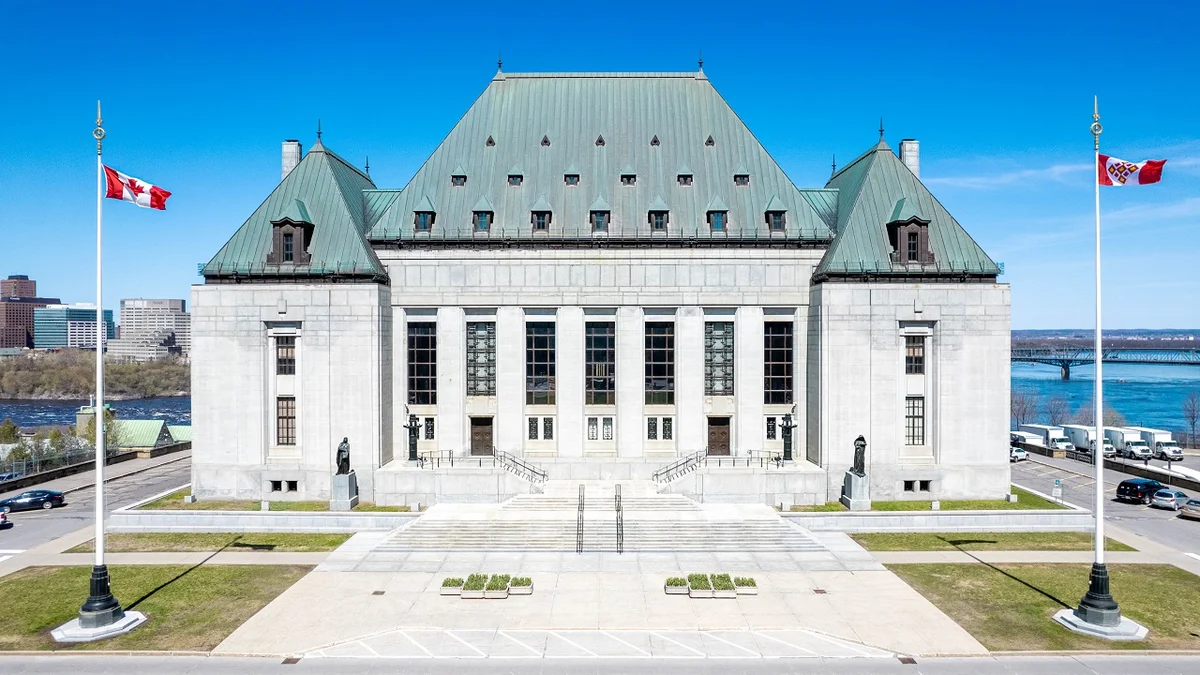
The Supreme Court of Canada is set to give one of the biggest constitutional decisions in the country’s recent history on Friday, November 27, 2026. The Court is deciding a major legal fight over Quebec’s secularism law, widely known as Bill 21. At the heart of the case is a simple but very important question: how far can a provincial government go in using a special rule in Canada’s Constitution to override citizens’ basic rights?
Bill 21 was passed on June 16, 2019, by the Quebec government led at the time by Premier François Legault. The government said the law was meant to keep the state completely neutral on religion. Under this law, many government workers in positions of authority are not allowed to wear religious symbols while doing their jobs. This includes items such as hijabs, turbans, kippahs, and visible crosses. The ban applies to public school teachers, school principals, judges, government lawyers, and police officers. The law also says that anyone giving or receiving public government services must keep their face uncovered.
Later, Quebec made the rules even stricter. The ban on religious symbols was expanded to cover everyone who works or interacts with children in public daycares, primary schools, and high schools—even unpaid volunteers. Because the law directly stops people from wearing items tied to their faith at work, many people argued that it unfairly harms religious minorities, especially Muslim women, Sikh men, and Jewish citizens.
Normally, a law like this could be struck down by Canadian courts for violating the Canadian Charter of Rights and Freedoms, which protects freedom of religion and equality. However, when Quebec passed Bill 21, it used a special power in Section 33 of the Charter called the “notwithstanding clause.” In simple terms, this clause lets a government pass a law even if it goes against certain Charter rights, and stops courts from cancelling the law on those grounds. Quebec used this clause right from the start to protect Bill 21 from court challenges.
Teachers, religious groups, civil rights organisations, and the English Montreal School Board went to court to challenge Bill 21. They argued that the law violates basic human rights, goes beyond what a provincial government is allowed to do, and misuses the notwithstanding clause by using it in advance to block court review. Lower courts in Quebec mostly upheld the law because of the notwithstanding clause, which led the challengers to take the case all the way to the Supreme Court of Canada.
Because the stakes are so high for the entire country, the Supreme Court held four full days of hearings in March 2026—one of the longest hearings in its history. A record 61 groups and governments took part in the case, including 51 interveners. Even Canada’s federal government joined the case and asked the Supreme Court to set clear limits on how provinces can use the notwithstanding clause. The federal government also asked the Court to confirm that judges can still officially declare when a law violates basic rights, even if the notwithstanding clause stops them from striking the law down.
The decision comes at a tense political moment in Quebec. Quebec’s newly elected Premier, Paul St-Pierre Plamondon of the Parti Québécois, has promised to strongly defend the province’s secularism laws and even suggested extending the ban on religious symbols to schoolchildren. The ruling is also being released on the same day another court hears a case on whether Quebec’s elected lawmakers must take an oath of loyalty to the King. Outside Quebec, other provinces such as Alberta and Saskatchewan have also started using the notwithstanding clause more often, so this ruling will affect all of Canada.
Although this Canadian judgment is not binding in India, it is very interesting and useful for Indian law students and readers. Both India and Canada are diverse, federal democracies with many religions and languages. While Quebec tries to keep religion completely out of public offices, India’s Constitution (Articles 25 to 28) follows a different approach that respects all religions and allows religious expression in public life, subject to public order, morality, and health. Canada’s debate over whether governments can override basic rights also mirrors India’s famous Basic Structure doctrine, which stops Parliament from taking away core constitutional freedoms and judicial review.
Official References
- Supreme Court of Canada — Official Website & Judgments Portal: https://www.scc-csc.ca/
- Supreme Court of Canada — Case Information & Decisions Database: https://decisions.scc-csc.ca/
- Canadian Charter of Rights and Freedoms, Section 33 (Notwithstanding Clause) — Department of Justice Canada: https://laws-lois.justice.gc.ca/eng/const/page-12.html