Skip to content
Close

Search

Gold scales of justice enclosed within a laurel wreath beside the text “The Law School Hub” and the tagline “Learn Law. Understand Justice.” on a professional grey background. Gold scales of justice enclosed within a laurel wreath beside the text “The Law School Hub” and the tagline “Learn Law. Understand Justice.” on a professional grey background. The Law School Hub

Learn Law. Understand Justice.

Gold scales of justice enclosed within a laurel wreath beside the text “The Law School Hub” and the tagline “Learn Law. Understand Justice.” on a professional grey background. Gold scales of justice enclosed within a laurel wreath beside the text “The Law School Hub” and the tagline “Learn Law. Understand Justice.” on a professional grey background. The Law School Hub

Learn Law. Understand Justice.

  • Home
  • All Blog Categories
    • Administrative Law
    • Banking and Finance Law
    • Case Summaries
    • Constitutional Law
    • Corporate and Commercial Law
    • Criminal Law
    • Environmental Law
    • Family Law
    • International Law
    • Intellectual Property Law
    • Judiciary Examination Preparation
    • Labour and Employment Law
    • Law Entrance Examination Guidance
    • Legal News Analysis
    • Legal Research and Writing
    • Taxation Law
    • Technology and Cyber Law
  • Case Summaries
    • Technology and Cyber Law Case Summaries
    • Taxation Law Case Summaries
    • Labour and Employment Law Case Summaries
    • International Law Case Summaries
    • Intellectual Property Law Case Summaries
    • Family Law Case Summaries
    • Environmental Law Case Summaries
    • Criminal Law Case Summaries
    • Corporate and Commercial Law Case Summaries
    • Constitutional Law Case Summaries
    • Banking and Finance Law Case Summaries
    • Administrative Law Case Summaries
  • Contributor’s Page
  • About Us
  • Join Our Community
  • Contact Us
  • Terms of Service
  • Privacy Policy

Main Menu

  • Home
  • All Blog Categories
    • Administrative Law
    • Banking and Finance Law
    • Case Summaries
    • Constitutional Law
    • Corporate and Commercial Law
    • Criminal Law
    • Environmental Law
    • Family Law
    • International Law
    • Intellectual Property Law
    • Judiciary Examination Preparation
    • Labour and Employment Law
    • Law Entrance Examination Guidance
    • Legal News Analysis
    • Legal Research and Writing
    • Taxation Law
    • Technology and Cyber Law
  • Case Summaries
    • Technology and Cyber Law Case Summaries
    • Taxation Law Case Summaries
    • Labour and Employment Law Case Summaries
    • International Law Case Summaries
    • Intellectual Property Law Case Summaries
    • Family Law Case Summaries
    • Environmental Law Case Summaries
    • Criminal Law Case Summaries
    • Corporate and Commercial Law Case Summaries
    • Constitutional Law Case Summaries
    • Banking and Finance Law Case Summaries
    • Administrative Law Case Summaries
  • Contributor’s Page
  • About Us
  • Join Our Community
  • Contact Us
  • Terms of Service
  • Privacy Policy
  • Home
  • All Blog Categories
    • Administrative Law
    • Banking and Finance Law
    • Case Summaries
    • Constitutional Law
    • Corporate and Commercial Law
    • Criminal Law
    • Environmental Law
    • Family Law
    • International Law
    • Intellectual Property Law
    • Judiciary Examination Preparation
    • Labour and Employment Law
    • Law Entrance Examination Guidance
    • Legal News Analysis
    • Legal Research and Writing
    • Taxation Law
    • Technology and Cyber Law
  • Case Summaries
    • Technology and Cyber Law Case Summaries
    • Taxation Law Case Summaries
    • Labour and Employment Law Case Summaries
    • International Law Case Summaries
    • Intellectual Property Law Case Summaries
    • Family Law Case Summaries
    • Environmental Law Case Summaries
    • Criminal Law Case Summaries
    • Corporate and Commercial Law Case Summaries
    • Constitutional Law Case Summaries
    • Banking and Finance Law Case Summaries
    • Administrative Law Case Summaries
  • Contributor’s Page
  • About Us
  • Join Our Community
  • Contact Us
  • Terms of Service
  • Privacy Policy
Close

Search

Home/Banking and Finance Law/Banking Ombudsman Scheme Explained: The Free, Powerful Way to Fight Your Bank and Win in India
Banking and Finance LawAll Blog Categories

Banking Ombudsman Scheme Explained: The Free, Powerful Way to Fight Your Bank and Win in India

By Yash Yogitta Joshi
June 20, 2026 7 Min Read
0
Updated on June 29, 2026
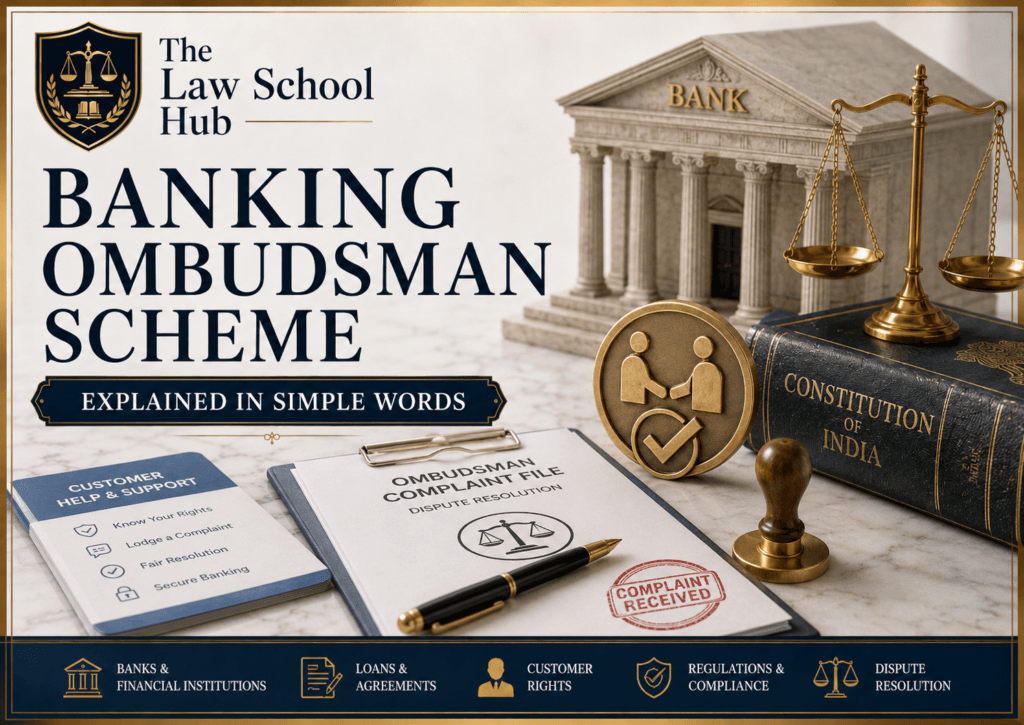
Banking Ombudsman Scheme blog cover showing ombudsman complaint file, complaint received stamp, customer help booklet, Constitution book, bank building, and justice scales.
A simple explanation of the Banking Ombudsman Scheme and how it helps bank customers resolve complaints fairly.

Legal note: This article is for educational purposes and does not replace advice from a qualified lawyer.

Table of Contents

  • 1. Introduction
  • 2. What Is the Banking Ombudsman Scheme?
  • 3. Key Features of the Banking Ombudsman Scheme
    • 3.1 It Is Completely Free
    • 3.2 Who Can File a Complaint?
    • 3.3 Who Can You Complain Against?
    • 3.4 What Compensation Can You Get?
    • 3.5 What Is the Time Limit?
    • 3.6 Where to File a Complaint
    • 3.7 Important Pre-Condition
  • 4. How the Banking Ombudsman Process Works
  • 5. Key Legal Provisions
  • 6. Case Law
  • 7. Practical Examples
  • 8. Ombudsman vs Consumer Court: Which One Should You Choose?
  • 9. Key Takeaways
  • 10. Conclusion
  • 11. FAQs
  • 12. Legal References

1. Introduction

The Banking Ombudsman Scheme is one of the most useful and underused legal tools available to ordinary bank customers in India. It is fast, free, and surprisingly powerful — and yet most people have never heard of it.

If your bank has failed you — whether through a failed ATM transaction, wrongful charges, non-refund of money, recovery agent harassment, or any other banking problem — the Banking Ombudsman Scheme is your best friend. You do not need a lawyer. You do not need to pay a single rupee. You just need to know how to use it.

This blog explains the Banking Ombudsman Scheme in simple, plain language so that any ordinary person can understand it and use it effectively.

2. What Is the Banking Ombudsman Scheme?

The Banking Ombudsman Scheme is a free dispute resolution mechanism set up by the Reserve Bank of India (RBI) to handle complaints from customers against banks, Non-Banking Financial Companies (NBFCs), and payment system operators.

The current framework is the RBI Integrated Ombudsman Scheme, 2021 (RBI IOS 2021), which came into effect on November 12, 2021. It replaced three separate earlier schemes (Banking Ombudsman Scheme 2006, Ombudsman Scheme for NBFCs 2018, and Ombudsman Scheme for Digital Transactions 2019) and merged them into a single, powerful scheme.

3. Key Features of the Banking Ombudsman Scheme

3.1 It Is Completely Free

One of the best features of the Banking Ombudsman Scheme is that it costs absolutely nothing. There are no fees, no court costs, and no lawyer needed. The RBI bears all costs of operating the Ombudsman offices across India.

3.2 Who Can File a Complaint?

Any person, whether an individual, firm, company, or any other legal entity, can file a complaint under the Banking Ombudsman Scheme. You do not need to be a citizen of India to file a complaint — NRIs with accounts in Indian banks can also use this scheme.

3.3 Who Can You Complain Against?

Under the RBI IOS 2021, you can file complaints against:

  • All scheduled commercial banks (including SBI, HDFC, ICICI, Axis, PNB, etc.)
  • Regional rural banks
  • Cooperative banks
  • Payment banks and small finance banks
  • Non-Banking Financial Companies (NBFCs) regulated by RBI
  • Payment system operators (like Paytm, PhonePe, Google Pay, BHIM, etc.)

3.4 What Compensation Can You Get?

Under the Banking Ombudsman Scheme, the Ombudsman has the power to:

  • Award up to Rs. 20 lakh as compensation for financial loss
  • Award up to Rs. 1 lakh for mental agony and harassment
  • Direct the bank to provide specific relief (like reopening a wrongfully closed account)
  • Direct the bank to refund wrongfully charged amounts with interest

3.5 What Is the Time Limit?

You must file your complaint with the Banking Ombudsman within one year of either:

  • The bank’s reply to your complaint (whether satisfactory or not), OR
  • The expiry of 30 days from the date you sent a complaint to the bank (if the bank has not replied)

3.6 Where to File a Complaint

The easiest way is to file online at cms.rbi.org.in (available 24×7, free). You can also send your complaint by post to any Ombudsman office or to the Centralised Receipt and Processing Centre (CRPC) of the RBI.

3.7 Important Pre-Condition

Before approaching the Ombudsman, you must have already filed a complaint with the bank and either: (a) received an unsatisfactory reply, or (b) not received any reply within 30 days.

Critical Rule: The Banking Ombudsman will not entertain complaints unless you have given your bank at least 30 days to respond. Always complain to the bank first.

4. How the Banking Ombudsman Process Works

StageStepWhat Happens
1File complaint at cms.rbi.org.inComplaint registered; reference number given; bank notified
2Bank submits its replyBank has 21 days to respond to the Ombudsman with its version
3Conciliation/MediationOmbudsman tries to settle the matter between you and the bank
4AwardIf conciliation fails, Ombudsman passes a binding Award
5Acceptance or AppealYou can accept the Award. Bank must comply within 30 days
6AppealEither party can appeal to RBI Appellate Authority within 30 days of Award

5. Key Legal Provisions

  • RBI Integrated Ombudsman Scheme, 2021 — RBI’s official notification
  • Banking Regulation Act, 1949 (S. 35A) — RBI’s power to regulate in customer interest
  • Consumer Protection Act, 2019 (S. 2(7)) — Banking as a ‘service’
  • RBI Charter of Customer Rights, 2015 — Right to grievance redressal

6. Case Law

6.1 RBI v. Jalan Committee Report and Banking Ombudsman Evolution

The Banking Ombudsman Scheme has been shaped by various RBI internal committee reports. The Damodaran Committee (2011) on customer service in banks was particularly influential in expanding the grounds for complaint and increasing the compensation amounts. (Read more — RBI website)

6.2 Consumer Forums on Banking Ombudsman Awards

Several High Courts and the NCDRC have held that an Ombudsman Award, once accepted by the complainant, is binding and enforceable. Banks that fail to comply with an Award face further action from the RBI.

7. Practical Examples

Example 1: ATM Swallowed Cash — Never Reversed

Kavita withdrew Rs. 10,000 from an ATM but the cash was not dispensed. Her account was debited. She complained to the bank but received no response in 30 days. She filed at cms.rbi.org.in. The Ombudsman resolved the matter in 3 weeks: the bank refunded Rs. 10,000 plus Rs. 100/day from the 6th day as per RBI guidelines.

Example 2: Insurance Mis-Sold at Bank Branch

Suresh was sold an insurance policy at his bank as a ‘guaranteed return product.’ When the returns were negative, he complained. Under the Banking Ombudsman Scheme, the Ombudsman found the bank had misrepresented the product and directed the bank to refund the premium amount.

8. Ombudsman vs Consumer Court: Which One Should You Choose?

FeatureBanking OmbudsmanConsumer Court
CostCompletely freeNominal fee (based on claim amount)
Lawyer needed?NoOptional but helpful
Speed30–90 daysMonths to years
Max CompensationRs. 20 lakh + Rs. 1 lakhNo upper limit
Who can appeal?Either party to Appellate AuthorityEither party to higher court
JurisdictionAll RBI-regulated entitiesAll service providers

9. Key Takeaways

  • The Banking Ombudsman Scheme (RBI IOS 2021) is the fastest and cheapest way to fight banking injustice.
  • It is completely free — no fees, no lawyer needed.
  • File online at cms.rbi.org.in anytime, 24×7.
  • Maximum compensation: Rs. 20 lakh (financial loss) + Rs. 1 lakh (mental agony).
  • You must first complain to your bank and give it 30 days before filing.
  • File within 1 year of the bank’s reply or 1 year after 30 days of bank’s inaction.

10. Conclusion

The Banking Ombudsman Scheme is a remarkable consumer protection tool that very few bank customers in India actually use. If more people knew about it, banks would be far more careful about how they treat their customers.

The process is simple: complain to the bank first, wait 30 days, then file at cms.rbi.org.in. The Ombudsman will do the rest — for free. Whether you have lost money in a failed ATM transaction, been harassed by a recovery agent, or been mis-sold a financial product, the Banking Ombudsman Scheme is your legal right and your strongest tool.

11. FAQs

Q1. What is the Banking Ombudsman Scheme in India?

It is the RBI Integrated Ombudsman Scheme, 2021 — a free dispute resolution system for customers of banks, NBFCs, and payment operators regulated by the RBI.

Q2. How much compensation can the Banking Ombudsman give?

Up to Rs. 20 lakh for financial loss, plus up to Rs. 1 lakh for mental agony and harassment.

Q3. Where do I file a Banking Ombudsman complaint?

Online at cms.rbi.org.in, available 24×7 and free.

Q4. Can I use the Ombudsman Scheme for UPI payment disputes?

Yes. The RBI IOS 2021 covers digital payment operators including UPI apps like Google Pay, PhonePe, Paytm, and BHIM.

Q5. What if I am not happy with the Ombudsman’s decision?

You can appeal to the RBI’s Appellate Authority (headed by the Deputy Governor) within 30 days of the Award.

Q6. Is there a fee to file a Banking Ombudsman complaint?

No. The Banking Ombudsman Scheme is completely free for complainants.

Q7. Can an NRI file a complaint under the Banking Ombudsman Scheme?

Yes. NRIs with accounts in Indian banks can file complaints against those banks under the RBI Integrated Ombudsman Scheme, 2021.

12. Legal References

  • RBI Integrated Ombudsman Scheme, 2021
  • RBI CMS Portal
  • Banking Regulation Act, 1949
  • Consumer Protection Act, 2019
  • RBI Charter of Customer Rights, 2015

At The Law School Hub, we simplify case laws, legal acts, and legal concepts for law students and legal readers.

Want to read more useful legal blogs? Visit The Law School Hub

Tags:

bank complaint RBIbank dispute resolution freebanking customer protection Indiabanking ombudsman 20 lakhbanking ombudsman appealbanking ombudsman compensationbanking ombudsman complaintbanking ombudsman eligibilitybanking ombudsman Indiabanking ombudsman process Indiabanking ombudsman schemebanking ombudsman time limitbanking ombudsman vs consumer courtbanking ombudsman what iscms.rbi.org.inhow does banking ombudsman workintegrated ombudsman scheme 2021ombudsman complaint against bankombudsman for banks Indiaombudsman scheme explainedonline banking complaint IndiaRBI IOS 2021RBI ombudsmanRBI ombudsman award
Author

Yash Yogitta Joshi

Hi, I am Yash Yogitta Joshi, the creator and author behind The Law School Hub, a legal education platform created to make Indian law simple, clear, and accessible for everyone.My interest in law began with a curiosity to understand how rights, justice, and legal systems work in everyday life. Over time, I realised that many students, aspirants, and citizens find legal concepts difficult because they are often explained in complex language. This inspired me to build The Law School Hub as a beginner-friendly space for learning law in a practical and easy-to-understand way.My goal is to create content that is accurate, useful, and easy to follow. I believe that legal education should not be limited to textbooks or courtrooms. Everyone should have access to basic legal knowledge so they can understand their rights, duties, and responsibilities.

Follow Me
Other Articles
Bank complaint guide cover showing complaint form, complaint letter, grievance redressal file, Banking Ombudsman booklet, Constitution of India, bank building, and scales of justice.
Previous

How to File a Complaint Against a Bank in India: Your Free Step-by-Step Legal Guide That Actually Works

Wrongful bank deduction cover showing account statement with wrongful deduction, refund request letter, passbook, calculator, rupee coins, Constitution book, gavel, and scales.
Next

Bank Wrongfully Deducted Money? Know Your Rights and Fight Back with These Proven Legal Steps

No Comment! Be the first one.

    Leave a Reply Cancel reply

    Your email address will not be published. Required fields are marked *

    Recent Posts

    • The Definitive Guide to Intellectual Property Rights: Why Every Common Person Must Deeply Care
    • Suhas Katti Case: How India Got Its First Cybercrime Conviction to Protect Women Online
    • Cadila Healthcare Case: Why Trademark Rules for Medicines Are Stricter in India
    • Supreme Court Takes Crucial Step: Extends Consultation Deadline on Draft AI Rules for Courts
    • Frustrated by Repeated Document Demands in Aadhaar Card Correction? 7 Powerful Legal Steps to Instantly Stop Government Harassment

    Recent Comments

    No comments to show.

    Archives

    • July 2026
    • June 2026

    Categories

    • Administrative Law
    • All Blog Categories
    • Banking and Finance Law
    • Case Summaries
    • Constitutional Law
    • Constitutional Law Case Summaries
    • Corporate and Commercial Law
    • Corporate and Commercial Law Case Summaries
    • Criminal Law
    • Family Law
    • Intellectual Property Law
    • Intellectual Property Law Case Summaries
    • Legal News Analysis
    • Technology and Cyber Law
    • Technology and Cyber Law Case Summaries
    Gold scales of justice enclosed within a laurel wreath beside the text “The Law School Hub” and the tagline “Learn Law. Understand Justice.” on a professional grey background.

    Page Lists
    • About Us
    • Contact Us
    • Contributor's Page
    • Home page | The Law School Hub
    • Join Our Community
    • Learn Law Through Our Blogs
    • Privacy Policy
    • Terms of Service
    Latest Posts
    • The Definitive Guide to Intellectual Property Rights: Why Every Common Person Must Deeply Care
    • Suhas Katti Case: How India Got Its First Cybercrime Conviction to Protect Women Online
    • Cadila Healthcare Case: Why Trademark Rules for Medicines Are Stricter in India
    • Supreme Court Takes Crucial Step: Extends Consultation Deadline on Draft AI Rules for Courts
    • Frustrated by Repeated Document Demands in Aadhaar Card Correction? 7 Powerful Legal Steps to Instantly Stop Government Harassment
    All Blog Categories
    • Administrative Law
    • All Blog Categories
    • Banking and Finance Law
    • Case Summaries
    • Constitutional Law
    • Constitutional Law Case Summaries
    • Corporate and Commercial Law
    • Corporate and Commercial Law Case Summaries
    • Criminal Law
    • Family Law
    • Intellectual Property Law
    • Intellectual Property Law Case Summaries
    • Legal News Analysis
    • Technology and Cyber Law
    • Technology and Cyber Law Case Summaries

    Let's Connect on Social Media

    • Instagram
    • LinkedIn
    • Facebook
    • Telegram
    • X
    • WhatsApp

    © 2026 The Law School Hub. All Rights Reserved.

    The content on this website is created for legal education, awareness, and academic purposes only. It does not constitute legal advice.