The Definitive Guide to Intellectual Property Rights: Why Every Common Person Must Deeply Care

Legal Note: The information provided in this blog is for educational and legal awareness purposes only and does not constitute professional legal advice. While every effort has been made to ensure legal accuracy, readers are advised to consult a qualified legal professional or verify with official statutes and bare acts before making any legal decisions.
Table of Contents
Introduction
What happens when you spend months writing a beautiful novel, only to find someone else selling it under their name on the internet? Furthermore, imagine starting a small home bakery called “Sweet Delights,” building a loyal customer base, and then receiving a legal notice claiming you have stolen that name from a massive corporation. In both of these frustrating scenarios, the answer lies in one powerful legal concept: Intellectual Property Rights.
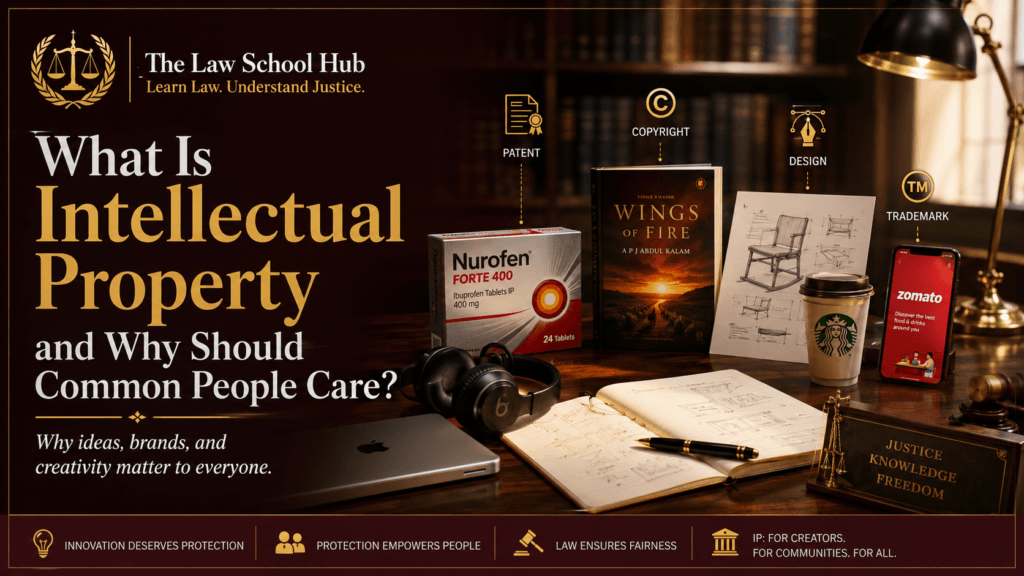
Directly answering the primary question—Intellectual Property (IP) refers to the creations of the human mind. Just as you can own physical property like a house, a car, or a piece of land, you can also legally own the intangible products of your intellect. This includes inventions, literary and artistic works, designs, symbols, names, and images used in commerce. Consequently, the laws that protect these mental creations and grant the creator exclusive rights to use, make, and profit from them are known as Intellectual Property Rights. You might think this is only a subject for massive tech companies or famous authors, but the truth is entirely different. Today, every common person—whether you are an Instagram content creator, a freelance designer, a small business owner, or a consumer buying medicines—interacts with Intellectual Property Rights daily. Understanding these rights is no longer an optional luxury; it is a fundamental necessity for protecting your ideas, your money, and your future.
Overview of Intellectual Property
To properly understand Intellectual Property Rights, we must first look at its core purpose. The basic philosophy behind these laws is to encourage innovation, creativity, and economic growth. If inventors and artists knew that their hard work could be freely copied by anyone the moment it was released, they would have no motivation to invest time and money into creating new things. Therefore, the government grants creators a legal monopoly over their creations, but usually only for a limited time.
In India, the framework for Intellectual Property Rights has evolved significantly, especially after India became a signatory to the TRIPS (Trade-Related Aspects of Intellectual Property Rights) Agreement under the World Trade Organization (WTO). As a result, Indian laws are now closely aligned with global standards, ensuring that an invention patented in India or a trademark registered in India holds weight and respect in the international commercial landscape.
Detailed Explanation: Types of Intellectual Property Rights
Intellectual Property Rights are broadly divided into several distinct categories. Each category protects a different type of mental creation. To build a strong foundation, we will explore each of these in detail.
1. Copyrights: Protecting Creative Expression
Copyright is a bundle of rights given by the law to the creators of literary, dramatic, musical, and artistic works, as well as the producers of cinematograph films and sound recordings. Importantly, copyright protects the expression of an idea, not the idea itself. For example, the idea of a boy going to a wizarding school cannot be copyrighted, but the exact written story of Harry Potter is protected by copyright. Moreover, copyright is an automatic right. As soon as you write a poem on a piece of paper or record a song on your phone, you hold the copyright. However, registering your copyright provides a solid legal presumption of ownership in court.
2. Trademarks: Protecting Brand Identity
A trademark is a visual symbol—which may be a word, signature, name, device, label, numerals, or a combination of colors—used by an enterprise to distinguish its goods or services from those of other enterprises. Think of the golden arches of McDonald’s, the half-bitten apple of Apple Inc., or the specific shape of a Coca-Cola bottle. Trademarks are crucial for building brand trust. Consequently, they protect consumers as much as they protect businesses. If Intellectual Property Rights did not protect trademarks, anyone could sell cheap, low-quality shoes with a Nike logo, completely confusing the common consumer.
3. Patents: Protecting Inventions
A patent is an exclusive statutory right granted by the government to an inventor. It allows the inventor to exclude others from making, using, selling, or importing the patented product or process without their explicit permission. However, to get a patent, an invention must meet three strict criteria: it must be novel (new), it must have an inventive step (non-obvious to an expert in the field), and it must be capable of industrial application (useful). Unlike copyrights, patents are definitely not automatic. You must undergo a rigorous application and examination process with the Patent Office. Furthermore, patents are generally granted for a period of 20 years, after which the invention enters the public domain for anyone to use.
4. Geographical Indications (GI): Protecting Regional Heritage
A Geographical Indication is a sign used on products that have a specific geographical origin and possess qualities, reputation, or characteristics that are essentially due to that place of origin. For instance, Darjeeling Tea, Kanchipuram Silk, and Alphonso Mangoes are all protected under GI. This ensures that only producers located within that specific geographical region can legally use the GI tag. This specific branch of Intellectual Property Rights heavily protects local farmers, artisans, and traditional craftsmen from corporate exploitation.
5. Industrial Designs: Protecting Aesthetic Value
While patents protect how a product works, industrial designs protect how a product looks. It covers the ornamental or aesthetic aspect of an article, which may consist of three-dimensional features (like the shape of a perfume bottle) or two-dimensional features (like patterns, lines, or colors). For a design to be registered, it must purely appeal to the eye and not be dictated solely by the product’s technical function.
6. Trade Secrets: Protecting Confidential Information
Trade secrets are intellectual property rights on confidential business information that provides an enterprise a competitive edge. Unlike other forms of IP, trade secrets are not registered with the government. Instead, they are protected by keeping them secret. The most famous example is the recipe for Coca-Cola or the algorithm behind Google’s search engine. If the secret is leaked through a breach of a non-disclosure agreement (NDA), the owner can sue for damages. However, if someone else independently discovers the secret, there is no legal protection.
Why Should Common People Care About Intellectual Property Rights?
It is a common misconception that Intellectual Property Rights are only for massive corporations, top-tier legal researchers, or wealthy inventors. In reality, the modern digital and gig economy has made IPR incredibly relevant to the common person. Here are several practical reasons why everyone must care:
1. The Rise of the Creator Economy: If you write a blog, shoot YouTube videos, create Instagram reels, or design digital art, you are generating intellectual property. Without understanding your rights, content thieves can re-upload your work, monetize it, and strip you of your hard-earned revenue. Understanding copyright law allows you to issue DMCA takedowns and protect your digital livelihood.
2. Protecting Small Businesses and Startups: Many young entrepreneurs start a business without registering their trademark. Consequently, after spending years building brand goodwill, they receive a “Cease and Desist” letter from a company that registered a similar name first. Understanding Intellectual Property Rights prevents this fatal business mistake, ensuring you legally secure your brand identity from day one.
3. Consumer Safety and Quality Assurance: As a consumer, Intellectual Property Rights protect you from dangerous counterfeit goods. Whether you are buying pharmaceutical medicines, electronic gadgets, or baby food, trademarks and patents ensure that you are buying the authentic product manufactured under strict quality controls, rather than a fake product that could cause you physical harm.
4. Employment Contracts and Freelancing: When you join a company or take on a freelance gig, you will likely sign contracts containing “IP Assignment Clauses.” If you do not understand Intellectual Property Rights, you might accidentally sign away the rights to a personal side-project you develop on your weekends. Knowing the law helps you negotiate fair contracts and retain ownership of your independent ideas.
5. Avoiding Unintentional Infringement: Sometimes, common people become the offenders without even realizing it. Using a popular song in your commercial podcast, using a copyrighted image from Google for your business flyer, or photocopying an entire textbook can invite heavy legal penalties. General legal awareness helps you stay compliant and avoid devastating lawsuits.
Key Legal Provisions Governing Intellectual Property in India
To ensure high authoritativeness and legal accuracy, we must examine the actual statutes that govern Intellectual Property Rights in India. For law students, judiciary aspirants, and legal researchers, these provisions form the bedrock of IP litigation.
The Copyright Act, 1957
- Section 13 (Classes of works in which copyright subsists): This section clearly states that copyright exists throughout India in original literary, dramatic, musical, and artistic works, cinematograph films, and sound recordings. Link to India Code.
- Section 14 (Meaning of Copyright): This is a critical provision that outlines the exclusive rights granted to the copyright owner, such as the right to reproduce the work, issue copies to the public, and make adaptations or translations.
- Section 52 (Certain acts not to be infringement of copyright): Known as the “Fair Dealing” provision. It allows the common person to use copyrighted material for private research, criticism, review, and reporting of current events without being liable for infringement.
The Trade Marks Act, 1999
- Section 9 (Absolute grounds for refusal of registration): This section prevents the registration of marks that are devoid of distinctive character or consist exclusively of marks that designate the kind, quality, or geographical origin of the goods. For example, you cannot trademark the word “Apple” if you are actually selling apples.
- Section 11 (Relative grounds for refusal of registration): This section protects existing brand owners by refusing registration of a new trademark if it is deceptively similar to an earlier trademark and creates a likelihood of confusion among the public.
- Section 29 (Infringement of registered trademarks): This provision lays down the conditions under which a registered trademark is considered infringed by a third party.
The Patents Act, 1970
- Section 3 (What are not inventions): This is one of the most litigated sections in Indian Intellectual Property Rights. It specifically excludes certain things from being patented, such as a mere discovery of a scientific principle, agricultural methods, or the mere discovery of a new form of a known substance which does not result in the enhancement of the known efficacy of that substance (Section 3(d) – famously used in pharmaceutical patents).
- Section 48 (Rights of patentees): Grants the exclusive right to prevent third parties from making, using, offering for sale, selling, or importing the patented product or process in India.
The Geographical Indications of Goods (Registration and Protection) Act, 1999
- Section 8 (Registration of Geographical Indications): Specifies that a GI can be registered in respect of any or all of the goods, comprised in such class of goods as may be classified by the Registrar.
- Section 21 (Rights conferred by registration): Provides the right to obtain relief in respect of infringement of the geographical indication to the registered proprietor and the authorized users.
Important Case Laws Shaping Intellectual Property Rights
Indian courts have played a magnificent role in interpreting and expanding Intellectual Property Rights. Here are landmark judgments that every legal researcher and CLAT student must know.
1. Patent Law: Novartis AG v. Union of India, (2013) 6 SCC 1
- Context: This is arguably the most famous patent case in Indian history. The Swiss pharmaceutical giant Novartis sought a patent for an anti-cancer drug named ‘Glivec’.
- Analysis: The Supreme Court of India rejected the patent application under Section 3(d) of the Patents Act, 1970. The Court held that the drug was merely a new form of an already known substance and did not show significantly enhanced therapeutic efficacy. This judgment was a massive victory for common people as it prevented the “evergreening” of patents, ensuring that life-saving drugs remain affordable and accessible as generic medicines in India.
2. Trademark Law (Passing Off): Yahoo! Inc. v. Akash Arora, 1999 (19) PTC 201 (Del)
- Context: The defendant launched a website providing services similar to Yahoo! under the domain name ‘Yahooindia.com’.
- Analysis: The Delhi High Court granted an injunction against the defendant. This case was a landmark because it established that domain names serve the same function as trademarks on the internet. Even though the internet was relatively new in India in 1999, the court applied the traditional concept of “passing off” (where a person sells their goods under the pretense that they are the goods of another) to protect Intellectual Property Rights in cyberspace.
3. Copyright Law: Eastern Book Company v. D.B. Modak, (2008) 1 SCC 1
- Context: The appellants published law reports (SCC) with headnotes and formatting. The respondents copied these judgments directly onto their CD-ROMs.
- Analysis: The Supreme Court established the “sweat of the brow” vs. “modicum of creativity” doctrine in India. The Court ruled that simply copying government judgments does not give rise to copyright. However, creating headnotes, formatting, and making editorial changes requires legal skill and minimal creativity, which is protected by Intellectual Property Rights. Thus, derivative works based on public domain material can have their own copyright.
4. Trademark Law (Trans-border Reputation): Coca-Cola Company v. Bisleri International Pvt. Ltd., 2009 (41) PTC 460 (Del)
- Context: Bisleri had assigned the trademark “MAAZA” to Coca-Cola for the Indian market but continued to use it for exports.
- Analysis: The Delhi High Court held that the export of goods from India with a trademark amounts to the use of the trademark in India. This case heavily clarified the jurisdictional boundaries and the assignment of Intellectual Property Rights, proving that once you sell your IP rights for a territory, you cannot indirectly exploit them there.
5. Patent Law (Injunctions): Bajaj Auto Limited v. TVS Motor Company Limited, (2009) 9 SCC 797
- Context: A dispute over the patent of digital twin spark plug ignition technology.
- Analysis: While addressing the patent infringement, the Supreme Court directed all courts in India to ensure that intellectual property disputes (trademarks, copyrights, and patents) are decided rapidly. The Court noted that temporary injunctions shouldn’t drag on for years, recognizing the fast-paced commercial realities of Intellectual Property Rights.
Practical Examples and Illustrations
To make these heavy legal concepts easier to digest, let us look at some practical, everyday examples:
- Illustration 1 (The Freelance Writer): Rahul, a freelance writer, is hired to write articles for a magazine. Unless his contract specifically states it is a “Work for Hire” and he assigns his copyright, Rahul remains the original owner of those articles under Intellectual Property Rights. The magazine only buys the right to publish them.
- Illustration 2 (The YouTuber’s Dilemma): Priya uploads a makeup tutorial and plays a famous Bollywood song in the background without permission. The music label issues a copyright strike. Priya’s video is taken down because she infringed on the music label’s Intellectual Property Rights. To avoid this, Priya must use royalty-free music or rely on the “Fair Dealing” exception if she is doing a direct critical review of the song.
- Illustration 3 (Startup Mistake): Aman opens a coffee shop named “StarBucks India” but spells it with a slightly different font. Starbucks Corporation will immediately sue Aman for trademark infringement and “passing off.” The court will shut Aman’s shop down because his brand name creates a likelihood of confusion among consumers, violating the core principles of Intellectual Property Rights.
Listicles: Key Rights and Exceptions
To quickly understand what you can and cannot do under Intellectual Property Rights, here are some crucial listicles.
5 Essential Rights of a Copyright Holder
- Right to Reproduce: The exclusive right to make copies of the original work in any format.
- Right to Distribute: The right to issue copies of the work to the public.
- Right to Adapt: The ability to convert a book into a movie, or translate a novel into another language.
- Right to Perform: The exclusive right to perform the work in public (e.g., a stage play).
- Moral Rights: The right to be credited as the author and the right to object to any distortion of the work that harms their reputation (Section 57, Copyright Act).
4 Common Exceptions to Copyright (Fair Dealing)
- Private Use: Research, study, or making a backup copy for personal computer use.
- Criticism and Review: Quoting paragraphs of a book to write a critical review.
- News Reporting: Using snippets of a work to report current events in a newspaper or broadcast.
- Educational Use: A teacher using excerpts in a classroom to explain a concept to students.
4 Steps to Register a Trademark in India
- Trademark Search: Conducting a thorough search on the IP India portal to ensure your desired brand name is unique.
- Filing the Application: Submitting Form TM-A with the required fees and documents.
- Examination and Publication: The registry examines the application. If accepted, it is published in the Trademarks Journal to invite opposition from the public for 4 months.
- Registration Certificate: If no one opposes the mark, the Trademark Registry issues the certificate, granting you exclusive Intellectual Property Rights over that brand name for 10 years (renewable).
Tables: Quick Reference for Law Students
Tables are excellent tools for CLAT aspirants and young lawyers to quickly distinguish between similar legal concepts.
Table 1: Comparing Major Intellectual Property Rights
| Feature | Copyright | Trademark | Patent |
|---|---|---|---|
| What it Protects | Literary, artistic, and musical works (Expression) | Brand names, logos, symbols, and slogans | Inventions, new processes, and functional products |
| Primary Purpose | Encourage art and culture | Prevent consumer confusion and protect brand identity | Encourage scientific and technological innovation |
| Is Registration Mandatory? | No, it is automatic upon creation. | Highly recommended, but unregistered marks can be protected under ‘passing off’. | Yes, strictly mandatory. No patent exists without registration. |
| Duration of Validity (India) | Lifetime of the author + 60 years. | 10 years (Can be renewed indefinitely). | 20 years from the date of filing. Cannot be renewed. |
| Governing Statute | The Copyright Act, 1957 | The Trade Marks Act, 1999 | The Patents Act, 1970 |
Table 2: Non-Patentable Inventions under Section 3 (Patents Act, 1970)
| Provision | Description | Practical Example |
|---|---|---|
| Section 3(a) | Frivolous inventions or those contrary to well-established natural laws. | A machine that claims to create perpetual motion without an energy source. |
| Section 3(b) | Inventions contrary to public order, morality, or causing harm to life/environment. | A device specifically designed to facilitate burglary or a genetically modified seed that poisons soil. |
| Section 3(c) | Mere discovery of a scientific principle or formulation of an abstract theory. | Discovering a new galaxy or formulating a new mathematical theorem. |
| Section 3(h) | Methods of agriculture or horticulture. | A new method of planting wheat to yield faster crops. |
Key Takeaways
- Intellectual Property Rights protect the creations of the human mind, balancing the creator’s right to profit with the public’s right to access information.
- The primary categories are Copyrights (art/literature), Trademarks (brands), Patents (inventions), and Geographical Indications (regional goods).
- Common people must care about IPR to protect their content on social media, secure their small business branding, and avoid expensive legal liabilities.
- Indian courts, as seen in the Novartis case, strictly balance Intellectual Property Rights with public welfare, preventing the monopolization of life-saving goods.
- If you are a creator or a business owner, always document your creative process and legally register your IP assets at the earliest opportunity.
Conclusion
In conclusion, Intellectual Property Rights are no longer just a complex subject confined to corporate boardrooms and elite law firms. In today’s rapidly evolving digital economy, IPR is the shield that protects your creativity and the sword that defends your business against unfair competition. Whether you are a law student analyzing the Eastern Book Company judgment, an entrepreneur drafting a business plan, or simply a consumer enjoying a genuine Darjeeling Tea, Intellectual Property Rights dictate the boundaries of fair play. By understanding the basics of Copyrights, Trademarks, and Patents, you empower yourself to navigate the modern world safely, ethically, and profitably. Ignorance of IP law is not bliss; it is an open invitation for exploitation. Protect your ideas, respect the ideas of others, and leverage the law to foster innovation.
Frequently Asked Questions (FAQs)
Q1: Can I copyright a mere idea I have for a revolutionary new app?
A1: No. Intellectual Property Rights, specifically copyright law, only protect the expression of an idea, not the idea itself. You cannot copyright the concept of the app, but you can copyright the specific software code, the user interface design, and the written content within the app.
Q2: Is my Indian trademark valid globally?
A2: Intellectual Property Rights are generally territorial. An Indian trademark only protects you in India. However, under the Madrid Protocol, you can file a single international application through the Indian Trademark Registry to seek protection in multiple member countries.
Q3: What is the difference between Trademark infringement and “Passing Off”?
A3: Infringement is a statutory remedy available only for registered trademarks under the Trade Marks Act, 1999. “Passing off” is a common law remedy available for unregistered trademarks, where you must prove that your brand has goodwill and the competitor is deceiving the public.
Q4: Can a software program be patented in India?
A4: Generally, under Section 3(k) of the Patents Act, 1970, mathematical methods, business methods, and computer programs per se are not patentable. Software is usually protected under Copyright Law. However, if the software has a “technical effect” tied to hardware, it might be patentable in specific circumstances.
Q5: What should I do if someone uses my copyrighted photo on their website?
A5: First, take screenshots as evidence. Then, you can send a formal Cease and Desist notice demanding they remove the image. If the website is hosted on a platform (like WordPress or Shopify), you can file a DMCA (Digital Millennium Copyright Act) takedown notice. If they refuse, you can pursue civil litigation for an injunction and damages.
Q6: Can I use 10 seconds of a movie for a YouTube review?
A6: Yes, usually. This falls under the “Fair Dealing” exception (Section 52 of the Copyright Act, 1957) for the purpose of criticism and review. However, the use must genuinely be for review, and the amount used must be reasonable and not serve as a substitute for the original work.
Legal References and Sources
- The Copyright Act, 1957: Sections 13, 14, 52, 57. (Reference: India Code)
- The Trade Marks Act, 1999: Sections 9, 11, 29. (Reference: India Code)
- The Patents Act, 1970: Sections 3, 48. (Reference: India Code)
- The Geographical Indications of Goods (Registration and Protection) Act, 1999: Sections 8, 21. (Reference: India Code)
- The Designs Act, 2000. (Reference: India Code)
- Case Law: Novartis AG v. Union of India, (2013) 6 SCC 1. (Reference: Supreme Court of India / Indian Kanoon)
- Case Law: Yahoo! Inc. v. Akash Arora, 1999 (19) PTC 201 (Del). (Reference: Delhi High Court / Indian Kanoon)
- Case Law: Eastern Book Company v. D.B. Modak, (2008) 1 SCC 1. (Reference: Supreme Court of India / Indian Kanoon)
- Case Law: Coca-Cola Company v. Bisleri International Pvt. Ltd., 2009 (41) PTC 460 (Del).
- Case Law: Bajaj Auto Limited v. TVS Motor Company Limited, (2009) 9 SCC 797.
- International Treaty: TRIPS (Trade-Related Aspects of Intellectual Property Rights) Agreement. (Reference: WTO Official Website)
- International Treaty: The Madrid Protocol for International Registration of Marks. (Reference: WIPO Official Website)
- Official Portal: Intellectual Property India, Ministry of Commerce and Industry. (Reference: IP India Portal)
- Legal Doctrine: “Sweat of the Brow” vs “Modicum of Creativity” Doctrine (Derived from Eastern Book Co. judgment).
- Legal Database references: Principles of passing off and infringement verified against standard commentaries available on SCC Online and Bar & Bench publications. (Note: As always, readers looking to file IP applications should independently verify the latest fee structures and notification amendments on the official IP India Gazette before publication of their applications.)
At The Law School Hub, we simplify case laws, legal acts, and legal concepts for law students and legal readers. Want to read more useful legal blogs? Visit The Law School Hub.