
Frustrated by Repeated Document Demands in Aadhaar Card Correction? 7 Powerful Legal Steps to Instantly Stop Government Harassment

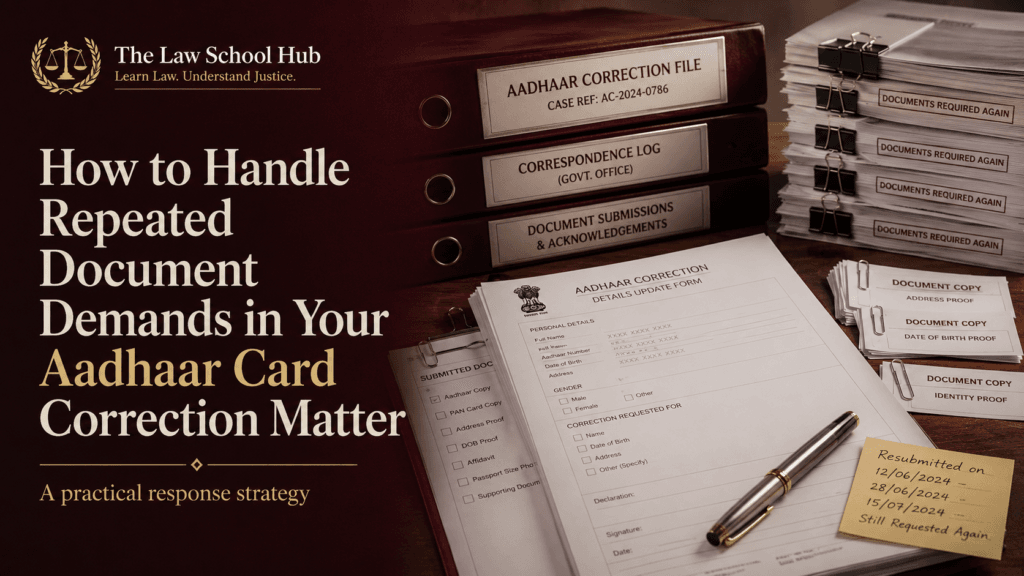
Legal Note: This article is strictly written for educational, academic, and general legal awareness purposes only. It does not constitute formal legal advice or create an attorney-client relationship. While we make every effort to ensure absolute legal accuracy, you must always verify the laws with official sources, such as the UIDAI portal, the India Code, or speak to a practicing advocate. Please check current government notifications, as administrative guidelines and Standard Operating Procedures (SOPs) frequently change.
Table of Contents
Introduction
If you are currently trapped in an endless, agonizing loop where you upload a perfectly valid government ID, only to face repeated document demands in Aadhaar card correction matters, you need immediate legal clarity. Directly answering your most urgent question: No, the Unique Identification Authority of India (UIDAI) cannot legally keep rejecting your valid documents and demanding new ones without providing a specific, recorded, and legally valid reason. When the backend system continuously flags your application with vague demands for “better proof” or “additional documents,” the authority is actively violating your statutory right to update your data and your constitutional right against arbitrary state action. Consequently, you do not have to sit back and passively accept this bureaucratic harassment. Because your Aadhaar details directly control your access to banking, passports, property registration, and essential government subsidies, having an update permanently stalled by infinite document requests is a severe infringement on your civil livelihood. Therefore, breaking out of a cycle of repeated document demands in Aadhaar card correction requires a highly aggressive administrative and legal strategy. By reading this comprehensive, simple, and legally rigorous guide, law students, young advocates, and everyday citizens will deeply understand exactly how to bypass automated computer rejections, invoke manual exception handling, and force the government to update their digital identity immediately.
Overview
The legal and technological framework surrounding the Aadhaar ecosystem in India represents a massive intersection of automated Artificial Intelligence (AI) and strict administrative law. Primarily, The Aadhaar (Targeted Delivery of Financial and Other Subsidies, Benefits and Services) Act, 2016, strictly governs exactly how the UIDAI collects, stores, and updates your demographic and biometric data. Because the UIDAI handles millions of update requests every single week, they heavily rely on automated Optical Character Recognition (OCR) and AI backend servers to verify the documents you upload. Unfortunately, these machines lack human common sense. If there is a minor spelling discrepancy, a slightly blurry scan, or a format that the AI does not recognize, it triggers an automated rejection and initiates a cycle of repeated document demands in Aadhaar card correction. However, Indian administrative law strictly dictates that technology cannot override constitutional fairness. Ultimately, you possess remarkably powerful legal tools—ranging from the Centralized Public Grievance Redress and Monitoring System (CPGRAMS) to the Right to Information (RTI) Act—to force a human officer to manually review your file and stop the endless automated demands. This extensively researched blog meticulously breaks down the legal illegitimacy of these endless document loops and provides the exact, step-by-step legal blueprint you must follow to fight back.
Detailed Explanation: The Anatomy of the Endless Document Loop
Navigating a massive bureaucratic machine requires absolute patience, but it also heavily demands a cold, calculated legal strategy. Therefore, you must first understand the backend administrative philosophy regarding why the system keeps asking for more proof before you can effectively escalate your case. Let us comprehensively break down the administrative concepts that make repeated document demands in Aadhaar card correction both a technical glitch and a legal violation.
The Backend Reality: AI vs. Human Verification
Firstly, you must understand that when you apply for a demographic update (like changing your name, address, or Date of Birth), a human being does not look at your document initially. The system uses automated software to compare the typed data on your application against the scanned image of the document you uploaded (like a PAN Card or Passport). Why does this cause endless demands?
- Strict Character Matching: If your Aadhaar application says “Mohammad” but your uploaded PAN card says “Mohd.”, the AI will flag it as a mismatch. It will reject the update and demand a “valid document.”
- Outdated AI Training: Sometimes, citizens upload perfectly valid, newly formatted documents (like a digitally signed e-PAN or a newly formatted marriage certificate). If the UIDAI backend software has not been updated to recognize this new format, it will simply reject it as “invalid” and ask for a different document.
- The Resolution Loop: When citizens see “document invalid,” they simply scan the exact same document again and re-upload it, hoping it will work. The AI rejects it again. This creates the frustrating cycle of repeated document demands in Aadhaar card correction.
Arbitrary State Action and the Rule of Law
In administrative law, the UIDAI is an instrumentality of the State under Article 12 of the Constitution of India. Consequently, they are strictly bound by the Rule of Law and the principles of natural justice. The Rule of Law dictates that the government cannot act upon whims or rigid, unthinking computer codes when it affects a citizen’s fundamental rights. When the UIDAI system continuously demands new documents without explicitly telling you what is wrong with the document you already submitted (e.g., “The seal is blurry” or “The spelling does not match”), it commits the legal sin of “Non-Speaking Orders.” Demanding new documents without giving reasoned justifications for rejecting the current ones is deemed arbitrary, unreasonable, and legally invalid.
The UIDAI Exception Handling Process (EHP)
This is the most crucial administrative secret you must know. The UIDAI legally recognizes that their standard online system and local enrollment centers cannot solve every problem. Therefore, they have a formal, legally sanctioned “Exception Handling Process” (EHP). When you face a situation of repeated document demands in Aadhaar card correction, especially for highly restricted updates like Date of Birth (DOB) or Gender, standard documents often fail due to hardcoded system limits. The EHP allows a senior government officer at the UIDAI Regional Office to manually override the computer system. They can accept alternative affidavits, physical verification reports, or court orders that the online portal’s AI would otherwise reject. Understanding how to legally force your application into this Exception Handling queue is the master key to solving your problem.
Key Legal Provisions Explained Simply
To effectively fight back and forcefully stop repeated document demands in Aadhaar card correction, you must speak the absolute language of the law. Bureaucrats and grievance portals react much faster and with far more respect when you specifically quote relevant statutes and parliamentary acts in your complaints. You can find detailed breakdowns and study materials on these specific laws at The Law School Hub.
The Constitution of India
- Article 14 (Equality before Law): This is your strongest constitutional shield against bureaucratic harassment. The Supreme Court of India has repeatedly held that Article 14 strikes at the very root of arbitrariness. Any government action that is arbitrary, unreasonable, or lacking logical application of mind violates Article 14. Therefore, an automated system locking you in a loop of repeated document demands in Aadhaar card correction without human intervention is actively deemed arbitrary and unconstitutional.
- Article 21 (Protection of Life and Personal Liberty): The Supreme Court has expansively ruled that the right to life includes the right to live with dignity and the right to an accurate identity. Because your Aadhaar is practically mandatory for banking, employment, and subsidies, having an incorrect card directly harms your livelihood. Therefore, keeping you trapped in a document loop actively infringes upon your fundamental Article 21 rights.
The Aadhaar (Targeted Delivery of Financial and Other Subsidies, Benefits and Services) Act, 2016
- Section 31 (Alteration of demographic information or biometric information): This is the foundational statute for your case. Section 31(1) strictly provides an Aadhaar number holder the statutory right to request the Authority to alter their information. Crucially, Section 31(3) dictates that upon receipt of such a request, the Authority shall make such alterations as may be prescribed. The legal word “shall” implies a mandatory, binding public duty. While UIDAI can reject forged documents, they cannot ignore their mandatory duty to process valid requests fairly and logically. They cannot hide behind faulty AI systems to evade Section 31.
- Section 32 (Access to own information and records): This section grants you the absolute statutory right to access your own information. If UIDAI maintains an internal file noting detailing exactly why your uploaded document was deemed insufficient, you have a legal right under this section to demand access to that specific internal reason.
The Digital Personal Data Protection Act, 2023 (DPDP Act)
- Section 8(8) (Duty of Data Fiduciary regarding Accuracy): This new, highly powerful privacy law completely changes the landscape. Under the DPDP Act, UIDAI is legally classified as a massive “Data Fiduciary.” Section 8(8) strictly mandates that every Data Fiduciary must ensure the completeness, accuracy, and consistency of personal data when that data is used to make a decision affecting the citizen. Therefore, by creating endless bureaucratic hurdles that prevent you from correcting your data, UIDAI is arguably violating its active statutory duty to maintain accurate data under the new digital privacy regime.
The Right to Information Act, 2005 (RTI Act)
- Section 4(1)(d): This is a massively powerful, often ignored provision in administrative law. It explicitly mandates that every public authority shall “provide reasons for its administrative or quasi-judicial decisions to affected persons.” Therefore, if you face repeated document demands in Aadhaar card correction, the RTI Act legally commands the UIDAI to provide you with the exact, factual reasons why your previous submissions were repeatedly rejected.
Important Case Laws Taught Simply
Understanding Supreme Court and High Court judgments heavily empowers you to assert your rights powerfully. When you draft legal notices, RTI applications, or writ petitions regarding endless repeated document demands in Aadhaar card correction, relying on these landmark cases definitively proves your authoritativeness to the bureaucracy.
1. The Right to Identity and Proportionality: Justice K.S. Puttaswamy (Retd.) v. Union of India
Citation: Justice K.S. Puttaswamy (Retd.) v. Union of India, (2019) 1 SCC 1. Simple Meaning: In this historic and monumental judgment, the Supreme Court upheld the constitutional validity of the Aadhaar Act but heavily emphasized that the data collection and update mechanisms must be robust, fair, and transparent. The Court recognized that identity is an essential, core part of human dignity protected under Article 21. Consequently, depriving a citizen of an accurate identity by trapping them in an unreasonable loop of repeated document demands in Aadhaar card correction violates the fundamental right to live with dignity and fails the test of administrative proportionality.
2. Overriding Rigid Administrative Rules for Students: Reshma v. Union of India (Kerala High Court)
Citation: Reshma v. Union of India, WP(C).No.19943 OF 2019(J) (Kerala High Court). Simple Meaning: High Courts regularly handle writ petitions where citizens face extreme hardship because of UIDAI’s rigid document rules. In this instance, a student desperately needed to correct her Date of Birth (DOB) to match her CBSE certificates for higher education. UIDAI continuously rejected it, citing exception limits and demanding impossible alternative proofs. The Kerala High Court forcefully directed the UIDAI to correct the date of birth, observing that rigid, inflexible administrative rules cannot be allowed to destroy a young student’s academic future when genuine school documents are presented. This case proves that High Courts will strictly intervene if document demands become unreasonable.
3. The Mandate for Reasoned Orders: Kranti Associates Pvt. Ltd. v. Masood Ahmed Khan
Citation: Kranti Associates Pvt. Ltd. v. Masood Ahmed Khan, (2010) 9 SCC 496. Simple Meaning: This is arguably the most important modern case on the necessity of giving administrative reasons. The Supreme Court laid down exhaustive principles, stating that reasons must be recorded by all administrative bodies. The Court beautifully stated that “reasons are the links between the materials on which certain conclusions are based and the actual conclusions.” Therefore, a system that simply spits out “Document Invalid – Upload New Document” without a reasoned explanation is legally void under the Kranti Associates doctrine.
4. Striking Down Arbitrary Action: Maneka Gandhi v. Union of India
Citation: Maneka Gandhi v. Union of India, AIR 1978 SC 597. Simple Meaning: This monumental judgment expanded the scope of Article 14 to firmly establish that arbitrariness is the direct enemy of equality. The Court held that any state procedure must be “right, just and fair” and not arbitrary, fanciful, or oppressive. Therefore, subjecting a citizen to endless, unexplainable repeated document demands in Aadhaar card correction is a procedurally unfair and oppressive state action, actively violating the Maneka Gandhi doctrine.
Practical Examples and Illustrations
To fully grasp how these complex administrative laws, DPDP regulations, and constitutional protections apply in the real world, let us meticulously look at practical, everyday illustrations that showcase exactly what happens and what you should do when you face repeated document demands in Aadhaar card correction.
Illustration 1: The Maiden Name to Married Name Loop
The Problem: Anjali got married and wishes to update her surname on her Aadhaar card. She uploads her legally registered Marriage Certificate online. After 15 days, it is rejected, demanding “Valid Proof of Identity (POI).” She goes to an enrollment center and uploads it again. It is rejected again with the exact same automated message. She is stuck in a cycle of repeated document demands in Aadhaar card correction. The Legal Reality: The UIDAI backend AI might not be able to read the specific font or regional seal on her state’s marriage certificate. The demand for a “valid” document is arbitrary because the marriage certificate is legally valid. The Solution:
- Anjali must not blindly upload the exact same scan a third time.
- She must utilize the Gazetted Officer Format (Annexure A). She must download the standard UIDAI certificate format, paste her photo, and have a Class I Gazetted Officer (like a government doctor or school principal) sign and stamp it, verifying her new married name based on the marriage certificate.
- This standardized Annexure A format bypasses the AI confusion and is almost never subjected to repeated document demands because it is an internally recognized UIDAI template.
Illustration 2: The Date of Birth (DOB) Exception Limit Exhaustion
The Problem: Vikram mistakenly entered his birth year as 1990 instead of 1992 during his first enrollment ten years ago. He previously fixed a spelling error in his name, which the careless operator accidentally logged as a DOB update. Now, he urgently needs to fix his DOB to match his 10th-grade mark sheet for a government job. Every time he applies, the system rejects it, stating “Exception Limit Reached” and demands “Valid Exception Proof,” creating endless repeated document demands in Aadhaar card correction. The Legal Reality: UIDAI rules strictly state that DOB can only be changed once in a lifetime online. Standard documents will automatically trigger a rejection because of a hardcoded backend rule, not because the 10th mark sheet is fake. The Solution:
- Vikram cannot solve this through the standard online portal or regular customer care. He must legally invoke the manual Exception Handling Process.
- He must physically travel to his designated UIDAI Regional Office (RO).
- He must submit a physical application, attaching his original 10th standard mark sheet, the rejection slips of his previous attempts, and a legally sworn affidavit on a ₹100 stamp paper declaring his true DOB. He must demand a senior designated officer manually review his genuine hardship, as authorized by UIDAI Exception SOPs.
Illustration 3: Address Proof for Rural Citizens (The Panchayat Certificate)
The Problem: Ram, a farmer, moves to a new village. He does not have a passport, a registered rent agreement, or a bank passbook at the new address. He uploads a certificate signed by his Village Panchayat Head. The UIDAI system rejects it, demanding a “Standard POA (Proof of Address).” He gets another letter from the local MLA, which is also rejected. The Legal Reality: UIDAI maintains a highly specific, rigid list of acceptable documents. Letters typed on standard letterheads by politicians or Panchayat heads are no longer accepted by the automated system, leading to repeated document demands in Aadhaar card correction. The Solution:
- Ram must stop acquiring random letters on letterheads.
- He must use the official UIDAI Standard Certificate Format for POI/POA.
- He must have the Village Panchayat Head or Mukhiya fill out this specific UIDAI form, sign it, and stamp it across his photograph. The backend system is trained to recognize this specific UIDAI form, immediately stopping the endless demands for standard documents.
Listicles: Vital Summaries for Quick Action
To make sure you do not forget the most important tactical points when you are deeply frustrated by government bureaucracy, memorize these simple, highly actionable lists related to an repeated document demands in Aadhaar card correction crisis.
7 Powerful Legal Steps to Stop Repeated Document Demands
- Stop Blind Re-Uploading: Never upload the exact same document after two rejections. You will lower your trust score in the backend system. Analyze the root cause.
- Utilize Annexure A (Standard Format): If your regional documents (like old birth certificates or rural address proofs) are constantly rejected, shift to the official UIDAI Gazetted Officer/Panchayat format. It bypasses AI confusion.
- Demand Specificity via 1947: Call the toll-free number. Do not accept a generic “upload better proof” answer. Demand the agent open an internal Service Request (SR) ticket to ask the backend team exactly what is wrong with the current document.
- File a Detailed CPGRAMS Grievance: Escalate immediately to the central government portal (pgportal.gov.in). Write firmly: “I am facing arbitrary and repeated document demands in Aadhaar card correction. This violates my statutory right to update data under Section 31 of the Aadhaar Act.”
- Invoke the Right to Information (RTI): File an online RTI directed to your UIDAI Regional Office. Ask for the “exact internal file notings and factual deficiencies recorded against URN [Your Number].” This forces them to justify their demands in writing.
- Execute Physical Exception Handling: For blocked DOB or Gender changes, abandon the online system. Visit the Regional Office physically with original documents and sworn affidavits for a manual, human override.
- Send a Formal Legal Notice: If all administrative avenues fail and your livelihood is threatened (e.g., passport blocked, pension stopped), have an advocate send a legal notice under Section 80 CPC warning the UIDAI of an impending High Court Writ Petition.
5 Valid Documents UIDAI Should Never Reject
If you have these highly authoritative documents and face repeated document demands in Aadhaar card correction, the UIDAI is usually in the wrong, and you have strong grounds for legal escalation:
- Indian Passport: The ultimate proof of identity, address, and DOB.
- PAN Card (Physical or e-PAN): The strongest proof of identity and name.
- 10th Standard / Matriculation Marksheet: The most universally accepted proof of Date of Birth in India.
- Voter ID (EPIC): Highly reliable proof of identity and address.
- Registered Sale Deed / Rent Agreement: Unquestionable proof of address, provided it is officially registered with the sub-registrar (not just notarized on a ₹10 stamp paper).
Tables: Decoding the Rejection Matrix
For a quick and highly tactical way to definitively understand what UIDAI’s vague demands actually mean, use this simple matrix to decode your repeated document demands in Aadhaar card correction status and apply the correct fix.
| Vague Demand Sent by UIDAI | What the Backend AI is Actually Seeing | The Specific Action You Must Take to Break the Loop |
|---|---|---|
| “Upload Valid Document” | You uploaded a blurry scan, a black-and-white photocopy, or a document not on the official 2024 UIDAI list. | Check the latest list. Use a scanning app to upload a crystal-clear, color scan of the original document (not a photocopy). |
| “Document Mismatch” | Spelling/Date error. (e.g., You typed “Ramesh Kumar” online, but the uploaded PAN says “Ramesh K.”). | Re-apply online. Ensure the data you type matches the uploaded document character for character, space for space. |
| “Exception Limit Reached – Provide Proof” | You hit the lifetime limit for DOB (1) or Gender (1) updates. The computer will reject all standard proofs. | Stop applying online. Gather your original Birth Certificate/10th Marksheet and physically visit the UIDAI Regional Office. |
| “Relationship Proof Invalid” | The Head of Family (HOF) document does not clearly state the exact familial relationship in standard terms. | Stop using old ration cards. Use the official UIDAI HOF Self-Declaration Affidavit format available on their portal. |
| “Invalid Format/Seal Missing” | You used a politician’s letterhead or an unregistered rent agreement. | Use the standardized UIDAI Annexure A Certificate signed by a Gazetted Officer/MLA/Tehsildar. |
Approaching the High Court: The Ultimate Legal Remedy
For law students, legal practitioners, and citizens facing severe, life-altering hardship, it is crucial to understand the ultimate constitutional remedy. What happens if UIDAI completely ignores your RTIs, closes your CPGRAMS tickets with generic replies, and keeps subjecting you to repeated document demands in Aadhaar card correction, causing you to lose a college seat, a vital pension, or a job offer?
In such extreme cases of administrative harassment and systemic failure, you must invoke Article 226 of the Constitution of India. You file a Writ Petition in the High Court of your respective state. Specifically, your lawyer will seek a Writ of Mandamus.
“Mandamus” translates to “We Command.” It is an extraordinary judicial order issued by a High Court to a statutory body (UIDAI) commanding them to perform a public duty that they have neglected or executed arbitrarily. By citing Section 31 of the Aadhaar Act (the mandatory duty to alter information) and Section 8(8) of the DPDP Act (the duty to maintain accurate data), your advocate will successfully argue that the UIDAI is acting arbitrarily and failing its statutory duties. High Courts frequently entertain these petitions when fundamental rights under Article 21 are severely threatened, often ordering the UIDAI to manually review and update the petitioner’s Aadhaar card within a strict timeframe of 2 to 4 weeks.
Key Takeaways
- Understanding exactly how the backend system operates turns you from a frustrated victim into an empowered citizen when facing repeated document demands in Aadhaar card correction.
- The UIDAI is a State authority heavily bound by the Constitution (Article 14), administrative law, and the new DPDP Act, 2023. They absolutely cannot reject valid applications arbitrarily or trap you in endless document loops without written, factual reasons.
- Never blindly re-upload the same document endlessly. If rejected twice, you must change your strategy: switch to the standardized UIDAI Annexure A format to bypass AI confusion.
- For highly restricted updates like a second Date of Birth change, standard documents will always trigger repeated demands. You must abandon the online portal and execute the manual Exception Handling Process at a Regional Office.
- If the government blatantly ignores your valid proofs and harms your livelihood, you possess powerful administrative and constitutional tools—ranging from CPGRAMS grievances and RTI applications to a Writ of Mandamus in the High Court—to secure absolute legal justice.
Conclusion
In the end, fighting bureaucratic opacity and faulty AI systems in India requires a remarkably calm mind and a fierce understanding of legal protocols. When you are subjected to repeated document demands in Aadhaar card correction, the government apparatus often relies on the assumption that you will eventually get exhausted and simply give up. However, by reading, internalizing, and executing the strict administrative protocols, escalation matrices, and constitutional protections discussed in this comprehensive guide, you completely neutralize the bureaucracy’s advantage. You now know exactly how to leverage the standardized UIDAI formats, how to utilize the PMO’s CPGRAMS portal, and how to invoke the RTI Act to force transparency. The Indian legal system provides remarkably strong tools for citizens who know how to demand accountability correctly. Therefore, stay calm, stop blindly uploading documents, rigorously demand specific reasons for every rejection, execute the exception handling protocols, and always aggressively fight for your fundamental right to a transparent, accurate, and harassment-free digital identity.
Frequently Asked Questions (FAQs)
To give you the absolute fastest help possible, here are clear, simple, and legally verified answers to the most common questions people ask when they face a severe situation of repeated document demands in Aadhaar card correction.
1. Is it legal for UIDAI to ask for a new document after I uploaded a valid PAN card? If your PAN card is a clear, color scan of the original and the spelling perfectly matches your requested update, demanding a new document is administratively arbitrary. However, if the PAN has a slight initial mismatch (e.g., R. Kumar vs. Ramesh Kumar), the demand is procedurally valid under their strict matching rules.
2. I keep getting “Invalid Document” despite uploading my original passport. What do I do? This is a classic AI failure. Do not re-upload. File a grievance on the UIDAI portal attaching the rejection SMS and the passport copy, stating: “My highly valid Indian Passport is being arbitrarily rejected by the automated system. I demand a manual review by a human officer immediately.”
3. What is the UIDAI Standard Certificate (Annexure A) and why does it stop document demands? Annexure A is a standardized, pre-approved blank form created by UIDAI. When filled out and stamped by a Gazetted Officer, MP, MLA, or Tehsildar, it replaces the need for random letters or diverse regional certificates. The backend AI is trained to recognize this specific format, drastically reducing rejection loops.
4. How does the new DPDP Act 2023 help me if I face repeated document demands in Aadhaar card correction? The Digital Personal Data Protection (DPDP) Act, 2023, classifies UIDAI as a Data Fiduciary. Section 8(8) forces them to ensure data accuracy. Therefore, if their broken systems and repeated demands unreasonably prevent you from keeping your data accurate, they are violating their legal duty under the new privacy law.
5. Can I use the RTI Act to find out why they keep rejecting my address proof? Yes, absolutely. Under Section 4(1)(d) and Section 6 of the RTI Act, 2005, you have a statutory right to ask UIDAI for the factual reasons behind its administrative decisions. You can specifically request the internal “file notings” and “exact deficiencies found” regarding your specific Update Request Number (URN).
6. My Date of Birth update requires a manual exception. Can I do this at a local bank Aadhaar center? No. Local bank, post office, or CSC operators do not have the administrative authority to approve Exception Handling requests. They can only process standard updates. For a limit-exhausted DOB exception, you must physically visit the main UIDAI Regional Office (RO) for your state.
7. Will filing a complaint on CPGRAMS actually stop the repeated document demands? Yes, CPGRAMS is highly effective because it is monitored directly by the central government. When you complain there, local UIDAI nodal officers are heavily pressured to provide a substantive, written resolution rather than a generic automated reply, forcing them to manually review your trapped application.
8. Can a simple spelling mistake on my Proof of Identity cause an endless loop? Yes, this is the most common cause. UIDAI’s automated systems match data rigidly. If your Aadhaar application says “Mohammad Ali” and your uploaded document says “Mohd. Ali,” the system will instantly reject it and demand a new document, trapping you in a loop until you fix the exact spelling discrepancy.
9. Can I sue UIDAI in a consumer court for harassing me with repeated document demands? While you technically can approach consumer forums for “deficiency of service” if you paid the ₹50 update fee, the Consumer Protection route is notoriously slow. Filing a Writ of Mandamus in the High Court under Article 226 for violation of statutory duties (Aadhaar Act) is a much faster and more powerful legal remedy for severe Aadhaar harassment.
10. I don’t have any of the 2024 approved documents. Am I permanently stuck? No. If you genuinely lack any standard documents (like a Passport, Voter ID, or Marksheet), you must fall back on the UIDAI Standard Certificate (Annexure A). You can have a Gazetted Officer, a Village Panchayat Head, or an MP/MLA verify your identity and address on that specific official form, which UIDAI is legally bound to accept.
Legal References
- The Constitution of India, 1950 (Official Repository).
- The Aadhaar (Targeted Delivery of Financial and Other Subsidies, Benefits and Services) Act, 2016 (India Code).
- The Digital Personal Data Protection Act, 2023 (Official e-Gazette of India).
- The Right to Information Act, 2005 (India Code).
- The Aadhaar (Enrolment and Update) Regulations, 2016 (UIDAI Official Gazette Notification).
- Justice K.S. Puttaswamy (Retd.) v. Union of India, (2019) 1 SCC 1 (Supreme Court landmark judgment on Privacy, Identity, and Aadhaar validity).
- Kranti Associates Pvt. Ltd. v. Masood Ahmed Khan, (2010) 9 SCC 496 (Supreme Court judgment strictly mandating reasoned orders for administrative actions).
- Maneka Gandhi v. Union of India, AIR 1978 SC 597 (Supreme Court judgment striking down arbitrary state action under Article 14).
- Reshma v. Union of India, WP(C).No.19943 OF 2019(J) (Kerala High Court judgment overriding rigid Aadhaar DOB limits for students).
- Unique Identification Authority of India (UIDAI) Official Grievance Redressal Policy & SOPs.
- Centralized Public Grievance Redress and Monitoring System (CPGRAMS).
- Supreme Court of India Official Judgments Portal.
- RTI Online Portal (Department of Personnel and Training, Govt of India).
- UIDAI Circular on Exception Handling Process (Subject to periodic internal revisions).
- SCC Online Legal Database (For extensive constitutional and administrative law research).
- Please note: Case citations, specific administrative guidelines, UIDAI document lists, and writ jurisdiction principles must be carefully verified against current government notifications before any formal court submission.
At The Law School Hub, we simplify case laws, legal acts, and legal concepts for law students and legal readers. Want to read more useful legal blogs? Visit The Law School Hub.