
Can They Legally Do This? 7 Shocking Truths When Your Aadhaar Card Correction Rejected Without Reason

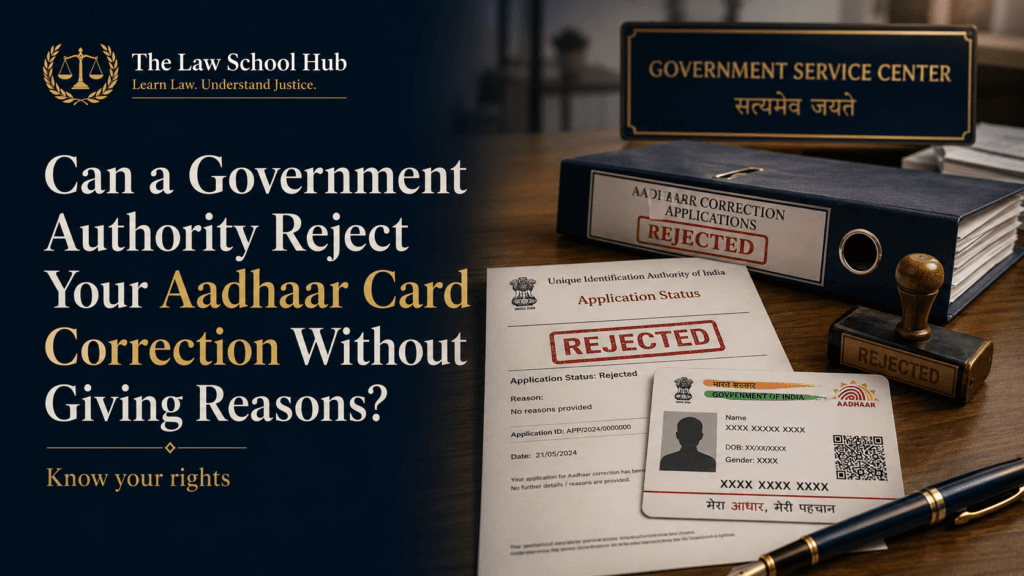
Legal Note: This article is strictly written for educational, academic, and general legal awareness purposes only. It does not constitute formal legal advice or create an attorney-client relationship. While we make every effort to ensure absolute legal accuracy, you must always verify the laws with official sources, such as the UIDAI portal, the India Code, or speak to a practicing advocate. Please check current government notifications, as administrative guidelines and Standard Operating Procedures (SOPs) frequently change.
Table of Contents
Introduction
If you are currently wondering whether a massive government authority like the Unique Identification Authority of India (UIDAI) can simply dismiss your identity update application without explaining why, you need a clear answer immediately. Directly answering your most urgent question: No, a government authority cannot legally reject your Aadhaar card correction without giving you specific, clear, and recorded reasons. When your Aadhaar card correction rejected silently or with a vague automated code, the government actively violates the foundational Principles of Natural Justice and your constitutional right against arbitrary state action. Consequently, you do not have to sit back and accept a silent rejection. Because your Aadhaar details directly control your access to banking, passports, subsidies, and fundamental livelihood, having an update denied without explanation is a severe infringement on your civil rights. Therefore, navigating a situation where your Aadhaar card correction rejected demands a strong understanding of administrative law, constitutional protections, and specific grievance mechanisms. By reading this comprehensive, simple, and legally rigorous guide, law students, legal practitioners, and everyday citizens will deeply understand exactly why the government is legally bound to provide reasons and how you can forcefully demand them.
Overview
The legal framework surrounding the Aadhaar ecosystem in India represents a complex intersection of massive digital infrastructure and strict administrative law. Primarily, The Aadhaar (Targeted Delivery of Financial and Other Subsidies, Benefits and Services) Act, 2016, governs how the UIDAI operates. While the UIDAI utilizes automated Artificial Intelligence (AI) and massive backend servers to process millions of requests, these technological systems do not exempt the authority from following the rule of law. Specifically, Indian administrative law strictly mandates that any state action affecting a citizen’s rights must be accompanied by a “Speaking Order”—an order that speaks for itself by providing clear reasons. Unfortunately, millions of citizens frequently face a frustrating scenario where their Aadhaar card correction rejected with vague automated SMS alerts like “Data Process Error” or “Document Rejected.” Ultimately, because you possess a fundamental right to your identity and to be treated fairly by the State, you possess remarkably powerful legal tools to force the authorities to justify their actions. This extensively researched blog meticulously breaks down the legal illegitimacy of silent rejections and the exact steps you must take to fight back.
Detailed Explanation: The Core Issue of Silent Rejections
Navigating a massive bureaucratic system requires absolute patience, but it also heavily demands a cold, calculated legal strategy. Therefore, you must first understand the legal philosophy behind why the government must give reasons before you launch a formal legal escalation. Let us comprehensively break down the administrative concepts that make a silent rejection illegal when your Aadhaar card correction rejected.
The Rule of Law and Administrative Action
Firstly, you must understand that UIDAI is a statutory body created by an Act of Parliament. Consequently, it is an instrumentality of the State under Article 12 of the Constitution of India. As a State entity, UIDAI is strictly bound by the Rule of Law. The Rule of Law dictates that the government cannot act upon its own whims or fancies. Every decision made by a government officer, whether it is approving a tender or updating a date of birth on an Aadhaar card, must be based on logic, law, and verified facts. Therefore, when your Aadhaar card correction rejected without a specific reason, the state acts arbitrarily, which is the exact opposite of the Rule of Law.
The Concept of a “Speaking Order”
In administrative law, a very famous concept exists known as a “Speaking Order.” A speaking order simply means that the administrative authority must record its reasons in writing when making a decision that negatively affects a citizen. Why is a speaking order so absolutely critical?
- It prevents arbitrariness: When an officer has to write down a reason, they are forced to apply their mind to the facts and the law, preventing them from rejecting applications out of laziness or bias.
- It enables the right to appeal: If you do not know why your Aadhaar card correction rejected, how can you possibly fix the error or appeal the decision? You cannot fight an invisible enemy.
- It allows judicial review: If you eventually take UIDAI to the High Court, the judge needs to read the reasons for rejection to decide if the government acted legally. A silent rejection completely paralyzes the court’s ability to perform judicial review.
Automated Rejections vs. Natural Justice
Currently, the biggest practical problem involves the UIDAI’s backend automated systems. When you apply for a demographic update (like a name or address change), an AI system often scans the uploaded document. If the AI detects a slight spelling mismatch or a blurry scan, it automatically drops the application. The citizen merely receives a text message saying, “Your update request has been rejected.”
However, technology cannot override constitutional law. Even if a computer makes the initial flag, a human being is legally entitled to know the exact factual basis for the rejection. Simply stating “Backend Error 404” or “Document Mismatch” is not a legally valid reason. A legally valid reason would state: “Your Aadhaar card correction rejected because the spelling on the uploaded PAN Card (Rahul S.) does not match the requested name (Rahul Sharma).” Furthermore, the lack of human intervention in providing clear reasons actively violates the basic tenets of administrative fairness.
The “Audi Alteram Partem” Rule
This is a Latin legal maxim that means “listen to the other side.” It is the most fundamental Principle of Natural Justice. Before the government takes away a right or rejects a crucial application, they must give you a fair hearing or a fair chance to explain yourself. While UIDAI cannot hold a physical court hearing for every single Aadhaar update, the spirit of this rule implies that they must tell you exactly what is wrong so you have a fair opportunity to correct it in your next application. When your Aadhaar card correction rejected silently, the UIDAI essentially denies you your right to be heard effectively.
Key Legal Provisions Explained Simply
To effectively fight back and demand answers when your Aadhaar card correction rejected, you must speak the language of the law. Government officers and grievance portals react much faster when you specifically quote relevant statutes and rules. You can find detailed breakdowns and study materials on these specific laws at The Law School Hub.
The Constitution of India
- Article 14 (Equality before Law): This is your strongest constitutional shield. The Supreme Court has repeatedly held that Article 14 strikes at the root of arbitrariness. Any government action that is arbitrary, unreasonable, or whimsical violates Article 14. Therefore, rejecting a valid citizen’s application without giving any logical reason is actively deemed arbitrary and unconstitutional.
- Article 21 (Protection of Life and Personal Liberty): The right to life includes the right to live with dignity. In the modern digital age, your Aadhaar is tied to your bank account, your rations, and your employment. Consequently, having an incorrect Aadhaar card heavily impacts your livelihood. Therefore, an unreasonable delay or an unexplained rejection where your Aadhaar card correction rejected actively infringes upon your Article 21 rights.
The Aadhaar (Targeted Delivery of Financial and Other Subsidies, Benefits and Services) Act, 2016
- Section 31 (Alteration of demographic information or biometric information): Section 31(1) strictly provides an Aadhaar number holder the right to request the Authority to alter their information. Crucially, Section 31(3) dictates that upon receipt of such a request, the Authority shall make such alterations as may be prescribed. The word “shall” implies a mandatory duty. While they can reject forged documents, they cannot ignore the mandatory duty to process valid requests fairly and transparently.
- Section 32 (Access to own information and records): This section gives you the absolute statutory right to access your own information. If UIDAI maintains an internal file noting or an error code detailing exactly why your Aadhaar card correction rejected, you have a legal right under this section to demand access to that specific information. They cannot hide it from you.
The Right to Information Act, 2005 (RTI Act)
- Section 4(1)(d): This is a massively powerful, often ignored provision. It explicitly mandates that every public authority shall “provide reasons for its administrative or quasi-judicial decisions to affected persons.” Therefore, the RTI Act itself legally commands the UIDAI to provide you with the exact reasons why your application was rejected.
- Section 6(1) (Request for obtaining information): When standard UIDAI customer care fails to give you a reason, you can legally file an RTI application under this section demanding the “daily progress report” and “specific reasons for rejection recorded on the file” for your specific Update Request Number (URN).
The Aadhaar (Enrolment and Update) Regulations, 2016
- Regulation 27 (Grievance Redressal Mechanism): This regulation legally structures the entire grievance process. It binds the UIDAI to set up a robust contact center. More importantly, the spirit of any grievance redressal mechanism legally requires the authority to provide a substantive resolution, not just a generic automated reply. Therefore, if your Aadhaar card correction rejected, the grievance cell is legally bound to investigate and provide the actual reason.
Important Case Laws Taught Simply
Understanding Supreme Court and High Court judgments heavily empowers you to assert your rights powerfully. When you draft legal notices, RTI applications, or writ petitions regarding a situation where your Aadhaar card correction rejected silently, relying on these landmark cases proves your authoritativeness to the bureaucracy.
1. The Mandate for Speaking Orders: S.N. Mukherjee v. Union of India
Citation: S.N. Mukherjee v. Union of India, AIR 1990 SC 1984. Simple Meaning: In this foundational administrative law judgment, the Supreme Court of India definitively established that an administrative authority exercising judicial or quasi-judicial functions must record reasons for its decisions. The Court noted that recording reasons ensures that the authority applies its mind to the case and prevents arbitrary action. Therefore, if UIDAI acts in a quasi-judicial manner by evaluating your documents and deciding your civil identity rights, they are strictly bound by this judgment to provide a speaking order when your Aadhaar card correction rejected.
2. The Expansion of Reasonableness: Kranti Associates Pvt. Ltd. v. Masood Ahmed Khan
Citation: Kranti Associates Pvt. Ltd. v. Masood Ahmed Khan, (2010) 9 SCC 496. Simple Meaning: This is arguably the most important modern case on the necessity of giving reasons. The Supreme Court laid down exhaustive principles, stating that reasons must be recorded by both quasi-judicial and administrative bodies. The Court beautifully stated that “reasons are the links between the materials on which certain conclusions are based and the actual conclusions.” Furthermore, the Court noted that giving reasons introduces clarity, checks the abuse of power, and guarantees fairness. You must quote this case if you are sending a legal notice to UIDAI demanding reasons for rejection.
3. Striking Down Arbitrariness: Maneka Gandhi v. Union of India
Citation: Maneka Gandhi v. Union of India, AIR 1978 SC 597. Simple Meaning: While originally a passport impounding case, this monumental judgment expanded the scope of Article 14 to firmly establish that arbitrariness is the direct enemy of equality. The Court held that any state procedure must be “right, just and fair” and not arbitrary, fanciful, or oppressive. Therefore, a silent, automated rejection without giving the citizen a chance to understand the error is a procedurally unfair state action, violating the Maneka Gandhi doctrine.
4. The Right to Identity: Justice K.S. Puttaswamy (Retd.) v. Union of India
Citation: Justice K.S. Puttaswamy (Retd.) v. Union of India, (2019) 1 SCC 1. Simple Meaning: In the historic Aadhaar constitutionality judgment, the Supreme Court upheld the Aadhaar Act but heavily emphasized that the data collection and update mechanisms must be robust, fair, and transparent. The Court recognized that identity is an essential part of human dignity under Article 21. Consequently, depriving someone of an accurate identity by unreasonably keeping an Aadhaar card correction rejected without justification violates the fundamental right to live with dignity.
Practical Examples and Illustrations
To fully grasp how these complex administrative laws and constitutional protections apply in the real world, let us meticulously look at practical, everyday illustrations that showcase exactly what happens and what you should do when your Aadhaar card correction rejected without a clear reason.
Illustration 1: The Automated Name Change Rejection
The Problem: Anjali recently got married and wishes to update her surname on her Aadhaar card. She uploads her legally registered marriage certificate online and pays the fee. After 15 days, she receives an SMS: “Your Aadhaar Update Request URN XXXXXXXXXXXXXX has been rejected due to invalid documents.” She calls the 1947 helpline, but the agent simply repeats the SMS and says they cannot see any further details. Her Aadhaar card correction rejected silently, and she is entirely stuck. The Legal Reality: The UIDAI has violated Section 4(1)(d) of the RTI Act and the Principles of Natural Justice. “Invalid documents” is a generic classification, not a reason. The Solution:
- Anjali must not blindly apply again.
- She must immediately file a grievance on the UIDAI portal, stating: “As per the Supreme Court mandate in Kranti Associates, please provide the specific, detailed reason why my marriage certificate was deemed invalid.”
- If they fail to respond within a week, she must file an RTI application demanding the exact file notings of her rejection. Usually, this forces the backend team to reveal that perhaps a specific seal was missing or the scan was slightly cropped, allowing her to fix it in her next attempt.
Illustration 2: The Date of Birth (DOB) Limit Trap
The Problem: Vikram needs to change his Date of Birth to match his 10th-grade mark sheet for an urgent government job application. He applies online, but it is instantly rejected with the code “Exception Limit Reached.” He visits a local enrollment center, but the operator says they cannot do anything because the system simply rejects it automatically without a human looking at it. His Aadhaar card correction rejected continuously. The Legal Reality: UIDAI rules state that DOB can only be changed once. However, administrative law dictates that rigid rules cannot entirely destroy a citizen’s fundamental rights without an exception mechanism. The Solution:
- Vikram cannot solve this through standard customer care. He must utilize the “Exception Handling Process.”
- He must physically travel to the UIDAI Regional Office.
- He must submit a physical application, attaching his valid documents, and specifically request a manual review. He must argue that a blanket automated rejection violates his right to a fair hearing, and he is legally requesting a designated officer to manually review his genuine hardship.
Illustration 3: The Unexplained Biometric Failure
The Problem: Ram, a 60-year-old farmer, goes to update his address. The operator captures his fingerprints, but due to years of manual labor, his prints are faded. The application is submitted, but 20 days later, his Aadhaar card correction rejected with the status “Quality Check Failed.” The Legal Reality: The UIDAI has a duty under the Aadhaar Regulations to provide accessible mechanisms for the elderly and those with degraded biometrics. Rejecting it without offering an alternative violates these statutory duties. The Solution:
- Ram must visit the center again and explicitly command the operator to utilize the “Biometric Exception” protocol.
- If the operator refuses, Ram must lodge a complaint via the Centralized Public Grievance Redress and Monitoring System (CPGRAMS), stating that he is being denied his statutory update rights without alternative reasons being provided.
Listicles: Vital Summaries for Quick Action
To make sure you do not forget the most important points when you are frustrated by government bureaucracy, memorize these simple, highly actionable lists related to an Aadhaar card correction rejected crisis.
7 Reasons Why UIDAI Must Provide “Speaking Orders”
- It is a Constitutional Mandate: Article 14 demands equality and fairness; arbitrary, silent rejections are strictly unconstitutional.
- It is a Statutory Right: Section 4(1)(d) of the RTI Act legally binds all public authorities to provide reasons for administrative decisions.
- It Follows Supreme Court Orders: The Kranti Associates judgment explicitly made it mandatory for all administrative bodies to record reasons.
- It Ensures Accountability: When an officer has to write down a reason, they are held personally accountable for not rejecting valid applications lazily.
- It Prevents Endless Cycles: Without knowing the specific error, a citizen will just keep uploading the same wrong document, wasting everyone’s time.
- It Enables Your Right to Appeal: You cannot effectively escalate a grievance to a Regional Officer if you do not know the factual basis of the rejection.
- It Facilitates High Court Review: If you file a Writ Petition, the judge relies entirely on the recorded reasons to determine if the UIDAI acted legally.
5 Immediate Steps to Take When Rejected Without Reason
- Capture the Evidence: Immediately screenshot the vague rejection SMS or portal status. Save your Update Request Number (URN) safely.
- Demand Specificity via 1947: Call the toll-free number. Do not accept “document error.” Demand they open an internal Service Request (SR) ticket to find the exact spelling or image mismatch.
- File a Written Portal Grievance: Use the official UIDAI grievance portal. Explicitly type that you are requesting a specific, recorded reason for the rejection, not a generic computer code.
- Invoke the RTI Act: If 30 days pass and you still only have vague answers, file an online RTI addressed to your UIDAI Regional Office. Ask for “File Notings” regarding your URN.
- Escalate to CPGRAMS: File a complaint on the central government PG portal. State clearly: “My fundamental right to identity is being hampered because UIDAI is arbitrarily rejecting my application without providing legally mandated reasons.”
Tables: A Simple Guide to Rejection Codes and Real Reasons
For a quick and easy way to definitively understand what UIDAI’s vague automated codes actually mean, use this simple matrix to decode your Aadhaar card correction rejected status.
| Vague Rejection Code Sent by UIDAI | What It Actually Means in Administrative Reality | The Specific Legal or Administrative Action You Must Take |
|---|---|---|
| “Invalid Document” | The document is blurry, expired, not on the approved list, or a black-and-white photocopy. | Check the latest UIDAI valid document list. Upload a highly clear, color scan of the original document. |
| “Data Process Error” | There is a spelling mismatch. (e.g., POI says “Ramesh Kumar” but you typed “Ramesh K.”). | Re-apply making sure the typed data matches the uploaded document character for character. |
| “Exception Limit Reached” | You have already updated your Date of Birth or Gender once before in your lifetime. | Do not apply online. Physically visit the UIDAI Regional Office with original documents for a manual override. |
| “Quality Check Failed” | The operator captured very poor fingerprints or a dark, blurry photograph. | Visit a different Aadhaar center with better equipment. Ask the operator to use biometric exceptions if your prints are worn out. |
| “Relationship Proof Invalid” | The Head of Family (HOF) document does not clearly state the exact relationship. | Ensure you use a standard UIDAI HOF affidavit format or a highly clear registered document like a ration card. |
Approaching the High Court: The Ultimate Legal Remedy
For law students, legal practitioners, and citizens facing severe hardship, it is crucial to understand the ultimate constitutional remedy. What happens if UIDAI completely ignores your RTIs, ignores CPGRAMS, and keeps your Aadhaar card correction rejected silently, causing you to lose a college seat or a vital pension?
In such extreme cases of administrative failure, you must invoke Article 226 of the Constitution of India. You file a Writ Petition in the High Court of your respective state. Specifically, you seek two distinct writs:
- Writ of Certiorari: You ask the High Court to “quash” (cancel) the silent rejection order, arguing that it is legally void because it lacks reasons (a non-speaking order) and violates the Principles of Natural Justice.
- Writ of Mandamus: You simultaneously ask the High Court to “command” the UIDAI to perform its statutory public duty under Section 31 of the Aadhaar Act and process your update application fairly, providing clear reasons if they choose to reject it again.
High Courts frequently entertain these petitions when fundamental rights are severely threatened. Before filing a writ, standard legal practice requires you to send a formal, strongly-worded legal notice to the UIDAI Regional Officer under Section 80 of the Civil Procedure Code (CPC), explicitly stating that their failure to provide reasons is unconstitutional and demanding immediate action to prevent litigation.
Key Takeaways
- Knowing exactly what your legal rights are turns you from a frustrated victim into an empowered citizen when your Aadhaar card correction rejected.
- UIDAI is a State authority bound by the Constitution and administrative law; they absolutely cannot reject applications arbitrarily without providing clear, written reasons.
- A silent rejection or a vague automated code actively violates the Principles of Natural Justice, Article 14 (Equality), and Section 4(1)(d) of the RTI Act.
- You must never accept a vague rejection. Use the escalation matrix: demand specific answers on 1947, file a detailed written grievance, and heavily utilize the RTI Act to force transparency.
- If the government blatantly ignores your administrative pleas and harms your livelihood, powerful constitutional tools like a Writ of Mandamus in the High Court ensure you get absolute legal justice.
Conclusion
In the end, fighting bureaucratic opacity in India requires a remarkably calm mind and a fierce understanding of legal principles. When your Aadhaar card correction rejected silently, the government apparatus often relies on the assumption that you do not know your rights and will simply give up. However, by reading and internalizing the strict administrative protocols, constitutional protections, and the mandatory requirement for “Speaking Orders” discussed in this comprehensive guide, you completely neutralize the bureaucracy’s advantage. You now know exactly how to leverage the RTI Act, how to demand specific file notings, and how to utilize the PMO’s CPGRAMS portal to force accountability. The Indian legal system provides remarkably strong tools for citizens who know how to demand answers correctly. Therefore, stay calm, rigorously demand specific reasons for every rejection, preserve your digital evidence, and always aggressively fight for your fundamental right to a transparent and accurate digital identity.
Frequently Asked Questions (FAQs)
To give you the absolute fastest help possible, here are clear, simple, and legally verified answers to the most common questions people ask when they face a severe situation where their Aadhaar card correction rejected without reasons.
1. Is it legally permissible for UIDAI to just send an SMS saying “Rejected”? No, it is not legally sufficient. While an SMS serves as a notification, administrative law requires UIDAI to maintain specific, recorded reasons for the rejection in their backend files. You have a legal right to demand and know those specific reasons.
2. I received a “Data Process Error.” Is this a legally valid reason? No. “Data Process Error” is an internal IT code, not a factual, substantive reason. A legally valid reason must explain why the process failed (e.g., “The uploaded PAN card was unreadable”). You must demand the actual factual reason through grievance portals.
3. Can I file an RTI specifically asking why my Aadhaar card correction rejected? Yes, absolutely. Under Section 4(1)(d) and Section 6 of the RTI Act, 2005, you have a statutory right to ask a public authority for the reasons behind its administrative decisions affecting you. You can ask for the specific file notings for your URN.
4. What should I do if the 1947 helpline agent says they cannot see the reason? Customer care agents often only see surface-level codes. You must firmly command them to raise an internal “Service Request (SR)” ticket and escalate it to the backend technical team so a human officer can investigate the exact cause of rejection.
5. My Date of Birth update was rejected instantly. Why did this happen? UIDAI software automatically blocks second-time DOB updates based on standard policy limits. The computer does not give a reason because it is a hardcoded block. You must bypass the computer and physically visit a Regional Office to demand a manual “Exception Handling” review.
6. Can I sue UIDAI for repeatedly rejecting my valid application? Yes. If UIDAI repeatedly and arbitrarily rejects a highly valid application containing perfect government documents (like a Passport or Court Order), and it causes you financial or personal harm, a lawyer can file a Writ Petition in the High Court seeking a Mandamus against the authority.
7. Does the new DPDP Act 2023 help if my Aadhaar card correction rejected? Yes. The Digital Personal Data Protection Act, 2023, classifies UIDAI as a Data Fiduciary. Section 8(8) forces Data Fiduciaries to ensure data accuracy. Therefore, unreasonably preventing you from keeping your data accurate violates their legal duty under the new privacy law.
8. Will CPGRAMS actually force UIDAI to give me a reason? Yes, CPGRAMS is highly effective. Because it is monitored by the central government, nodal officers are heavily pressured to provide substantive, written replies to close the grievance ticket, forcing them to reveal the exact reason for rejection.
9. Can a simple spelling mistake on my PAN card cause a rejection? Yes, this is the most common reason for rejection. UIDAI’s automated systems match data strictly. If your Aadhaar application says “Mohd. Ali” and your PAN card says “Mohammad Ali,” the system will instantly reject it due to the mismatch.
10. What is a “Speaking Order” and how does it relate to Aadhaar? A “Speaking Order” is a legal term meaning an official decision that clearly explains its own reasoning. The Supreme Court mandates that all government decisions affecting citizens must be speaking orders. Therefore, a silent Aadhaar rejection is legally invalid because it is a “non-speaking order.”
Legal References
- The Constitution of India, 1950 (Official Repository).
- The Aadhaar (Targeted Delivery of Financial and Other Subsidies, Benefits and Services) Act, 2016 (India Code).
- The Right to Information Act, 2005 (India Code).
- The Aadhaar (Enrolment and Update) Regulations, 2016 (UIDAI Official Gazette Notification).
- S.N. Mukherjee v. Union of India, AIR 1990 SC 1984 (Supreme Court landmark judgment on the necessity of Speaking Orders).
- Kranti Associates Pvt. Ltd. v. Masood Ahmed Khan, (2010) 9 SCC 496 (Supreme Court judgment mandating reasons for administrative actions).
- Maneka Gandhi v. Union of India, AIR 1978 SC 597 (Supreme Court judgment striking down arbitrary state action under Article 14).
- Justice K.S. Puttaswamy (Retd.) v. Union of India, (2019) 1 SCC 1 (Supreme Court landmark judgment on Aadhaar validity and Right to Identity).
- Unique Identification Authority of India (UIDAI) Official Grievance Redressal Policy.
- Centralized Public Grievance Redress and Monitoring System (CPGRAMS).
- Supreme Court of India Official Judgments Portal.
- RTI Online Portal (Department of Personnel and Training, Govt of India).
- Ministry of Electronics and Information Technology (MeitY) Notifications.
- SCC Online Legal Database (For extensive constitutional and administrative law research).
- Indian Kanoon (Open Access Legal Database for preliminary case law research).
- Please note: Case citations, specific administrative guidelines, and writ jurisdiction principles must be carefully verified against current government notifications before any formal court submission.
At The Law School Hub, we simplify case laws, legal acts, and legal concepts for law students and legal readers. Want to read more useful legal blogs? Visit The Law School Hub.