
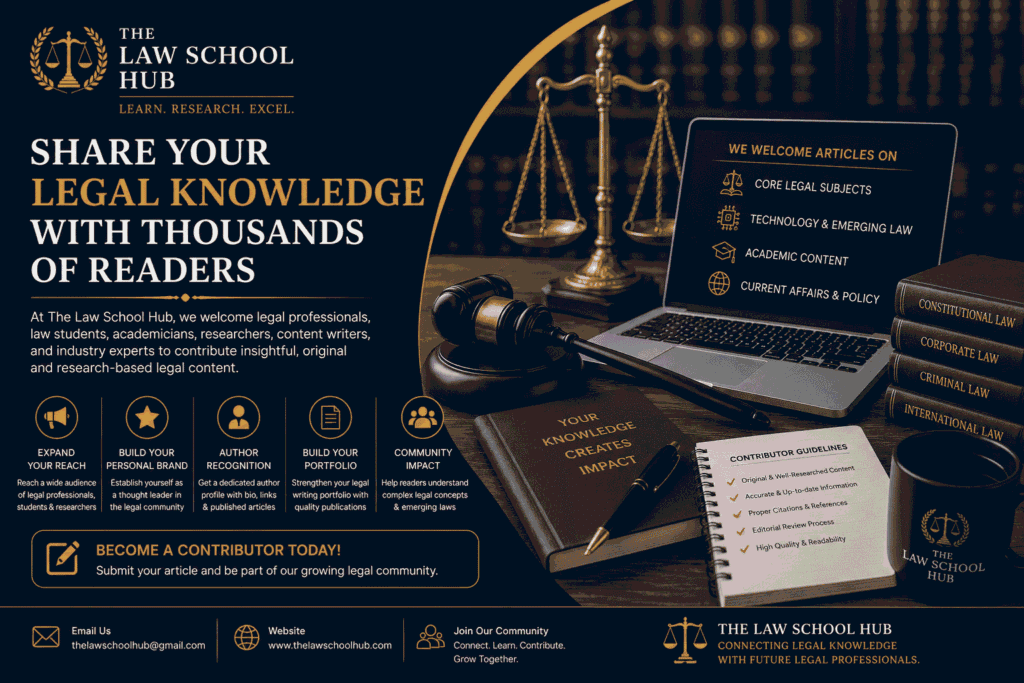
⚖️ Share Your Legal Knowledge with Thousands of Readers
At The Law School Hub, we are committed to making legal knowledge accessible, accurate, and easy to understand. 📚 We welcome contributions from legal professionals, law students, academicians, researchers, content writers, and industry experts who are passionate about law, technology, policy, and legal education. If you have valuable insights, practical experience, or research-based knowledge to share, we invite you to become a contributor and join our growing legal community. 🚀
🌟 Why Write for The Law School Hub?
Contributing to The Law School Hub offers numerous benefits:
📢 Expand Your Professional Reach
Showcase your expertise before a growing audience of law students, legal practitioners, researchers, and professionals.
🏆 Build Your Personal Brand
Establish yourself as a thought leader in your area of legal expertise.
👤 Author Recognition
Receive a dedicated author profile featuring your biography, credentials, social media links, and published articles.
📂 Portfolio Development
Strengthen your legal writing portfolio with high-quality published content.
🤝 Community Impact
Help readers understand complex legal concepts, landmark judgments, statutes, regulations, and emerging legal developments.
📚 Topics We Accept
We welcome original and well-researched content related to:
⚖️ Core Legal Subjects
- 📜 Constitutional Law
- 🚔 Criminal Law
- 🏛️ Civil Law
- 💼 Corporate Law
- 🤝 Contract Law
- 👨👩👧 Family Law
- 🏠 Property Law
- 👷 Labour Law
- 💰 Taxation Law
- 🌱 Environmental Law
💻 Technology & Emerging Law
- 🤖 Artificial Intelligence Law
- 🔐 Cyber Law
- 🛡️ Data Privacy & Protection
- 🌐 Digital Rights
- 💡 Intellectual Property Rights
- ⛓️ Blockchain & Cryptocurrency Regulation
- 💳 FinTech Law
- 📱 Social Media Law
🎓 Academic Content
- 📖 Case Law Analysis
- ⚖️ Landmark Judgments
- 📝 Legal Research Articles
- 💭 Legal Commentary
- 🎒 Law School Guides
- 🚀 Career Advice for Law Students
- ✍️ Legal Writing Tips
🌍 Current Affairs & Policy
- 🏛️ Legal Reforms
- 📄 New Bills and Acts
- 📢 Government Policies
- 🌎 International Law Developments
- 📈 Regulatory Updates
📋 Contributor Guidelines
To maintain quality and credibility, all submissions must comply with the following requirements:
✨ Original Content
- ✅ Articles must be 100% original.
- ❌ Plagiarism is strictly prohibited.
- 🤖 AI-assisted writing may be used for research support, but submissions must be reviewed, edited, and fact-checked by the author.
🎯 Accuracy
- ✅ All legal information must be accurate and up-to-date.
- 📚 Cite statutes, regulations, case laws, and official sources whenever applicable.
📏 Article Length
- Minimum: 1,000 words
- Recommended: 1,500–2,500 words
🖋️ Formatting Requirements
- 📌 Use clear headings and subheadings.
- 📌 Include short paragraphs for readability.
- 📌 Use bullet points where appropriate.
- 📌 Add tables when beneficial.
🔗 Citations
- 📖 Reference official legal sources whenever possible.
- 🌐 Include hyperlinks to legislation, court decisions, government portals, and recognized legal databases.
🔍 Editorial Review Process
Every submission undergoes editorial review to ensure:
✅ Legal accuracy
✅ Content quality
✅ Readability
✅ SEO optimization
✅ Compliance with editorial standards
Our editorial team reserves the right to edit content for clarity, grammar, formatting, and search engine optimization.
👨⚖️ Contributor’s Author Profile Benefits
Approved contributors may receive:
- 🌟 Dedicated author page
- 📝 Professional bio section
- 🔗 Social media profile links
- 🌐 Website link (where appropriate)
- 🏅 Recognition across The Law School Hub platform
📤 Contributor’s Submission Process
1️⃣ Prepare Your Article
Prepare your article in Microsoft Word (.docx) format.
2️⃣ Include the Following Details
- 👤 Full Name
- 💼 Professional Designation
- 🎓 Educational Qualifications
- 📝 Short Author Bio (50–100 words)
- 🔗 LinkedIn Profile URL
- 📧 Email Address
- 📸 Profile Photograph (Optional)
3️⃣ Submit for Review
Submit your article for editorial review.
🛡️ Contributor Code of Ethics
Contributors must:
- ⚖️ Maintain professional integrity.
- 📚 Avoid misleading legal interpretations.
- ©️ Respect copyright laws.
- 🤝 Disclose conflicts of interest.
- 🚫 Avoid promotional or overly commercial content.
🚀 Become a Contributor Today
Whether you are a law student sharing research, an advocate discussing practical legal issues, or an academic exploring emerging legal trends, your voice can help educate and empower readers.
Join The Law School Hub and contribute to building a reliable, accessible, and insightful legal knowledge platform. 🌟
📬 Ready to Contribute?
📩 Submit your article and become part of our growing legal community.
⚖️ The Law School Hub
📚 Connecting Legal Knowledge with Future Legal Professionals.