
Introduction
Picture making videos, sharing jokes online, tossing out hot takes, or responding to viral clips. At times, you might wonder: can I even use this stuff? Truth is, there’s no one size fits all reply. Using someone else’s work sometimes falls under fair use, a rule letting people borrow parts legally when rules are followed. Yet knowing if your version crosses into forbidden territory isn’t always straightforward. Here’s how it actually works, stripped of confusion.
Understanding Fair Use?
A rule exists that allows some uses of copyrighted material without permission. In India, you will find this idea spelled out in Section 52 of the Copyright Act from 1957, listing actions not seen as violations. The United States handles similar cases through Section 107 of Title 17 of its own copyright law.
Fair use exists because strict rules can get in the way of honest critique, classroom teaching, or new art. That’s why borrowing someone else’s work sometimes stays within legal bounds – just as long as it helps something bigger than profit alone.
Certain uses might be allowed, yet that doesn’t mean everything goes. Each situation gets looked at differently.
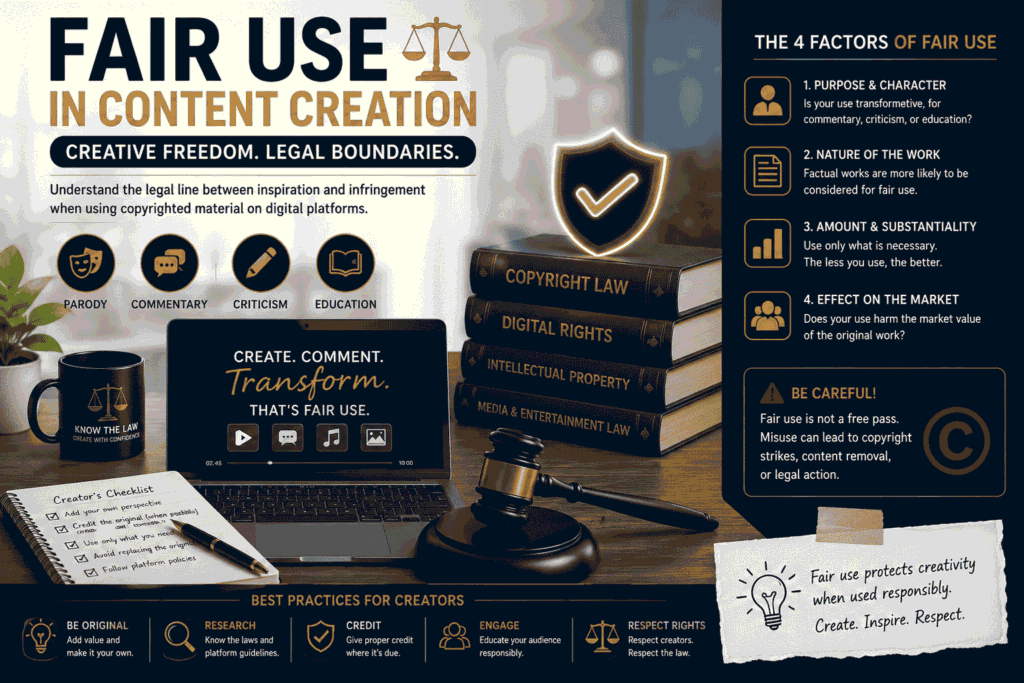
The Four Things Courts Consider for Fair Use!
Fair use in the U.S. comes down to how judges weigh four key points during rulings on creative work. Over in India, legal thinking leans on context too – that happens through what’s laid out in Section 52.
1. Purpose and Nature of the Use
What matters most is change. A fresh twist lifts it up – could be humor, a different take, or even a classroom example. Copying without shift falls flat every time. When purpose twists into something unexpected, like satire or analysis, it stands stronger. Profit alone, if nothing’s altered, rarely makes the cut.
2. Nature of the Copyrighted Work
What gets extra protection in court? Creative stuff – like novels, movies, or music – not dry facts like news stories or official reports. If a piece has already been shared with the public, it’s easier to reuse compared to something never released. The law watches tighter when material stays under wraps.
3. How Much Was Taken and How Important It Is
A snippet might seem harmless compared to copying everything. Yet when that little piece holds what people remember most, trouble can start.
4. Market Impact
Most times, folks see this as key. When your material takes the place of the real thing – say someone streams your clip rather than purchasing the movie – alarm bells go off. In cases where your work isn’t going head-to-head with the source, judges tend to lean toward calling it fair use.
Here is how these four factors play out in practice:
| Factor | Favours Fair Use | Favours Infringement | Content Creator Tip |
| Purpose & Character | Commentary, parody, education, criticism | Commercial gain, entertainment copying | Add transformative commentary or critique |
| Nature of Work | Factual, published material | Highly creative, unpublished | Prefer factual sources when possible |
| Amount Used | Small, necessary portion | Entire or substantial portion | Use only what is needed for your point |
| Market Effect | No harm to original market | Substitutes for or harms original work | Do not replace the original; link to it |
Parody vs. Satire: Not the Same Thing
It surprises some people how often they mix up parody with satire under fair use rules. Yet courts see them differently, which shapes outcomes. What one thinks counts as humor might not hold up when tested. The line between mimicking a work versus mocking society shifts legal ground entirely.
Mocking something often means copying it closely, just twisted a bit. That twist? It points back to what came first. When someone exaggerates a famous tune, say in a sketch, they’re not stealing – they’re showing flaws. Judges tend to see that as acceptable, since the joke depends on recognition. Think of a performer stretching every note of a hit song until it cracks into silliness. The law usually backs such acts, seeing them as commentary, not theft.
Mocking the world around us, satire borrows someone else’s creation without aiming at that piece directly. Since its target sits elsewhere – often institutions or trends – the law views such borrowing as less essential. That distance weakens its claim under fair use rules.
Imitation of a Bollywood movie for humor? That’s parody. When a familiar tune plays under jabs at a public figure, the line blurs. Protection fades in those moments. Context decides everything.
How Digital Platforms Manage This!
Digital spaces such as YouTube, Instagram, and Facebook follow both country laws and their own rules about copyright. A tool named Content ID runs on YouTube, checking every new video the moment it goes up. It looks for clips that match files owners have submitted as protected. When a link is found, the syhttp://youtubestem acts based on what the owner chose ahead of time. This process happens without people needing to step in. Rights holders decide if they want ads shown, tracking, or removal. The whole check unfolds silently behind the scenes. Matches pop up even if only part of a song or scene appears. Rules shift slightly depending on where someone lives. Each platform handles reports differently but stays within legal lines.
Should there be a match, the rights owner might stop your video from being viewed. They could take ad money instead of you if they choose to run commercials on it. Or maybe they simply watch how well it performs without making changes.
Filing a counter-notice while citing fair use? That’s allowed – though it counts as an official legal move. Should the copyright owner push back and head to court, standing your ground becomes necessary.
Most times, Instagram uses bots to catch rule breaks, while people can also flag posts by hand. Not judges, these sites act fast when alerted, removing content without trial-like checks. Rules let them dodge blame if they pull things down after warnings.
Fair Use and Copyright Law in India
Here, certain acts aren’t seen as breaking copyright law. One exception lets people copy material for private study. Courts allow reproduction during judicial proceedings. Another allowance covers recordings made strictly for educational broadcasts. Some uses in Parliament or state legislatures fall outside violation. Reporting current events may also qualify under specific conditions. Fair dealing with news commentary is sometimes permitted too
Using something fairly if it’s just for yourself, like when looking into a topic
• Criticism or review of a work
• Reporting of current events
• Use for educational purposes
Nowhere near as broad, the phrase “fair dealing” appears in India’s legal system instead of “fair use.” Depending on the particular exception cited, judges decide if the use counts as reasonable.
A ruling stood out when the Delhi High Court looked at how news outlets used movie snippets on air. When India TV faced off against Yashraj Films in 2012, questions arose about fair usage. Clips shown by broadcasters had to serve real journalistic purpose. Entertainment-driven segments failed to meet the standard set. What mattered was intent behind airing those scenes.
Examples From Real Life For People Who Create
Reaction Videos
Most of the time, dropping a full track or film moment into your video brings trouble. When what you say reshapes the meaning, fair use might protect you – yet copyright owners often challenge anyway. Let your voice lead. Show just enough footage to make sense. The smaller the borrowed piece, the safer the ground.
Memes
Most memes act like jokes about culture, not copies meant to replace. When a picture gets changed to tease an idea, it usually avoids trouble better than simply repeating the source without reason. Still, some people who made these edits got legal warnings anyway.
Cover Songs
Most times, doing a cover song doesn’t fall under fair use by default. Instead, if distributing covers in India for profit, legal permission is required through a special permit outlined in Section 31C of the Copyright Act.
Educational Explainers
Picture showing up early – short snippets, visuals, or borrowed lines helping clarify an idea in learning videos often fall safely under fair use. Because the goal shifts toward teaching, reshaping the original, that backing grows much harder to challenge.
What Content Creators Actually Do?
- Start by changing things – put your own thoughts into what you borrow, question it, reshape its message. A fresh take matters more than repeating facts. Look closer, push further, challenge the original instead of just passing it along. Meaning grows when you dig in, not when you echo. Your voice shifts how people see the source.
- Start small. Take only what you need instead of grabbing full tracks, movies, or written pieces. A little goes far when used right. Whole works stay behind. Pull snippets, not complete copies. Less fills the role just fine. Grabbing everything isn’t required. Tiny bits work better most times. Leave the rest alone. Pick fragments wisely. Full versions sit unused. Small slices carry weight too.
- Putting a name on borrowed work won’t make copying lawful – still, doing so hints at honesty. Original authors deserve mention even when permission slips through cracks.
- Look for Creative Commons or royalty-free content when possible.
- If uncertainty hits, go for a license anyway – plenty of owners will talk terms.
Before making money from content with someone else’s work, get advice from a lawyer.
Conclusion
Here’s how it works. Fair use isn’t a backdoor trick – it’s a rule built on balance. When crafting parodies, reactions, or lessons, one thing stays true: transformation matters most. What counts is whether your work adds new meaning instead of copying. The effect on the source material’s value plays a big role too. Another key point sits quietly – did you take only what was necessary? Each case turns on its own shape, never assumed.
Nowhere is safety clearer than knowing exactly where limits lie when making something new. Copyright rules in India, along with global standards, allow room for fresh takes on existing work – yet those allowances come with hard edges. Stepping too far means risk, even with good intent.
When uncertainty hits, seek a lawyer first – knowledge keeps you sharp. Moving forward means knowing the rules.
Frequently Asked Questions
1. What is fair use in content creation?
Using someone else’s work without asking can be okay if it’s for review, satire, teaching, or analysis – so long as rules are followed. India handles this through a concept called fair dealing, written into law under Section 52 of its 1957 Copyright Act.
2. Parody’s place within Indian copyright rules – does it fit or not?
Parody might fall within the boundaries of criticism or review, as outlined in Section 52 of India’s Copyright Act from 1957 – provided it actually engages with the source material. Still, compared to the broader scope of fair use in the United States, Indian courts take a tighter approach. Every situation gets weighed based on its own circumstances, leaving little room for sweeping conclusions.
3. Using Copyrighted Music in YouTube Videos?
Most times, grabbing a tune you did not pay for leads to trouble – videos silenced, flagged, or worse. Fair use might save you, sure, when edits change the original enough and only small pieces appear. Still, counting on that? Risky. Picking tracks cleared for reuse keeps things calm, smooth, predictable.
4. How does parody stand apart from satire under copyright rules?
Imitation with a critical edge – that’s what parody brings, drawing clear lines back to its source while mocking it. Because of that link, courts often see it as more justified under fair use rules. On the flip side, satire borrows a piece just to poke at another target altogether. Since the borrowed content isn’t essential in those cases, legal backing tends to shrink.
5. Putting someone’s name on their work – does that keep you safe from copyright issues?
Just because you give credit doesn’t mean using someone else’s work is allowed. Giving attribution helps show respect, yet it won’t turn illegal copying into something permitted. Meeting the rules for fair use or fair dealing remains necessary regardless. What matters most is whether the use fits within legal limits, not just if a name was mentioned.
6. What happens if YouTube flags my video for copyright?
Sound might get silenced by YouTube, or the clip could be taken down entirely – sometimes revenue goes straight to whoever owns the rights. A rebuttal based on fair use is possible, yet should the owner push forward legally, showing up in court becomes necessary to back that stance.
7. Are memes protected under fair use?
Some memes might fall under fair use when they change the original enough to make a point or poke fun at something. Still, that doesn’t mean they’re always safe – people who make them have been warned by lawyers before.
8. Section 52 of the Copyright Act 1957?
Whatever you keep to yourself – like reading or studying a work – is safe under Indian law. Picture using parts of a book to critique it; that counts too. Even pulling quotes for reviews won’t land you in trouble. Spreading news based on copyrighted material? Allowed, if done fairly. Private copying sits fine within these lines. Research use is carved out right in Section 52 of the 1957 Copyright Act. No penalty tags onto actions like these by design.
‘What counts as fair use isn’t decided by a set number or time limit. Judges check if the amount taken goes beyond what’s needed, also whether the core part of the work was copied. Smaller pieces tend to carry less risk.’