Your Auto-Debit Was Deducted After Cancellation: How to Legally Force a Chargeback for SaaS Subscriptions in India

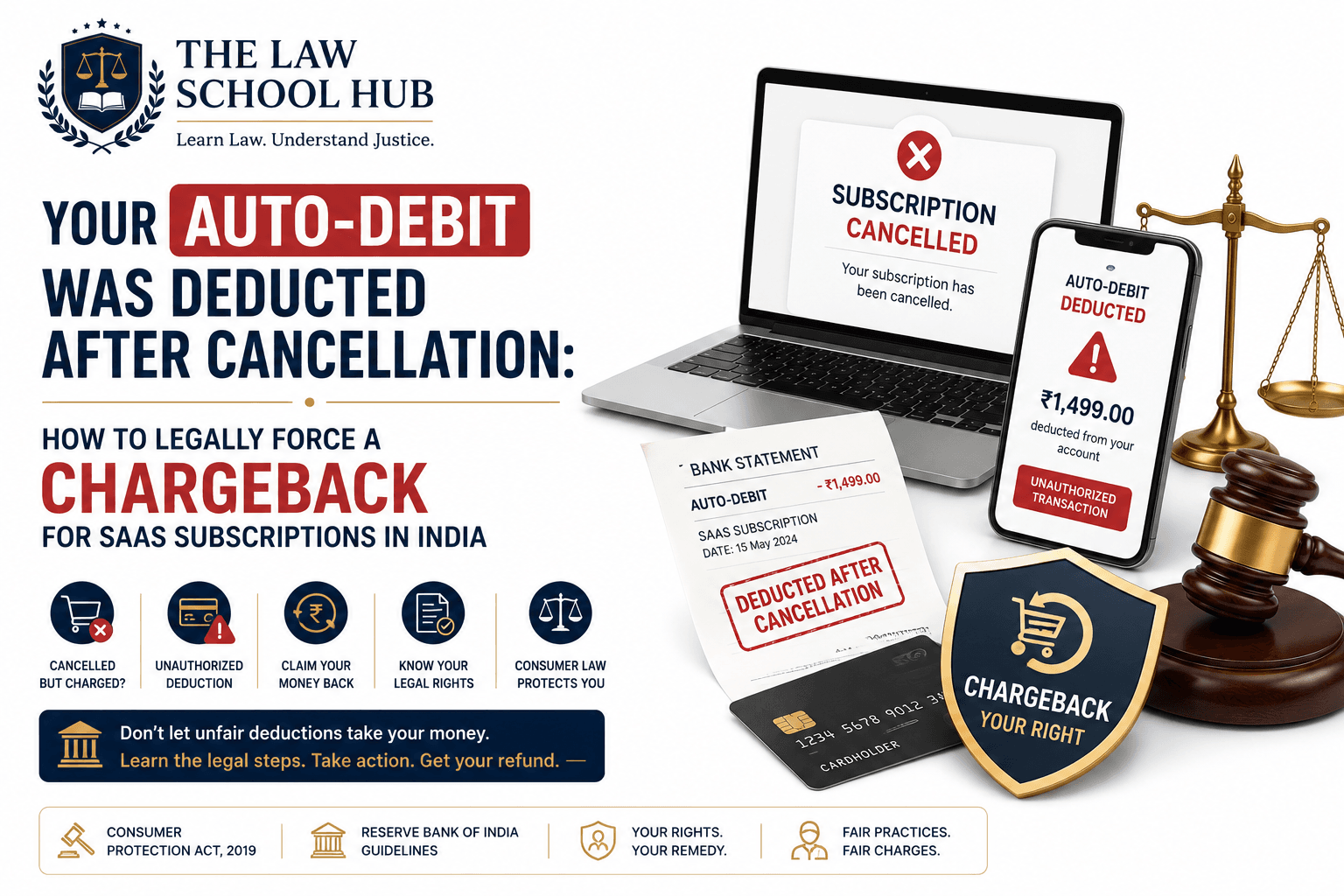
We have all been there. You sign up for a free trial of a shiny new SaaS (Software as a Service) platform—maybe a design tool, a cloud storage app, or a resume builder. You responsibly cancel your subscription a day before the billing cycle begins. You breathe a sigh of relief. But the next morning, your phone buzzes. You look at the screen, and your heart sinks. Your bank just messaged you: Your account has been debited.
Panic sets in. Why did this happen when you clearly cancelled the plan? More importantly, how do you get your hard-earned money back?
If you are dealing with a failed auto-debit cancellation in India, you are not alone. Thousands of consumers, young lawyers, and students face unauthorized deductions every day due to merchant negligence, payment gateway glitches, or banking delays. Fortunately, Indian banking and consumer protection laws are heavily heavily weighted in favor of the consumer.
In this comprehensive guide, we will break down exactly how you can legally force a chargeback for unauthorized SaaS subscriptions. We will explore the Reserve Bank of India (RBI) guidelines, consumer protection laws, and the exact legal steps you need to take.
Legal Note: The information provided in this blog is for educational and informational purposes only and does not constitute formal legal advice. While every effort has been made to ensure legal accuracy based on current RBI guidelines and Indian laws, readers are advised to consult a qualified legal professional or check the latest official gazettes before taking legal action. Laws and banking guidelines are subject to periodic amendments.
Table of Contents
Overview of the Topic
When you subscribe to a SaaS platform, you typically set up an “e-mandate” (electronic mandate) on your credit card, debit card, or UPI. This mandate gives the merchant permission to automatically deduct a specific amount at regular intervals.
Proper auto-debit cancellation in India requires the merchant or your bank to revoke this mandate. When an auto-debit is deducted after you have formally cancelled your subscription, the transaction transforms from an authorized payment into an unauthorized electronic banking transaction.
Under the stringent rules laid down by the RBI and the consumer rights guaranteed by the Consumer Protection Act, 2019, your bank and the merchant share the liability to refund this money. You do not have to accept the loss. By escalating the matter legally, you can force a chargeback—a reversal of the transaction directly driven by your bank.
Explained: The Mechanics of SaaS Auto-Debits
To effectively fight an unauthorized charge, you must first understand how auto-debits function under Indian law.
What is an E-Mandate?
An e-mandate is a digital standing instruction. In recent years, the RBI overhauled the recurring payment ecosystem to protect consumers from hidden SaaS charges. Whenever you set up a recurring payment, a digital contract is formed between you (the customer), the payment aggregator (like Razorpay or Stripe), and your bank.
Why Deductions Happen Post-Cancellation
When you execute an auto-debit cancellation in India, the SaaS platform is supposed to send an immediate signal to the payment gateway to terminate the e-mandate. However, deductions still occur due to three main reasons:
- Merchant Bad Faith (Dark Patterns): The SaaS company intentionally delays processing your cancellation request to squeeze out one more billing cycle.
- Technical Glitches: The merchant cancels your account, but their payment API fails to communicate the cancellation to the Indian payment aggregator.
- Banking Lag: Your bank receives the cancellation request but fails to update its internal database before the scheduled clearing cycle.
Regardless of the reason, once you hit “cancel” and receive a confirmation, any subsequent charge is illegal. You have an absolute right to initiate a chargeback.
What is a Chargeback?
A chargeback is a consumer protection mechanism where your bank forcefully retrieves funds from the merchant’s bank account and returns them to you. Unlike a standard refund—where you politely ask the merchant for your money—a chargeback is a formal banking dispute. It is your ultimate weapon when dealing with a failed auto-debit cancellation in India.
Key Legal Provisions Protecting You
When demanding a chargeback, throwing random legal jargon at the bank will not help. You must cite specific, accurate legal provisions. Here is the legal arsenal at your disposal when fighting a botched auto-debit cancellation in India:
1. Reserve Bank of India (Digital Payments – E-mandate Framework) Directions
The RBI governs all payment systems in the country. The central bank has issued clear directives regarding e-mandates on cards and UPI.
- The 24-Hour Notification Rule: Banks must send you a pre-transaction notification at least 24 hours before actual charge. This gives you a window to manually block the transaction.
- Customer’s Right to Withdraw: The RBI explicitly states that issuers (banks) must provide customers with a direct facility to withdraw an e-mandate at any point in time.
- Zero Liability Framework: Under RBI circulars on unauthorized electronic banking transactions, if the unauthorized debit is a result of a deficiency on the part of the bank, the customer has zero liability.
Note: You can read more about banking regulations in our dedicated banking law section at The Law School Hub.
2. The Consumer Protection Act, 2019
The modern Consumer Protection Act is highly effective for resolving digital transaction disputes.
- Deficiency in Service (Section 2(11)): The Consumer Protection Act, 2019, s. 2(11) defines “deficiency” as any fault, imperfection, shortcoming, or inadequacy in the quality, nature, and manner of performance that is required to be maintained by law. When a bank fails to stop a cancelled auto-debit, it directly commits a deficiency in service.
- Unfair Trade Practice (Section 2(47)): The Consumer Protection Act, 2019, s. 2(47) covers unfair methods or deceptive practices. A SaaS company ignoring your auto-debit cancellation in India and continuing to bill you falls squarely into this category.
- Filing a Complaint (Section 35): This section empowers you to file an electronic complaint with the District Consumer Disputes Redressal Commission against both the SaaS company and your bank.
3. The Payment and Settlement Systems Act, 2007 (PSS Act)
The PSS Act regulates payment gateways and clearing houses.
- Section 18: The Payment and Settlement Systems Act, 2007, s. 18 grants the RBI the power to formulate policies for payment system operators. Payment gateways must strictly adhere to mandate cancellations; failure to do so can result in hefty penalties for the operators.
4. The Information Technology Act, 2000
Because SaaS subscriptions are digital contracts, the IT Act applies.
- Penalty for Damage to Computer System (Section 43): The Information Technology Act, 2000, s. 43 imposes a penalty on anyone who accesses or causes disruption to a computer resource without permission. Drawing funds via an unauthorized mandate can arguably be framed as unauthorized access to your digital financial resources.
5. The Indian Contract Act, 1872
- Compensation for Breach (Section 73): The Indian Contract Act, 1872, s. 73 provides that the party who suffers from a breach of contract is entitled to receive compensation for any loss or damage caused. The cancellation of a SaaS subscription terminates the contract. Any subsequent auto-debit is a breach of the agreed termination.
Important Case Laws on Banking Deficiency
To build a legally sound chargeback claim, you should support your arguments with established jurisprudence. When a bank refuses to reverse a botched auto-debit cancellation in India, citing these cases in your legal notice will show them you mean business.
1. Vijaya Bank v. Gurnam Singh, (2010) 13 SCC 775
In this landmark judgment, the Supreme Court of India dealt with the liability of banks regarding unauthorized withdrawals. The Court held that a bank is liable for a deficiency in service if it honors transactions that shouldn’t have been processed (in this case, fraudulent cheques beyond the overdraft limit). Author’s Analysis: Applying the ratio of this case to modern digital transactions, if a bank honors an e-mandate after receiving a cancellation instruction from the customer, it commits a gross deficiency in service and is legally bound to compensate the customer.
2. CIC v. Canara Bank, (2021) SCC OnLine SC 107
The Supreme Court ruled that parallel remedies can exist in banking disputes. The pendency of a criminal investigation (such as cyber fraud) does not preclude a consumer from filing a case for deficiency in service before consumer forums. Author’s Analysis: Even if your bank claims the unauthorized SaaS debit is a “cyber fraud issue” that requires police intervention, this judgment empowers you to hold the bank accountable in a consumer court for failing its duty to secure your account post-cancellation.
3. Amitabha Dasgupta v. United Bank of India, (2021) 2 SCC 1
While this case primarily dealt with the management of bank lockers, the Supreme Court laid down an expansive principle regarding a bank’s fiduciary duty. The Court emphasized that banks owe a high duty of care to their customers to protect their assets. Author’s Analysis: By failing to honor a direct request for an auto-debit cancellation in India, the bank breaches its fiduciary duty to protect the customer’s funds from unauthorized third-party (merchant) extraction.
Practical Examples and Illustrations
Let us look at a few real-life scenarios to understand how auto-debit cancellation in India plays out.
Illustration 1: The Ignored SaaS Cancellation
Rahul signs up for a premium video editing SaaS platform for a one-month project. On the 25th day, he navigates to the billing portal, clicks “Cancel Subscription,” and receives a confirmation email. On the 30th day, the platform charges him ₹4,500. Legal Action: Rahul must first email the SaaS provider with the cancellation proof. If they refuse to refund, he must file a chargeback with his credit card issuer, submitting the cancellation email as primary evidence. The bank is legally required to reverse the charge.
Illustration 2: The Silent Bank Error
Priya manually revokes a mandate for a cloud storage app directly through her bank’s mobile app under the “Manage Mandates” section. Despite the app showing the mandate as “Cancelled,” she is debited ₹1,500 the following week. Legal Action: Since Priya cancelled the mandate via the bank’s own infrastructure, the merchant is not at fault—the bank is. Priya can file a complaint with the RBI Banking Ombudsman for a clear deficiency in service by the bank.
How to Legally Force a Chargeback?
If you are a victim of an unauthorized deduction, follow these 5 definitive steps to force a chargeback successfully:
5 Steps to Execute an Auto-Debit Chargeback
- Gather Irrefutable Evidence: Take screenshots of your SaaS account dashboard showing the “Cancelled” status. Save all cancellation confirmation emails, timestamped messages, and your bank statement showing the unauthorized debit.
- Send a Final Demand Email to the Merchant: Write a stern email to the SaaS company’s support team. Attach your evidence and state that if the refund is not processed within 48 hours, you will initiate a banking chargeback for “services not rendered/unauthorized transaction.”
- File a Dispute with Your Bank (The Chargeback): Do not call general customer care. Log into your net banking portal and locate the “Dispute Transaction” or “Chargeback” section. Select the reason as “Cancelled Subscription / Unauthorized Debit.” Upload your cancellation email as proof.
- Send a Legal Notice: If the bank or merchant ignores you, draft a formal legal notice citing the Consumer Protection Act, 2019, s. 2(11), and the RBI E-mandate Framework. Send it to the grievance officer of the payment gateway and your bank’s nodal officer.
- Escalate to the RBI Ombudsman or Consumer Forum: If 30 days pass without a resolution from the bank, file a free online complaint on the RBI CMS (Complaint Management System) portal. Alternatively, file a case on the e-Daakhil consumer forum portal.
Your Consumer Rights Under RBI E-Mandate Rules
- Right to Notification: You must receive an alert 24 hours before any recurring deduction.
- Right to Revoke: You can unilaterally revoke any mandate via your banking app; you do not need the merchant’s permission.
- Right to AFA: Any recurring payment above ₹15,000 mandates an Additional Factor of Authentication (OTP). It cannot be auto-debited silently.
- Right to Zero Liability: If you notify the bank of an unauthorized transaction promptly (usually within 3 working days), your liability is zero.
Table 1: Authorized vs. Unauthorized Auto-Debits
| Scenario | Authorized Transaction? | Legal Remedy |
|---|---|---|
| Debit occurs during an active, uncancelled SaaS subscription. | Yes | No legal remedy. You agreed to the terms. |
| Debit occurs after receiving a cancellation confirmation email. | No | File a Chargeback; send legal notice for deficiency. |
| Debit amount exceeds the maximum limit set by you on the mandate. | No | Bank must reverse the excess amount immediately. |
| Debit occurs without a 24-hour pre-transaction notification alert. | No | RBI guideline violation; eligible for Ombudsman complaint. |
| Merchant refuses to provide a cancellation button on their website. | No (Dark Pattern) | Cancel mandate directly via bank; file Consumer Court complaint. |
Table 2: Timeline for Dispute Resolution
| Action Step | Recommended Timeframe |
|---|---|
| Notify the Merchant | Immediately upon receiving the debit SMS. |
| Notify the Bank (Zero Liability Window) | Within 3 working days of the unauthorized transaction. |
| File Formal Chargeback Request | Within 30 to 120 days (depending on your card network rules, e.g., Visa/Mastercard). |
| Escalate to RBI Ombudsman | After giving the bank 30 days to resolve the complaint. |
Conclusion
Managing an auto-debit cancellation in India shouldn’t feel like a hostage negotiation. While aggressive SaaS billing practices and banking lags are frustrating, the law is firmly on your side. The RBI’s robust digital payment frameworks and the Consumer Protection Act, 2019, provide a powerful safety net.
If you are wrongfully charged after cancelling a subscription, do not passively accept the loss. Gather your evidence, demand a chargeback from your bank, cite the relevant legal provisions, and escalate the issue to the Ombudsman if necessary. By standing up for your rights, you not only recover your money but also hold corporations accountable for their deceptive billing practices.
Frequently Asked Questions (FAQs)
1. Can my bank refuse to initiate a chargeback for a SaaS subscription?
No. If you provide documented proof that you cancelled the subscription before the billing date, the bank is legally obligated to register a dispute and initiate the chargeback process under RBI guidelines.
2. I deleted the SaaS app. Does that count as an auto-debit cancellation in India?
No. Simply deleting an app from your phone does not cancel the subscription or revoke the bank mandate. You must actively cancel the plan within the app’s account settings or revoke the e-mandate directly through your bank’s net banking portal.
3. What if the SaaS company is based outside India?
If you used an Indian credit or debit card, the transaction is governed by your card network (Visa/Mastercard/RuPay) and your Indian issuing bank. You can still file a chargeback with your Indian bank for “services cancelled,” and the card network will mediate the dispute globally.
4. How long does a chargeback take to process?
Once initiated, a standard chargeback investigation can take anywhere from 45 to 90 days. However, banks often provide a temporary or provisional credit to your account while they investigate the dispute with the merchant.
5. The merchant says their “Terms and Conditions” state no refunds. What now?
A merchant’s internal policy cannot override the law. If they charged you after a successful cancellation, it is an unauthorized debit. The Consumer Protection Act overrides unfair, one-sided contracts. Your chargeback claim will prevail.
6. Do I need to hire a lawyer to get a chargeback?
No. You can easily initiate a chargeback through your bank’s customer portal. If that fails, filing a complaint with the RBI Banking Ombudsman is a free, online process that does not require legal representation. However, consulting a young lawyer to draft a strong legal notice can speed up the bank’s response time.
Legal References
- Reserve Bank of India, Digital Payments – E-mandate Framework, 2026 (and preceding circulars on processing of e-mandates on cards for recurring transactions).
- Reserve Bank of India, Customer Protection – Limiting Liability of Customers in Unauthorised Electronic Banking Transactions (Circular DBR.No.Leg.BC.78/09.07.005/2017-18).
- The Consumer Protection Act, 2019, Section 2(11) (Deficiency).
- The Consumer Protection Act, 2019, Section 2(47) (Unfair Trade Practice).
- The Consumer Protection Act, 2019, Section 35 (Manner in which complaint shall be made).
- The Consumer Protection (E-Commerce) Rules, 2020.
- The Payment and Settlement Systems Act, 2007, Section 18 (Power of Reserve Bank to give directions).
- The Information Technology Act, 2000, Section 43 (Penalty and compensation for damage to computer, computer system, etc.).
- The Information Technology Act, 2000, Section 10A (Validity of contracts formed through electronic means).
- The Indian Contract Act, 1872, Section 73 (Compensation for loss or damage caused by breach of contract).
- Supreme Court of India: Vijaya Bank v. Gurnam Singh, (2010) 13 SCC 775 (Liability of bank for deficiency in service).
- Supreme Court of India: CIC v. Canara Bank, (2021) SCC OnLine SC 107 (Maintainability of consumer complaints alongside criminal investigations).
- Supreme Court of India: Amitabha Dasgupta v. United Bank of India, (2021) 2 SCC 1 (Fiduciary duty and high standard of care owed by banks).
- Reserve Bank of India – Integrated Ombudsman Scheme, 2021 (Mechanism for grievance redressal).
- India Code Digital Repository (For verification of statutory language and sections).
- National Consumer Disputes Redressal Commission (NCDRC) procedural guidelines on electronic banking disputes.
At The Law School Hub, we simplify case laws, legal acts, and legal concepts for law students and legal readers. Want to read more useful legal blogs? Visit The Law School Hub.
Building a community around law, learning, and legal awareness through The Law School Hub.
I’m Yash Yogitta Joshi. Join me on LinkedIn → Click to view my Profile