
Section 69 of the BNS: When Does a “Broken Promise to Marry” Actually Become a Crime?

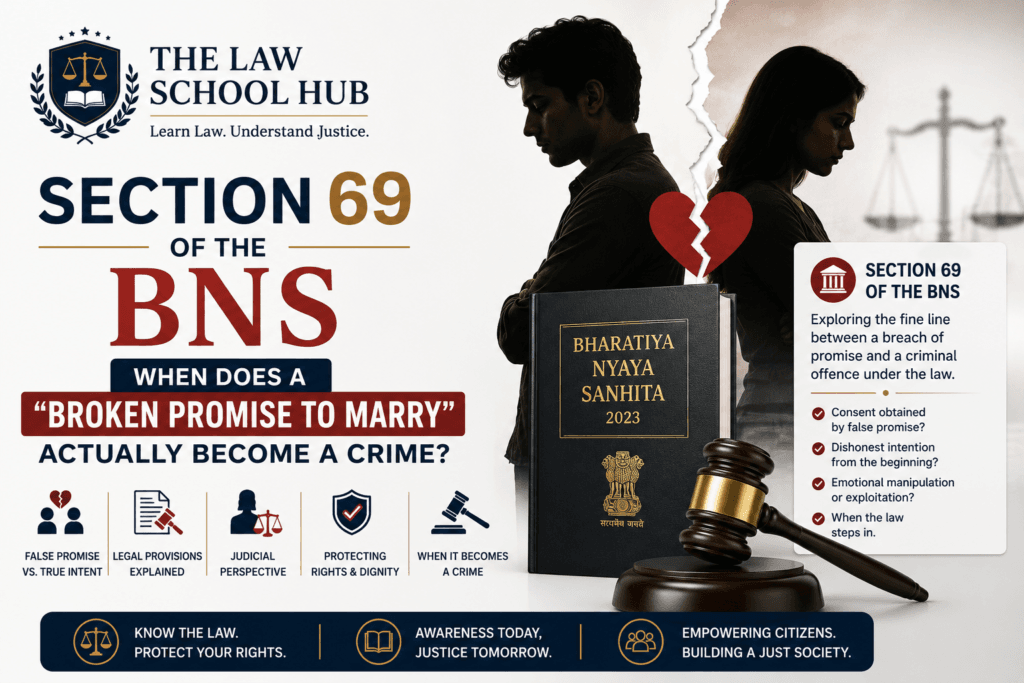
Relationships are beautifully complex, but their endings can sometimes blur the lines between emotional heartbreak and criminal liability. If you are wondering whether a partner walking away from a relationship after making a promise of marriage has committed a crime, the answer lies in a specific new legal provision. Directly addressing your question: a broken promise to marry becomes a crime under Section 69 of the BNS only when the promise was entirely false from the very beginning, made with zero intention of fulfilling it, and was used solely as a deceptive tool to obtain sexual consent. If the promise was genuine at the time it was made, but the marriage could not happen later due to unforeseen circumstances, it is a simple breach of promise, not a crime.
The introduction of the new criminal laws in India has brought significant changes, and Section 69 of the BNS is one of the most talked-about provisions. For decades, Indian courts struggled to balance cases involving intimate relationships that ended poorly. Police stations were flooded with complaints where women accused their ex-partners of rape because a promise to marry was broken. Previously, the law did not have a specific section for this, forcing courts to interpret these situations under severe rape or cheating charges.
Today, the law has evolved. The Bharatiya Nyaya Sanhita, 2023 (BNS), has carved out a distinct, standalone offense for this exact scenario. In this comprehensive, beginner-friendly guide, we will break down exactly how Section 69 of the BNS works, what constitutes “deceitful means,” the crucial difference between a false promise and a broken promise, and how the Supreme Court of India views these sensitive cases.
Legal Note: The information provided in this blog is for educational and informational purposes only and does not constitute formal legal advice. While every effort has been made to ensure legal accuracy based on the Bharatiya Nyaya Sanhita, 2023, and established Supreme Court jurisprudence, readers are advised to consult a qualified legal professional or check the latest official gazettes before taking legal action. Criminal laws are subject to judicial interpretation and periodic amendments.
Table of Contents
Overview of the Topic
When two consenting adults engage in a physical relationship, the law generally respects their privacy and autonomy. However, the legal dynamic shifts dramatically if the consent for physical intimacy was obtained through a lie.
Section 69 of the BNS specifically targets individuals who trick a woman into a sexual relationship. It addresses scenarios where a person uses “deceitful means” or makes a “promise to marry” without any actual intention of keeping that promise.
Historically, under the Indian Penal Code, 1860 (IPC), a false promise to marry was often prosecuted as rape under Section 375, arguing that the woman’s consent was invalid due to a “misconception of fact” under Section 90 of the IPC. This created massive legal confusion. Some breakups led to devastating rape charges, while genuine victims of sexual deceit struggled to prove rape. Section 69 of the BNS clears this confusion. It explicitly states that this specific act of deceit is a crime, but importantly, it clarifies that it does not amount to the offense of rape. It is a separate crime with its own dedicated punishment of up to ten years in prison.
Explained: Section 69 of the BNS
To truly understand how Section 69 of the BNS operates, we must dissect its language and understand the legislative intent behind it. The law is designed to punish manipulation, not to penalize failed relationships.
The Core Concept of “Deceitful Means”
Section 69 of the BNS introduces the phrase “deceitful means” as a primary trigger for the crime. But what exactly does this mean in a romantic context? The statute provides a very helpful explanation. According to the law, deceitful means include:
- False Inducement of Employment or Promotion: If a person in a position of power promises a woman a job, a salary hike, or a promotion in exchange for sexual favors, knowing they will never provide that job, they are using deceitful means.
- Suppressing Identity: If a person hides their true identity—such as their real name, their religion, or the fact that they are already legally married—to convince a woman to marry them or have relations with them, this falls squarely under Section 69 of the BNS.
These scenarios show that the law is targeting severe, calculated fraud that strips away a woman’s ability to give informed, genuine consent.
The “Promise to Marry” Clause
The most debated aspect of Section 69 of the BNS revolves around the promise of marriage. The law penalizes an individual who makes a promise to marry a woman “without any intention of fulfilling the same.”
This is where the timeline of the person’s mental state (mens rea) becomes the most important factor in the entire case.
The Difference Between a “False Promise” and a “Breach of Promise”
If you take away only one lesson from this blog, let it be this distinction. Indian jurisprudence has repeatedly emphasized the difference between a false promise and a breach of promise. Section 69 of the BNS relies entirely on this difference.
- A False Promise (The Crime): Here, the accused never wanted to marry the victim. On day one, when he proposed marriage, he was lying. He used the promise solely as a trap to lure the woman into a sexual relationship. Because his intention was malicious from the very beginning, his actions attract Section 69 of the BNS.
- A Breach of Promise (Not a Crime): Here, the couple genuinely loved each other. The accused honestly wanted to marry the woman when he made the promise. They engaged in a consensual physical relationship. However, months or years later, circumstances changed. Perhaps their families opposed the union, they realized they were incompatible, or one partner simply fell out of love. This is a bona fide (genuine) relationship that failed. A breakup, even a painful one, does not trigger Section 69 of the BNS.
The law cannot punish human emotions changing over time. It only punishes calculated deception.
Legal Provisions Connected to Section 69 of the BNS
1. The Bharatiya Nyaya Sanhita, 2023, s. 69
This is the heart of our discussion. Section 69 of the BNS clearly outlines the punishment for sexual intercourse by deceitful means or false promise to marry. The section mandates a punishment of imprisonment which may extend to ten years and also a fine. Crucially, it specifically notes that such an act “not amounting to the offence of rape” separates it from harsher rape provisions.
Note: You can read more about criminal statutes in our dedicated criminal law section at The Law School Hub.
2. The Bharatiya Nyaya Sanhita, 2023, s. 63 (The Offense of Rape)
While Section 69 of the BNS covers deceit, Section 63 covers the traditional offense of rape. Rape involves sexual intercourse against a woman’s will, without her consent, or when her consent is obtained by putting her in fear of death or hurt. The legislature deliberately kept Section 69 of the BNS separate to ensure that deceitful relationships are punished strictly, but without carrying the specific social and legal weight of a rape conviction.
3. The Bharatiya Nyaya Sanhita, 2023, s. 62 (Consent Under Misconception)
This section corresponds to the old Section 90 of the IPC. It states that if consent is given by a person under a “misconception of fact,” and the person doing the act knows about this misconception, the consent is legally invalid. In many cases involving Section 69 of the BNS, prosecutors will argue that the false promise of marriage created a “misconception of fact” in the woman’s mind, thereby invalidating her consent.
Important Case Laws Shaping Section 69 of the BNS
Because the BNS is a newly enacted code, the courts will rely heavily on the established jurisprudence of the Supreme Court of India regarding false promises to marry under the old IPC. These landmark cases define how judges interpret “intention” and “consent.”
1. Pramod Suryabhan Pawar v. State of Maharashtra, (2019) 9 SCC 608
In this definitive judgment, the Supreme Court of India meticulously laid down the distinction between a false promise to marry and a breach of promise. The Court quashed an FIR against a man, noting that the couple had been in a long-standing relationship and the marriage could not happen due to caste differences. Author’s Analysis: This case is the bedrock for interpreting Section 69 of the BNS. The Court held that to criminalize the act, the promise must be false at its very inception. If the accused had the intention to marry when the promise was made, subsequent failure to marry does not make the sexual relationship non-consensual.
2. Anurag Soni v. State of Chhattisgarh, (2019) 13 SCC 1
In this case, the accused promised to marry the victim but secretly arranged his marriage with another woman. Even after fixing his marriage elsewhere, he continued a physical relationship with the victim under the pretense of marrying her. Author’s Analysis: The Supreme Court upheld the conviction here. This scenario perfectly illustrates when Section 69 of the BNS applies. The accused’s act of finalizing another marriage while simultaneously promising marriage to the victim proved that his promise was a calculated, deceitful lie from the start.
3. Uday v. State of Karnataka, (2003) 4 SCC 46
The Supreme Court analyzed the concept of “misconception of fact.” The couple belonged to different castes, and the victim knew from the beginning that their families would likely never agree to the marriage. Yet, she engaged in a physical relationship based on his promise. Author’s Analysis: The Court acquitted the accused. When a woman is fully aware of the practical obstacles to marriage (like strict family opposition) and still freely chooses to engage in a relationship, she cannot later claim her consent was based entirely on a misconception. This principle will heavily influence defenses under Section 69 of the BNS.
4. Dr. Dhruvaram Murlidhar Sonar v. State of Maharashtra, (2019) 18 SCC 191
The accused and the victim were both educated professionals working in the same hospital. They fell in love, lived together, and had a physical relationship. Later, the accused refused to marry her. Author’s Analysis: The Supreme Court quashed the criminal proceedings. The Court noted that the victim was an educated, mature woman who made a conscious choice to live with the accused. It was a case of a love affair failing, not a case of initial deception. Section 69 of the BNS is not meant to police the private consensual affairs of mature adults who willingly take relationship risks.
5. Maheshwar Tigga v. State of Jharkhand, (2020) 10 SCC 108
The Supreme Court reiterated that an extended physical relationship over several years strongly indicates consent and a genuine romantic involvement, rather than a relationship secured solely by a false promise. Author’s Analysis: If a couple is together for four years before breaking up, it is incredibly difficult for the prosecution to prove under Section 69 of the BNS that the man was lying for all four years solely to get physical intimacy. The length of the relationship often serves as proof of initial bona fide intentions.
Illustrations
To make legal concepts easier to digest, let us look at some practical scenarios applying Section 69 of the BNS.
Illustration 1: The Calculated Fraud (Crime)
Ravi creates a fake profile on a matrimonial website. He claims to be an unmarried doctor. He meets Sneha, promises her marriage, and convinces her to have a physical relationship. A week later, Sneha discovers Ravi is unemployed, happily married, and using a fake name. Legal Application: Ravi is blatantly guilty under Section 69 of the BNS. He used deceitful means (suppressing identity) and made a promise to marry with zero intention of fulfilling it.
Illustration 2: The Honest Heartbreak (Not a Crime)
Arjun and Priya are college classmates. They fall deeply in love and promise to marry each other after graduation. They engage in a consensual relationship for three years. After college, Arjun’s family threatens to disown him if he marries Priya. Succumbing to extreme family pressure, Arjun breaks up with Priya in tears. Legal Application: Arjun is not guilty under Section 69 of the BNS. His promise to marry Priya was genuine when he made it in college. The breakup was a breach of promise caused by later circumstances, not an initial false promise to extract sexual favors.
Illustration 3: The Workplace Trap (Crime)
Mr. Sharma is a company director. He tells his junior employee, Anjali, that he will make her the Vice President of the branch, provided she engages in a physical relationship with him. Anjali agrees, hoping for the promotion. Sharma never promotes her and later fires her. Legal Application: Sharma has committed an offense under Section 69 of the BNS. He used the “false inducement of promotion” as a deceitful means to obtain sexual consent.
5 Essential Elements to Prove Section 69 of the BNS
For the police and prosecution to successfully secure a conviction under Section 69 of the BNS, they must prove the following elements beyond a reasonable doubt:
- The Act: There must be sexual intercourse between the accused and the victim.
- The Inducement: The accused must have made a clear, unequivocal promise to marry, or used deceitful means (like false job promises or hiding identity).
- The False Intention: The prosecution must prove that the accused never intended to keep the promise from the very moment he made it.
- The Motivation: It must be shown that the victim gave her consent for the physical relationship only because she believed the false promise.
- The Absence of Rape: The circumstances must not cross the threshold into force, coercion, or lack of consent outlined in the rape provisions of the BNS.
Rights of the Parties under Section 69 of the BNS
Understanding your legal rights is crucial, whether you are the victim filing the complaint or the accused defending against false allegations.
For the Victim (Complainant):
- You have the right to file an FIR at any police station (Zero FIR) if you realize you have been sexually deceived.
- You have the right to privacy during the investigation.
- You can present WhatsApp chats, emails, matrimonial site profiles, and call recordings to prove the accused’s initial deceptive intentions.
For the Accused:
- You have the right to seek Anticipatory Bail from the Sessions Court or High Court if you fear a false FIR is being registered due to a bitter breakup.
- You have the right to produce evidence (like long-term relationship photos, joint bank accounts, or family introduction chats) to prove that the relationship was genuine and the promise was not false at inception.
- You are presumed innocent until proven guilty; a mere breakup does not automatically make you a criminal under Section 69 of the BNS.
Table 1: Section 69 of the BNS vs. Rape (Section 63 of the BNS)
| Legal Aspect | Section 69 of the BNS (Deceitful Means) | Section 63 of the BNS (Rape) |
|---|---|---|
| Nature of Act | Consent is obtained through a calculated lie or fake promise. | No consent at all, or consent obtained through fear, force, or threats. |
| Role of Consent | Victim willingly consents, but based on a misconception (the lie). | Victim does not consent, or is incapable of consenting (e.g., intoxicated). |
| Punishment | Imprisonment up to 10 years and a fine. | Rigorous imprisonment (minimum 10 years to life) and a fine. |
| Social Stigma | Treats the act as a severe breach of trust and sexual fraud. | Treats the act as the highest violation of bodily autonomy. |
Table 2: False Promise vs. Breach of Promise
| Element | False Promise to Marry (Crime) | Breach of Promise to Marry (Not a Crime) |
|---|---|---|
| Intention at Start | Malafide (Bad faith). Never wanted to marry. | Bonafide (Good faith). Genuinely wanted to marry. |
| Purpose of Promise | Used merely as a tool to gain sexual access. | Made out of love, affection, and future planning. |
| Reason for Failure | The accused simply runs away after getting what they want. | Unforeseen circumstances (family dispute, career changes, incompatibility). |
| Applicability of Law | Punishable strictly under Section 69 of the BNS. | No criminal liability. Purely a personal matter. |
Conclusion
The introduction of Section 69 of the BNS is a monumental step forward in Indian criminal jurisprudence. For years, the legal system struggled to squeeze cases of sexual deceit into the rigid definitions of rape, leading to convoluted judgments and prolonged trauma for all parties involved. By creating a specific, well-defined crime for obtaining sexual consent through deceitful means or a false promise to marry, the lawmakers have provided clarity.
However, it is equally important to remember that the law does not criminalize a broken heart. Relationships fail, promises fall apart, and people change their minds. Unless the prosecution can definitively prove that the promise was a deliberate, malicious lie from the very first day, a breakup remains a private tragedy, not a public crime. Section 69 of the BNS strikes a delicate balance—it protects vulnerable individuals from predatory sexual fraud while safeguarding genuine individuals from being branded criminals merely because their romantic relationship did not end in marriage.
Frequently Asked Questions (FAQs)
1. Is a broken promise to marry considered rape under the new laws?
No. This is the biggest change. Under the new laws, a false promise to marry is not classified as rape. It is covered under Section 69 of the BNS as a separate offense for using “deceitful means,” carrying a maximum punishment of 10 years.
2. Can a man file a case under Section 69 of the BNS if a woman breaks a promise to marry?
The language of Section 69 of the BNS states, “Whoever… has sexual intercourse with her…” This implies the victim in the context of this specific section is recognized as a woman. Therefore, the provision is not entirely gender-neutral regarding the victim.
3. What happens if family pressure causes the breakup?
If a man genuinely promised to marry a woman but had to back out later due to severe family opposition, it is considered a “breach of promise” and not a “false promise.” This scenario does not attract criminal charges under Section 69 of the BNS.
4. Does a long-term relationship affect a Section 69 case?
Yes, significantly. The Supreme Court has repeatedly held that if a couple was in a long-term physical relationship for months or years, it strongly suggests genuine romantic involvement, making it difficult to prove that the initial promise was entirely false.
5. How can I prove the promise was false from the beginning?
Evidence is crucial. You can prove a false promise by showing that the accused was already married, was actively searching for a bride on matrimonial sites while dating you, or sent messages proving he never intended to marry you.
6. Can I get bail if an FIR is registered against me under Section 69 of the BNS?
Yes. Since cases of relationship disputes can sometimes lead to vindictive FIRs, the accused has the right to apply for Anticipatory Bail under the BNSS. The court will evaluate the initial facts to see if it looks like a genuine relationship that simply failed.
7. Does suppressing my caste or religion count as “deceitful means”?
Yes. If you deliberately hide your true identity, including your religion or marital status, to convince someone to have a physical relationship with you, it falls under the “suppressing identity” clause of Section 69 of the BNS.
Legal References
- The Bharatiya Nyaya Sanhita, 2023, Section 69 (Sexual intercourse by employing deceitful means, etc.).
- The Bharatiya Nyaya Sanhita, 2023, Section 63 (Punishment for rape).
- The Bharatiya Nyaya Sanhita, 2023, Section 62 (Act done by consent under misconception).
- The Bharatiya Nagarik Suraksha Sanhita, 2023 (Procedural context for FIR and Bail).
- Supreme Court of India: Pramod Suryabhan Pawar v. State of Maharashtra, (2019) 9 SCC 608.
- Supreme Court of India: Anurag Soni v. State of Chhattisgarh, (2019) 13 SCC 1.
- Supreme Court of India: Uday v. State of Karnataka, (2003) 4 SCC 46.
- Supreme Court of India: Dr. Dhruvaram Murlidhar Sonar v. State of Maharashtra, (2019) 18 SCC 191.
- Supreme Court of India: Maheshwar Tigga v. State of Jharkhand, (2020) 10 SCC 108.
- Supreme Court of India: Sonu @ Subhash Kumar v. State of U.P., (2021) 15 SCC 517.
- Supreme Court of India: Shambhu Kharwar v. State of U.P., (2022) 9 SCC 103.
- Supreme Court of India: Deelip Singh v. State of Bihar, (2005) 1 SCC 88 (Historical context of misconception of fact).
- Supreme Court of India: Deepak Gulati v. State of Haryana, (2013) 7 SCC 675.
- Supreme Court of India: Tilak Raj v. State of Himachal Pradesh, (2016) 4 SCC 140.
- India Code Digital Repository (For statutory verification of the BNS provisions, accessible via India Code).
- Ministry of Home Affairs, e-Gazette (For the official notification of the Bharatiya Nyaya Sanhita, 2023).
At The Law School Hub, we simplify case laws, legal acts, and legal concepts for law students and legal readers. Want to read more useful legal blogs? Visit The Law School Hub.