
Death During a Road-Rage Assault: Murder, Culpable Homicide or Negligent Death?

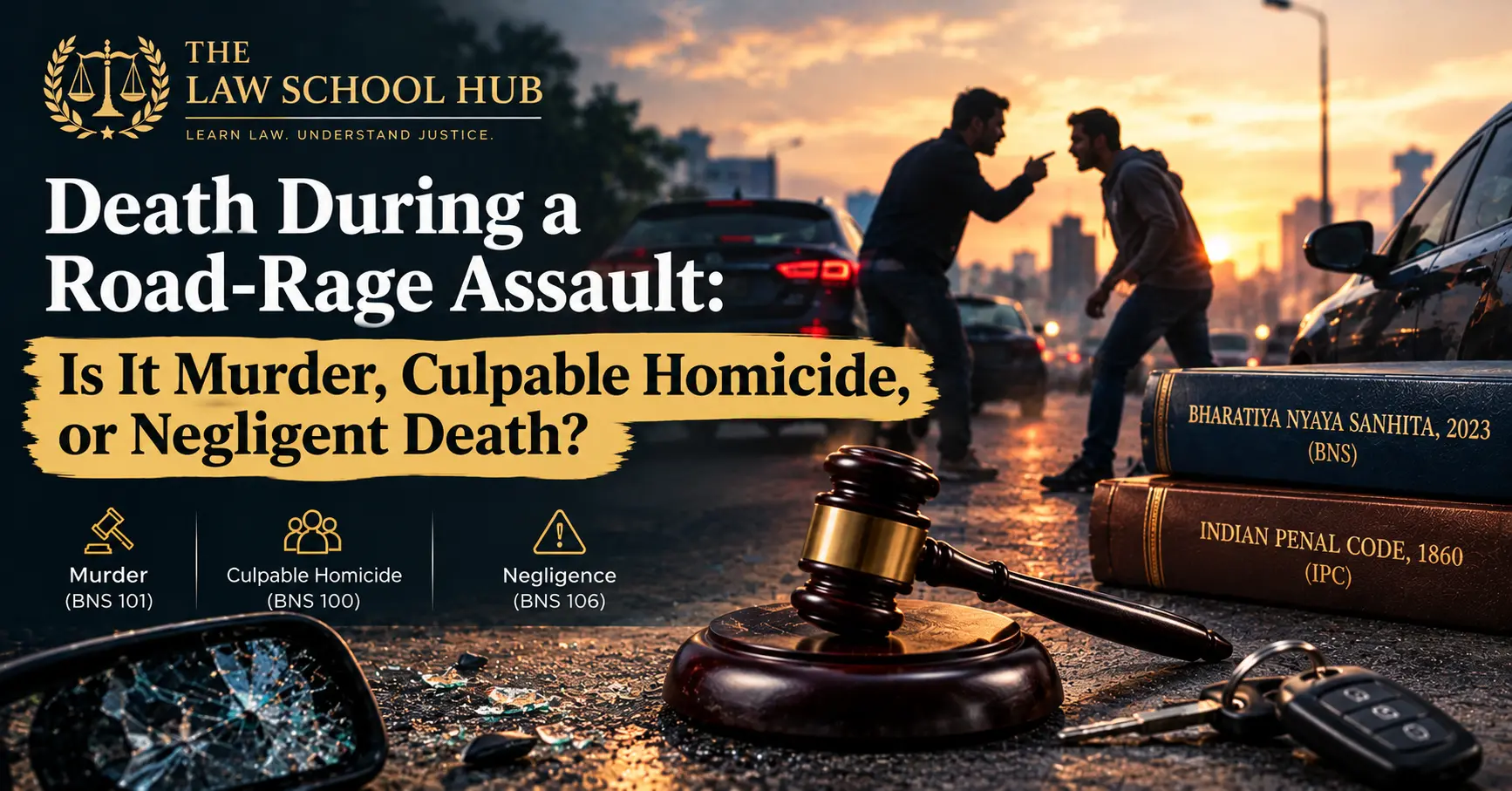
If a heated argument over a scratched bumper escalates, and someone tragically loses their life, how does the law categorize the crime? Is a death during a road rage assault considered cold-blooded murder, culpable homicide, or simply a negligent accident?
The short answer is: it depends entirely on the intention (mens rea), the knowledge of the consequences, and whether there was sudden provocation. In Indian criminal law, a death during a road rage assault rarely falls into a simple black-and-white category. The courts meticulously examine the facts of each case to determine the exact mental state of the accused at the moment of the assault.
Whether you are a judiciary aspirant trying to decode the Bharatiya Nyaya Sanhita (BNS) 2023, a young lawyer preparing for a criminal trial, or a curious reader wanting to understand your legal surroundings, this guide is for you. We will break down the thin, often confusing line between murder, culpable homicide, and negligent death, backing our analysis with landmark Supreme Court judgments and practical examples.
Legal Note Disclaimer
The information provided in this blog is for educational and informational purposes only. It does not constitute legal advice. Criminal law is heavily dependent on specific facts and circumstances. While we strive to maintain absolute legal accuracy in line with the Bharatiya Nyaya Sanhita, 2023, and the Indian Penal Code, 1860, always consult a qualified legal professional or refer to the official e-Gazette for specific legal counsel.
Table of Contents
Overview of the Topic
Road rage is an aggressive or angry behavior exhibited by a driver of a road vehicle. In India, crowded streets, stressful commutes, and poor traffic discipline frequently lead to minor altercations. Tragically, a simple argument over overtaking can sometimes escalate into a physical brawl, resulting in a fatality.
When a death during a road rage assault occurs, law enforcement and the courts face a complex challenge. They must fit an unplanned, chaotic event into one of three specific legal buckets under the new Bharatiya Nyaya Sanhita, 2023 (which replaced the Indian Penal Code, 1860):
- Murder (Section 101 BNS): The highest degree of crime, involving a clear intention to kill or cause an injury that the offender knows is likely to cause death.
- Culpable Homicide Not Amounting to Murder (Section 100 BNS): A lesser degree of crime where death is caused with intention or knowledge, but under circumstances of sudden provocation or a sudden fight without premeditation.
- Death by Negligence (Section 106 BNS): A situation where death is caused by a rash or negligent act without any intention or knowledge of causing death.
Understanding how the police and judges differentiate these three categories is crucial for grasping the practical application of Indian criminal law.
Detailed Explanation
To accurately categorize a death during a road rage assault, we must analyze the specific elements that separate murder, culpable homicide, and negligence. Let us explore these concepts step-by-step.
1. When is it Considered Murder?
For a death during a road rage assault to be classified as murder, the prosecution must prove that the accused had a clear, premeditated intention to kill, or the intention to cause bodily injury sufficient in the ordinary course of nature to cause death.
In the context of road rage, pure murder is rare because road altercations are typically spontaneous. However, if a driver gets out of their car, retrieves a deadly weapon like an iron wrench or a gun from their trunk, and repeatedly strikes the victim on the head, the court will likely view this as murder. The act of fetching a weapon shows a conscious forming of intent. The law assumes that any reasonable person knows that striking someone repeatedly on the head with an iron rod will lead to death.
2. When is it Culpable Homicide Not Amounting to Murder?
Most serious road rage deaths fall under this category. Culpable homicide sits between murder and negligence. The accused possessed the intention to cause bodily harm, but the act happened in the “heat of the moment.”
Indian law recognizes that human beings can lose their temper. If a death during a road rage assault occurs due to a “sudden fight in the heat of passion upon a sudden quarrel,” the law grants a partial concession. Provided the offender did not take undue advantage or act in a cruel and unusual manner, the charge drops from murder to culpable homicide not amounting to murder. This distinction is vital because it dramatically reduces the potential prison sentence.
3. When is it Causing Death by Negligence?
Sometimes, a death during a road rage assault does not involve a direct, intentional physical beating. Instead, an angry driver might rashly speed away from an argument to intimidate the other person and accidentally run them over.
If there was absolutely no intention to cause death or bodily injury, and no knowledge that the act would cause death, the crime becomes one of criminal negligence. The core element here is a failure to exercise the reasonable care expected of a driver.
Key Legal Provisions
To analyze a death during a road rage assault professionally, you must understand the exact statutory framework. Following the implementation of the new criminal laws in 2024, law students must familiarize themselves with the Bharatiya Nyaya Sanhita (BNS), 2023. Here are the key sections:
The Bharatiya Nyaya Sanhita, 2023
- Section 100 BNS (Culpable Homicide): This section replaces Section 299 of the IPC. It states that whoever causes death by doing an act with the intention of causing death, or with the intention of causing such bodily injury as is likely to cause death, or with the knowledge that he is likely by such act to cause death, commits the offence of culpable homicide.
- Section 101 BNS (Murder): Replacing Section 300 of the IPC, this section outlines when culpable homicide elevates to murder. Crucially, it includes the “Exceptions” (such as sudden provocation or a sudden fight) which downgrade murder back to culpable homicide.
- Section 105 BNS (Punishment for Culpable Homicide): Replacing Section 304 IPC, this provision dictates the punishment. If the act is done with intention, it carries life imprisonment or up to ten years. If done only with knowledge (but no intention), the punishment is up to ten years.
- Section 106 BNS (Causing Death by Negligence): Replacing Section 304A IPC, this states that whoever causes death by any rash or negligent act not amounting to culpable homicide shall be punished with imprisonment up to five years (with higher penalties for hit-and-run cases).
Important Case Laws
1. Surinder Kumar v. UT, Chandigarh, (1989) 2 SCC 217
- The Context: An altercation occurred spontaneously, leading to a fatal stabbing.
- The Legal Principle: The Supreme Court elucidated Exception 4 to Section 300 IPC (now under Section 101 BNS). The Court held that to invoke the “sudden fight” exception, four ingredients are necessary: (i) a sudden fight; (ii) no premeditation; (iii) the act must be done in the heat of passion; and (iv) the offender must not have taken undue advantage or acted in a cruel manner.
- Original Analysis: This case is the bedrock for defending a death during a road rage assault. If a lawyer can prove the road rage incident was entirely spontaneous and the fatal blow was struck in the immediate heat of the moment without cruelty, the charge is restricted to culpable homicide, saving the accused from a mandatory life sentence.
2. Navjot Singh Sidhu v. State of Punjab, (2007) 2 SCC 574
- The Context: In a highly publicized road rage case, former cricketer Navjot Singh Sidhu had an altercation with an elderly man over vehicle parking. Sidhu struck the man, who later died.
- The Legal Principle: The Supreme Court initially analyzed whether the single blow delivered by Sidhu was meant to cause death. The Court noted that the intention to kill or cause deadly injury was absent. The death was attributed to sudden cardiac failure combined with the physical assault.
- Original Analysis: This case perfectly highlights the complexity of a death during a road rage assault. The Supreme Court ultimately convicted Sidhu under Section 323 IPC (voluntarily causing hurt) rather than culpable homicide, because the specific intent or knowledge to cause a fatal injury via a bare-fisted punch to an outwardly healthy individual was not established beyond reasonable doubt. (Note: The court later reviewed the sentencing, but the jurisprudential analysis on intent remains vital).
3. Alister Anthony Pareira v. State of Maharashtra, (2012) 2 SCC 648
- The Context: While strictly a drunk driving hit-and-run case, it frequently applies to road rage incidents involving vehicular assault. The accused drove his car into construction workers sleeping on the pavement.
- The Legal Principle: The Supreme Court differentiated between “negligence” (Section 304A IPC / Section 106 BNS) and “knowledge” (Section 304 Part II IPC / Section 105 BNS). The Court ruled that driving a vehicle with reckless disregard for human life imputes knowledge that death could result, elevating the crime from mere negligence to culpable homicide.
- Original Analysis: If a driver in a road rage fit intentionally rams the victim’s car at high speeds causing death, they cannot hide behind Section 106 BNS (negligence). Following Pareira, courts will impute “knowledge” and charge them with culpable homicide.
4. Viram , Virabhai Somabhai v. State of Gujarat, (2020) 15 SCC 125
- The Context: A dispute led to a physical attack resulting in death.
- The Legal Principle: The Court held that the intention to kill can be gathered from the nature of the weapon used, the part of the body chosen for assault, and the force applied.
- Original Analysis: In a death during a road rage assault, if a person uses a heavy jack-handle and strikes the victim repeatedly on the skull, Viram dictates that the court must infer an intention to kill (Murder), regardless of the suddenness of the quarrel, because striking a vital organ with a deadly weapon demonstrates cruel and unusual action.
Practical Examples
Illustration 1:
The Accidental Bump (Negligence) Rahul and Amit get into a shouting match at a traffic signal. Angered, Rahul decides to speed away to avoid further confrontation. In his haste and anger, he fails to check his blind spot and accidentally clips Amit, who falls, hits his head on the divider, and dies.
- Legal Outcome: Rahul had no intention to hit Amit, nor did he know his hasty departure would cause death. His actions were rash. He will be charged with Causing Death by Negligence under Section 106 of the BNS.
Illustration 2:
The Sudden Fistfight (Culpable Homicide) Vikram and Karan’s cars scrape against each other. Both step out, furious. A heated verbal argument instantly escalates into a fistfight. In the heat of the moment, Vikram pushes Karan violently. Karan falls, fractures his skull on the pavement, and succumbs to the injury.
- Legal Outcome: There was no premeditation. It was a sudden fight in the heat of passion. Vikram did not use a weapon or act in a cruel manner. This death during a road rage assault falls under Exception 4 to Section 101 BNS. Vikram will be charged with Culpable Homicide Not Amounting to Murder under Section 105 BNS.
Illustration 3:
The Intentional Run-Over (Murder) Suresh and Ravi argue aggressively over a parking spot. Ravi slaps Suresh and walks away toward a shop. Enraged by the insult, Suresh gets into his SUV, starts the engine, aims his vehicle directly at Ravi, and intentionally accelerates, crushing Ravi against a wall and killing him instantly.
- Legal Outcome: Although the trigger was sudden, Suresh’s act of aiming his heavy vehicle at Ravi shows a clear, conscious intention to cause fatal injuries, or at the very least, knowledge that such an act is so imminently dangerous it must cause death. He acted in a cruel and unusual manner. Suresh will face a Murder charge under Section 101 BNS.
Key Factors the Courts Analyze
When a judge presides over a trial concerning a death during a road rage assault, they do not look at the incident as a single blur. They meticulously dissect the event. Here is a list of the primary factors courts evaluate:
5 Factors to Determine the Nature of the Offence:
- Presence of Premeditation: Was there any prior enmity, or was the altercation entirely spontaneous?
- Nature of the Weapon: Did the accused use bare hands, or did they fetch a weapon (e.g., cricket bat, iron rod, firearm)?
- Target Area on the Victim: Were the injuries inflicted on vital body parts (head, chest) or non-vital parts (limbs)?
- Proportionality of Force: Did the accused continue beating the victim after the victim was incapacitated? (Taking “undue advantage”).
- Mental State (Mens Rea): Did the accused intend to kill, intend only to hurt, or simply act with rash negligence?
Immediate Steps to Take if Involved in a Road Accident:
- Do Not Flee: Under Section 106(2) of the BNS, fleeing the scene and failing to report a fatal accident to a police officer or Magistrate carries a severe penalty (up to 10 years).
- Seek Medical Help: Section 134 of the Motor Vehicles Act, 1988 mandates the driver to take all reasonable steps to secure medical attention for the injured person.
- Do Not Engage in Physical Altercations: If the other party is aggressive, lock your doors, record a video for evidence, and call the emergency police number immediately.
- File a Police Report (FIR): Ensure you file a report detailing your version of events as quickly as possible to establish an unmanipulated record.
Table 1: Distinguishing the Offence in Road Rage
| Element | Murder (Sec 101 BNS) | Culpable Homicide (Sec 100/105 BNS) | Negligence (Sec 106 BNS) |
|---|---|---|---|
| Intention to Kill | Yes, absolutely present. | Not necessarily to kill, but to cause serious bodily injury. | Completely absent. |
| Premeditation | Can be present or formed instantly. | Absent (Sudden fight/provocation). | Absent. |
| Cruelty/Undue Advantage | Present. Offender acted brutally. | Absent. Offender did not take undue advantage. | Not applicable (Accidental nature). |
| Example Act | Intentionally ramming someone with a car. | Fatal push during a sudden fistfight. | Speeding away and accidentally clipping a pedestrian. |
| Maximum Punishment | Death penalty or Life Imprisonment. | Up to 10 Years or Life Imprisonment. | Up to 5 Years (10 years if hit-and-run). |
Table 2: IPC to BNS Conversion for Homicide & Negligence
| Legal Concept | Old IPC (1860) Section | New BNS (2023) Section | Key Change in BNS |
|---|---|---|---|
| Culpable Homicide Definition | Section 299 IPC | Section 100 BNS | Re-numbered; language modernized. |
| Murder Definition | Section 300 IPC | Section 101 BNS | Organized into clearer sub-clauses. |
| Punishment for Murder | Section 302 IPC | Section 103 BNS | Includes specific provisions for mob lynching. |
| Punishment for Culpable Homicide | Section 304 IPC | Section 105 BNS | Restructured sentencing frameworks. |
| Causing Death by Negligence | Section 304A IPC | Section 106 BNS | Significantly higher penalty (10 yrs) introduced for hit-and-run without reporting. |
Conclusion
Determining criminal liability for a death during a road rage assault is one of the most intricate exercises in Indian criminal jurisprudence. The law recognizes the flawed nature of human temperament. It understands that a sudden outburst of anger on a congested road does not necessarily equate to the cold-blooded mindset of a murderer.
Therefore, the distinction heavily relies on the nuances of intention, the existence of a sudden quarrel, and the proportionality of the violence used. While the Bharatiya Nyaya Sanhita, 2023 has modernized the penal code, the core judicial philosophy remains the same: the punishment must precisely match the mental state of the offender at the exact moment the fatal blow was struck.
As road infrastructure expands and vehicle density increases, legal professionals must be deeply well-versed in differentiating between Section 101, Section 105, and Section 106 of the BNS to ensure justice is served fairly in road-related fatalities.
Frequently Asked Questions (FAQs)
1. Is a death during a road rage assault always considered murder?
No. It is very rarely considered murder. Most road rage deaths occur due to sudden fights without premeditation. If the offender did not take undue advantage or act in a cruel manner, the courts usually classify it as Culpable Homicide Not Amounting to Murder.
2. What happens if I accidentally hit someone while trying to escape an angry driver?
If you accidentally cause a death while trying to flee a dangerous road rage situation, you may be charged with Causing Death by Negligence (Section 106 BNS). However, you can raise the defense of “Right of Private Defense” (Section 34 BNS onwards) if you can prove you reasonably feared for your life.
3. Does the new Bharatiya Nyaya Sanhita (BNS) change road rage laws?
The core principles of homicide and negligence remain similar to the IPC, but the BNS has restructured the sections and introduced stricter penalties. Notably, Section 106(2) of the BNS imposes up to 10 years in prison if you cause death by rash driving and escape without reporting it to the authorities.
4. Can a single punch in a road rage fight lead to a culpable homicide charge?
Yes, but it depends on the circumstances. If the punch was delivered with extreme force to a vulnerable part of the head, a court might find knowledge that it was likely to cause death. However, as seen in the Navjot Singh Sidhu case, courts often require strong medical evidence to link a single, bare-handed punch to homicide rather than just “causing hurt.”
5. What should I do if a driver gets out of their car and approaches me aggressively?
Do not step out of your vehicle. Lock your doors, roll up your windows, start recording on your smartphone, and dial the police emergency number immediately. Engaging in a physical fight can escalate quickly, risking your life or leading to severe criminal charges.
6. Are hit-and-run cases considered murder?
A standard hit-and-run is usually considered Death by Negligence (Section 106 BNS). However, if the prosecution proves the driver knew people were sleeping on the pavement and drove recklessly over them anyway, it can be elevated to Culpable Homicide (as established in the Alister Anthony Pareira case).
Legal References and Verified Sources
- The Bharatiya Nyaya Sanhita, 2023, Section 100 (Culpable homicide).
- The Bharatiya Nyaya Sanhita, 2023, Section 101 (Murder).
- The Bharatiya Nyaya Sanhita, 2023, Section 105 (Punishment for culpable homicide not amounting to murder).
- The Bharatiya Nyaya Sanhita, 2023, Section 106 (Causing death by negligence).
- The Indian Penal Code, 1860, Section 299 (Historical reference).
- The Indian Penal Code, 1860, Section 300 (Historical reference).
- The Indian Penal Code, 1860, Section 304A (Historical reference).
- The Motor Vehicles Act, 1988, Section 134 (Duty of driver in case of accident and injury to a person).
- The Motor Vehicles Act, 1988, Section 184 (Driving dangerously).
- Constitution of India, 1950, Article 21 (Protection of life and personal liberty).
- Navjot Singh Sidhu v. State of Punjab, (2007) 2 SCC 574.
- Surinder Kumar v. UT, Chandigarh, (1989) 2 SCC 217.
- Alister Anthony Pareira v. State of Maharashtra, (2012) 2 SCC 648.
- Viram @ Virabhai Somabhai v. State of Gujarat, (2020) 15 SCC 125.
- State of Punjab v. Saurabh Bakshi, (2015) 5 SCC 182.
- K.M. Nanavati v. State of Maharashtra, AIR 1962 SC 605. (Reference for the doctrine of sudden provocation).
- Official legislation portal of India via India Code.
- Official judgments database via the Supreme Court of India.
Want to Read More?
At The Law School Hub, we simplify case laws, legal acts, and complex legal concepts for law students, young practitioners, and legal readers. If you found this detailed breakdown of criminal liability in road rage cases helpful, there is much more to explore.
Keep Learning. Stay Updated. Connect with me on Linkedin.