Can Passport Seizure Become an Arbitrary Travel Restriction in India?

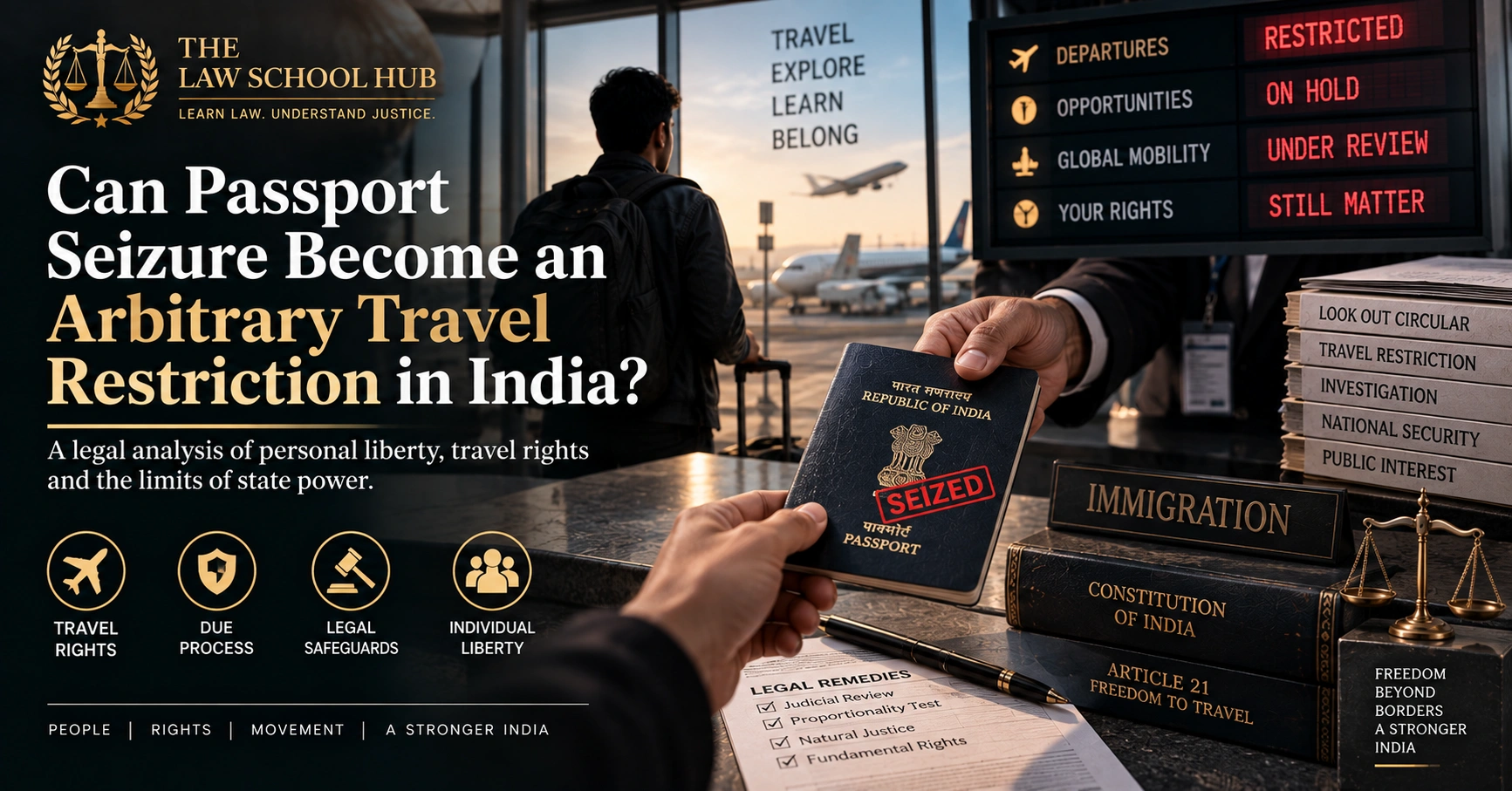
Table of Contents
Introduction
Holding a passport and travelling abroad is a fundamental right of every Indian citizen. However, when a person is accused of a crime or becomes involved in a legal dispute, investigating agencies often try to take their passport away. This immediately stops the person from leaving the country. For a student studying abroad, a business owner with international clients, or a person visiting family, losing a passport causes severe personal and financial damage.
The core legal question is whether the police can simply take your passport and keep it in their locker forever. If the police can stop you from travelling without following a fair legal process, it becomes an arbitrary travel restriction. Indian law protects citizens from such unchecked power. The Supreme Court of India has established very clear boundaries between what the police can do temporarily and what only the official Passport Authority can do permanently.
This guide explains the exact laws governing passport seizure in India. It breaks down the constitutional protections, the specific statutes involved, and the landmark court decisions that prevent police and government agencies from unfairly locking citizens inside the country.
Legal Information Notice
Legal information notice: This article is for general educational and informational purposes. It does not constitute legal advice or create an attorney-client relationship.
Overview of the Topic
To understand why passport seizures often become legally controversial, you must first understand the conflict between individual freedom and criminal investigation.
When the police investigate a serious crime, their primary goal is to ensure the accused person does not run away to another country. To achieve this, the police often use their general search powers to physically take the person’s passport.
However, taking a passport is not like taking a stolen mobile phone or a weapon used in a crime. A passport represents a citizen’s personal liberty. If the police keep the passport indefinitely without formally cancelling it through the proper legal channels, they bypass the law. This creates an arbitrary travel restriction because the citizen is left in a legal trap. They cannot travel, but they also have not been officially given a reason or a chance to defend themselves before the passport authorities.
Indian courts have stepped in to solve this problem by clarifying that while police can temporarily seize a passport as evidence, only the regional Passport Office has the legal authority to hold it long-term or cancel it.
Detailed Explanation
The debate over passport seizure involves constitutional rights, police powers, and specific passport laws. To understand the legal position, we must break this topic down into its fundamental parts.
1. The Fundamental Right to Travel Abroad
Under the Indian Constitution, the right to travel abroad is deeply protected. It is not a luxury or a privilege granted by the government. It is a basic human right. If the government wants to restrict this right, it cannot act on a whim. The government must have a valid law, and the process used to restrict the travel must be fair, just, and reasonable. Any action that blocks travel without a fair hearing is considered an arbitrary travel restriction and is illegal.
2. The Difference Between Seizure and Impounding
This is the most critical distinction in Indian passport law. The words “seize” and “impound” might sound similar in everyday English, but they mean completely different things in a courtroom.
Seizure: This means taking physical possession of an item for a short time. When the police raid a house and find a passport, they take it physically. This is a temporary action to secure evidence.
Impounding: This means taking an item and keeping it officially for a long period under the authority of a specific law. Impounding involves a formal legal decision to suspend the use of that document.
The Supreme Court has clearly stated that while police officers have the general power to seize a passport during an investigation, they absolutely do not have the power to impound it.
3. The Correct Legal Procedure
If the police or the Central Bureau of Investigation (CBI) believe that a person is a flight risk, they cannot simply put the seized passport in their own desk drawer. The law requires them to follow a strict procedure.
Once the police seize the passport, they must send it to the Passport Authority as quickly as possible. The police must write a letter to the Passport Authority explaining why they think the person should not be allowed to travel.
The Passport Authority then takes over. The Passport Authority must issue a formal legal notice to the citizen. This is called a show-cause notice. The citizen gets a fair chance to explain why their passport should not be blocked. Only after hearing the citizen’s side of the story can the Passport Authority decide to officially impound the passport.
4. Look Out Circulars as an Alternative Restriction
Because the courts have made it very difficult for police to hold passports illegally, investigating agencies increasingly use a different method called a Look Out Circular (LOC).
An LOC is an alert sent to all airports and immigration checkpoints. When a person with an active LOC tries to scan their passport at the airport, the immigration officer stops them from boarding the flight. Even though the person physically holds their passport, the LOC acts as a severe travel restriction. Like direct passport seizures, courts have repeatedly ruled that LOCs cannot be issued randomly or kept active for years without strong, justified reasons, as this also creates an arbitrary travel restriction.
Key Legal Provisions
To challenge an unfair restriction on travel, a person must know the exact laws that govern this area. The legal framework relies on the Constitution, the specific law for passports, and the general criminal procedure code.
1. Article 21 of the Constitution of India
What it says: No person shall be deprived of his life or personal liberty except according to procedure established by law.
What it means: The Supreme Court has ruled that the phrase “personal liberty” includes the right to travel abroad. Therefore, the government cannot take away your passport unless there is a specific, valid law that allows them to do so. Furthermore, the procedure used to take it must be totally fair. If a police officer takes your passport without following a fair procedure, they are directly violating your Article 21 rights.
2. Section 10(3) of the Passports Act, 1967
What it says: This section lists the exact reasons why the Passport Authority can vary, impound, or revoke a passport.
What it means: This is the most important statute regarding travel restrictions. It says a passport can only be impounded if it threatens the sovereignty and integrity of India, security of the state, friendly relations with foreign countries, or public order. Most importantly for ordinary citizens, a passport can be impounded if a criminal court case is officially pending against the passport holder. The power under this section belongs exclusively to the Passport Authority, not to the police.
3. Section 106 of the Bharatiya Nagarik Suraksha Sanhita, 2023 (BNSS)
What it says: Any police officer may seize any property which may be alleged or suspected to have been stolen, or which may be found under circumstances which create suspicion of the commission of any offence.
What it means: This new law replaced Section 102 of the old Code of Criminal Procedure (CrPC). It gives police the power to seize “property” during an investigation. While a passport is technically property and can be seized temporarily under this section, this law does not give police the right to hold the passport indefinitely. Holding it indefinitely transforms the seizure into an impounding, which violates the Passports Act.
Important Case Laws
The rules preventing police from holding passports indefinitely did not appear overnight. They were created through several landmark decisions by the Supreme Court of India. These cases protect citizens from arbitrary state action.
1. Maneka Gandhi v. Union of India, (1978) 1 SCC 248
Facts: The government impounded the passport of Maneka Gandhi, a prominent journalist and politician, in public interest. The government refused to give her any written reasons for doing so and did not give her a chance to defend herself.
Legal Issue: Can the government impound a passport without giving the person a hearing or a valid reason, and does this violate the right to personal liberty under Article 21?
Arguments: The government argued that the Passports Act gave them total power to impound passports for the public good. Maneka Gandhi argued that the right to travel abroad is a fundamental right, and taking it away without a fair hearing is an arbitrary travel restriction.
Court’s Reasoning: The Supreme Court delivered one of the most famous judgments in Indian legal history. The Court stated that simply having a law is not enough. The procedure inside that law must be right, just, and fair. It cannot be arbitrary, fanciful, or oppressive. Taking a passport without giving the person a chance to be heard violates the basic principles of natural justice.
Decision: The Court held that the right to travel abroad is part of personal liberty under Article 21. The government must provide reasons and a fair hearing before impounding a passport.
Importance: This case established the absolute rule that travel restrictions must follow strict due process and cannot be arbitrary.
2. Suresh Nanda v. Central Bureau of Investigation, (2008) 3 SCC 674
Facts: The CBI was investigating an arms deal corruption case. During a raid, the CBI physically seized the passport of the accused, Suresh Nanda. The CBI kept the passport in their own custody for a long time. They argued they had the power to do this under the general police seizure powers of Section 102 of the CrPC.
Legal Issue: Does the general police power to seize property during an investigation include the power to retain a passport indefinitely, effectively impounding it?
Arguments: The CBI argued that a passport is a piece of evidence and can be held just like any other seized document. The citizen argued that holding a passport long-term is legally called “impounding,” and only the Passport Authority has this special power under the Passports Act.
Court’s Reasoning: The Supreme Court drew a very sharp line between “seizure” and “impounding.” The Court explained that police can certainly seize a passport temporarily at a crime scene or during a raid. However, keeping it in their possession for months or years completely restricts the person’s right to travel. The Passports Act is a special law that overrides general police powers when it comes to passports.
Decision: The Supreme Court ruled that investigating agencies like the police or the CBI cannot impound a passport. If they seize it, they must send it to the Passport Authority. Only the Passport Authority can decide whether to officially impound it after holding a proper hearing.
Importance: This is the most crucial case for anyone facing a police passport seizure today. It forces the police to hand the matter over to the civil passport authorities, preventing the police from using the passport as an indefinite tool for harassment.
3. Satwant Singh Sawhney v. D. Ramarathnam, AIR 1967 SC 1836
Facts: An Indian citizen running an export business travelled frequently. The government ordered him to surrender his passports because of ongoing investigations, claiming they had the absolute executive power to issue or withdraw passports at their own discretion.
Legal Issue: Does an Indian citizen have a fundamental right to travel abroad, and can the executive government restrict this right without a specific law?
Arguments: The government claimed that issuing a passport was a state privilege, not a citizen’s right. Therefore, they could take it back whenever they wanted.
Court’s Reasoning: Before this case, India did not even have a proper Passports Act. The Supreme Court looked at Article 21 and declared that the right to travel is a fundamental right. The government cannot restrict a fundamental right simply by giving an executive administrative order. They need a proper law passed by Parliament.
Decision: The Court struck down the arbitrary executive action and ruled that a person cannot be stopped from travelling abroad without legislative authority.
Importance: This historic judgment forced the Indian Parliament to officially draft and pass the Passports Act of 1967. It ended the era where the government could arbitrarily deny travel documents without legal backing.
Practical Examples and Illustrations
To understand how the courts apply these complex constitutional rules in daily life, consider the following hypothetical situations.
Hypothetical Example 1: The Lengthy Financial Investigation
Scenario: Rahul is a director of a company accused of financial fraud. The local police raid his office, seize his passport, and keep it in the police station locker for two years. They refuse to return it, saying the investigation is still ongoing. They never inform the Passport Office.
Legal Position: The police action is completely illegal. While the initial seizure on the day of the raid was lawful, keeping it for two years constitutes “impounding.” According to the Supreme Court in the Suresh Nanda case, police have no legal power to impound a passport.
Practical Point: Rahul can file an application before the local Magistrate or a Writ Petition in the High Court demanding the return of his passport, as the police are enforcing an arbitrary travel restriction beyond their legal authority.
Hypothetical Example 2: The Show-Cause Notice
Scenario: Priya is facing a serious criminal trial for cheating. The police seize her passport and immediately send it to the Regional Passport Office (RPO). The RPO sends Priya a written letter asking her to explain why her passport should not be impounded under Section 10(3) of the Passports Act since a criminal case is pending against her.
Legal Position: This procedure is completely legal and correct. The police did not keep the passport. They followed the law by sending it to the RPO. The RPO is following the rule laid down in Maneka Gandhi by giving Priya a fair hearing (due process) before making a final decision.
Practical Point: Priya must reply to the RPO’s notice with the help of a lawyer. She can request permission to travel by showing that she needs to attend a business conference and promises to return to face trial, but the final power to impound rests legally with the RPO.
Hypothetical Example 3: The Unreasonable Airport Block
Scenario: Amit is involved in a minor civil dispute over a property boundary with his neighbour. The neighbour has a friend in the police department. The police officer illegally issues a Look Out Circular (LOC) against Amit. When Amit tries to go to Dubai for a holiday, immigration stops him, even though he has his passport in his hand and no criminal case exists.
Legal Position: This is a severe and arbitrary travel restriction. An LOC cannot be issued for minor civil disputes. It is meant for serious criminals evading arrest or people whose departure hurts the economic interests of India. The police officer has abused his power and violated Amit’s fundamental right under Article 21.
Practical Point: Amit can immediately approach the High Court to quash (cancel) the LOC, and he can ask the court to order the police to pay financial compensation for ruining his travel plans and violating his fundamental rights.
Practical Consequences / What This Means in Real Life
When your right to travel is restricted, the real-world impact is immediate and deeply stressful.
For Students: If a student’s passport is arbitrarily held by the police due to a false complaint, they may miss their university admission deadlines abroad, ruining their academic career.
For Business Professionals: An inability to travel can cause massive financial losses, breached international contracts, and a ruined professional reputation.
For Ordinary Citizens: It causes severe emotional distress, especially if a person needs to travel for urgent medical treatment or to visit sick family members overseas.
Because of this severe damage, citizens must know that they do not have to accept illegal police behavior. If a police officer tells you, “Your passport is seized and you cannot leave India until the trial ends in five years,” you must know that this statement is legally incorrect unless the Passport Authority has officially intervened.
Important Exceptions or Limitations
While the law strongly protects your right to travel, there are specific situations where travel restrictions are perfectly legal. The general rule against arbitrary seizure does not apply in every situation.
Pending Criminal Trials: If a criminal court has officially framed charges against you, and the trial is ongoing, the Passport Authority has the clear legal power under Section 10(3)(e) of the Passports Act to impound your passport. You must seek permission from the trial judge to travel.
Bail Conditions: When a person is arrested and released on bail, the judge often adds a specific condition stating that the accused must surrender their passport to the court. This is a lawful judicial order, not an arbitrary travel restriction by the police.
Fugitives and Absconders: If a person commits a serious crime and tries to flee the country to avoid arrest, the police are legally justified in requesting an emergency LOC to stop them at the airport. This is a necessary measure to uphold the law, not an arbitrary abuse of power.
Difference Between Police Seizure and Official Impounding
| Feature | Police Seizure (Under BNSS/CrPC) | Official Impounding (Passports Act) |
| Who exercises the power? | Any investigating police officer. | The Regional Passport Authority. |
| Duration of the hold | Temporary (just to secure the document). | Long-term or permanent. |
| Legal purpose | To collect and secure evidence during an investigation. | To formally suspend the citizen’s right to use the travel document. |
| Right to a hearing | Not required at the exact moment of physical seizure. | Absolutely mandatory. The citizen must get a show-cause notice first. |
| Can they keep it forever? | No. Supreme Court strictly prohibits indefinite police retention. | Yes, if the legal grounds under Section 10(3) are successfully proved. |
Source of Travel Restrictions
| Type of Restriction | Issuing Authority | Legal Validity if done without process |
| Physical Seizure | Police / CBI | Illegal if kept indefinitely (Suresh Nanda case). |
| Impounding | Regional Passport Office | Legal, but only if they give a fair hearing (Maneka Gandhi case). |
| Bail Condition | Magistrate / Trial Court Judge | Completely legal and binding on the accused. |
| Look Out Circular (LOC) | Immigration Bureau based on agency request | Illegal if used for minor civil disputes or without strong justification. |
Key Takeaways
- Fundamental Right: The right to travel abroad is a fundamental right protected under Article 21 of the Constitution (Right to Life and Personal Liberty).
- Seizure is Not Impounding: Police can temporarily seize a passport as evidence, but they cannot keep it indefinitely.
- The Suresh Nanda Rule: The Supreme Court has strictly ruled that investigating agencies (like CBI or local police) do not have the power to impound a passport.
- The Passport Authority’s Role: Only the official Passport Authority can impound a passport, and they must follow the specific rules in the Passports Act, 1967.
- Right to be Heard: Under the Maneka Gandhi ruling, you cannot be subjected to an arbitrary travel restriction. The Passport Authority must give you a fair hearing before impounding your document.
- Remedies: If your passport is illegally held by the police, you can approach the courts to order its immediate return.
Conclusion
The Indian legal system carefully balances the need to investigate crimes with the need to protect individual freedom. A passport is not merely a government booklet; it represents a citizen’s constitutional right to cross international borders.
While law enforcement agencies have the necessary power to temporarily seize a passport during a raid or investigation, they cannot use this power as a backdoor method to trap a citizen inside the country forever. As firmly established by the Supreme Court, allowing police to indefinitely hold a passport without a proper hearing creates an illegal and arbitrary travel restriction. Only the Passport Authority, operating under the strict procedural safeguards of the Passports Act, holds the power to impound a travel document. Any citizen facing an unjustified passport seizure has strong constitutional grounds to challenge the action in court and reclaim their right to travel.
FAQs
1. Can the local police seize my passport during a criminal investigation?
Answer: Yes, the police can physically seize a passport during an investigation to secure it as evidence, but they cannot hold onto it indefinitely because they do not have the legal power to impound it.
2. What must the police do after they seize a passport?
Answer: According to Supreme Court judgments, the police must forward the seized passport to the Regional Passport Authority, as only the Passport Authority has the power to decide if it should be formally impounded.
3. Can my passport be impounded without any warning?
Answer: No, the law requires the Passport Authority to issue a show-cause notice and give you a fair chance to explain your side before making a final decision, ensuring you are not subjected to an arbitrary travel restriction.
4. What happens if a trial court judge orders me to surrender my passport for bail?
Answer: Surrendering a passport as a condition for bail is a valid judicial order, and you must follow it, but you can always file an application before the same judge later asking for temporary permission to travel for work or emergencies.
5. How is a Look Out Circular (LOC) different from passport seizure?
Answer: An LOC is an alert sent to immigration checkpoints to stop you from flying even if you physically hold your passport, whereas a seizure means the police have actually taken the physical booklet from your possession.
6. Can the government stop me from travelling for a minor civil dispute, like a family property fight?
Answer: No, travel restrictions and LOCs are meant for serious criminal offences or situations affecting national economic interests, and using them to block travel over a private civil dispute is illegal and arbitrary.
7. Which court can I approach if the police refuse to return my passport?
Answer: You can file an application before the Magistrate court handling your case, or you can file a Writ Petition before the High Court under Article 226 of the Constitution to protect your fundamental right to travel.
Legal References
- The Constitution of India, 1950: Article 21
- The Passports Act, 1967: Section 10
- The Bharatiya Nagarik Suraksha Sanhita, 2023: Section 106
- Supreme Court of India: Maneka Gandhi v. Union of India, (1978) 1 SCC 248
- Supreme Court of India: Suresh Nanda v. Central Bureau of Investigation, (2008) 3 SCC 674
- Supreme Court of India: Satwant Singh Sawhney v. D. Ramarathnam, AIR 1967 SC 1836
At The Law School Hub, we simplify complex legal acts, landmark judgments, and essential constitutional rights for law students, professionals, and everyday readers. Want to explore more clear, in-depth Indian legal guides? Visit The Law School Hub.
I’m Yash Yogitta Joshi. Join me on LinkedIn → Click to view my Profile
Building a community around law, learning, and legal awareness through The Law School Hub.