
A.K. Gopalan Caselaw: Powerful Lessons on Personal Liberty and Preventive Detention

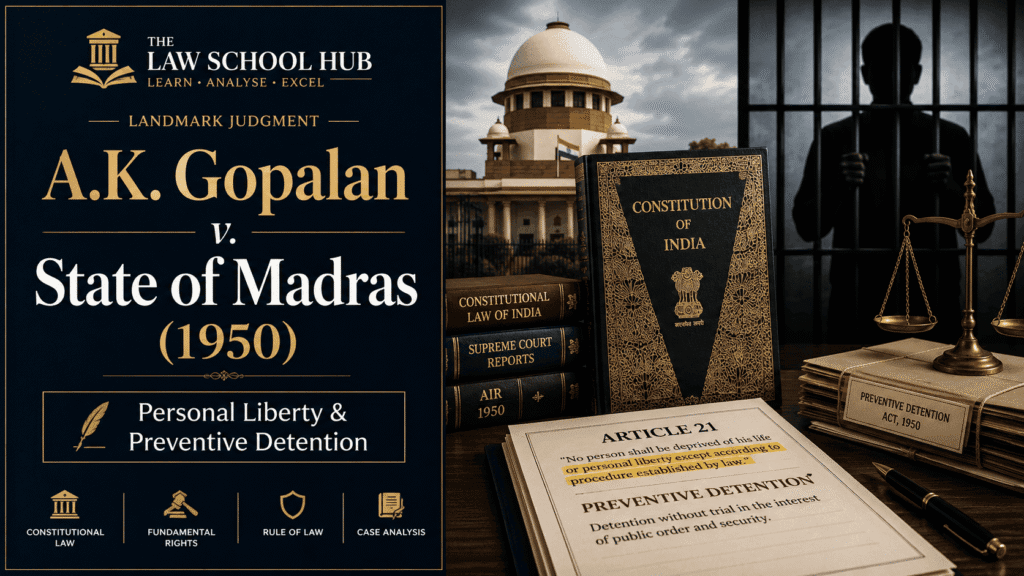
Table of Contents
Introduction
The A.K. Gopalan case is one of India’s earliest and most debated constitutional law judgments on personal liberty and preventive detention. In simple terms, the Supreme Court held in 1950 that a person could lose personal liberty if the State followed a valid law and its procedure. Therefore, the A.K. Gopalan case gave a narrow meaning to Article 21 and accepted preventive detention under the Preventive Detention Act, 1950, except for one harsh secrecy clause. Later, Maneka Gandhi changed this approach by requiring fair, just and reasonable procedure.
Case Details Table
| Case Name | A.K. Gopalan v. State of Madras |
| Court | Supreme Court of India |
| Citation | AIR 1950 SC 27; 1950 SCR 88 |
| Date of Judgment | 19 May 1950 |
| Bench Strength | Six judges |
| Key Judges | H.J. Kania C.J., Fazl Ali, Patanjali Sastri, Mahajan, Mukherjea and S.R. Das JJ. |
| Petitioner | A.K. Gopalan |
| Respondent | State of Madras |
| Core Issue | Personal liberty and preventive detention |
| Outcome | Detention law broadly upheld; Section 14 struck down |
Overview
The A.K. Gopalan case arose soon after the Constitution came into force. A.K. Gopalan, a communist leader, challenged his detention through a habeas corpus petition under Article 32. He argued that preventive detention violated his fundamental rights under Articles 19, 21 and 22. However, the majority treated these rights as separate compartments. As a result, the Court mainly asked whether a law existed and whether that law allowed detention. This made the A.K. Gopalan case a starting point for the debate between State security and individual liberty.
Background
India became a constitutional democracy in 1950, yet the new State faced political unrest, partition-related tensions and public order concerns. Consequently, Parliament enacted the Preventive Detention Act, 1950. Preventive detention allows the State to detain a person not as punishment for a proved offence but to stop a feared future act. Because this power can affect liberty without a regular criminal trial, courts must examine it carefully. The A.K. Gopalan judgment tested how far the Constitution protected a person against such detention.
In that period, the Court preferred textual discipline. It compared the phrase “procedure established by law” with the American idea of “due process of law”. Therefore, the A.K. Gopalan case became a landmark because the Court refused to import a wider due process review into Article 21.
Facts
A.K. Gopalan had faced detention even before the Constitution started operating. After earlier criminal convictions and detention orders, the authorities served him with a fresh detention order under the Preventive Detention Act, 1950. Therefore, he approached the Supreme Court directly.
He asked for a writ of habeas corpus and argued that his detention had no constitutional basis. He challenged the Act and the order on several grounds. First, he argued that the law violated personal liberty under Article 21. Secondly, he argued that detention affected freedom of movement under Article 19(1)(d). Thirdly, he claimed that the preventive detention safeguards under Article 22 had not received proper respect. Finally, he objected to Section 14 of the Act because it prevented disclosure of detention grounds even before a court. These facts made the A.K. Gopalan case a direct clash between constitutional liberty and executive detention power.
Issues
- Whether the Preventive Detention Act, 1950 violated Article 21 of the Constitution.
- Whether personal liberty under Article 21 included the freedoms listed in Article 19.
- Whether Article 22 created a special constitutional framework for preventive detention.
- Whether the Court could test the fairness of the procedure or only check whether a legal procedure existed.
- Whether Section 14 of the Act, which restricted disclosure of grounds, remained constitutionally valid.
Arguments
Petitioner’s Arguments
The petitioner argued that personal liberty cannot mean only physical freedom from prison. Instead, it includes the practical ability to move, speak, associate and live freely. Therefore, detention should satisfy Article 19 as well as Article 21. Moreover, he argued that a law which takes liberty must not be arbitrary or unreasonable. The A.K. Gopalan case, from his side, asked the Court to read fundamental rights together and protect liberty in a broad way.
He also attacked Section 14 because it blocked meaningful judicial review. If the detenu and the court cannot examine the grounds properly, habeas corpus becomes weak. Therefore, the petitioner treated secrecy as a serious danger to liberty.
State’s Arguments
The State argued that preventive detention had express constitutional recognition under Article 22. Therefore, once the Act followed Article 22, the Court should not import extra safeguards from Article 19 or Article 21. The State also argued that Article 21 only required a procedure established by law. If Parliament made the law and the executive followed it, the detention should stand. Accordingly, in the State’s view, the A.K. Gopalan case required judicial restraint, not a broad due process test.
Judgment
The Supreme Court, by majority, upheld the validity of the Preventive Detention Act, 1950, but struck down Section 14. The Court held that Article 21 did not contain the American due process standard. Instead, “law” meant enacted law, and “procedure established by law” meant the procedure created by that law. Therefore, the Court did not ask whether the procedure was fair in a broader moral sense.
Further, the majority treated Article 19 and Article 21 as separate rights. According to this view, when a person loses liberty through detention, Article 19 freedoms do not automatically apply. Moreover, Article 22 specifically deals with arrest and preventive detention. Therefore, the A.K. Gopalan case gave Article 22 a special role.
However, the Court found Section 14 unconstitutional because it prevented disclosure of detention grounds in court. This point mattered because some level of judicial review must remain possible. Still, the petition failed overall, and Gopalan did not secure release through this decision.
Ratio Decidendi
The ratio decidendi of the A.K. Gopalan case can be stated simply: a deprivation of personal liberty satisfies Article 21 if it follows a law made by a competent legislature and the procedure stated in that law. At that time, Article 21 did not require the procedure to be fair, just and reasonable. Also, fundamental rights operated separately, so a detention law under Article 21 did not automatically face Article 19 scrutiny.
This ratio explains why the A.K. Gopalan case later attracted criticism. The Court protected formal legality, but it did not fully test substantive fairness.
Legal Principles from the A.K. Gopalan Case
| Legal Principle | Simple Explanation |
| Procedure established by law | The Court read Article 21 narrowly and focused on whether a valid legal procedure existed. |
| Compartment theory of rights | The majority treated Articles 19, 21 and 22 as separate protections rather than interlinked guarantees. |
| Preventive detention safeguards | Article 22 supplied specific rules for detention, including communication of grounds and advisory board review. |
| Limited judicial review | The Court did not use Article 21 to test fairness in the modern due process sense. |
| Secrecy cannot destroy review | Section 14 failed because it blocked disclosure of grounds even in court. |
Importance
The A.K. Gopalan case remains important because it shows the original judicial approach to personal liberty. It also explains why later courts had to expand Article 21. For law students, the case works like the first chapter of India’s Article 21 journey.
First, the A.K. Gopalan case shows how the Court balanced public order and liberty in the early Republic. Secondly, it explains the difference between “procedure established by law” and “due process of law”. Thirdly, it helps students understand why Maneka Gandhi became revolutionary in 1978. Finally, it proves that constitutional meaning can evolve through judicial interpretation.
Exam-Oriented Listicle: 5 Points to Remember
- Remember the A.K. Gopalan case as the early narrow reading of Article 21.
- Use the A.K. Gopalan case to explain why formal legality alone can weaken personal liberty.
- Compare the A.K. Gopalan case with Maneka Gandhi whenever an exam asks about due process.
- Mention that the A.K. Gopalan case upheld preventive detention but struck down Section 14.
- Connect the A.K. Gopalan case with Article 22 because preventive detention safeguards formed the core constitutional debate.
A.K. Gopalan Case vs Maneka Gandhi: Quick Table
| Point | A.K. Gopalan case | Maneka Gandhi approach |
| Article 21 approach | Formal procedure established by law | Fair, just and reasonable procedure |
| Relationship of rights | Rights viewed separately | Articles 14, 19 and 21 viewed together |
| Judicial review | Narrow review of legal procedure | Broader review of fairness and reasonableness |
| Liberty protection | State-friendly | Rights-protective |
Illustration for Better Understanding
Illustration: Suppose a law allows detention for public order. Under the A.K. Gopalan case approach, a court would mainly ask whether the law exists, whether the legislature had power and whether the stated procedure was followed. However, under the modern Maneka Gandhi approach, the court also asks whether the procedure is fair, non-arbitrary and reasonable. This simple contrast explains the entire shift in Article 21 law.
Critical Analysis
Critically, the A.K. Gopalan case appears too formal when viewed from modern constitutional standards. If any valid law could take liberty without a fairness test, then Parliament and the executive received wide power. Therefore, the judgment gave weak protection against arbitrary detention.
At the same time, the decision must be understood in context. India was newly independent, and the judiciary worked within a text that consciously used “procedure established by law” instead of “due process”. Even so, Justice Fazl Ali’s dissent looked ahead. He favoured a more integrated reading of fundamental rights. Later constitutional law moved closer to that view.
In R.C. Cooper v. Union of India, the Supreme Court weakened the separate-compartment theory. Then, in Maneka Gandhi v. Union of India, the Court transformed Article 21. It held that procedure under Article 21 must be fair, just and reasonable and must also satisfy Articles 14 and 19. Therefore, the A.K. Gopalan case is no longer good law on that narrow Article 21 approach, but it remains historically essential.
Conclusion
The A.K. Gopalan case is a foundational judgment on personal liberty and preventive detention. Although the Supreme Court adopted a narrow view of Article 21, the case created the constitutional debate that later produced stronger liberty protection. Therefore, students should not study the A.K. Gopalan case as an isolated old judgment. Instead, they should read it with R.C. Cooper, Maneka Gandhi and the right to privacy decision. Together, these cases show how Indian constitutional law moved from formal legality to meaningful fairness.
FAQs on A.K. Gopalan v. State of Madras
What is the A.K. Gopalan case about?
The A.K. Gopalan case is about personal liberty, Article 21 and preventive detention under the Preventive Detention Act, 1950.
What did the Supreme Court hold in A.K. Gopalan v. State of Madras?
The Court upheld preventive detention and held that Article 21 required only procedure established by law, not a broader due process test.
Why is the A.K. Gopalan case important?
It is important because it shows the early narrow interpretation of Article 21 and the separate treatment of fundamental rights.
Was the Preventive Detention Act, 1950 declared unconstitutional?
No. The Act broadly survived, but Section 14 was struck down because it restricted disclosure of detention grounds in court.
Which judge dissented in the A.K. Gopalan case?
Justice Fazl Ali dissented and supported a broader connection between personal liberty and other fundamental rights.
Did Maneka Gandhi overrule the A.K. Gopalan case?
Maneka Gandhi rejected the narrow approach of the A.K. Gopalan case and required fair, just and reasonable procedure under Article 21.
What is preventive detention?
Preventive detention means detention to prevent a possible future threat, not punishment after conviction for a past offence.
Which Articles were discussed in the A.K. Gopalan case?
The major Articles were Article 19, Article 21, Article 22 and Article 32 of the Constitution.
Legal References
- A.K. Gopalan v. State of Madras judgment
- Supreme Court judgment PDF copy
- Constitution of India
- Article 21 – Protection of life and personal liberty
- Article 22 – Protection against arrest and detention
- Article 19 – Freedoms under the Constitution
- R.C. Cooper v. Union of India
- Maneka Gandhi v. Union of India
- Justice K.S. Puttaswamy v. Union of India
- The Law School Hub
We provide case laws, legal acts and useful resources for law students and legal readers. Want to read more simple legal blogs? Visit The Law School Hub and continue your legal learning journey.
Editorial Note
This blog draft has been written in an original, simple and student-friendly style for legal education. For publication, you may run a final plagiarism scan with your preferred plagiarism checker and update internal website links if your legal resources pages use specific custom URLs.