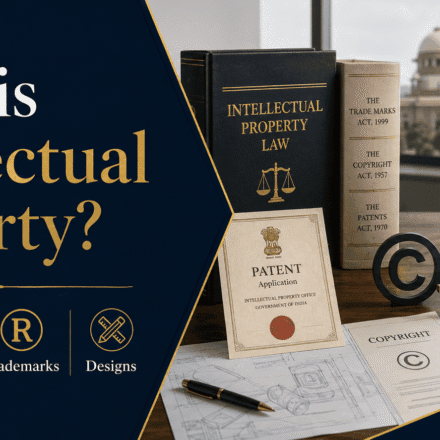









What Is Intellectual Property? A Complete, Simple Guide to Protect Creative Ideas in India


Intro: What Is Intellectual Property?
Intellectual property means legal protection for creations of the mind, such as inventions, brand names, logos, books, music, software, designs, and unique local products. In simple words, intellectual property rights in India help creators, students, founders, artists, businesses, and researchers protect the value of their ideas once those ideas take a legally recognisable form. Therefore, if you create a product, write content, build a brand, design packaging, invent technology, or develop a creative work, you should understand how intellectual property works before someone copies, sells, or misuses it.
This guide explains intellectual property rights in India in a simple, casual, and formal way. Moreover, it uses clear examples so a first-year law student, startup founder, blogger, designer, or small business owner can quickly understand the topic. However, remember one key point at the beginning: law usually protects expression, invention, design, brand identity, confidential know-how, and source indicators, not a raw idea sitting only in your mind.
Overview: Intellectual Property Rights in India
The phrase intellectual property rights in India covers different legal tools. For example, patents protect inventions, copyright protects original creative works, trade marks protect brand identity, designs protect the look of articles, geographical indications protect region-linked goods, and special laws protect plant varieties and semiconductor layout designs. Consequently, one business may need more than one form of protection.
For instance, imagine a startup launches a smart water bottle. The technical mechanism may need a patent, the product name may need a trade mark, the bottle shape may need design protection, the website content may enjoy copyright, and the customer list may need trade secret protection. As a result, intellectual property rights in India operate like a legal toolkit rather than a single law.
Why Intellectual Property Matters Today
Today, businesses do not earn only from factories, land, or physical stock. Instead, they also earn from software code, formulas, brand trust, product design, content, data, and technology. Therefore, intellectual property rights in India help convert creativity into an asset that owners can license, sell, franchise, assign, or enforce.
Moreover, intellectual property protects effort. A songwriter may spend months composing music. A student may build a legal-tech tool. A food entrepreneur may develop a unique brand and packaging style. Similarly, a farmer group may preserve a product connected to a particular region. In each case, intellectual property rights in India can help stop unfair copying and build commercial confidence.
Main Types of Intellectual Property Rights in India
India recognises several categories of intellectual property. Although people often talk only about patents, copyright, and trademarks, intellectual property rights in India also include industrial designs, geographical indications, plant variety protection, semiconductor layout designs, and trade secrets. Each category protects a different kind of value.
First, patents protect inventions that meet legal tests such as novelty, inventive step, and industrial application. Secondly, copyright protects original literary, artistic, musical, cinematographic, sound recording, and software-related works. Thirdly, trade marks protect brand identifiers such as names, logos, labels, shapes, and sometimes sounds. Therefore, intellectual property rights in India require proper classification before filing.
Quick Table: Which IP Right Protects What?
| IP Type | What It Protects | Simple Example | Main Indian Law |
| Patent | Technical invention | New water purifier mechanism | The Patents Act, 1970 |
| Copyright | Original expression | Book, song, film, software code | The Copyright Act, 1957 |
| Trade mark | Brand identity | Logo, name, label, slogan | The Trade Marks Act, 1999 |
| Design | Product appearance | Shape or pattern of a bottle | The Designs Act, 2000 |
| GI | Place-linked goods | Darjeeling Tea, Banarasi Saree | GI Act, 1999 |
| Trade secret | Confidential business information | Recipe, formula, algorithm | Contracts and civil law |
As shown above, the correct IP category depends on what you want to protect. Therefore, intellectual property rights in India should be selected according to the asset, not according to popularity or guesswork.
1. Patents: Protection for New Inventions
A patent protects a new invention, such as a machine, process, device, chemical composition, or technical improvement. Under the Patents Act, 1970, a patent can give the owner the right to stop others from making, using, selling, importing, or offering the patented invention without permission. Therefore, patents form one of the strongest forms of intellectual property rights in India for technology-heavy businesses.
For example, if an engineering student invents a low-cost water purification device with a new technical mechanism, the student may consider patent protection. However, a mere business idea, mathematical method, discovery, or obvious improvement may not qualify. Consequently, intellectual property rights in India do not protect every idea automatically; they protect the legal subject matter that fits statutory requirements.
2. Copyright: Protection for Creative Expression
Copyright protects original expression, not the general idea behind it. In India, the Copyright Act, 1957 deals with literary works, dramatic works, musical works, artistic works, cinematograph films, sound recordings, computer programs, databases, and related rights. Therefore, copyright plays a daily role in intellectual property rights in India for authors, YouTubers, musicians, photographers, coders, filmmakers, and bloggers.
For example, the idea of writing a romantic song about rain does not belong to one person. However, the exact lyrics, tune, sound recording, and artwork can receive protection if they satisfy the law. Similarly, a legal blog article enjoys copyright in its original written expression, but not in every legal concept discussed in it. Therefore, intellectual property rights in India protect creativity without freezing common knowledge.
3. Trade Marks: Protection for Brand Identity
A trade mark helps customers identify the source of goods or services. It may include a brand name, logo, label, slogan, shape, colour combination, or other distinctive sign. Under the Trade Marks Act, 1999, registration strengthens brand protection and helps owners take action against confusingly similar marks. Thus, trade marks form a core part of intellectual property rights in India for businesses.
For example, a bakery called ‘Golden Crust’ may use a unique logo, packaging style, and tagline. If another bakery adopts a confusingly similar name and logo in the same market, customers may get misled. Therefore, trade mark law protects both the business owner and the consumer. In that way, intellectual property rights in India encourage honest branding.
4. Designs: Protection for Product Appearance
Design protection covers the visual appearance of an article, such as its shape, pattern, configuration, ornamentation, or composition of lines and colours. The Designs Act, 2000 focuses on the aesthetic aspect of products, not their technical function. Therefore, intellectual property rights in India can protect the look of a bottle, chair, lamp, mobile cover, jewellery design, or packaging article.
For example, if a startup creates a unique ergonomic chair with an attractive outer shape, design registration may protect the visual form. However, if the innovation lies in the chair’s mechanical adjustment system, patent law may become more relevant. Consequently, intellectual property rights in India require a careful distinction between function and appearance.
5. Geographical Indications: Protection for Regional Reputation
A geographical indication, or GI, connects goods with a specific place where quality, reputation, or characteristics come from that origin. The Geographical Indications of Goods (Registration and Protection) Act, 1999 gives legal recognition to such products. Therefore, intellectual property rights in India also protect community-linked heritage and local economic identity.
For example, Darjeeling Tea, Kanchipuram Silk, Nagpur Orange, and Kolhapuri Chappal carry regional value. A GI does not belong to one private company in the usual sense. Instead, authorised users connected with the region can benefit. Therefore, intellectual property rights in India can support artisans, farmers, producer groups, and traditional industries.
6. Trade Secrets and Confidential Information
Trade secrets protect valuable confidential information, such as formulas, recipes, algorithms, client lists, pricing strategies, manufacturing methods, or internal processes. In India, trade secrets usually receive protection through contracts, confidentiality clauses, employment policies, equitable principles, and civil remedies. Therefore, intellectual property rights in India also include practical business safeguards beyond registration systems.
For example, a restaurant recipe, a coaching institute’s question bank, or a software company’s source code may remain valuable because competitors do not know it. However, the owner must take reasonable steps to keep it confidential. Therefore, non-disclosure agreements, access controls, password systems, and employee training matter. As a result, intellectual property rights in India require both legal drafting and everyday discipline.
Other Special IP Protections
India also has specialised protection for plant varieties and semiconductor integrated circuit layout designs. The Protection of Plant Varieties and Farmers’ Rights Act, 2001 encourages the development of new plant varieties while recognising farmers’ contributions. Similarly, the Semiconductor Integrated Circuits Layout-Design Act, 2000 protects original layout designs of integrated circuits. Thus, intellectual property rights in India adapt to agriculture and advanced technology.
Registration: Is It Always Needed?
Registration depends on the category of IP. Patent, trade mark, design, GI, plant variety, and semiconductor layout protection usually need formal registration. Copyright can exist without registration, but registration still helps as evidence. Therefore, intellectual property rights in India work differently depending on the protected asset.
Moreover, filing early can prevent disputes. If two businesses use similar names, the earlier user or registrant may gain a stronger position depending on facts. Likewise, public disclosure before patent filing can create serious problems. Therefore, businesses should not wait until copying starts. Instead, they should map their IP before launch. This planning makes intellectual property rights in India more effective.
Practical Registration Table
| Question | Practical Answer |
| Should I file before launch? | Yes, especially for trade marks, patents, and designs where public use can create risks. |
| Can one product have many IP rights? | Yes. A product may involve patent, design, trade mark, copyright, and trade secret protection. |
| Can I use online images freely? | No. Check licence terms, ownership, and permitted use before publishing or selling. |
| Should freelancers assign IP? | Yes. Use written IP assignment clauses to avoid ownership disputes later. |
Common Mistakes People Make About IP
Many creators believe that sending an idea to themselves by email gives complete protection. However, evidence of creation is not the same as a registered right. Likewise, many founders assume that a domain name automatically protects their brand. It does not. Therefore, intellectual property rights in India need clear legal steps.
Another mistake is mixing up copyright, patent, and trade mark. For example, a logo may involve copyright in the artwork and trade mark protection for brand use. A product may involve a patent for function and design protection for appearance. Therefore, intellectual property rights in India may overlap, but each right has a separate purpose.
How to Protect Your Intellectual Property: A Simple Checklist
Start with an IP audit. List your brand names, logos, products, content, software, designs, databases, formulas, confidential information, and regional products. Then, match each asset with the correct legal category. This basic exercise makes intellectual property rights in India easier to understand and manage.
Next, search before you file. Check existing trade marks, published patents, designs, and domain names. After that, choose the right filing strategy. Furthermore, use contracts with employees, freelancers, co-founders, vendors, distributors, and licensees. Therefore, intellectual property rights in India require documentation as much as creativity.
Remedies for IP Infringement in India
When someone copies or misuses protected IP, the owner may seek civil remedies such as injunctions, damages, accounts of profits, delivery-up of infringing goods, and other court orders. In some cases, IP statutes also provide criminal remedies. Therefore, intellectual property rights in India can give both preventive and corrective relief.
For example, if a competitor sells goods under a confusingly similar brand name, the trade mark owner may seek an injunction. Similarly, if someone uploads a pirated movie or copies software, copyright remedies may apply. However, every case depends on facts, proof, registration status, limitation, and jurisdiction. Therefore, intellectual property rights in India should be enforced with careful legal strategy.
Conclusion
Intellectual property is the legal bridge between creativity and commercial value. It protects inventions, creative works, brands, product designs, regional goods, confidential know-how, plant varieties, and semiconductor layouts. Therefore, intellectual property rights in India matter to students, startups, artists, writers, researchers, farmers, manufacturers, and online creators.
However, protection does not work automatically in every situation. You must identify the correct IP category, preserve proof, register where required, use contracts, monitor misuse, and enforce rights carefully. Moreover, you should treat IP as an asset from the beginning, not as an afterthought after copying begins.
In short, intellectual property rights in India help reward innovation, protect reputation, encourage investment, and support fair competition. When creators understand the basics, they can turn ideas into safer, stronger, and more valuable legal assets.
FAQs on Intellectual Property
What is intellectual property in simple words?
Intellectual property means creations of the mind that law can protect. For example, inventions, books, music, software, logos, product designs, and regional product names can fall under intellectual property rights in India when they meet legal requirements.
What are the main types of intellectual property?
The main types include patents, copyright, trade marks, industrial designs, geographical indications, trade secrets, plant varieties, and semiconductor layout designs. Therefore, intellectual property rights in India cover both creative and commercial assets.
Is copyright the same as a patent?
No. Copyright protects original expression such as books, songs, films, art, and software code. A patent protects a technical invention. Therefore, intellectual property rights in India use different laws for different assets.
Can an idea be protected under IP law?
A raw idea alone usually does not get protection. However, its expression, invention, design, confidential form, or brand identity may get protection. Therefore, intellectual property rights in India protect legally recognised forms of ideas.
Do I need registration for intellectual property?
It depends. Patents, trade marks, designs, GIs, plant varieties, and semiconductor layouts generally require registration. Copyright can arise without registration, although registration helps as evidence. Therefore, intellectual property rights in India need category-wise planning.
Who owns IP created by an employee?
Ownership depends on employment terms, contracts, the nature of work, and the type of IP. Therefore, businesses should use clear IP assignment and confidentiality clauses to manage intellectual property rights in India.
How can startups protect IP in India?
Startups should conduct an IP audit, search their brand name, file relevant applications, protect confidential information, and sign contracts with founders, employees, freelancers, and vendors. This makes intellectual property rights in India stronger from the start.
What is the difference between a trade mark and a brand name?
A brand name is the commercial identity used in the market. A trade mark is the legal protection that can cover that name or logo if it qualifies. Therefore, intellectual property rights in India help turn brand identity into enforceable rights.
What happens if someone copies my IP?
You should collect evidence, check ownership and registration, and consult a legal professional. Depending on the right involved, intellectual property rights in India may allow injunctions, damages, accounts of profits, takedowns, or other remedies.
Are trade secrets protected in India?
Yes, but mostly through contracts, confidentiality duties, employment policies, and civil remedies rather than a single registration system. Therefore, intellectual property rights in India also depend on internal security practices.
Legal References and Backlinks Used
- WIPO: What is Intellectual Property?
- IP India: Intellectual Property India, Government of India
- The Patents Act, 1970
- The Copyright Act, 1957
- The Trade Marks Act, 1999
- The Designs Act, 2000
- The Geographical Indications of Goods (Registration and Protection) Act, 1999
- The Protection of Plant Varieties and Farmers’ Rights Act, 2001
- The Semiconductor Integrated Circuits Layout-Design Act, 2000
We provide case laws, legal acts, and useful legal resources for law students and readers. Want to read more blogs? Visit The Law School Hub for more simple legal guides.