







Introduction
Alderslade v Hendon Laundry Ltd is a leading English contract law case on exclusion clauses, negligence, and bailment. In simple words, the Court of Appeal allowed a laundry business to rely on a clause that limited compensation for lost clothes, even though the clause did not expressly use the word negligence. Therefore, Alderslade v Hendon Laundry Ltd matters because it explains when general words in a contract can still protect a party from negligence-based liability.
Overview
Alderslade v Hendon Laundry Ltd began when a customer gave valuable handkerchiefs to a laundry for washing. The laundry lost them. The contract limited compensation to twenty times the washing charge. Consequently, the customer wanted the full value, while the laundry wanted the lower contractual amount. The Court of Appeal accepted the laundry’s argument because negligence offered the only realistic basis for liability.
At a Glance
| Field | Details |
| Case | Alderslade v Hendon Laundry Ltd |
| Citation | [1945] KB 189; [1945] 1 All ER 244 |
| Court | Court of Appeal of England and Wales |
| Area | Contract law, exclusion clauses, bailment, negligence |
| Main judge | Lord Greene MR |
| Core principle | A limitation clause may cover negligence where negligence is the only realistic legal basis of liability. |
Facts of the Case
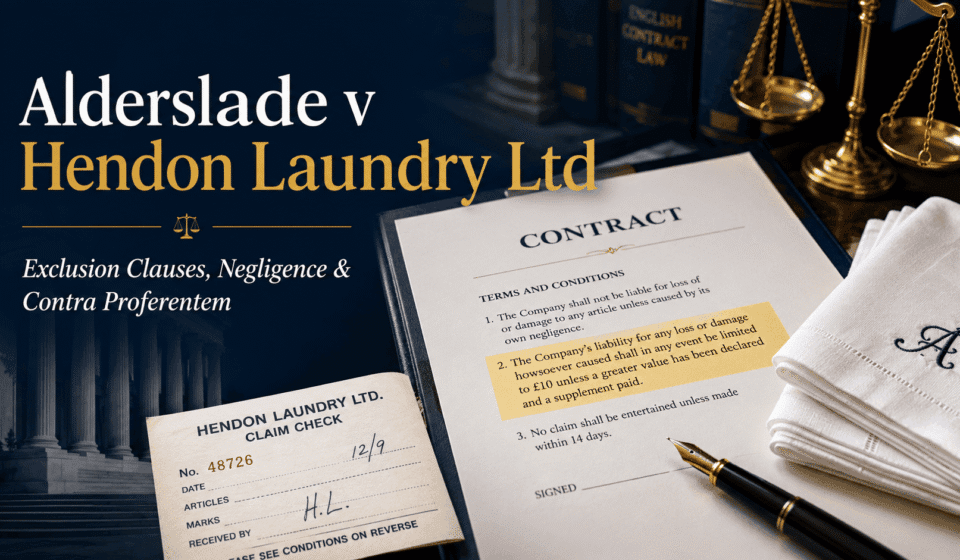
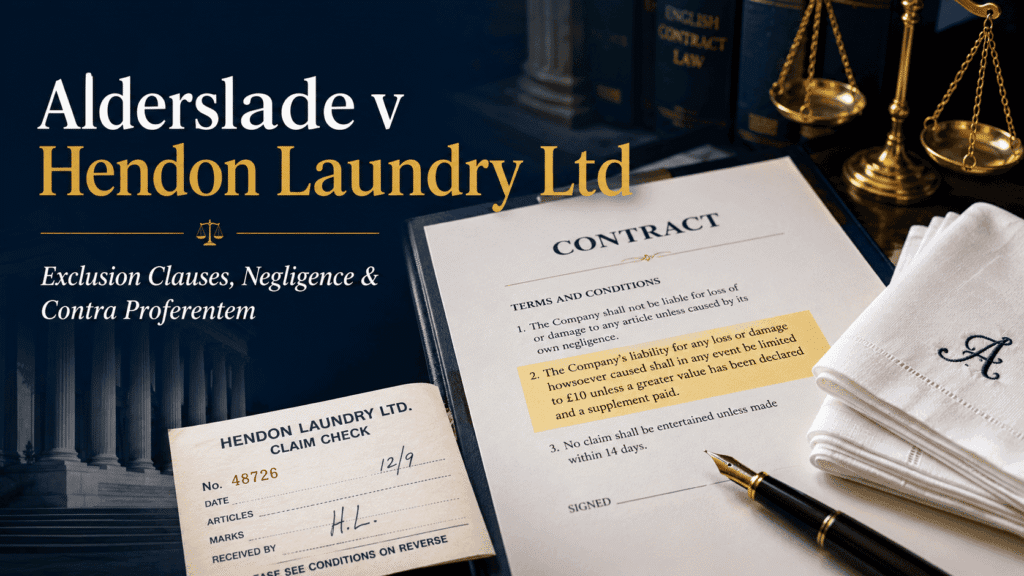
In Alderslade v Hendon Laundry Ltd, the claimant sent ten large handkerchiefs to the defendant laundry. The items did not return. As a result, the claimant sued for damages and claimed the value of the missing handkerchiefs. However, the laundry relied on a printed condition in the contract. The condition stated that the maximum amount allowed for lost or damaged articles would be twenty times the charge made for laundering.
That formula created a major difference. The claimant sought about £5, but the clause reduced the amount to 11 shillings and 5 pence. Moreover, the clause did not directly say that the laundry could limit liability for negligence. So, the central question in Alderslade v Hendon Laundry Ltd became simple: could general words limit liability for negligent loss?
Legal Issue
The issue in Alderslade v Hendon Laundry Ltd was whether a limitation clause for lost or damaged articles applied to loss caused by negligence. Usually, courts read exclusion clauses strictly. Also, when a clause protects a party from its own negligence, the court expects clear language. However, this case presented a special situation because the laundry had no other realistic source of liability for the lost goods.
Judgment and Reasoning
The Court of Appeal held in favour of Hendon Laundry Ltd. In other words, the laundry could rely on the limitation clause. Lord Greene MR reasoned that the only way the laundry could become liable for the lost articles was through negligence in caring for the goods. Therefore, if the clause did not cover negligence, it would have almost no practical work to do.
This reasoning makes Alderslade v Hendon Laundry Ltd different from many other exclusion clause cases. Where a clause can cover another type of liability, courts usually avoid reading it as protection against negligence unless the wording makes that meaning clear. However, where negligence supplies the only sensible basis of liability, the court may treat the clause as extending to negligence.
Why the Case Matters
Alderslade v Hendon Laundry Ltd matters for three practical reasons. First, it shows that courts do not read exclusion clauses mechanically. Secondly, it reminds businesses that limitation clauses should use clear wording.
Moreover, Alderslade v Hendon Laundry Ltd connects neatly with contra proferentem. That rule says an unclear clause should operate against the party relying on it. Yet, this case shows that contra proferentem does not automatically defeat every limitation clause.
Five Key Lessons from Alderslade v Hendon Laundry Ltd
1. Clear drafting matters: a business should mention negligence directly if it wants strong protection.
2. Context matters: the court looks at the real commercial setting, not just isolated words.
3. Limitation differs from total exclusion: a reasonable cap may look fairer than a complete escape.
4. Bailment creates a duty of care: a person who takes another’s goods must handle them carefully.
5. Modern statutes matter: laws can restrict unfair limitation clauses today.
Exclusion Clauses and Negligence Today
Although Alderslade v Hendon Laundry Ltd remains an important common law authority, modern courts also consider statutory controls. For example, under Section 2 of the Unfair Contract Terms Act 1977, a business cannot exclude or restrict liability for negligence causing death or personal injury. For other loss, the clause must satisfy the reasonableness test. Similarly, Section 62 of the Consumer Rights Act 2015 says an unfair consumer term does not bind the consumer.
Therefore, a business cannot simply print a harsh clause and expect automatic protection. It must show fair notice, clear language, and legal reasonableness. As a result, Alderslade v Hendon Laundry Ltd works best as a common law interpretation rule, not as a free licence to impose unfair terms.
Indian Law Connection
Indian readers can connect Alderslade v Hendon Laundry Ltd with bailment under the Indian Contract Act, 1872. Section 151 says a bailee must take as much care of goods as an ordinarily prudent person would take of their own goods. Section 152 adds that, in the absence of a special contract, a bailee is not liable for loss if the bailee has taken that level of care.
Consequently, the Indian law discussion also turns on care, contract, and special terms. If an Indian dry cleaner adds a limitation clause, a court may examine wording, notice, bargaining power, and public policy. Thus, Alderslade v Hendon Laundry Ltd gives students a helpful comparative example, although Indian courts must apply Indian law.
Simple Illustration of Alderslade v Hendon Laundry Ltd
Imagine that you give an expensive blazer to a dry cleaner. The receipt says: “For lost or damaged garments, maximum compensation is ten times the cleaning charge.” Later, the shop loses the blazer. If negligent care is the only realistic claim, the logic of Alderslade v Hendon Laundry Ltd suggests that the clause may cover negligence. However, modern consumer law may still test fairness and reasonableness.
Key Takeaway Table for Alderslade v Hendon Laundry Ltd
| Point | What the case says |
| Facts | The laundry lost the customer’s handkerchiefs. |
| Clause | Compensation would be twenty times the laundering charge. |
| Argument | The customer said the clause did not mention negligence. |
| Decision | The Court of Appeal allowed the laundry to rely on the clause. |
| Rule | General words may cover negligence if negligence is the only real basis of liability. |
| Modern caution | Statutory fairness rules may restrict harsh clauses today. |
Conclusion
Alderslade v Hendon Laundry Ltd teaches a compact but powerful lesson: courts interpret exclusion and limitation clauses by looking at the whole contract and the realistic sources of liability. The case does not say that every vague clause protects negligence. Instead, it says that where negligence is the only meaningful basis for liability, the court may read the clause as applying to negligence. Therefore, students should remember Alderslade v Hendon Laundry Ltd as a case about context, drafting, bailment, and careful contractual interpretation.
FAQs
1. What is Alderslade v Hendon Laundry Ltd about?
Alderslade v Hendon Laundry Ltd is about a laundry that lost a customer’s handkerchiefs and relied on a clause limiting compensation for lost or damaged articles.
2. What did the Court of Appeal decide in Alderslade v Hendon Laundry Ltd?
The Court of Appeal decided that the limitation clause applied because negligence was the only realistic basis on which the laundry could be liable.
3. Why is Alderslade v Hendon Laundry Ltd important in contract law?
It explains when general words in a limitation clause can cover negligence, even without the express word negligence.
4. Does the case support exclusion clauses completely?
No. Alderslade v Hendon Laundry Ltd supports a limitation clause on its facts. However, courts still read unclear clauses strictly and modern statutes control unfair terms.
5. What is the contra proferentem link?
Contra proferentem means ambiguity works against the party relying on the clause. However, Alderslade v Hendon Laundry Ltd shows that courts first examine whether the clause has any other realistic purpose.
6. Is Alderslade v Hendon Laundry Ltd relevant for Indian law students?
Yes. It helps Indian law students understand bailment, duty of care, negligence, and contractual limitation clauses in a comparative way.
7. Which Indian Contract Act sections connect with this case?
Sections 151 and 152 of the Indian Contract Act, 1872 connect with the case because they deal with the bailee’s duty of care and liability for loss of bailed goods.
8. What should businesses learn from this case?
Businesses should draft limitation clauses clearly, bring them to the customer’s notice, and check whether consumer protection laws make the clause unfair or unreasonable.
Legal References and Further Reading
- Alderslade v Hendon Laundry Ltd [1945] KB 189 – LawTeacher summary
- Alderslade v Hendon Laundry Ltd [1945] KB 189 – Oxbridge Notes summary
- Oxford University Press Learning Link – key exclusion clause cases
- Unfair Contract Terms Act 1977, Section 2 – legislation.gov.uk
- Consumer Rights Act 2015, Section 62 – legislation.gov.uk
- Indian Contract Act, 1872 – India Code official PDF
- Canada Steamship Lines Ltd v The King [1952] AC 192 – BAILII
- Hollier v Rambler Motors (AMC) Ltd [1972] 2 QB 71 – BAILII
We provide case laws, legal acts, study notes, and practical resources for law students. Want to read more contract law blogs? Visit The Law School Hub and explore more legal resources.