






Fundamental Rights Under the Indian Constitution: Powerful Guide to Your Essential Legal Protections

Legal note: This article is for educational purposes and does not replace advice from a qualified lawyer.
Introduction
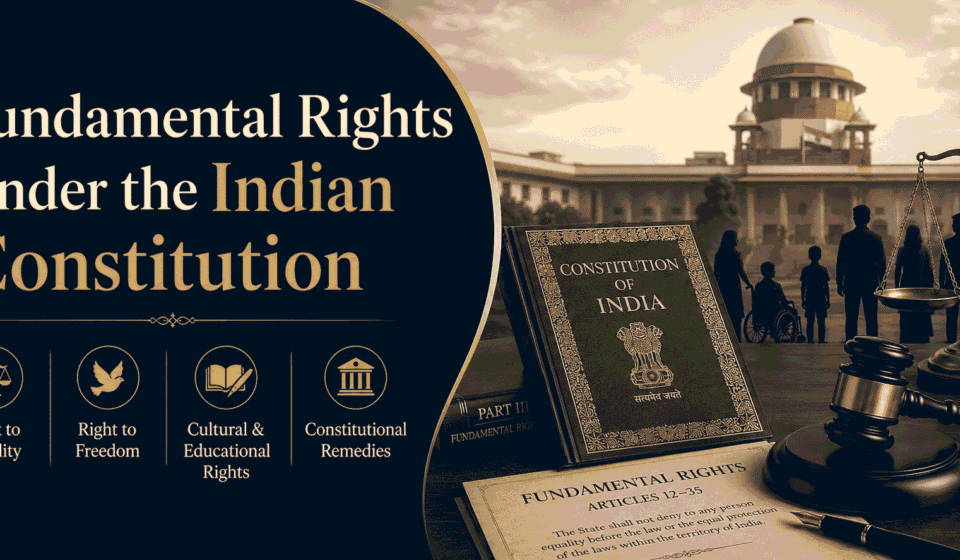
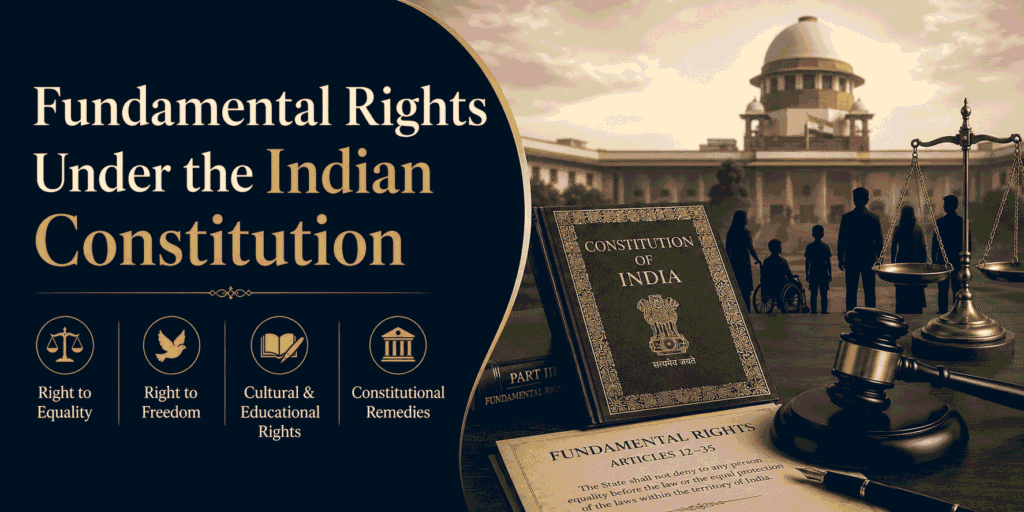
Fundamental rights under the Indian Constitution are the basic legal protections that every person or citizen can claim against the State when the State acts unfairly, arbitrarily, or unlawfully. In simple words, fundamental rights protect equality, liberty, dignity, religious freedom, cultural identity, education, and access to constitutional remedies. They appear mainly in Part III of the Constitution, from Articles 12 to 35, and courts can enforce them through writs and constitutional petitions.
Therefore, if a government authority violates your liberty, discriminates without legal reason, restricts your speech beyond constitutional limits, or denies a core protection, fundamental rights allow you to question that action before a court. However, these rights are not just exam topics. They shape daily life, public policy, policing, education, employment, digital privacy, and democracy itself.
Overview: What Are Fundamental Rights?
Fundamental rights are special constitutional guarantees. They are called fundamental because they support the basic idea of a free and democratic society. They limit State power. Moreover, they give individuals a practical way to demand fair treatment from public authorities.
The Constitution uses Article 12 to define the expression “State” for Part III. It includes the Government and Parliament of India, State Governments and Legislatures, local bodies, and other authorities under government control. Consequently, fundamental rights usually operate against State action. In some situations, however, constitutional values also influence private relationships through statutes, judicial directions, and public duties.
Article 13 gives these guarantees strong legal force. It says that laws inconsistent with fundamental rights become void to the extent of inconsistency. As a result, Parliament and State Legislatures cannot pass laws that destroy the basic protections given by Part III. Courts also review executive orders, rules, notifications, and administrative actions when they affect fundamental rights.
Quick Table: Six Groups of Fundamental Rights
| Group | Articles | Simple Meaning |
| Right to Equality | Articles 14-18 | Equality before law, non-discrimination, equal public employment opportunity, abolition of untouchability, and prohibition of titles. |
| Right to Freedom | Articles 19-22 | Speech, assembly, association, movement, residence, profession, life and liberty, education, and arrest safeguards. |
| Right Against Exploitation | Articles 23-24 | Protection from trafficking, forced labour, begar, and hazardous child labour. |
| Freedom of Religion | Articles 25-28 | Freedom of conscience, religious practice, religious affairs, and limits on religious instruction and taxes. |
| Cultural and Educational Rights | Articles 29-30 | Protection of language, script, culture, and minority educational institutions. |
| Constitutional Remedies | Article 32 | Right to approach the Supreme Court for enforcement of fundamental rights through writs. |
1. Right to Equality: Articles 14 to 18
The right to equality is the starting point of fundamental rights. Article 14 promises equality before the law and equal protection of the laws. In daily terms, the State cannot treat people differently without a fair, rational, and legally acceptable reason. Also, equals should receive equal treatment in similar situations.
Article 15 prohibits discrimination on grounds such as religion, race, caste, sex, or place of birth. However, the Constitution also allows special provisions for women, children, socially and educationally backward classes, Scheduled Castes, Scheduled Tribes, and economically weaker sections. Therefore, equality does not always mean identical treatment. It often means fair treatment according to real social conditions.
Article 16 protects equality of opportunity in public employment. Article 17 abolishes untouchability. Article 18 prohibits most titles. Together, these fundamental rights attack both legal inequality and social hierarchy. They also make the State responsible for building a fair public order.
2. Right to Freedom: Articles 19 to 22
The right to freedom gives citizens the space to think, speak, move, associate, work, and live with personal liberty. Article 19 protects several freedoms, including speech and expression, peaceful assembly, association, movement, residence, and profession or occupation. However, Article 19 also permits reasonable restrictions for grounds such as public order, morality, security of the State, decency, and other listed reasons.
Article 20 protects people in criminal matters. It guards against retrospective criminal punishment, double jeopardy, and compelled self-incrimination. Article 21 states that no person shall be deprived of life or personal liberty except according to procedure established by law. Over time, courts have read this article widely to include dignity, privacy, fair procedure, livelihood, health, environment, and many other protections.
Article 21A provides free and compulsory education for children from six to fourteen years. Article 22 adds safeguards against arrest and detention. Thus, these fundamental rights protect both civil liberty and procedural fairness. Moreover, they ensure that State power follows law, reason, and justice.
3. Right Against Exploitation: Articles 23 and 24
The right against exploitation protects human dignity in direct terms. Article 23 prohibits trafficking, begar, and forced labour. Article 24 prohibits employment of children below fourteen years in factories, mines, and hazardous employment. Consequently, these fundamental rights connect constitutional law with labour dignity, child protection, and social justice.
This part matters because exploitation often hides behind poverty, debt, social pressure, and informal work. Therefore, constitutional protection must work along with labour laws, child protection laws, criminal law, and welfare schemes. Courts and authorities can use these fundamental rights to protect vulnerable people from economic and physical abuse.
4. Right to Freedom of Religion: Articles 25 to 28
India follows a constitutional model of secularism. Article 25 protects freedom of conscience and the right to freely profess, practise, and propagate religion. However, this freedom remains subject to public order, morality, health, and other provisions of Part III. Therefore, religious freedom is protected, but it cannot override basic constitutional values.
Article 26 protects the right of religious denominations to manage religious affairs. Article 27 restricts compulsion to pay taxes for promotion of a particular religion. Article 28 deals with religious instruction in educational institutions. Together, these fundamental rights balance individual faith, institutional autonomy, and the secular character of the State.
5. Cultural and Educational Rights: Articles 29 and 30
Cultural and educational rights protect India’s diversity. Article 29 protects the interests of minorities by allowing citizens with a distinct language, script, or culture to conserve it. Article 30 gives minorities the right to establish and administer educational institutions of their choice.
These fundamental rights are important because democracy should not force cultural uniformity. Instead, it must protect communities that may otherwise lose their language, script, or identity. At the same time, minority institutions must follow standards related to education, administration, and public interest.
6. Right to Constitutional Remedies: Article 32
Article 32 gives people the right to approach the Supreme Court for enforcement of fundamental rights. Dr. B.R. Ambedkar famously treated it as the heart and soul of the Constitution because rights need remedies. Without an effective remedy, even the strongest right becomes weak.
Article 32 gives people the right to approach the Supreme Court for enforcement of fundamental rights. Dr. B.R. Ambedkar famously treated it as the heart and soul of the Constitution because rights need remedies. Without an effective remedy, even the strongest right becomes weak.
Important Writs for Enforcing Fundamental Rights
| Writ | Meaning | Common Use |
| Habeas Corpus | To produce a detained person before court. | Illegal arrest or detention. |
| Mandamus | To command a public authority to perform a legal duty. | Refusal to act despite a public duty. |
| Certiorari | To quash an illegal order of a lower court or tribunal. | Jurisdictional error or violation of natural justice. |
| Prohibition | To stop a lower court or tribunal from exceeding jurisdiction. | Proceedings going beyond legal authority. |
| Quo Warranto | To question a person’s authority to hold public office. | Illegal appointment to a public post. |
Landmark Case Laws That Shaped Fundamental Rights
Indian constitutional law developed through powerful judicial interpretation. For example, Kesavananda Bharati v. State of Kerala protected the basic structure doctrine and limited Parliament’s power to damage the core identity of the Constitution. As a result, fundamental rights gained deeper protection within the larger constitutional framework.
Similarly, Maneka Gandhi v. Union of India transformed Article 21. The Supreme Court connected life and personal liberty with fairness, reasonableness, and natural justice. Consequently, a legal procedure must not be arbitrary. It must also satisfy constitutional fairness.
Later, Justice K.S. Puttaswamy v. Union of India recognised privacy as a constitutionally protected right linked with life, liberty, dignity, and autonomy. In the digital age, this decision made fundamental rights more relevant to data protection, surveillance, identity, and personal choice.
In Shreya Singhal v. Union of India, the Supreme Court struck down Section 66A of the Information Technology Act because it violated free speech under Article 19(1)(a). Therefore, fundamental rights also protect online expression when State restrictions become vague, excessive, or chilling.
| Case Law | Core Principle | Why It Matters |
| Kesavananda Bharati v. State of Kerala | Basic structure doctrine limits Parliament’s amending power. | Protected the constitutional identity that supports fundamental rights. |
| Maneka Gandhi v. Union of India | Article 21 requires fair, just, and reasonable procedure. | Expanded the meaning of life and personal liberty. |
| Justice K.S. Puttaswamy v. Union of India | Privacy is part of life, liberty, dignity, and autonomy. | Made fundamental rights powerful in the digital age. |
| Shreya Singhal v. Union of India | Vague speech restrictions can violate Article 19(1)(a). | Protected online free speech and reduced chilling effects. |
Are Fundamental Rights Absolute?
No. Most fundamental rights are not absolute. The Constitution allows reasonable restrictions, especially under Article 19. For instance, free speech may face restrictions for public order, defamation, morality, decency, contempt of court, or national security. However, restrictions must remain lawful, reasonable, and proportionate.
This balance matters. Without restrictions, one person’s freedom may harm another person’s safety or dignity. However, without judicial review, restrictions may become tools of control. Therefore, courts examine whether the restriction has a legal basis, a legitimate aim, a rational connection with that aim, and a fair balance between individual rights and public interest.
Who Can Claim Fundamental Rights?
Some fundamental rights apply to all persons, while some apply only to citizens. For example, Article 14 and Article 21 protect every person within India. On the other hand, Article 19 freedoms are available to citizens. This distinction matters for foreign nationals, companies, associations, and institutions.
Moreover, companies and legal entities may claim certain rights when the nature of the right fits them. However, rights linked to human dignity, conscience, or personal liberty usually belong to natural persons. Therefore, the answer depends on the wording of the article and the facts of the case.
Fundamental Rights vs Directive Principles
Fundamental rights appear in Part III, while Directive Principles of State Policy appear in Part IV. Fundamental rights are enforceable in court. Directive Principles guide the State in making laws and policies. However, both parts support constitutional governance.
Courts often try to harmonise them. For example, social welfare measures may advance Directive Principles, but they cannot destroy the core of fundamental rights. Therefore, good constitutional interpretation balances liberty, equality, dignity, and social justice.
Practical Examples: When Can You Use Fundamental Rights?
You may rely on fundamental rights when a public authority acts arbitrarily, discriminates without valid reason, restricts lawful speech, unlawfully detains a person, denies fair procedure, censors expression beyond constitutional limits, or violates dignity and privacy.
For example, if a person faces illegal detention, a habeas corpus petition may help. If a public authority refuses to perform a legal duty, mandamus may apply. If a law violates equality or free speech, a constitutional challenge may arise. Therefore, fundamental rights help citizens convert constitutional promises into legal action.
Checklist: How to Analyse a Fundamental Rights Issue
First, identify the State action. Next, locate the right affected. Then, ask whether the right applies to a person or only a citizen. After that, examine whether the restriction has legal authority. Also, check whether the restriction is reasonable, non-arbitrary, and proportionate.
Finally, choose the correct remedy. In urgent rights violations, a writ petition may be suitable. However, some disputes may require statutory appeals, criminal remedies, civil suits, or administrative complaints. Therefore, legal strategy depends on facts, urgency, evidence, and the type of violation.
Conclusion
Fundamental rights under the Indian Constitution are the backbone of constitutional democracy. They protect people from arbitrary State action, secure liberty and equality, preserve dignity, and give minorities space to protect their culture and education. Most importantly, they offer enforceable remedies through courts.
However, these rights work best when citizens understand them. Therefore, every student, professional, and ordinary citizen should know the basic structure of Part III, the meaning of Articles 12 to 35, and the role of courts in protecting constitutional freedoms. Fundamental rights are not only legal concepts. They are everyday protections that help people live with dignity in a democratic society.
FAQs on Fundamental Rights Under the Indian Constitution
1. What are fundamental rights under the Indian Constitution?
These rights are basic constitutional protections given mainly under Part III of the Constitution. They protect equality, freedom, dignity, religion, culture, education, and access to constitutional remedies.
2. How many constitutional rights are there in India?
India currently recognises six broad groups of fundamental rights: right to equality, right to freedom, right against exploitation, right to freedom of religion, cultural and educational rights, and right to constitutional remedies.
3. Which Articles deal with these rights?
Articles 12 to 35 of the Constitution deal with fundamental rights. Article 12 defines the State, Article 13 gives legal force to rights, and Articles 14 to 32 contain major rights and remedies.
4. Are fundamental rights available only to citizens?
No. Some constitutional protections, such as Article 14 and Article 21, protect all persons. However, some rights, such as Article 19 freedoms, are available only to citizens.
5. Can these rights be restricted?
Yes. Many rights can face reasonable restrictions. However, restrictions must follow law, serve a legitimate purpose, and remain fair, reasonable, and proportionate.
6. What is Article 32?
Article 32 allows a person to approach the Supreme Court for enforcement of fundamental rights. The Court can issue writs such as habeas corpus, mandamus, certiorari, prohibition, and quo warranto.
7. What is the difference between fundamental rights and human rights?
Human rights are broader moral and legal rights recognised internationally. Fundamental rights are those human rights that the Indian Constitution specifically guarantees and makes enforceable in Indian courts.
8. What is the most important fundamental right?
No single right is always the most important. However, Article 21 has become extremely significant because courts have interpreted life and personal liberty to include dignity, privacy, fair procedure, health, and more.
9. Can a private person violate fundamental rights?
Fundamental rights mainly operate against the State. However, some rights influence private conduct through laws, court directions, and duties imposed by statutes.
10. Where can I file a case for violation of fundamental rights?
You may approach the Supreme Court under Article 32 or a High Court under Article 226. The correct forum depends on the facts, urgency, and remedy required.
Legal References and Backlinks Used
- Constitution of India, Part III – Fundamental Rights (official Legislative Department PDF)
- Part III – Fundamental Rights overview by Constitution of India portal
- Article 14 – Equality before law
- Kesavananda Bharati v. State of Kerala – Supreme Court of India
- Maneka Gandhi v. Union of India – Supreme Court judgment PDF
- Justice K.S. Puttaswamy v. Union of India – Supreme Court judgment PDF
- Shreya Singhal v. Union of India – judgment PDF resource
- The Law School Hub – Constitutional Rights
We provide case laws, legal acts, constitutional law notes, and practical legal resources for students and readers. Want to read more simple legal guides? Visit The Law School Hub for more constitutional law resources and easy-to-understand legal blogs.