







How to Incorporate a Company in India? A Powerful Step-by-Step Legal Guide for Founders

Introduction
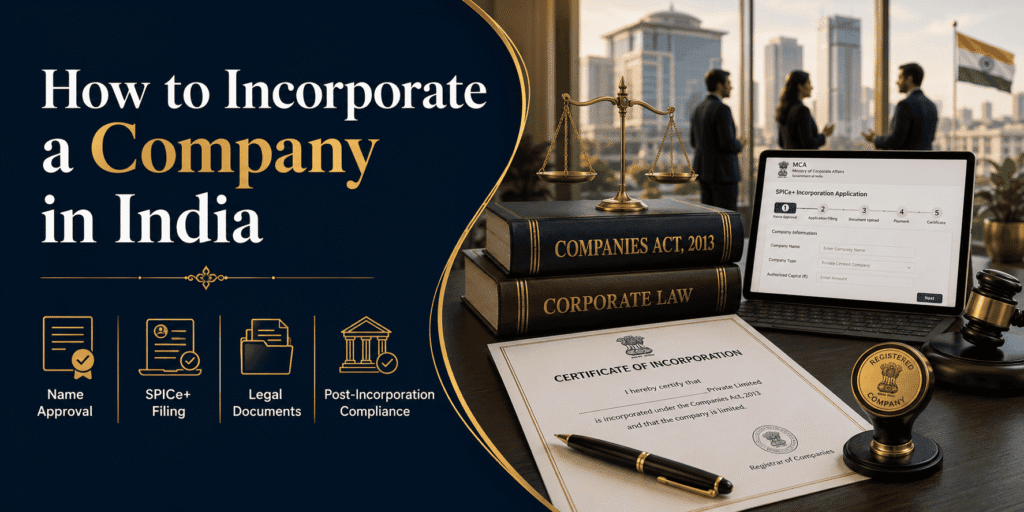
If you want to legally start and scale a business, company incorporation in India is the formal process of creating a company under the Companies Act, 2013 through the Ministry of Corporate Affairs. In simple words, it gives your business a separate legal identity, limited liability, a Certificate of Incorporation, a Corporate Identification Number, and a compliance framework. Therefore, company incorporation in India is not just paperwork. It is the legal foundation that allows founders to open a bank account, raise funds, sign contracts, protect personal assets, and build a credible business from day one.
For most founders, the process can look confusing because it involves name approval, digital signatures, director details, the memorandum, the articles, the registered office, SPICe+ forms, PAN, TAN, and post-incorporation filings. However, once you break it into clear steps, company incorporation in India becomes a structured and manageable legal process.
This guide explains company incorporation in India in a simple, casual, and formal tone. It covers the legal meaning, types of companies, required documents, step-by-step procedure, important legal references, common mistakes, and FAQs that founders usually search before registering a company.
Note: This blog is for general legal education. It should not replace advice from a company secretary, chartered accountant, lawyer, or tax professional for your specific facts.
Overview: What Is Company Incorporation in India?
Company incorporation in India means registering a business as a company with the Registrar of Companies under the Companies Act, 2013. After approval, the company becomes a separate legal person. It can own property, sue and be sued, enter contracts, issue shares, and continue even if its shareholders or directors change.
The main law is the Companies Act, 2013. The incorporation procedure is supported by the Companies (Incorporation) Rules, 2014 and online MCA forms. The process is now largely digital. So, founders do not usually need to visit a government office for routine company incorporation in India.
Legal reference: Companies Act, 2013 is the central law that regulates formation, management, compliance, and winding up of companies in India. The incorporation provisions are mainly found in Chapter II of the Act.
Why Company Incorporation in India Matters for Founders
A business can start as a sole proprietorship or partnership, but company incorporation in India gives stronger legal recognition. It separates the business from the owners. As a result, shareholders usually risk only the amount they invest, subject to fraud, personal guarantees, and statutory exceptions.
Moreover, investors, banks, vendors, and large clients often prefer dealing with an incorporated company. This is especially true for startups, technology businesses, consulting firms, e-commerce brands, manufacturing units, and service companies. Therefore, company incorporation in India can improve trust, funding readiness, and long-term governance.
Key benefits include:
- Separate legal identity for the business.
- Limited liability protection for shareholders in most cases.
- Better credibility with investors, banks, customers, and vendors.
- Clear shareholding structure and ownership records.
- Continuity even when founders, directors, or shareholders change.
- Easier access to contracts, funding, tenders, and formal business opportunities.
Types of Companies You Can Incorporate in India
Before starting company incorporation in India, you should choose the right structure. The structure affects ownership, funding, compliance, tax planning, and public perception.
| Type of company | Best suited for | Basic requirement |
| Private Limited Company | Startups, growing businesses, family businesses, and investor-backed ventures. | Minimum two shareholders and two directors. |
| One Person Company | Solo founders who want a company structure with limited liability. | One member and one nominee, subject to eligibility rules. |
| Public Limited Company | Large businesses that may raise capital from the public. | Minimum seven members and stricter compliance. |
| Section 8 Company | Non-profit objectives such as charity, education, research, social welfare, or art. | License-based structure for charitable or non-profit purposes. |
Under Section 3 of the Companies Act, 2013, a company may be formed for any lawful purpose by the required number of persons. This provision is the starting point for company incorporation in India because it explains who may form a public company, private company, or one person company.
Step-by-Step Process for Company Incorporation in India
The exact process may vary based on the type of company, state, proposed business activity, and professional advice. Still, most cases of company incorporation in India follow these practical steps.
- Step 1: Choose the company type: First, decide whether you need a private limited company, one person company, public company, or Section 8 company. For most startups and small businesses, a private limited company is the preferred option because it balances credibility, ownership flexibility, and investor acceptance.
- Step 2: Obtain Digital Signature Certificates: The proposed directors and subscribers generally need Digital Signature Certificates because incorporation forms are filed online. A DSC helps sign electronic forms securely on the MCA portal.
- Step 3: Apply for name reservation: Next, select a unique name. The name should not be identical or too similar to an existing company, LLP, registered trademark, or restricted expression. Founders can use SPICe+ Part A for name reservation. A good name should match the business object and still remain legally acceptable.
- Step 4: Prepare MOA and AOA: The Memorandum of Association states the main objects, liability, capital, and subscriber details. The Articles of Association contain internal management rules. These documents are extremely important because they shape the company’s powers and governance.
- Step 5: Fill SPICe+ incorporation forms: Company incorporation in India is generally filed through the integrated SPICe+ system. It covers incorporation details, director information, registered office information, capital details, PAN, TAN, and linked services. Depending on the case, linked forms such as AGILE-PRO-S, e-MOA, e-AOA, and declaration forms may also apply.
- Step 6: Attach required documents: The application usually requires identity proof, address proof, registered office proof, utility bill, consent of directors, declarations, subscriber details, and professional certification. If the registered office is rented, a rent agreement and no-objection certificate from the owner may be needed.
- Step 7: Submit the application and pay fees: After review and digital signatures, the professional or applicant uploads the forms on the MCA portal and pays the applicable fee and stamp duty. The Registrar may approve the form, ask for clarification, or reject it if the defects are serious.
- Step 8: Receive Certificate of Incorporation: If the Registrar is satisfied, the company receives a Certificate of Incorporation. The certificate includes the Corporate Identification Number. PAN and TAN are usually issued along with incorporation. At this point, company incorporation in India is complete for registration purposes.
- Step 9: Complete post-incorporation compliance: After incorporation, the company must maintain statutory registers, open a bank account, issue share certificates, appoint the first auditor, hold board meetings, and file the declaration for commencement of business where applicable.
Legal reference: Section 7 of the Companies Act, 2013 deals with incorporation of a company and requires prescribed documents and information to be filed with the Registrar. It is one of the most important provisions for company incorporation in India.
Documents Required for Company Incorporation in India
Documents should be accurate because incorrect details can delay approval. In practice, professionals usually verify names, addresses, signatures, object clauses, and utility bills before filing.
| Document | Purpose |
| PAN card of Indian directors/subscribers | Identity verification and tax linkage. |
| Passport for foreign nationals | Identity proof for non-resident or foreign subscribers/directors. |
| Address proof | Verification through Aadhaar, voter ID, driving licence, bank statement, or similar document. |
| Registered office proof | Shows the proposed office address of the company. |
| Utility bill | Supports the office address, usually not older than the permitted period. |
| No-objection certificate | Required from the owner if the office premises are rented or used with permission. |
| MOA and AOA | Defines the objects, powers, capital, and internal regulations. |
| Director consent and declarations | Confirms willingness to act as director and compliance with legal requirements. |
Important Legal Provisions for Incorporation
Company incorporation in India sits on a legal base. Founders do not need to memorise every section, but they should know the provisions that affect registration and early compliance.
| Provision | What it covers | Why it matters |
| Section 3, Companies Act, 2013 | Formation of company for a lawful purpose. | Identifies who can form a public, private, or one person company. |
| Section 4, Companies Act, 2013 | Memorandum and name requirements. | Guides the name clause, registered office state, objects, liability, and capital clause. |
| Section 7, Companies Act, 2013 | Incorporation filing with the Registrar. | Core provision for documents and information needed for registration. |
| Section 10A, Companies Act, 2013 | Declaration for commencement of business. | Important for companies with share capital after incorporation. |
| Section 12, Companies Act, 2013 | Registered office of company. | Requires a registered office capable of receiving official communications. |
| Companies (Incorporation) Rules, 2014 | Detailed rules and forms. | Supports name reservation, incorporation forms, declarations, and linked filings. |
For statutory reading, founders can refer to the Companies (Incorporation) Rules, 2014 and the official MCA portal before starting company incorporation in India.
SPICe+ Form: The Core of Online Company Registration
SPICe+ is the main integrated web form used for company incorporation in India. It helps founders complete multiple registrations through one connected filing journey. In practical terms, it reduces duplication and brings name reservation, incorporation, DIN allotment, PAN, TAN, and linked registrations into one digital workflow.
Although the MCA system simplifies filing, the form still needs careful drafting. A small mismatch in names, addresses, object clauses, share capital, or proof documents can trigger resubmission. Therefore, founders should treat SPICe+ as a legal form, not a casual online application.
The form usually works with linked filings. For example, e-MOA and e-AOA capture constitutional documents, while AGILE-PRO-S supports GSTIN, EPFO, ESIC, professional tax in applicable states, bank account opening, and shop and establishment registration where available.
Common Mistakes to Avoid During Company Incorporation in India
- Choosing a name that is too similar to an existing company, LLP, or trademark.
- Using a broad object clause without checking regulatory approvals.
- Uploading unclear or outdated address proof.
- Forgetting a no-objection certificate for a rented registered office.
- Entering different spellings of a director’s name across documents.
- Ignoring state-specific stamp duty and professional tax requirements.
- Delaying post-incorporation compliance after receiving the certificate.
- Treating the company bank account as a personal account.
Post-Incorporation Compliance Checklist
Many founders think company incorporation in India ends when the Certificate of Incorporation arrives. However, the first few months matter a lot. A newly incorporated company should organise its legal records immediately.
| Compliance item | When it matters | Practical note |
| Open company bank account | Immediately after incorporation. | Use the company’s legal name, PAN, and incorporation documents. |
| Declaration for commencement of business | Applicable to companies with share capital. | Check Section 10A requirements before starting business transactions. |
| Registered office compliance | Within the statutory timeline and continuously thereafter. | Keep proof and board records ready. |
| First board meeting | Soon after incorporation as per legal requirements. | Approve key matters such as bank account, share certificates, and appointments. |
| Appointment of first auditor | Early compliance requirement. | Avoid delay because it affects annual compliance. |
| Issue share certificates | After allotment/subscription formalities. | Maintain proper share records and stamping where applicable. |
| Maintain statutory registers | Ongoing compliance. | Essential for governance, due diligence, and investment rounds. |
Legal reference: Sections such as Section 10A of the Companies Act, 2013 and Section 12 of the Companies Act, 2013 are important after company incorporation in India because they deal with commencement of business and registered office compliance.
How Long Does Company Incorporation in India Take?
In many straightforward cases, company incorporation in India can move quickly once documents are ready. However, actual timelines depend on name availability, MCA processing, document accuracy, professional review, digital signatures, state stamp duty, and whether the Registrar asks for clarification.
A realistic founder-friendly approach is to keep documents ready before filing. Also, choose two or three name options, finalise the object clause, confirm the registered office proof, and check whether any sector-specific approval is needed.
Cost of Company Incorporation in India
The cost of company incorporation in India depends on authorised capital, state stamp duty, professional fees, digital signature costs, and linked registrations. Government fees may change, so founders should check the MCA portal or ask their professional for a current estimate before filing.
Avoid choosing a structure only because the initial cost looks low. Instead, compare compliance burden, fundraising needs, founder control, tax planning, and long-term business goals.
Private Limited Company vs OPC: Quick Comparison
| Point | Private Limited Company | One Person Company |
| Number of owners | Minimum two shareholders. | One member with nominee. |
| Best for | Startups, co-founders, funding plans, and scalable businesses. | Solo founders who want limited liability. |
| Investor preference | Usually stronger for equity fundraising. | May be less preferred for venture funding. |
| Compliance | Regular company compliance. | Company compliance with OPC-specific rules. |
| Flexibility | More flexible for future shareholding changes. | Useful for single-owner control at the early stage. |
Conclusion
Company incorporation in India is the legal gateway for building a formal, credible, and scalable business. It gives your venture a separate identity, protects ownership records, improves trust, and creates a structured compliance framework. However, the process should not be rushed.
Before filing, choose the right company type, finalise a legally acceptable name, prepare accurate documents, draft clear MOA and AOA clauses, complete SPICe+ carefully, and plan post-incorporation compliance. In short, company incorporation in India works best when founders treat it as a legal foundation, not just an online registration task.
When done properly, company incorporation in India can help your business look more professional, raise capital more easily, sign stronger contracts, and grow with legal confidence.
FAQs on Company Incorporation in India
1. What is company incorporation in India?
Company incorporation in India is the process of registering a company with the Registrar of Companies under the Companies Act, 2013. Once approved, the company receives a Certificate of Incorporation and becomes a separate legal entity.
2. Which form is used for company incorporation in India?
SPICe+ is the key integrated web form used for company incorporation in India. It connects name reservation, incorporation, DIN allotment, PAN, TAN, and other linked services.
3. Can one person incorporate a company in India?
Yes. A single eligible person may incorporate a One Person Company. However, the founder must check OPC eligibility rules, nominee requirements, and conversion conditions.
4. Is a registered office necessary during incorporation?
Yes. A company must have a registered office capable of receiving official communications. If the final office is not available at incorporation, the law provides a timeline for registered office compliance.
5. What documents are required for company incorporation in India?
Usually, identity proof, address proof, PAN, passport where applicable, registered office proof, utility bill, NOC, MOA, AOA, director consent, and declarations are required.
6. How long does company incorporation in India take?
The timeline depends on name approval, document accuracy, MCA processing, and resubmissions. Straightforward cases may move faster when documents are complete and consistent.
7. Is GST registration mandatory with company incorporation?
GST registration depends on turnover, business type, interstate supply, e-commerce activity, and legal requirements. AGILE-PRO-S allows GST application during incorporation, but founders should check whether GST is required for their business.
8. What is the difference between MOA and AOA?
MOA defines the company’s objects, capital, liability, and basic constitutional details. AOA contains internal rules for management, shares, meetings, directors, and governance.
9. What happens after a company is incorporated?
After company incorporation in India, founders should open a bank account, complete commencement requirements where applicable, appoint the first auditor, issue share certificates, maintain registers, and start regular compliance.
10. Do I need a lawyer or company secretary for incorporation?
The process is online, but professional help is useful because mistakes in documents, clauses, names, and forms can delay approval and create compliance problems later.
For publishing, place the target keyword company incorporation in India in the SEO title, URL slug, first paragraph, one H2, image alt text, and FAQ section. This helps company incorporation in India remain clear to readers and search engines without awkward stuffing.
Legal References and Backlinks Used
- Companies Act, 2013 – India Code
- Companies Act, 2013 PDF – India Code
- Section 7, Companies Act, 2013 – India Code
- Companies (Incorporation) Rules, 2014 – India Code
- Ministry of Corporate Affairs Portal
- MCA Company Forms Download Page
We provide case laws, legal acts, startup-law explainers, and practical legal resources for students, founders, and professionals. Want to read more blogs? Visit The Law School Hub for more simple and useful legal guides.