
The Ultimate Checklist for Handling Cybercrime Reporting to Quickly Stop Devastating Online Scammers

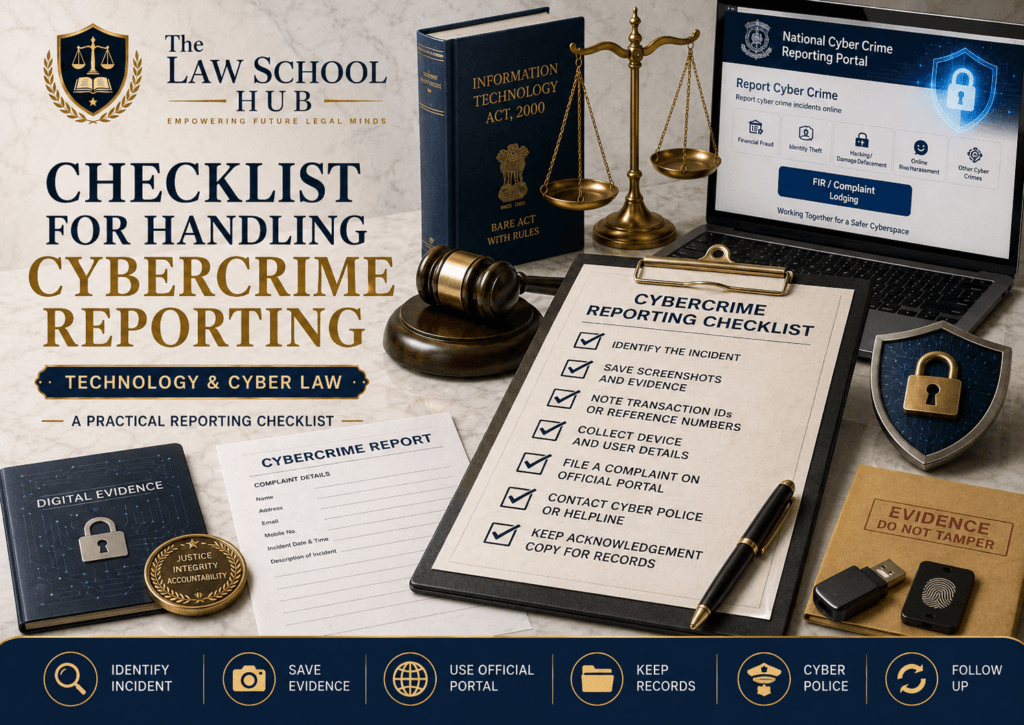
Legal Note: This article is intended for educational and informational purposes only and does not constitute formal legal advice. While every effort has been made to ensure legal accuracy, readers must verify provisions with official sources or consult a practicing advocate. Laws such as the IPC/IEA/CrPC have transitioned to the Bharatiya Nyaya Sanhita (BNS), Bharatiya Sakshya Adhiniyam (BSA), and Bharatiya Nagarik Suraksha Sanhita (BNSS) frameworks; kindly verify current applications based on the date of the offense.
Table of Contents
Introduction
When a devastating digital attack occurs—whether it is a rapidly draining bank account, a hijacked social media profile, or a corporate ransomware breach—the sheer panic that follows often paralyzes victims. In these critical first moments, victims constantly ask: “What exactly must I do right now to stop the hacker and save my money?” Directly answering this urgent question, your absolute first step is to immediately call the 1930 National Cybercrime Helpline to freeze fraudulent financial transactions, followed instantly by preserving your digital device without deleting any data. However, relying on memory during a crisis is a terrible legal strategy. To successfully navigate the complex maze of technology law, evidence preservation, and police procedures, you need a highly structured, foolproof action plan. Consequently, implementing a rigorous Checklist for Handling Cybercrime Reporting is not just an administrative formality; it is the fundamental difference between permanently losing your assets and aggressively prosecuting the cybercriminal. Therefore, this comprehensive guide will provide law students, young lawyers, and everyday netizens with the ultimate, step-by-step Checklist for Handling Cybercrime Reporting, ensuring you never miss a vital legal deadline or compromise your digital evidence.
Overview
The legal framework governing cyberspace in India operates at the intricate intersection of technology and procedural criminal law. Primarily, the Information Technology Act, 2000 dictates the substantive offenses, defining what constitutes a cybercrime, such as hacking, identity theft, or data breaches. Simultaneously, the newly implemented Bharatiya Nagarik Suraksha Sanhita, 2023 (BNSS) outlines exactly how police must investigate these crimes, while the Bharatiya Sakshya Adhiniyam, 2023 (BSA) strictly governs how digital evidence must be collected and presented in court. Because digital evidence is incredibly volatile and easily destroyed, the law requires victims to act with intense speed and precision. Ultimately, failing to follow a precise Checklist for Handling Cybercrime Reporting frequently leads to procedural blunders, resulting in the rejection of evidence and the acquittal of scammers. This detailed blog meticulously breaks down every chronological step you must take, providing a clear roadmap to secure justice.
Detailed Explanation
Navigating a cyber investigation requires cold, calculated legal precision. Victims and their legal representatives must view the incident not merely as a traumatic event, but as a crime scene that requires immediate securing. To ensure absolute compliance with Indian cyber jurisprudence, we must dissect the ultimate Checklist for Handling Cybercrime Reporting into four distinct, chronological phases.
Phase 1: Immediate Containment (Minute 0 to Minute 60)
The very first phase of your Checklist for Handling Cybercrime Reporting focuses entirely on stopping the ongoing damage. Lawyers often refer to this as the “Golden Hour.”
- Sever the Digital Connection: If you suspect your computer or phone is actively compromised, disconnect it from the internet immediately. Turn off the Wi-Fi and unplug the ethernet cable. However, crucially, do not turn the device off. Powering down a device can erase temporary RAM data that forensic experts desperately need.
- Execute the Financial Freeze: If the cybercrime involves unauthorized bank transfers, UPI fraud, or credit card scams, your immediate priority is dialing 1930. This is the Citizen Financial Cyber Fraud Reporting and Management System. Calling this number initiates a real-time alert across the banking network, attempting to freeze the stolen funds in the scammer’s destination account before they can withdraw it.
- Block Affected Financial Instruments: Concurrently, use your banking application or call your bank’s emergency customer service line to permanently block the compromised debit card, credit card, or net banking access.
- Secure Uncompromised Accounts: If a scammer has breached your email or social media, use a different, uncompromised device to change the passwords for all your critical accounts. Immediately enable Two-Factor Authentication (2FA) across all platforms.
Phase 2: Meticulous Evidence Preservation (Hour 1 to Hour 24)
The most common reason cybercrime prosecutions fail is the destruction of primary evidence. Therefore, this second phase of the Checklist for Handling Cybercrime Reporting is legally paramount.
- Do Not Delete Anything: Overcome the urge to delete abusive messages, phishing emails, or fraudulent SMS alerts out of anger or embarrassment. Deleting these items destroys the corpus delicti—the physical body of the digital crime.
- Capture Comprehensive Screenshots: Take clear screenshots of everything. Capture the fake website, the abusive WhatsApp chat, the fraudulent transaction confirmation, and the scammer’s profile picture. Ensure the device’s time and date stamp are visible in every screenshot.
- Extract Deep Digital Footprints: Screenshots are only secondary evidence. You must dig deeper. For email frauds, extract the “Email Header” (often found by clicking “Show Original” or “View Source” in your email client). The header contains the critical IP address of the sender. For social media crimes, copy the exact, unique URL of the scammer’s profile, not just their display name, as display names can be changed instantly.
- Draft the Statutory Evidence Certificate: Under Indian law, printed digital evidence is entirely useless without a legal guarantee. You must prepare a certificate under Section 63 of the BSA. This certificate must state that the computer or phone you used to print the screenshots was operating correctly and was under your lawful control.
Phase 3: Formal Legal Registration (Day 1 to Day 3)
Once you have contained the threat and secured the evidence, the next vital step in your Checklist for Handling Cybercrime Reporting is formally notifying the State authorities and invoking your statutory rights.
- File on the National Portal: You do not need to visit a police station immediately. Log on to the National Cyber Crime Reporting Portal (NCRP). Create an account, fill in the incident details chronologically, and upload your preserved evidence (PDFs of screenshots, email headers, and bank statements).
- Utilize the Anonymous Reporting Feature: If the crime involves highly sensitive matters, such as non-consensual intimate imagery (revenge porn) or child sexual abuse material (CSAM), you can utilize the specific “Report Anonymously” button on the NCRP. This protects your identity while initiating a state investigation.
- Obtain the Acknowledgment Number: Upon submitting your complaint online, the portal will generate a unique acknowledgment number. Save this number securely, as it is required for all future correspondence with the police and your bank.
- Execute the RBI 72-Hour Mandate: If you suffered financial fraud, police reporting is not enough. You must formally submit a written dispute to your home bank branch within three working days. Under the Reserve Bank of India (RBI) guidelines, reporting unauthorized third-party fraud within this specific timeframe often grants you “zero liability,” legally forcing the bank to refund your stolen money.
Phase 4: Active Legal Follow-Up and Escalation (Day 3 to Day 30)
Filing a complaint is merely the beginning of the legal battle. The final phase of your Checklist for Handling Cybercrime Reporting involves holding authorities accountable.
- Track the Nodal Officer Assignment: The national portal automatically routes your complaint to the nodal cyber officer of your specific State or Union Territory. Track the portal to see which local police station has been assigned the investigation.
- Demand a Formal FIR Registration: An online complaint is initially treated as an inquiry. You must follow up with the assigned police station to ensure they convert the complaint into a formal First Information Report (FIR) under the relevant sections of the BNSS and the IT Act.
- Assert Your Right to a Zero FIR: If the local police station claims the scammer is located in a different state and refuses to register the FIR citing territorial jurisdiction, firmly remind them of their legal duty. Under Section 173 of the BNSS, you have the absolute right to a “Zero FIR.” The police must register the crime locally and subsequently transfer it.
- Escalate Police Inaction: If the police persistently ignore your complaint, you must escalate the matter legally. Draft a written application detailing the crime and the police’s refusal, and send it via registered post to the Superintendent of Police (SP). If the SP also fails to act, you must consult a lawyer to file an application before a Judicial Magistrate under Section 175(3) of the BNSS, compelling the police to investigate.
Key Legal Provisions
To execute this Checklist for Handling Cybercrime Reporting effectively, legal professionals and victims must deeply understand the statutory backbone of Indian cyber law. Relying on these exact sections in your legal drafts ensures law enforcement takes your complaint seriously. You can explore these acts in greater detail through comprehensive study materials at The Law School Hub.
The Information Technology Act, 2000
- Section 43 (Penalty and Compensation for damage to computer, computer system, etc.): This is a foundational civil provision. It allows a victim to seek financial compensation from an adjudicating officer if someone accesses their computer, downloads data, or introduces a virus without permission. It is a critical tool for corporate cyber breaches.
- Section 66 (Computer Related Offences): This provision translates the civil wrongs of Section 43 into criminal offenses. It prescribes imprisonment for up to three years and hefty fines for anyone who dishonestly or fraudulently commits data theft or hacking. This is the primary penal section you must ensure the police include in your FIR.
- Section 66C (Punishment for identity theft): This crucial section protects your digital identity. It specifically targets scammers who fraudulently make use of your electronic signatures, passwords, or unique identification features. If a hacker takes over your email, this section applies.
- Section 66D (Punishment for cheating by personation by using computer resource): This is the core provision invoked for modern phishing scams, fake social media profiles, and matrimonial frauds. When someone pretends to be a bank official or a friend online to extract money, they violate Section 66D.
- Section 70B (Indian Computer Emergency Response Team to serve as national agency for incident response): This section dictates the mandatory corporate Checklist for Handling Cybercrime Reporting. It imposes a massive legal duty on corporate entities, intermediaries, and data centers to report severe cyber incidents (like ransomware attacks) to CERT-In within exceptionally tight timeframes, often as short as 6 hours.
- Section 75 (Act to apply for offence or contravention committed outside India): This highly important section protects your rights against international attackers. It clearly states that the IT Act applies to an offense committed outside India by any person, provided the act involves a computer resource located physically in India.
The Bharatiya Sakshya Adhiniyam, 2023 (BSA)
- Section 63 (Admissibility of electronic records): Formerly known as Section 65B of the Indian Evidence Act, this new provision is the most critical evidentiary step in your checklist. It strictly mandates that any electronic record (such as printed emails, WhatsApp chats, or server logs) must be accompanied by a specific, signed certificate to be deemed admissible as evidence in a court of law. Submitting digital evidence without a Section 63 certificate renders your evidence legally invisible to the judge.
The Bharatiya Nagarik Suraksha Sanhita, 2023 (BNSS)
- Section 173 (Information in cognizable cases): Formerly Section 154 of the CrPC, this section legally obligates police officers to register a First Information Report (FIR) for cognizable offenses. More importantly, it statutorily solidifies the concept of the “Zero FIR,” eliminating the excuse of territorial jurisdiction that police frequently use to avoid complex cybercrime cases.
- Section 175(3) (Power of Magistrate to direct investigation): Formerly Section 156(3) CrPC, this provision is your ultimate legal remedy. If the police stubbornly fail in their duty to register your cybercrime FIR, you have the statutory right to approach a Judicial Magistrate. The Magistrate can subsequently order the police to launch an immediate, binding criminal investigation.
Important Case Laws
Judicial precedents from the Supreme Court and High Courts continuously shape how a Checklist for Handling Cybercrime Reporting is executed in practice. Referencing these exact cases in your legal representations significantly boosts your authoritativeness and legal standing.
1. The Mandatory Evidence Certificate: Arjun Panditrao Khotkar v. Kailash Kushanrao Gorantyal
Citation: Arjun Panditrao Khotkar v. Kailash Kushanrao Gorantyal, (2020) 7 SCC 1. Relevance: In this monumental judgment, the Supreme Court of India definitively settled decades of confusion surrounding electronic evidence. The Court ruled that the statutory certificate (formerly under Section 65B of the Evidence Act, now Section 63 of the BSA) is a strict, mandatory condition precedent for the admissibility of electronic records. The Court held that victims cannot bypass this requirement. Therefore, drafting this certificate is a non-negotiable, mandatory item on your Checklist for Handling Cybercrime Reporting.
2. The Absolute Duty to Register an FIR: Lalita Kumari v. Govt. of U.P.
Citation: Lalita Kumari v. Govt. of U.P., (2014) 2 SCC 1. Relevance: A Constitution Bench of the Supreme Court unequivocally mandated that the police must register an FIR if the information provided by the victim discloses the commission of a cognizable offense. The police have absolutely no discretion to conduct a preliminary inquiry to check the veracity of the complaint before registering the FIR if a serious crime is clear on its face. This judgment empowers victims to demand formal registration during Phase 4 of their checklist.
3. Virtual Presence and Jurisdiction: State of Maharashtra v. Dr. Praful B. Desai
Citation: State of Maharashtra v. Dr. Praful B. Desai, (2003) 4 SCC 601. Relevance: Although primarily dealing with video conferencing in criminal trials, this landmark case established the foundational principle that “virtual presence” is entirely equivalent to “physical presence” in the eyes of Indian criminal law. This judgment reinforces the concept that jurisdiction in cyberspace extends far beyond physical boundaries, supporting a victim’s right to file a cybercrime report from their own physical location regardless of where the hacker resides.
4. Intermediary Guidelines and Takedowns: Shreya Singhal v. Union of India
Citation: Shreya Singhal v. Union of India, AIR 2015 SC 1523. Relevance: While most famous for striking down the unconstitutional Section 66A of the IT Act to protect free speech, this case also laid down crucial guidelines regarding the duties of internet intermediaries (like Facebook or YouTube). The Court clarified that platforms are only obligated to take down unlawful content upon receiving a valid court order or a notification from an appropriate government agency. Therefore, your checklist must include obtaining a formal police order to force a platform to remove defamatory content, rather than just relying on the platform’s internal reporting buttons.
Practical Examples and Illustrations
To truly master this protocol, let us examine how the Checklist for Handling Cybercrime Reporting applies directly to highly realistic, real-world illustrations.
Illustration 1: The Remote Access App Banking Fraud
The Scenario: Vikram receives a call from someone claiming to be a telecom executive offering a 5G upgrade. The caller convinces Vikram to download a screen-sharing application (like AnyDesk) and make a ₹10 test payment. Suddenly, the scammer takes remote control of Vikram’s phone, reads his OTPs, and transfers ₹3,00,000 from his savings account. Applying the Checklist:
- Phase 1: Vikram’s immediate step on the Checklist for Handling Cybercrime Reporting is to disconnect his phone from the internet to sever the screen-sharing connection. Next, he instantly dials 1930 to trigger a financial freeze on the stolen ₹3,00,000.
- Phase 2: He uses a separate phone to take photos of the compromised phone’s screen, documenting the app downloaded and the caller’s phone number.
- Phase 3: He formally submits a written dispute to his bank branch within the RBI’s 72-hour window, legally shifting the liability away from himself.
Illustration 2: Corporate Ransomware and Data Exfiltration
The Scenario: A mid-sized healthcare tech company in Bangalore discovers that all their patient servers are encrypted. A digital note demands 5 Bitcoin to release the decryption key. Furthermore, the hackers threaten to leak sensitive patient health records on the dark web if the ransom is not paid. Applying the Checklist:
- Phase 1: The company’s IT team immediately disconnects the infected servers from the main network to prevent lateral movement of the malware.
- Phase 2: They preserve the encrypted server logs and the exact digital ransom note for forensic analysis.
- Phase 3: Crucially, because they are a corporate entity, their Checklist for Handling Cybercrime Reporting mandates absolute compliance with Section 70B of the IT Act. The legal team must report this severe breach to CERT-In (the national nodal agency) within 6 hours. Failing to do so attracts severe corporate penalties.
Illustration 3: Cyber Defamation and Image Morphing
The Scenario: Priya, a university student, discovers that heavily morphed, defamatory images of her are being circulated on a fake Instagram account, causing her immense psychological distress. Applying the Checklist:
- Phase 1: Priya does not confront the fake account directly, as that would alert the perpetrator.
- Phase 2: She diligently executes the evidence preservation step of the Checklist for Handling Cybercrime Reporting. She copies the exact profile URL, takes timestamps screenshots, and drafts her Section 63 BSA certificate.
- Phase 3: She utilizes the anonymous reporting feature on cybercrime.gov.in specifically designed for crimes against women. Subsequently, she approaches the local cyber cell to convert the online complaint into a formal FIR, requesting the police to issue a formal notice to Instagram to reveal the IP address of the fake account creator.
Listicles: Vital Summaries for the Checklist
To ensure rapid recall during high-stress situations, memorize these core components of the Checklist for Handling Cybercrime Reporting:
Top 10 Immediate Actions in Your Checklist
- Sever internet access to the compromised device immediately.
- Dial 1930 instantly to report financial fraud and initiate a fund freeze.
- Block compromised cards and UPI IDs via your banking app.
- Change all passwords from an entirely separate, secure device.
- Do not delete any original data, including texts, emails, or malicious apps.
- Extract the URL or Email Header for precise digital identification.
- Take time-stamped screenshots of all fraudulent communications.
- Register a formal complaint online at cybercrime.gov.in.
- Submit a written fraud dispute to your bank within 3 working days.
- Draft a Section 63 BSA Certificate to legally authenticate your printed evidence.
5 Critical Legal Mistakes to Avoid in Your Checklist
- Delaying due to jurisdiction: Never wait to find the “right” police station. You have the right to a Zero FIR anywhere.
- Factory resetting the device: Formatting your phone before a forensic inspection destroys the corpus delicti.
- Attempting vigilantism: “Hacking back” against the scammer violates Section 43 of the IT Act and makes you a criminal.
- Accepting police refusal: Never walk away if police refuse to register an FIR; escalate to a Magistrate.
- Ignoring corporate reporting duties: Companies must not hide breaches to save reputation; they must report to CERT-In within 6 hours.
Tables: Tactical Organization for Cybercrime Reporting
For a rapid, visual legal assessment, use this comparison matrix to align the required evidence with the specific type of cybercrime you are handling within your checklist.
| Category of Cybercrime | Primary Action on Checklist | Essential Digital Evidence to Gather | Applicable Legal Section |
|---|---|---|---|
| Financial / UPI Fraud | Dial 1930 immediately. | Transaction IDs (UTR), exact timestamps, fake SMS. | Section 66D IT Act & BNS Cheating Provisions. |
| Phishing / Email Scam | Do not click links; block sender. | Full Email Header showing the originating IP address. | Section 66C & 66D IT Act. |
| Social Media Hacking | Report to platform; secure email. | Exact profile URL, IP logs if available. | Section 66 & 43 IT Act. |
| Ransomware Attack | Disconnect servers; DO NOT pay. | Server logs, encrypted file samples, ransom note. | Section 43 IT Act & CERT-In Guidelines. |
| Police Inaction | Draft escalation letter. | Printout of the cybercrime.gov.in acknowledgment number. | Section 173 & 175(3) of the BNSS, 2023. |
Key Takeaways
- Implementing a strict Checklist for Handling Cybercrime Reporting transforms a victim’s panicked reaction into a highly effective, legally sound strategy.
- The absolute most critical factor in financial cybercrimes is speed. Utilizing the 1930 helpline and formally notifying the bank within 72 hours dictates whether you recover your funds.
- Electronic evidence is remarkably fragile and procedurally demanding. Submitting screenshots without a Section 63 BSA certificate renders your evidence inadmissible in an Indian court.
- You are not bound by physical borders. The concept of the Zero FIR under the BNSS mandates that law enforcement must record your cyber complaint regardless of where the scammer resides.
- The law empowers you with escalation tools. If the police fail in their duty, approaching a Judicial Magistrate under Section 175(3) BNSS is your ultimate legal remedy.
Conclusion
In conclusion, successfully battling modern digital crime requires significantly more than just technical knowledge; it requires absolute procedural discipline. The internet is a fast-moving landscape, and cybercriminals rely heavily on your confusion and delay to successfully launder money and erase their tracks. However, by strictly adhering to this comprehensive Checklist for Handling Cybercrime Reporting, you effectively neutralize their advantage. You secure your financial perimeter, perfectly preserve the volatile digital evidence in accordance with strict evidentiary laws, and force the legal machinery to act swiftly on your behalf. Technology law in India is robust and heavily favors an organized victim. Therefore, keep this checklist accessible, maintain your composure during a crisis, assert your statutory rights confidently, and never allow a procedural error to give a cybercriminal an avenue for escape.
FAQs
1. What is the absolute most urgent step in a Checklist for Handling Cybercrime Reporting? If the crime involves money, the most urgent step is calling the 1930 National Cybercrime Helpline to freeze the fraudulent transaction, followed immediately by blocking your bank accounts. If it is a data breach, the most urgent step is disconnecting the device from the internet without turning it off.
2. I took screenshots of the WhatsApp scam. Is that enough evidence? No. While screenshots are a good first step, they are considered secondary evidence. To make them legally admissible in court, your checklist must include drafting and signing a mandatory statutory certificate under Section 63 of the Bharatiya Sakshya Adhiniyam (BSA).
3. The police station refused my complaint because the hacker is in another state. What do I do? You must assert your right to a Zero FIR. Under Section 173 of the BNSS, police are legally obligated to register a cognizable cybercrime complaint regardless of territorial jurisdiction. If they still refuse, you can escalate the complaint to the Superintendent of Police.
4. How quickly must I report an unauthorized bank transfer to get my money back? According to strict Reserve Bank of India (RBI) guidelines, you must formally report the unauthorized transaction to your bank within three (3) working days. Meeting this deadline is a critical checklist item that often ensures zero financial liability for the victim.
5. Can I file a cybercrime report without physically going to a police station? Yes. You can initiate the entire legal process online through the National Cyber Crime Reporting Portal (cybercrime.gov.in). The portal generates an acknowledgment number and routes the complaint to your local nodal officer for investigation.
6. Do companies have a different reporting checklist than private individuals? Yes. Corporate entities have much stricter statutory duties. Under Section 70B of the IT Act, companies and data centers must execute their incident response checklist rapidly, as they are legally mandated to report severe cyber breaches to CERT-In within 6 hours.
7. I accidentally clicked a phishing link, but I don’t think any money was stolen. Should I still follow the checklist? Yes. You should still disconnect the device, change your passwords from a different machine, and run a thorough antivirus scan. You should also report the malicious URL to the cybercrime portal to help authorities take down the phishing server.
8. What should I do if a hacker is demanding money to unlock my computer? Do not pay the ransom. Paying funds criminal syndicates and provides zero legal guarantee that they will return your data. Add “Preserve Ransom Note” to your checklist, disconnect the network, and report the extortion immediately.
9. Can I hire a private hacker to trace the person who scammed me? Absolutely not. “Hacking back” or engaging in active defense is strictly illegal in India under Section 43 of the Information Technology Act. Doing so will transition your status from a victim into a criminal suspect.
10. What if the police completely ignore my online cybercrime complaint for months? If your online complaint remains pending without an FIR registration, you must escalate. The final step in your legal checklist is to hire an advocate to file a formal application before a Judicial Magistrate under Section 175(3) of the BNSS, who can then order the police to investigate.
Legal References
- The Information Technology Act, 2000 (India Code Repository).
- The Bharatiya Sakshya Adhiniyam, 2023 (Official e-Gazette of India).
- The Bharatiya Nagarik Suraksha Sanhita, 2023 (Ministry of Home Affairs).
- The Bharatiya Nyaya Sanhita, 2023.
- Reserve Bank of India (RBI) Master Circular on Customer Protection – Limiting Liability of Customers in Unauthorised Electronic Banking Transactions.
- Arjun Panditrao Khotkar v. Kailash Kushanrao Gorantyal, (2020) 7 SCC 1 (Supreme Court Landmark Judgment on Electronic Evidence Certification).
- Lalita Kumari v. Govt. of U.P., (2014) 2 SCC 1 (Supreme Court Constitution Bench Judgment on Mandatory FIR Registration).
- State of Maharashtra v. Dr. Praful B. Desai, (2003) 4 SCC 601 (Supreme Court Judgment on Virtual Presence and Jurisdiction).
- Shreya Singhal v. Union of India, AIR 2015 SC 1523 (Supreme Court Judgment on Intermediary Liability and Free Speech).
- National Cyber Crime Reporting Portal (cybercrime.gov.in).
- Ministry of Electronics and Information Technology (MeitY) Official Notifications regarding Cyber Security.
- Supreme Court of India Official Judgments Portal.
- Indian Computer Emergency Response Team (CERT-In) Guidelines and Directives under Section 70B.
- High Court of Delhi Rules on Electronic Evidence Presentation and Preservation.
- SCC Online Legal Database (For comprehensive case law research).
- Indian Kanoon (Open Access Legal Database for preliminary research).
- Please note: Case citations must be carefully verified against current SCC/AIR volumes before any formal court submission.
At The Law School Hub, we simplify case laws, legal acts, and legal concepts for law students and legal readers. Want to read more useful legal blogs? Visit The Law School Hub.