
7 Dangerous Myths About Cybercrime Reporting That Are Destroying Your Absolute Legal Success Today

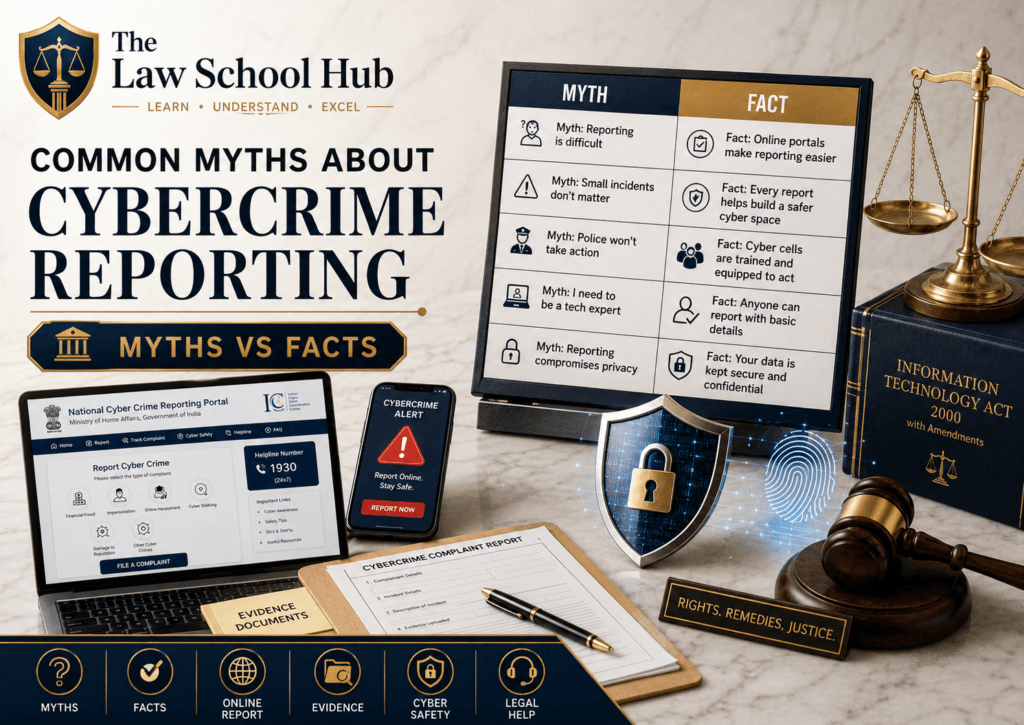
Legal Note: The content provided in this blog is for educational, general awareness, and informational purposes only. It does not constitute formal legal advice. While every effort has been made to ensure legal accuracy based on the Information Technology Act, 2000, and current judicial precedents as of 2026, readers are strongly advised to consult a qualified legal professional or verify procedures with official government portals before initiating legal action.
Table of Contents
Introduction
Why do thousands of victims in India hesitate to pursue justice after a digital attack? The answer lies in a web of misinformation: many people believe cybercrime reporting is an endless trap of police harassment, technical complexity, and jurisdictional confusion. In simple terms, cybercrime reporting is the formal mechanism of notifying the State about a digital wrong, yet it is often shrouded in myths that prevent people from acting within the “Golden Hour.” If you believe that your local police station can refuse your complaint because “it happened on the internet,” or if you think that only a computer expert can file a report, you are operating under dangerous misconceptions. This blog aims to dismantle these barriers by providing the absolute legal truth behind cybercrime reporting. Whether you are a law student mastering the Information Technology Act or a citizen seeking to protect your digital rights, this guide will replace fear with factual, actionable legal knowledge.
Overview
India’s transition to a digital-first economy has unfortunately been shadowed by a rise in digital offenses. Consequently, the legal framework, primarily the Information Technology Act, 2000, and the Bharatiya Nyaya Sanhita (BNS), 2023, has evolved to provide robust protection. However, the efficacy of these laws depends entirely on the victim’s ability to initiate cybercrime reporting accurately. Historically, the gap between “law on paper” and “law in practice” was filled with myths that discouraged reporting. Today, with the centralized National Cyber Crime Reporting Portal and specialized Cyber Cells, the process has been democratized. This detailed exploration will contrast seven common myths against the actual statutory provisions and judicial precedents, ensuring that you can navigate the legal system with absolute confidence.
Detailed Explanation: Debunking the Myths of Cybercrime Reporting
Myth 1: “Cybercrime Reporting Requires an Expert Level of Technical Knowledge”
The Myth: Many citizens believe they cannot approach the police unless they can explain exactly how a hack happened, using terms like “SQL injection” or “social engineering.”
The Legal Reality: The law does not require the victim to be a forensic analyst. Essentially, your duty in cybercrime reporting is to provide a “statement of facts.” Under the Information Technology Act, 2000, the victim’s role is to describe the harm suffered—such as unauthorized access or financial loss. The technical investigation is the statutory responsibility of the Investigating Officer (IO) and the forensic experts at the Cyber Cell. As long as you can provide basic evidence like screenshots or bank statements, the machinery of the law can be activated.
Myth 2: “The Police Can Refuse a Complaint Based on Jurisdiction”
The Myth: A common misconception is that you must report a cybercrime only at the police station where the “server” is located or where the criminal lives.
The Legal Reality: This is one of the most persistent hurdles in cybercrime reporting. However, the Supreme Court has repeatedly clarified the concept of the Zero FIR. Since digital crimes are borderless, you have the absolute legal right to file a report at any police station in India. They are legally mandated to register the information and then transfer it to the relevant department. Furthermore, the National Cyber Crime Reporting Portal acts as a “virtual station,” allowing you to report from home, which the system then automatically routes to the appropriate state authority.
Myth 3: “Reporting Small Financial Frauds is a Waste of Time”
The Myth: People often think, “It was only ₹500, the police won’t care.”
The Legal Reality: Small-value cybercrime reporting is often the key to catching high-value criminal syndicates. Modern cybercriminals often use “salami slicing” techniques, stealing tiny amounts from thousands of victims simultaneously. When you report a small fraud, you provide a phone number, a UPI ID, or an IP address. When multiple people report the same “small” identifiers, the police can map out a massive criminal operation. Legally, under Section 66D of the IT Act, the threshold for “cheating by personation” is not defined by the amount stolen; the act itself is the crime.
Myth 4: “Filing a Complaint on the Portal is the Same as an FIR”
The Myth: Many believe that clicking “submit” on cybercrime.gov.in means a criminal case has been officially started.
The Legal Reality: In the context of cybercrime reporting, a portal complaint is generally treated as a “preliminary inquiry” or a “complaint petition.” While it alerts the authorities, it does not always automatically become a First Information Report (FIR). To convert the portal acknowledgement into an FIR—which is the trigger for arrests and formal investigations—the victim often needs to visit the local Cyber Cell to verify their statement and provide original copies of evidence. Understanding this distinction is vital for ensuring your case reaches the prosecution stage.
Myth 5: “Deleting the Abusive Content/Messages Makes You Safer”
The Myth: Victims of online harassment or threats often delete the messages out of fear, shame, or a desire to “clean up” their digital space.
The Legal Reality: In cybercrime reporting, deleting the content is akin to destroying the “murder weapon.” Under the Bharatiya Sakshya Adhiniyam (BSA), 2023 (which replaced the Evidence Act), digital evidence is the foundation of the trial. If you delete the messages before the police can secure a forensic image, the case becomes legally “toothless.” The correct approach is to take screenshots and preserve the metadata (like the timestamp and sender’s ID) before reporting.
Myth 6: “The 1930 Helpline is Only for Immediate Calls”
The Myth: If it has been more than 24 hours, people assume the 1930 helpline for financial fraud is useless.
The Legal Reality: While the “Golden Hour” (the first 2 hours) is ideal, cybercrime reporting to 1930 remains useful for several days. Even if the money has moved out of the first fraudster’s account, the helpline can “flag” the secondary and tertiary accounts where the money might be sitting. This creates a “digital freeze” across the banking ecosystem, increasing the chances of eventual recovery.
Myth 7: “Reporting a Cybercrime Leads to Endless Court Visits”
The Myth: Citizens fear that cybercrime reporting will consume years of their life in litigation.
The Legal Reality: Most cybercrime investigations, especially those involving financial fraud, are resolved at the “Adjudication” or “Investigation” stage. Under Section 43 of the IT Act, for matters involving damages or compensation (like corporate data theft), the Secretary of Information Technology acts as an Adjudicating Officer. This is a quasi-judicial process that is significantly faster than traditional criminal courts.
For a deeper understanding of how the Indian police system handles these procedures, you can read our comprehensive guide on the Indian Legal System and Police Procedures.
Key Legal Provisions: The Statutory Truth
To debunk myths effectively, one must look at the specific sections of the law that govern cybercrime reporting.
1. The Information Technology Act, 2000
- Section 66D (Cheating by Personation): This counters the myth that “it’s not a crime if I gave the OTP.” The law recognizes that being tricked into giving data is a criminal act of personation.
- Section 79 (Intermediary Liability): This addresses the myth that “Facebook/Google is responsible for the crime.” Intermediaries have “Safe Harbor” but must cooperate with cybercrime reporting efforts to maintain it.
- Section 80 (Power of Police to Enter/Search): This provision empowers specialized officers (Inspector rank and above) to investigate cybercrimes across jurisdictions, supporting the Zero FIR principle.
2. The Bharatiya Sakshya Adhiniyam (BSA), 2023
- Section 63 (Electronic Records): This is the replacement for Section 65B of the Evidence Act. It mandates the process for making digital evidence admissible. Understanding this counters the myth that “a simple screenshot is always enough.” The screenshot must be backed by a legal certificate during the trial.
3. The Bharatiya Nagarik Suraksha Sanhita (BNSS), 2023
- Mandatory FIR Registration: This new procedural law strengthens the Lalita Kumari mandate, making it harder for police to ignore cybercrime reporting by claiming a “preliminary inquiry” is needed for every case.
Important Case Laws
The judiciary has been the primary “myth-buster” in the realm of cybercrime reporting.
1. Lalita Kumari v. Govt. of U.P., (2014) 2 SCC 1
The Legal Rule: Registration of an FIR is mandatory if the information discloses a cognizable offense. Myth Debunked: This case destroys the myth that police have the “discretion” to refuse your cyber complaint. If you show evidence of a crime like hacking or stalking, they must register the FIR.
2. Shreya Singhal v. Union of India, AIR 2015 SC 1523
The Legal Rule: Struck down Section 66A of the IT Act. Myth Debunked: This case clarified the myth that “any offensive post is a cybercrime.” It protected free speech by ensuring that cybercrime reporting is reserved for actual legal wrongs, not just “offensive” opinions.
3. Arjun Panditrao Khotkar v. Kailash Kushanrao Gorantyal, (2020) 7 SCC 1
The Legal Rule: Clarified that Section 65B(4) certificates are a condition precedent for the admissibility of electronic evidence. Myth Debunked: It counters the myth that digital evidence is “easy.” It teaches victims and lawyers that the source device must be handled with care from the moment of cybercrime reporting.
Practical Examples and Illustrations
Illustration 1: The “Server Location” Myth
Scenario: A student in Delhi is scammed by a fake website hosted in the US, with the criminal operating from Jharkhand. The local Delhi police station says, “Go to Jharkhand.” Legal Reality: Based on the Lalita Kumari judgment and the concept of Zero FIR, the Delhi police are legally bound to initiate cybercrime reporting. The location of the server or the criminal is irrelevant to the victim’s right to file a report at their current location.
Illustration 2: The “Small Amount” Myth
Scenario: A housewife loses ₹200 to a fake “recharge” app. She thinks it’s too small to report. Legal Reality: If she initiates cybercrime reporting, the police link her “₹200 loss” to the same UPI ID used to scam 5,000 others. Her small report leads to the freezing of an account containing ₹10 Lakhs of stolen money.
Illustration 3: The “Expert” Myth
Scenario: A small business owner’s Instagram is hacked. He waits three days to “hire a hacker” to find the culprit before going to the police. Legal Reality: By the time he acts, the log files on Instagram’s server might be overwritten. His delay, caused by the myth that he needs “technical proof,” makes the legal cybercrime reporting much harder. He should have reported the “fact of unauthorized access” immediately.
Listicles: Actionable Truths
5 Facts That Prove Cybercrime Reporting Works
- Fund Freezing: Through the 1930 system, crores of rupees are frozen daily across the Indian banking network.
- Anonymous Reporting: You can report child pornography or non-consensual images on the portal without revealing your name to the public.
- Takedown Orders: Valid cybercrime reporting allows the police to issue notices to Meta, Google, or X to remove harmful content within 24-72 hours.
- Zero FIR Rights: You have the legal power to demand a receipt for your complaint at any police station in India.
- Digital Footprints: Even if a criminal uses a VPN, specialized cyber cells can often trace them through “metadata” and financial trails.
Common Misconceptions vs. Legal Realities
| Misconception | The Absolute Legal Reality |
|---|---|
| “I need a lawyer to file on the portal.” | The portal is designed for direct citizen use; no lawyer is needed for filing. |
| “If I delete the app, the scam stops.” | Deleting the app doesn’t stop the crime; only cybercrime reporting can block the criminal’s access. |
| “The police will keep my phone forever.” | Police usually create a “Forensic Image” and return the device unless it is central to the crime. |
| “Only high-tech hacking is a cybercrime.” | Even a simple abusive WhatsApp message can be a crime under the BNS and IT Act. |
Tables: Quick Reference for Myth-Busting
Table 1: The Myth vs. Statute Matrix
| The Myth | The Countering Statute / Rule | Impact on Cybercrime Reporting |
|---|---|---|
| “Only local crimes can be reported.” | Zero FIR / BNSS 2023 | Encourages immediate reporting anywhere. |
| “Small frauds aren’t crimes.” | Section 66D IT Act | Legally recognizes any digital cheating as an offense. |
| “Platforms won’t help.” | IT (Intermediary Guidelines) Rules, 2021 | Mandates platforms to assist within strict timelines. |
| “Screenshots are enough for trial.” | Section 63 BSA, 2023 | Reminds victims to keep the original device safe. |
Table 2: The Effectiveness of Immediate Action
| Action Taken | Myth-based Delay | Reality-based Immediate Action |
|---|---|---|
| Calling 1930 | “Wait for bank opening hours.” | Money is gone; recovery is 0%. |
| Portal Entry | “Find the hacker’s IP first.” | Information is fresh; recovery is High. |
| FIR Registration | “Wait for a lawyer’s advice.” | Suspect might flee or delete data. |
Key Takeaways
- Don’t wait for “Technical Proof”: Your job in cybercrime reporting is to report the fact of the crime; let the police handle the tech.
- The Portal is Your First Step, Not the Last: Follow up your online complaint with a visit to the police station for a formal FIR.
- Zero FIR is a Statutory Right: Never accept a refusal based on jurisdiction.
- Small Crimes Matter: Every report helps build a larger map of criminal activity.
- Preserve Everything: Never delete messages or call logs until the police have recorded the evidence.
- The Golden Hour is Real: Action within the first 2 hours of financial fraud is the only reliable way to get your money back.
Conclusion
The greatest ally of a digital criminal is the victim’s hesitation. This hesitation is almost always fueled by the common myths surrounding cybercrime reporting. By understanding that the law is designed to be victim-centric, borderless, and technically accessible, you strip the offender of their most powerful tool: anonymity. Whether it is a small UPI scam or a complex case of identity theft, the legal machinery of the Information Technology Act and the BNS can only protect those who activate it. For law students, debunking these myths is essential for providing sound legal counsel. For the general public, it is the key to digital survival. Remember, the internet never forgets, and with proper cybercrime reporting, the law doesn’t either. Stay informed, act swiftly, and never let a myth stand between you and your digital rights.
Frequently Asked Questions (FAQs)
1. Does cybercrime reporting cost any money? Absolutely not. Reporting a cybercrime on the National Portal (cybercrime.gov.in) or at any police station is a free government service. Any website asking for a “registration fee” to report a crime is likely a scam itself.
2. What if I realized I was scammed 3 months ago? Is it too late for cybercrime reporting? It is never too late to report a crime for the purpose of investigation and prosecution. However, for “recovery” of money, the chances are very low after 3 months. Regardless, reporting helps the police block the criminal’s accounts and prevent future victims.
3. If I report a crime anonymously, can the police still investigate? Yes. For specific crimes like child pornography or threats to women, the portal allows “anonymous reporting.” The police will use the evidence you provide to start an investigation, though they may contact you privately if they need further details.
4. Can I withdraw my report if I realize it was a mistake? Yes, you can inform the Investigating Officer if you wish to withdraw a complaint. However, if an FIR has been registered for a serious (cognizable) offense, it may require a High Court order to “quash” the FIR.
5. I was scammed on a foreign website. Does cybercrime reporting in India help? Yes. Indian law enforcement coordinates with international agencies (like Interpol) and through “Mutual Legal Assistance Treaties” (MLAT) to investigate cross-border crimes. Reporting in India is the first step in that international chain.
6. Do the police always take your phone away during cybercrime reporting? Not always. In many cases, the police will “clone” or “image” the data they need and return the device. If the device is the primary tool of the crime or contains volatile evidence that cannot be imaged on-site, they may keep it for a forensic lab audit.
7. Is a “Zero FIR” different from a regular FIR? The only difference is the serial number. A Zero FIR is registered without a number at a station that lacks jurisdiction. It is then transferred to the correct station, where it is assigned a regular FIR number. Its legal weight is identical.
Legal References and Sources
- Statute: The Information Technology Act, 2000.
- Statute: The Bharatiya Nyaya Sanhita (BNS), 2023.
- Statute: The Bharatiya Nagarik Suraksha Sanhita (BNSS), 2023.
- Statute: The Bharatiya Sakshya Adhiniyam (BSA), 2023.
- Case Law: Lalita Kumari v. Govt. of U.P., (2014) 2 SCC 1.
- Case Law: Shreya Singhal v. Union of India, AIR 2015 SC 1523.
- Case Law: Arjun Panditrao Khotkar v. Kailash Kushanrao Gorantyal, (2020) 7 SCC 1.
- Government Portal: National Cyber Crime Reporting Portal.
- Official Initiative: Cyber Dost (Ministry of Home Affairs).
- Regulatory Body: Reserve Bank of India (RBI) – Customer Protection Circulars.
- Agency: Indian Computer Emergency Response Team (CERT-In).
- Legal News: Bar & Bench (Updates on the transition to BNSS and BSA).
- Legal News: LiveLaw (Analyses of recent Cyber Cell jurisdictional rulings).
- Gazette: e-Gazette of India (IT Rules 2021 and 2023 amendments).
- Legal Database: SCC Online (Case citations for digital evidence).
- Legal Database: Indian Kanoon (Full text of IT Act judgments).
At The Law School Hub, we simplify case laws, legal acts, and legal concepts for law students and legal readers. Want to read more useful legal blogs? Visit The Law School Hub!