Can Artists Be Forced to Remove Controversial Work? The Article 19 Test for Artistic Expression.

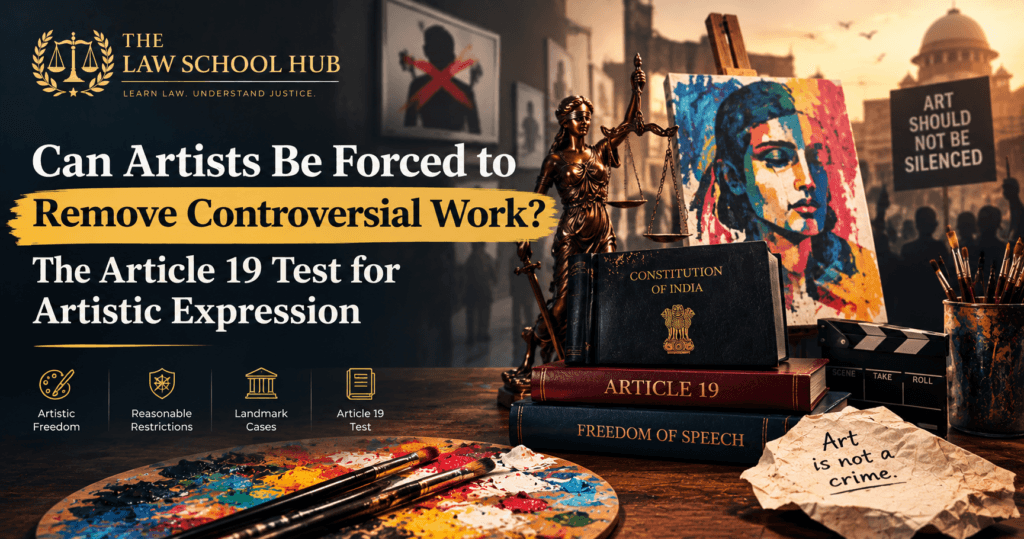
Can a painter be forced to take down a controversial painting? Can the government ban a movie just because a specific community finds it offensive? If you are a law student, a young lawyer, or simply a citizen interested in the arts, you have probably asked these questions. The short answer is: yes, but only under extremely strict conditions. When society clashes with creativity, Indian courts apply a specific constitutional benchmark known as the test for artistic expression under Article 19.
Art is not just a hobby; it is a fundamental pillar of human liberty. However, no freedom is absolute. The Constitution of India protects the right of artists to create freely, but it also gives the State the power to impose reasonable restrictions in the interest of public order, morality, and security. In this comprehensive guide, we will explore how courts balance an artist’s creative freedom against the sentiments of society. We will break down the rules, the exceptions, and the landmark case laws that every legal professional must know.
Legal Note: The information provided in this blog is for educational, academic, and legal awareness purposes only. While we base our analysis on verified Supreme Court judgments, official statutes, and the Constitution of India, this does not constitute professional legal advice. Always consult the official India Code, latest notifications, or a practicing advocate for specific legal issues.
Table of Contents
Overview of the Topic
To understand how courts evaluate artistic expression under Article 19, we must first look at the foundation of free speech in India. Every citizen has the right to express their thoughts, and art—whether it is a painting, a movie, a novel, or a stand-up comedy routine—is merely a medium of expression.
However, art often pushes boundaries. It challenges social norms, criticizes the government, and questions religious beliefs. When a piece of art angers a group of people, they often demand its removal, citing hurt sentiments or a threat to public order. This creates a legal battlefield. On one side stands the artist, claiming their fundamental right to free speech. On the other side stands the State, trying to prevent riots, obscenity, or defamation.
When a case like this reaches the judiciary, the judge does not decide whether the art is “good” or “bad.” Instead, the court applies a strict legal test to see if banning the art is a “reasonable restriction” permitted by the Constitution. If the restriction is unreasonable, the art stays. If it falls squarely within constitutional exceptions, the artist must remove or alter their work.
Detailed Explanation
When we talk about evaluating artistic expression under Article 19, we are actually discussing a multi-layered legal test. The judiciary uses this test to ensure that the government does not act like an absolute dictator over creative minds. Let us break down the exact mechanism the courts use.
1. The Presumption of Free Speech
The very first step in the legal test is the presumption of freedom. The court begins with the assumption that the artist has an absolute right to create and publish their work. The burden of proof never lies on the artist to prove that their art is harmless. Instead, the burden lies entirely on the State or the protesting party to prove that the art is legally dangerous. This principle ensures that censorship remains the exception, not the rule.
2. The Test of Reasonableness
If the government bans a book or a movie, the ban must be “reasonable.” But what does reasonable mean? The Supreme Court of India has clarified that reasonableness is not an abstract concept. For a ban on artistic expression under Article 19 to be valid, the restriction must have a direct, proximate, and rational connection to the goal the government is trying to achieve. The State cannot use a sledgehammer to crack a nut. If a minor edit can solve the problem, a complete ban on the artwork is legally unreasonable.
3. The “Clear and Present Danger” Equivalent
In the United States, courts use the “Clear and Present Danger” test. In India, we use a similar standard, often referred to as the “spark in a powder keg” test. For the State to ban artistic expression under Article 19 on the grounds of public order, the connection between the art and the threat of violence must be immediate. The court asks: Will showing this movie immediately cause a riot? Or is the threat of violence remote and speculative? If the threat is distant, the court will protect the art.
4. Rejecting the Heckler’s Veto
One of the most important concepts in media law is the rejection of the “Heckler’s Veto.” Imagine an artist organizes an exhibition, and a violent mob threatens to burn down the gallery if the exhibition opens. The government might be tempted to ban the exhibition to keep the peace. However, the courts have strictly held that the State cannot surrender to threats. It is the government’s duty to provide police protection to the artist, not to ban the art. You cannot suppress artistic expression under Article 19 simply because a few intolerant people threaten violence.
5. From the Hicklin Test to Community Standards
When dealing with obscenity in art, the legal test has evolved. Earlier, Indian courts used the British “Hicklin Test,” which judged a work based on isolated, out-of-context scenes that could corrupt vulnerable minds. Today, courts evaluate artistic expression under Article 19 using the “Community Standards Test.” The judge looks at the artwork as a whole. A naked sculpture might be obscene if placed outside a school, but it is protected art if displayed in a controlled gallery or a historical museum. The overall message and context of the art matter most.
Key Legal Provisions
1. Freedom of Speech and Expression
- Provision: Article 19(1)(a) of the Constitution of India, 1950
- Explanation: This Article guarantees all citizens the right to freedom of speech and expression. The Supreme Court has repeatedly affirmed that this includes the right to express oneself through movies, paintings, cartoons, literature, and digital media.
2. Reasonable Restrictions
- Provision: Article 19(2) of the Constitution of India, 1950
- Explanation: This is the shield the government uses. It allows the State to restrict free speech in the interests of sovereignty, security of the State, friendly relations with foreign states, public order, decency or morality, contempt of court, defamation, or incitement to an offence. If a ban does not fit strictly into one of these categories, it is unconstitutional.
3. Hurting Religious Sentiments
- Old Law: Section 295A of the Indian Penal Code, 1860
- New Law: Section 299 of the Bharatiya Nyaya Sanhita, 2023
- Explanation: This section punishes deliberate and malicious acts intended to outrage religious feelings. When angry mobs demand the removal of art, they usually file police complaints under this section. However, the law requires “malicious intent.” An artist creating a critique of religion in good faith is generally protected.
4. Obscenity
- Old Law: Sections 292 and 293 of the Indian Penal Code, 1860
- New Law: Section 294 of the Bharatiya Nyaya Sanhita, 2023
- Explanation: This law prohibits the sale and distribution of obscene materials. When analyzing artistic expression under Article 19, courts must balance this section against the true literary or artistic merit of the work. If the work is purely for scientific, literary, or artistic value, it is exempt from obscenity charges.
5. Film Certification Rules
- Provision: Section 5B of the Cinematograph Act, 1952
- Explanation: This section guides the Censor Board (CBFC). Interestingly, Section 5B is a direct copy-paste of the restrictions found in Article 19(2). It dictates that a film cannot be certified if it goes against the security of the State, public order, decency, or morality.
Important Case Laws
1. S. Rangarajan v. P. Jagjivan Ram, (1989) 2 SCC 574
This is arguably the most crucial judgment regarding artistic expression under Article 19. A Tamil film criticized the reservation policy, and protests erupted. The State revoked the film’s certificate, fearing riots. The Supreme Court overruled the ban, stating that the anticipation of danger cannot be an excuse to suppress free speech. (Original Analysis: The Court established the “proximate nexus” test here. It declared that freedom of expression cannot be held to ransom by an intolerant group of people. It is the State’s duty to maintain law and order, not to crush the artist’s voice.)
2. Maqbool Fida Husain v. Raj Kumar Pandey, 2008 Cri LJ 4107 (Del)
Legendary painter M.F. Husain faced massive backlash and criminal charges for painting a Hindu goddess in the nude. The Delhi High Court dismissed the criminal complaints, giving a monumental victory to artistic expression under Article 19. (Original Analysis: Justice Sanjay Kishan Kaul beautifully noted that art is a fundamental tool for challenging orthodox views. The court applied the community standards test, observing that nudity in Indian art has historical roots and cannot automatically be classified as obscene just because it offends a few individuals.)
3. Viacom 18 Media Pvt. Ltd. v. Union of India, (2018) 1 SCC 761
When the movie Padmaavat was set to release, several state governments banned it, fearing massive riots by certain community groups. The Supreme Court stayed the bans, allowing the film to release. (Original Analysis: This case is a modern reaffirmation against the Heckler’s Veto. The Supreme Court made it clear that once the Central Board of Film Certification (CBFC) clears a movie, state governments cannot use “public order” as a flimsy excuse to ban it. The protection of artistic expression under Article 19 supersedes state-level political panic.)
4. Aveek Sarkar v. State of West Bengal, (2014) 4 SCC 257
A sports magazine published a photograph of tennis player Boris Becker posing naked with his fiancée. The police filed obscenity charges. The Supreme Court quashed the charges and officially buried the outdated Hicklin test. (Original Analysis: The Court adopted the “Community Standards Test” here. It ruled that a picture must be viewed in its complete context. Since the photograph intended to challenge racial discrimination, the court held that it was protected artistic expression under Article 19 and did not appeal to the prurient interest.)
5. S. Tamilselvan v. Govt. of Tamil Nadu, 2016 SCC OnLine Mad 5960
Writer Perumal Murugan was hounded by local mobs over his novel One Part Woman, leading him to declare that “Perumal Murugan the writer is dead.” The Madras High Court stepped in, dismissed all criminal complaints, and ordered the State to protect the author. (Original Analysis: The High Court laid down detailed guidelines on how the police must handle mobs attacking artists. The judgment famously stated, “Let the author be resurrected,” proving that the judiciary remains the ultimate guardian of artistic expression under Article 19.)
6. K.A. Abbas v. Union of India, (1970) 2 SCC 780
This was the first case where the Supreme Court tested the constitutional validity of pre-censorship of films. The Court upheld the power of the Censor Board but insisted that the guidelines for censorship must be clear and reasonable. (Original Analysis: The Court recognized that films have a unique, powerful impact on the masses compared to books. Therefore, prior censorship is a valid, reasonable restriction, provided it strictly follows the boundaries of Article 19(2).)
Practical Examples
Example 1:
The Historical Satire Imagine a filmmaker creates a satirical comedy about a famous historical king, showing him as a clumsy and funny character. A political group claims this hurts their cultural pride and threatens to burn down cinemas. The State bans the movie to “maintain public order.” The Result: The court will strike down the ban. “Cultural pride” is not a valid ground for restriction under Article 19(2). Furthermore, anticipating violence from a mob is not a valid reason to ban the film. The State must arrest the mob, not ban the artist’s comedy.
Example 2:
The Malicious Propaganda Suppose an artist paints a series of posters explicitly calling for a specific minority community to be attacked and killed, and pastes them across a sensitive neighborhood that recently suffered riots. The Result: This is not protected artistic expression under Article 19. This falls under the “incitement to an offence” and “public order” exceptions in Article 19(2). The State is legally justified in forcing the removal of this dangerous work because the threat of violence is clear, present, and proximate.
Example 3:
The Bold Novel An author writes a gritty fictional novel about human trafficking, which includes graphic, realistic descriptions of abuse. The police arrest the author for obscenity under Section 294 of the BNS. The Result: The court will acquit the author. Applying the community standards test, the court will evaluate the novel as a whole. Because the graphic scenes are necessary to tell a story with deep social and literary value, they do not qualify as legally obscene.
Quick Checklist
If you are a legal researcher evaluating whether a piece of art can be banned, use this quick checklist based on Supreme Court guidelines:
When evaluating artistic expression under Article 19, the State MUST ensure:
- Constitutional Backing: Does the ban strictly fall within the eight grounds mentioned in Article 19(2)? (e.g., morality, public order, defamation).
- Proximate Cause: Is the art directly causing violence, like a spark in a powder keg?
- Proportionality: Is banning the art the least restrictive measure available?
- No Heckler’s Veto: Is the ban just a cowardly surrender to an angry, threatening mob?
- Contextual Judgment: Has the artwork been judged as a whole, rather than picking out a single controversial scene or dialogue?
- Intent Assessment: Did the artist have a malicious intent to cause a riot, or were they genuinely offering a social critique?
Table 1: Protected vs. Unprotected Art
| Scenario | Legal Status | Relevant Legal Concept |
|---|---|---|
| Mocking a politician in a cartoon. | Protected | Freedom of Speech (Fair Criticism). |
| Art that directly incites a riot. | Unprotected | Incitement to an offence / Public Order. |
| Painting nudity for historical context. | Protected | Community Standards Test (Not Obscene). |
| Spreading defamatory lies about a private citizen. | Unprotected | Defamation restriction under Art 19(2). |
| A certified movie facing mob threats. | Protected | Rejection of the Heckler’s Veto. |
Table 2: Mapping the Old and New Criminal Laws
| Offence Related to Art | Old Law (Indian Penal Code) | New Law (Bharatiya Nyaya Sanhita) |
|---|---|---|
| Selling/Distributing Obscene Books | Section 292 | Section 294 |
| Obscene Acts and Songs | Section 294 | Section 296 |
| Deliberately Hurting Religious Feelings | Section 295A | Section 299 |
| Defamation through Art/Writing | Section 499 | Section 356 |
(Note: Always refer to the latest bare acts to stay updated on how artistic expression under Article 19 interacts with the new BNS).
Conclusion
The debate around artistic expression under Article 19 is essentially a debate about democracy itself. A society that forces artists to constantly look over their shoulders is a society that stops thinking, innovating, and growing. As we have seen through the powerful judgments in cases like S. Rangarajan and M.F. Husain, the Indian judiciary has consistently stepped up to protect the creative minds of the nation.
While the Constitution allows for reasonable restrictions, these exceptions are strictly meant to protect the nation’s survival and public peace, not to coddle the fragile egos of easily offended groups. Artists cannot be forced to remove controversial work simply because it makes society uncomfortable. Art is meant to disturb the comfortable and comfort the disturbed. By strictly applying the legal tests, the courts ensure that our fundamental right to free speech remains a living, breathing reality rather than just ink on paper.
FAQs (Frequently Asked Questions)
1. What is the Article 19 test for artistic expression?
It is a judicial evaluation to determine if a ban on an artwork is a “reasonable restriction” under Article 19(2). The court checks if the art directly threatens public order, security, or morality, and ensures the restriction is proportional.
2. Can the government ban a movie to prevent riots?
Usually, no. The Supreme Court has ruled that anticipating mob violence is not a valid reason to crush artistic expression under Article 19. It is the State’s duty to suppress the mob and protect the movie’s screening.
3. Is the Censor Board (CBFC) constitutional?
Yes. In the K.A. Abbas case, the Supreme Court ruled that prior censorship of films is constitutional because movies have a massive, immediate impact on the public. However, the CBFC must follow the strict rules of Article 19(2).
4. What happens if a painting offends my religious feelings?
Being offended does not give you the right to ban the art. To be penalized under Section 299 of the BNS (formerly 295A IPC), the artist must have a deliberate and malicious intention to outrage religious feelings. Good faith critique is protected.
5. How do courts decide if an artwork is obscene?
Courts use the “Community Standards Test,” replacing the old Hicklin Test. The judge looks at the artwork as a whole and decides whether it has genuine artistic, literary, or social value, or if it purely appeals to base, prurient interests.
6. Does freedom of speech include the right to make memes?
Absolutely. Memes, cartoons, and digital satires are recognized forms of artistic expression under Article 19. As long as they do not cross into severe defamation or incitement of violence, they are constitutionally protected.
7. What is the “Heckler’s Veto” in Indian law?
The Heckler’s Veto happens when the government bans a legal speech or artwork just because a hostile crowd threatens violence. Indian courts strictly reject the Heckler’s Veto, ordering the State to protect the artist instead.
8. Can an artist be forced to change the title of their movie?
Yes, but only if the title directly violates a law (like copyright infringement) or clearly causes a massive public order issue. Often, producers voluntarily change titles (like Padmaavat) to avoid lengthy legal battles, though they have the right to fight it in court.
9. Are web series censored in India the same way as movies?
Currently, OTT platforms (web series) are not subject to the same strict prior-censorship (Censor Board) as cinema releases. They operate under a tiered self-regulatory framework under the IT Rules, though they are still bound by the reasonable restrictions of Article 19(2).
10. What should a young lawyer argue when defending an artist?
A lawyer should argue that the burden of proof is on the State. They must prove there is no “proximate nexus” between the art and any alleged danger, that the art must be viewed as a whole, and that the ban is entirely unreasonable.
Legal References and Citations
Statutes and Constitutional Provisions:
- The Constitution of India, 1950, Art. 19(1)(a) (Freedom of Speech).
- The Constitution of India, 1950, Art. 19(2) (Reasonable Restrictions).
- The Indian Penal Code, 1860, s. 292 (Obscenity).
- The Bharatiya Nyaya Sanhita, 2023, s. 294 (Obscenity).
- The Indian Penal Code, 1860, s. 295A (Outraging religious feelings).
- The Bharatiya Nyaya Sanhita, 2023, s. 299 (Outraging religious feelings).
- The Cinematograph Act, 1952, s. 5B (Principles for guidance in certifying films).
Judgments (Supreme Court and High Courts):
- S. Rangarajan v. P. Jagjivan Ram, (1989) 2 SCC 574.
- Maqbool Fida Husain v. Raj Kumar Pandey, 2008 Cri LJ 4107 (Del).
- Viacom 18 Media Pvt. Ltd. v. Union of India, (2018) 1 SCC 761.
- Aveek Sarkar v. State of West Bengal, (2014) 4 SCC 257.
- S. Tamilselvan v. Govt. of Tamil Nadu, 2016 SCC OnLine Mad 5960.
- K.A. Abbas v. Union of India, (1970) 2 SCC 780.
- Ranjit D. Udeshi v. State of Maharashtra, AIR 1965 SC 881.
- Bobby Art International v. Om Pal Singh Hoon (Bandit Queen case), (1996) 4 SCC 1.
- Prakash Jha Productions v. Union of India, (2011) 8 SCC 372.
- Anand Patwardhan v. Union of India, (1996) 3 Bom CR 586.
At The Law School Hub, we simplify case laws, legal acts, and legal concepts for law students and legal readers. Want to read more useful legal blogs? Visit The Law School Hub today and master the law with ease!
Keep Learning. Stay Updated. Connect with me on Linkedin.