ADM Jabalpur v. Shivkant Shukla (1976): India’s Darkest Constitutional Moment — Habeas Corpus, the Emergency, and a Lone Dissent

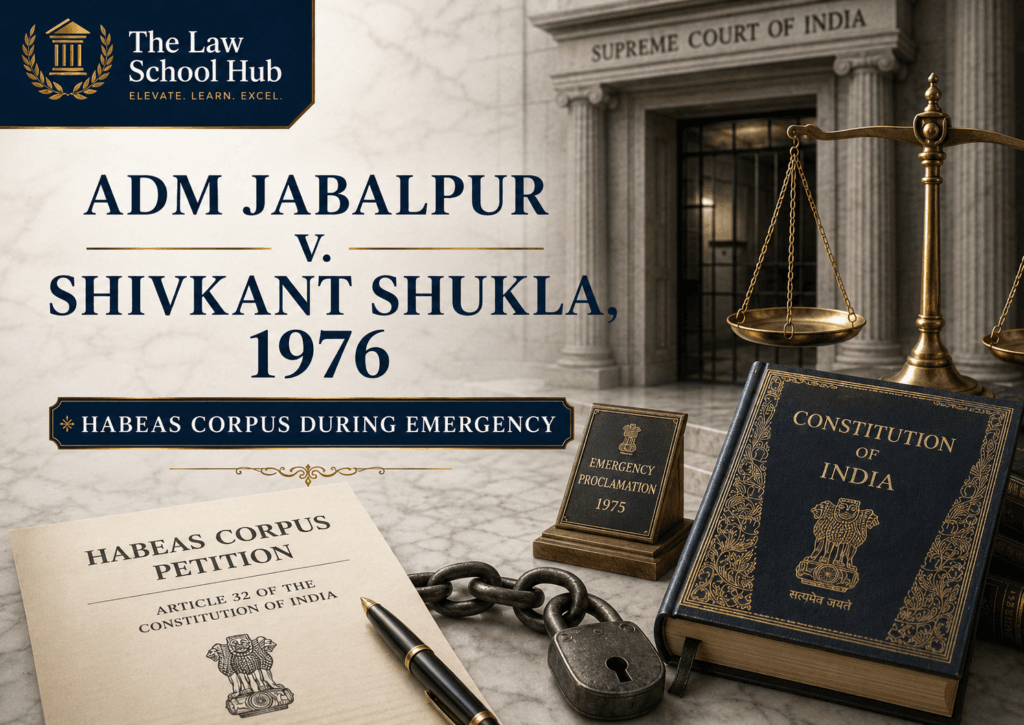
Table of Contents
Introduction
The ADM Jabalpur case is the most controversial and, many say, the most shameful judgment in the history of the Supreme Court of India. Decided in April 1976, during the Emergency proclaimed by Indira Gandhi’s government, this case addressed a terrifying question: during a state of emergency, can the government detain a person indefinitely without any legal justification, and can that person not even approach the courts to question the detention? By a shocking 4:1 majority, the Supreme Court answered yes — the right to move the courts was suspended during the Emergency. Only one judge, Justice H.R. Khanna, dissented. His dissent is now remembered as one of the finest moments of judicial courage in Indian history.
Case Details at a Glance
| Case Name | Additional District Magistrate, Jabalpur v. Shivkant Shukla |
| Court | Supreme Court of India |
| Year | 1976 |
| Citation | AIR 1976 SC 1207 / (1976) 2 SCC 521 |
| Bench / Judges | 5-Judge Constitution Bench (CJ A.N. Ray, Justices Beg, Chandrachud, Bhagwati, and H.R. Khanna) |
| Legal Area | Constitutional Law — Emergency, Habeas Corpus, Article 21 |
| Main Issue | Whether courts could issue writs of habeas corpus during Emergency when right to move courts is suspended |
| Final Decision | Courts cannot issue habeas corpus during Emergency; right to life and liberty suspended (4:1 majority) |
| Important Legal Principle | (Majority) Rights suspended during Emergency are not enforceable in courts; (Dissent — Khanna J.) No law can deprive a person of life and liberty without authority of law |
Background
On 25 June 1975, the President of India proclaimed a national Emergency under Article 352(1) of the Constitution on grounds of internal disturbance. The Emergency suspended many civil liberties and gave the government sweeping powers.
Under the Maintenance of Internal Security Act, 1971 (MISA) and other detention laws, thousands of people — opposition politicians, activists, journalists, and ordinary citizens — were arrested and detained without trial. President’s Order under Article 359(1) suspended the right of citizens to move any court to enforce their fundamental rights under Articles 14, 21, and 22.
Many detainees filed habeas corpus petitions in various High Courts, arguing that their detention was illegal. Several High Courts — including Allahabad, Delhi, Madhya Pradesh, Rajasthan, and others — upheld the petitions and ordered the detainees’ release. The government appealed to the Supreme Court, leading to the ADM Jabalpur case.
Facts of the Case
Shivkant Shukla and other detainees were arrested without being given any grounds of detention, as required under normal law. They filed habeas corpus petitions before the Madhya Pradesh High Court at Jabalpur. The High Court held that even during the Emergency, the detainees had a right to approach the court and that the government must show legal authority for the detention.
The government challenged the High Court’s order before the Supreme Court. The key question: with the Presidential Order suspending Article 21 (right to life and personal liberty), could anyone petition the court under Article 226 for habeas corpus?
Issues Before the Court
- Whether, during a Presidential emergency with Article 21 suspended, a person has any right to move a High Court under Article 226 for a writ of habeas corpus.
- Whether the courts retain any power to enquire into the legality of detention during the Emergency.
- Whether there exists any common law right or inherent right to personal liberty that survives the suspension of Article 21.
Arguments by the Parties
The government (ADM Jabalpur) argued that the Presidential Order under Article 359(1) specifically suspended the right to move any court for enforcement of Article 21 (right to life and liberty). Therefore, High Courts had no jurisdiction to issue habeas corpus on the basis of Article 21. The Executive was above judicial review during the Emergency.
The detainees argued that even if Article 21 is suspended, courts retain jurisdiction under Article 226, which cannot be completely removed by a Presidential Order. They also argued that no Presidential Order can authorise detention without any legal basis — there must be some law, however minimal, authorising the detention.
Judgment of the Court
By a 4:1 majority, the Supreme Court ruled in favour of the government:
- The Presidential Order under Article 359 had suspended the right to move courts for enforcement of Article 21.
- In the absence of Article 21, no person detained under MISA could maintain a writ petition in any court to challenge the detention.
- Even if the detention was malicious or in bad faith, the courts could not interfere.
- The majority held that during Emergency, the rule of law is replaced by the rule of Executive.
Justice H.R. Khanna delivered a solitary and heroic dissent:
- Even in the absence of Article 21, a person cannot be deprived of life and liberty without the authority of law. This is a fundamental principle of common law that the Constitution itself did not displace.
- No President’s Order can authorise arbitrary detention without any legal sanction whatsoever.
- Even under emergency, some minimum rights must survive, or else the rule of law itself ceases to exist.
Ratio Decidendi (Majority)
- During Emergency, when Article 21 is suspended by Presidential Order, no person can approach a High Court for habeas corpus to challenge detention under MISA.
- High Courts have no power to release a person who has no enforceable right due to the Emergency suspension.
Justice Khanna’s Dissent — The Immortal Minority View
Justice H.R. Khanna’s dissent is one of the most celebrated judicial opinions in Indian legal history. He wrote that even if Article 21 is suspended, the rule of law — the most basic constitutional principle — mandates that no one can be deprived of life or liberty except in accordance with law. Arbitrary detention, without any law authorising it, is impermissible in any constitutional order.
The government reportedly transferred Justice Khanna after his dissent, and he was superseded for the position of Chief Justice — a clear act of political retaliation that he accepted with dignity. His dissent was later vindicated when the 44th Constitutional Amendment (1978) amended Article 359 to prevent the suspension of Articles 20 and 21 even during Emergency.
Legal Principles Explained
Article 21 guarantees that no person shall be deprived of life or personal liberty except according to procedure established by law. Article 359 allows the President to suspend the right to move courts for enforcement of fundamental rights during Emergency — but as amended in 1978, it cannot suspend Articles 20 and 21.
Habeas corpus (literally ‘you shall have the body’) is a writ that commands a person who detains another to produce the detainee before the court and justify the detention. It is one of the oldest and most fundamental safeguards against arbitrary State power.
The 44th Constitutional Amendment (1978), enacted after the Emergency, specifically provided that Articles 20 and 21 cannot be suspended even during Emergency — directly overruling the ADM Jabalpur judgment’s practical effect.
Importance of the Case
- One of the most widely condemned Supreme Court judgments in Indian history — often called India’s darkest constitutional hour.
- Justice Khanna’s dissent inspired generations of judges and lawyers to prioritise constitutional values over political pressure.
- The 44th Constitutional Amendment (1978) directly responded to this case by protecting Articles 20 and 21 from Emergency suspension.
- The case is a powerful cautionary tale about judicial abdication and the importance of an independent judiciary.
- In 2017, a nine-judge bench in Justice K.S. Puttaswamy v. Union of India expressly held that ADM Jabalpur was wrongly decided.
Critical Analysis
The ADM Jabalpur majority judgment has been universally criticised. Judges who decided it — including Justice Chandrachud, who later became Chief Justice — expressed deep regret for their decision. The case illustrates the danger of judicial deference to executive authority, particularly in times of crisis.
Legal scholars argue that the majority misread the Constitution. Even if Article 21 is suspended, it does not follow that no law at all is required to detain someone — it only means the specific fundamental right under Article 21 cannot be enforced. Common law rights and statutory requirements for lawful detention should have survived.
The lone dissent of Justice Khanna — delivered knowing it would cost him the Chief Justiceship — is a reminder that judicial courage and constitutional fidelity are more important than institutional convenience. His dissent is now taught in law schools as an example of how judges should uphold constitutional values even under pressure.
Illustrations and Examples
Imagine a society where, during a crisis, the government announces: ‘We can arrest anyone for any reason, and no court can ask us why.’ That is what the ADM Jabalpur majority permitted during the Emergency. Justice Khanna said: even in a crisis, there must be some law authorising the arrest. Arbitrary detention — detention without any legal basis — is never acceptable in a constitutional democracy.
Key Takeaways
| Key Point | Detail |
| Case Name | ADM Jabalpur v. Shivkant Shukla (1976) |
| Context | National Emergency, 1975–1977 |
| Majority View | Courts cannot issue habeas corpus during Emergency when Article 21 is suspended |
| Dissent | Justice H.R. Khanna — no arbitrary detention even during Emergency |
| Constitutional Fix | 44th Amendment (1978) — Articles 20 and 21 cannot be suspended during Emergency |
| Later Development | Overruled in Puttaswamy v. Union of India (2017) |
| Lesson | Judicial independence and constitutional fidelity must prevail even under political pressure |
Conclusion
The ADM Jabalpur case is India’s most sobering constitutional lesson. It shows what happens when courts abdicate their role as guardians of fundamental rights. The case also demonstrates, through Justice Khanna’s dissent, that individual judicial courage can be a bulwark against institutional failure.
The 44th Constitutional Amendment reversed the practical impact of this judgment. The Puttaswamy case (2017) formally declared it wrongly decided. But the case remains in the syllabus — and in legal memory — as a reminder of what is at stake when a democratic system abandons the rule of law.
FAQs
Q: What was the ADM Jabalpur case about?
A: It was a 1976 Supreme Court case that decided whether courts could issue habeas corpus writs to release people detained during India’s Emergency, after their right to move courts under Article 21 was suspended.
Q: What did the Supreme Court decide in ADM Jabalpur?
A: By 4:1, the Court held that courts could not issue habeas corpus during the Emergency, effectively allowing unlimited detention without judicial review.
Q: Who dissented in ADM Jabalpur?
A: Justice H.R. Khanna delivered the sole dissent, holding that no person could be deprived of life and liberty without the authority of law, even during Emergency.
Q: Was ADM Jabalpur overruled?
A: Yes. In Justice K.S. Puttaswamy v. Union of India (2017), a nine-judge bench expressly held that ADM Jabalpur was wrongly decided.
Q: How did the 44th Amendment respond to ADM Jabalpur?
A: The Constitution (44th Amendment) Act, 1978, amended Article 359 to ensure that Articles 20 and 21 cannot be suspended even during a national emergency.
Q: Why is Justice Khanna’s dissent famous?
A: His dissent upheld the rule of law against political pressure, and he was subsequently denied promotion to Chief Justice in apparent retaliation — but his stand is remembered as the finest moment of judicial courage in Indian history.
Legal References
• ADM Jabalpur v. Shivkant Shukla – Indian Kanoon
• Article 21 – Constitution of India – India Code
• Article 359 – Constitution of India – India Code
• Maintenance of Internal Security Act, 1971 – India Code
• Constitution (44th Amendment) Act, 1978 – India Code
• Justice K.S. Puttaswamy v. Union of India (2017) – Indian Kanoon
At The Law School Hub, we simplify case laws, legal acts, and legal concepts for law students and legal readers. Want to read more useful legal blogs? Visit The Law School Hub for more such informational blogs.