The Sudden Exit: Can the FRRO Deport a Foreigner While Their Visa is Still Valid?

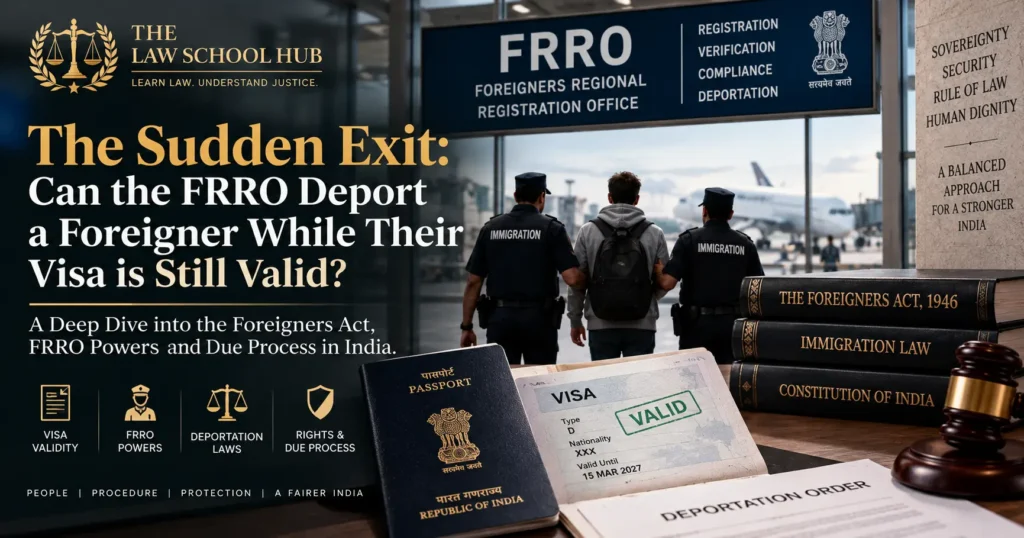
Table of Contents
Introduction
A common legal question asked by international visitors and expatriates living in India is whether the government can force them to leave the country if their visa has not yet expired. Many people mistakenly believe that holding a valid visa acts as a binding contract that guarantees their right to stay in the country until the exact expiry date printed on their passport. However, this is a serious misunderstanding of Indian immigration law. Under the Indian legal system, the government holds the absolute power to expel or deport any foreign national at any time. The Foreigners Regional Registration Officer (FRRO) can absolutely FRRO deport a foreigner even if their visa is completely valid and paid for. A visa is simply a temporary permission slip, not a fundamental right. If the government decides that a person’s continued presence is unwanted, unlawful, or dangerous, they can cancel that permission instantly and order the person to leave the country without needing permission from a judge.
Legal Information Notice
Legal information notice: This article is for general educational and informational purposes. It does not constitute legal advice or create an attorney-client relationship.
Overview of the Topic
Every independent country has the ultimate power to decide who is allowed to enter its borders and who is allowed to stay. In India, this immense power belongs to the Central Government. The government manages this through the Ministry of Home Affairs and the Bureau of Immigration. The Foreigners Regional Registration Officer is the local government official in charge of tracking, managing, and regulating foreigners in specific cities and districts.
When a person enters India, they do so because the government has granted them a privilege. Because this is a privilege and not a fundamental constitutional right, the government can withdraw it at any moment. If the FRRO suspects that a foreigner is breaking local laws, working secretly on a tourist visa, or acting against the interests of India, the FRRO will not wait for the visa to expire. They will issue an immediate order demanding that the foreigner leave the country. This article will explain the exact laws that give the FRRO this massive power, the basic rights that foreigners actually possess, and how the highest courts in India have ruled on this sensitive issue.
Detailed Explanation
1. The Power of the Central Government
The power to control the entry and exit of foreign nationals rests entirely with the Central Government of India. The government does not need to file a civil lawsuit or win a criminal trial to remove a foreigner. The law gives the executive branch of the government the direct authority to manage borders. This is considered an inherent part of national sovereignty. Sovereignty: This means the absolute authority of a country to govern itself and protect its own borders without outside interference.
2. The Role of the FRRO
Because the Central Government in New Delhi cannot physically monitor every single foreigner across the entire country, it delegates its massive powers to local officers. The Foreigners Regional Registration Officer is a senior police officer who acts as the civil authority for immigration matters in major cities.
What the FRRO does: The FRRO handles visa extensions, registration of long-term visitors, and the monitoring of foreign activities. More importantly, the FRRO holds the delegated power to curtail visas and issue a Leave India Notice. When the FRRO issues this notice, the previously valid visa is effectively cancelled, and the foreigner becomes an illegal resident if they do not leave immediately.
3. Why a Visa is Not a Guarantee
A visa is a highly conditional document. When a foreigner signs their visa application, they agree to follow a very strict set of rules. For example, a tourist visa strictly bans employment, business activities, or religious preaching. If a person holds a valid five-year tourist visa but starts working in a local restaurant, they have broken the primary condition of their visa.
Because the condition is broken, the validity of the visa instantly collapses. The government does not have to wait five years to punish them. The FRRO will instantly cancel the document and FRRO deport a foreigner because their legal basis for staying in the country has vanished.
4. The Difference Between Deportation and a Leave India Notice
While people use the word deportation for everything, the FRRO uses specific legal procedures.
Leave India Notice: This is a formal written letter telling the foreigner to pack their bags and leave the country within a specific time, usually a few days or weeks. The foreigner buys their own ticket and leaves peacefully.
Deportation: If the foreigner ignores the notice, or if they commit a serious crime, the FRRO will order their arrest. The foreigner will be placed in a detention camp and then physically forced onto an aeroplane by the police. Both actions completely override whatever expiry date is written on the original visa.
Key Legal Provisions
The massive power held by the FRRO is not arbitrary. It comes directly from specific, strict laws passed by the Indian Parliament before and after independence.
1. The Foreigners Act, 1946
This is the most powerful and important law governing foreign nationals in India. It gives the Central Government absolute control over immigration.
1.1. Section 3 of the Foreigners Act
What the law says: Section 3 gives the Central Government the power to make official orders prohibiting, regulating, or restricting the entry, presence, or departure of foreigners. Specifically, Section 3(2)(c) gives the government the exact power to order that a foreigner shall not remain in India or in any prescribed area inside India.
What it means in simple English: This specific section is the main weapon used by the FRRO. It legally allows the government official to write a piece of paper ordering a foreigner to leave the country. The law is written so broadly that the FRRO does not even need to give a long explanation or hold a court trial before issuing the order.
1.2. Section 14 of the Foreigners Act
What the law says: Section 14 deals with penalties. It states that if any person remains in any area in India longer than the period permitted, or if they do any act in violation of the conditions of their visa, they shall be punished with imprisonment which may extend to five years, and shall also be liable to pay a heavy fine.
What it means in simple English: If the FRRO cancels a valid visa and tells the foreigner to leave, and the foreigner refuses to buy a ticket and stays, they become a criminal under this section. They can be thrown into an Indian jail for five years simply for refusing to leave.
2. The Constitution of India
To understand why a foreigner cannot easily fight a deportation order in court, we must carefully look at the fundamental rights guaranteed by the Indian Constitution. The Constitution treats citizens and foreigners very differently.
2.1. Article 19(1)(e) of the Constitution
What the law says: All citizens shall have the right to reside and settle in any part of the territory of India.
What it means in simple English: This is the most crucial distinction in immigration law. The Constitution clearly uses the word citizens. This means that foreigners absolutely do not have a fundamental constitutional right to live, reside, or settle in India. Because they have no fundamental right to stay, they cannot go to a judge and claim that the FRRO is violating their constitutional rights by sending them home.
2.2. Article 21 of the Constitution
What the law says: No person shall be deprived of his life or personal liberty except according to procedure established by law.
What it means in simple English: Unlike Article 19, this article uses the word person. This means foreigners are fully protected by Article 21 while they are inside India. The FRRO cannot torture them, beat them, or lock them in a dark cell without a fair legal process. However, the Supreme Court has clarified that the right to life does not include the right to reside in a foreign country. Therefore, deporting someone legally does not violate Article 21.
Important Case Laws
The highest courts in India have repeatedly examined the immense power of the government to expel foreigners. The following judgments firmly establish the exact legal position.
1. Hans Muller of Nurenburg v. Superintendent, Presidency Jail, Calcutta
Facts: A West German national named Hans Muller was living in India. The Indian government suspected him of illegal activities. Without holding a long criminal trial, the government arrested him and ordered his absolute deportation back to West Germany. Muller filed a legal case, arguing that placing him in jail to deport him violated his fundamental rights and that he should be allowed to stay or at least choose which country he was sent to.
Legal Issue: Does the Indian government have the absolute, unrestricted power to expel a foreign national from its territory?
Court’s Reasoning: The Supreme Court of India looked deeply at the Foreigners Act. The senior judges stated that the power of a government to expel a foreigner is an absolute and inherent right of every sovereign nation. The Court noted that the Foreigners Act gives the Central Government absolute and unfettered discretion to remove any person who is not a citizen. The Court explicitly highlighted that foreigners do not possess the constitutional right to reside in India under Article 19.
Decision: The Supreme Court dismissed Muller’s petition. The Court held that the government can expel a foreigner at any time, and can also arrest them and detain them specifically to ensure the deportation is actually carried out.
Importance: This 1955 judgment is the ultimate foundation of Indian immigration law. It officially confirmed that the government has the absolute legal power to FRRO deport a foreigner regardless of their arguments or preferences.
2. Louis De Raedt v. Union of India
Facts: Two foreign nationals from Belgium had been living in India continuously since 1937. They had lived in India for over fifty years. In 1987, the government suddenly refused to extend their visas any further and issued an official order demanding that they leave India immediately. The foreigners went to the Supreme Court. They argued that because they had lived in India peacefully for fifty years, forcing them out violated their fundamental right to life and liberty under Article 21.
Legal Issue: Can a foreigner claim the right to remain in India under Article 21 if they have lived in the country for many decades?
Court’s Reasoning: The Supreme Court carefully examined the difference between the right to life and the right to reside. The judges firmly stated that while Article 21 protects a foreigner from being killed or unfairly tortured, it absolutely does not grant them the right to stay in the country. The right to reside and settle is exclusively reserved for Indian citizens under Article 19(1)(e).
Decision: The Supreme Court ruled in favour of the government and upheld the expulsion order. The Court stated that the Central Government has the unrestrictive right to expel foreigners, no matter how many years they have lived in the country.
Importance: This case destroys the common myth that living in India for a long time gives a foreigner permanent legal protection. It proved that a visa, or even decades of visa renewals, never converts into a fundamental right to stay.
3. Sarbananda Sonowal v. Union of India
Facts: This famous case dealt with a massive influx of undocumented migrants crossing the border into the Indian state of Assam. The government of India had passed a special, softer law for Assam that made it very difficult to deport suspected foreigners compared to the rest of the country. Citizens of Assam challenged this softer law in the Supreme Court.
Legal Issue: Is the power to identify and deport illegal foreigners a fundamental duty of the Central Government to protect the nation?
Court’s Reasoning: The Supreme Court took a very strict view on national security. The judges declared that the massive, unchecked arrival of foreigners amounted to an external aggression against the State of Assam. The Court strongly reminded the government that the Foreigners Act gives the executive branch the ultimate power to secure the borders.
Decision: The Supreme Court struck down the softer law. The Court forced the government to use the strict powers of the Foreigners Act, 1946 across the entire country, reaffirming that expelling unwanted foreigners is a basic sovereign duty.
Importance: While this case dealt with undocumented migrants, it strongly reinforced the legal principle that the government’s power to deport under the Foreigners Act is paramount and must be used forcefully to protect the country.
Practical Examples and Illustrations
1. The Working Tourist
Scenario: John is a citizen of Australia who holds a valid five-year Multiple Entry Tourist Visa for India. He visits Goa for a holiday. While there, he runs out of money. He starts working as a bartender at a local beach shack and earns cash. The local police find out and inform the FRRO.
Legal Position: John has severely violated the fundamental conditions of his tourist visa, which strictly prohibits taking up employment. The FRRO has the absolute power under Section 3 of the Foreigners Act to instantly cancel his valid visa and issue a Leave India Notice.
Practical Point: John cannot argue that he still has four years left on his visa. Because he broke the rules, the visa is legally worthless. He must pack his bags and leave the country within the time given by the FRRO, or face arrest and criminal charges.
2. The Overstaying Student
Scenario: Amina is a student from Nigeria studying in an Indian university on a valid Student Visa. She finishes her final exams and graduates. Her student visa is valid for another six months. Instead of returning home or studying further, she starts running an independent clothing business in Delhi.
Legal Position: A student visa is strictly granted for educational purposes. Once the primary purpose ends, and the foreigner engages in completely unauthorized business activities, the FRRO can legally curtail the remaining six months of the visa.
Practical Point: The FRRO will issue an order demanding that Amina leave. The valid date printed on her passport provides no protection if she changes the purpose of her visit without seeking prior official permission from the government.
3. The Security Threat
Scenario: David is a journalist from the United Kingdom holding a valid Journalist Visa. During his stay, Indian intelligence agencies report that David is secretly visiting restricted border areas without the mandatory special permits and is taking photographs of military installations.
Legal Position: The government does not need to wait for a criminal trial to conclude. Because national security is the highest priority, the FRRO, acting on instructions from the Ministry of Home Affairs, will instantly cancel his visa using their absolute sovereign power.
Practical Point: David will likely be detained immediately. He will be placed on the first available flight back to the United Kingdom, and his name will be added to the official Blacklist, preventing him from ever entering India again.
Practical Consequences / What This Means in Real Life
When the FRRO decides to use its massive power, the consequences for the foreigner are severe, immediate, and long-lasting.
1. Immediate Loss of Status: The moment the FRRO curtails a visa or issues a Leave India Notice, the foreigner instantly loses their legal right to be in India. They cannot open bank accounts, they cannot sign rent agreements, and their presence becomes legally hostile.
2. The Blacklist System: When a person is deported or forced to leave early because of a rule violation, the FRRO updates a central computer system managed by the Bureau of Immigration. The foreigner’s passport number and biometric details are added to the Blacklist. This means they will be completely blocked from getting another Indian visa in the future, and if they try to fly to India, immigration officers will stop them at the airport and send them back.
3. Financial Loss: The government does not refund visa fees if they cancel the document early. Furthermore, the foreigner must usually pay for their own expensive, last-minute flight ticket home. If they are placed in a detention centre, they lose access to their personal property and local businesses left behind.
Important Exceptions or Limitations
While the power of the government is vast and absolute, there are a few very rare and strict exceptions where a court might temporarily stop the FRRO from deporting someone.
1. Marriage to an Indian Citizen: If a foreigner is legally married to an Indian citizen and has children born in India, courts are sometimes sympathetic. While marriage does not automatically grant Indian citizenship or a permanent right to stay, High Courts have occasionally paused deportation orders to allow the foreigner to apply for a long-term Spouse Visa or an Overseas Citizen of India (OCI) card, keeping the family together.
2. Severe Threat to Life (Non-Refoulement): If a foreigner proves that sending them back to their home country will result in their immediate murder or torture due to a raging civil war or severe political persecution, they can ask the High Court for mercy. High Courts occasionally use Article 21 (Right to Life) to temporarily stop the FRRO from deporting them, allowing them time to seek official refugee status with the United Nations. However, this is a temporary humanitarian shield, not a permanent legal right to reside.
3. Arbitrary and Malicious Action: If a foreigner can absolutely prove that the FRRO officer cancelled the visa purely out of personal revenge, bribery demands, or complete lack of official authority, the High Court can strike down the order using the Writ of Mandamus. Courts demand that government officials act fairly, even when they possess massive power.
Visa Expiry vs. Visa Cancellation
| Concept | What it means | Legal Consequence |
| Visa Expiry | The natural end date printed on the visa arrives. | The foreigner must leave or properly apply for a legal extension beforehand. |
| Visa Cancellation | The FRRO terminates the visa before the printed end date. | The foreigner becomes an illegal resident instantly and must leave immediately. |
Fundamental Rights of Citizens vs. Foreigners
| Constitutional Right | Belongs to Indian Citizens? | Belongs to Foreigners in India? |
| Article 19: Right to reside and settle | Yes, absolutely. | No, never. |
| Article 21: Right to life and liberty | Yes, absolutely. | Yes, protects against illegal torture or unfair jail time. |
| Right to challenge deportation | Citizens cannot be deported. | Very limited scope, only if the order is completely arbitrary or threatens basic life. |
Key Takeaways
- Absolute Power: The Indian government has the absolute sovereign power to expel any foreign national at any time under the Foreigners Act, 1946.
- Not a Contract: A visa is a conditional privilege, not a fundamental constitutional right. It does not guarantee a stay until the expiry date.
- Instant Cancellation: If a foreigner breaks visa rules, engages in crime, or threatens national security, the FRRO can legally cancel the visa instantly.
- No Right to Reside: The Supreme Court has repeatedly ruled that foreigners do not possess the fundamental right to reside in India under Article 19 of the Constitution.
- Leave India Notice: Deportation usually begins with a formal written notice from the FRRO demanding that the foreigner leave the country within a short deadline.
- Limited Court Help: Because the government’s power is absolute, Indian courts rarely interfere with deportation orders unless there is a severe violation of basic human rights or gross official misconduct.
Conclusion
The question of whether the government can remove a person who holds a fully paid and valid visa has a very clear legal answer. The Foreigners Regional Registration Officer (FRRO) holds the absolute, delegated legal authority to FRRO deport a foreigner at any time if they violate the strict conditions of their stay or act against the interests of the nation.
Indian immigration law values the sovereign security of the country above the personal travel plans of international visitors. While foreigners are protected against cruel and unusual punishment under Article 21 of the Constitution, they simply do not possess a constitutional right to live or settle on Indian soil. A visa provides temporary entry, but it can evaporate the moment the government decides the visitor is no longer welcome. For international visitors, the clear legal lesson is that perfect compliance with local laws and strict adherence to specific visa rules is the only way to safely enjoy their stay in India until their actual departure date.
FAQs
1. Can the police deport me, or only the FRRO?
Answer: Local police can arrest a foreigner for committing a crime or overstaying, but the official power to issue the formal Leave India Notice and order the physical deportation is exercised by the FRRO acting on behalf of the Central Government.
2. Will I get a refund for my visa if the FRRO cancels it early?
Answer: No, the Indian government does not issue financial refunds for visa fees if the visa is cancelled early due to rule violations or security reasons.
3. What happens if I refuse to leave after receiving a Leave India Notice?
Answer: If you deliberately ignore the official notice, you become an illegal resident, and the FRRO can order the police to arrest you, place you in a detention centre, and charge you under Section 14 of the Foreigners Act, which carries a penalty of up to five years in prison.
4. Can I hire a lawyer and appeal to a judge to stop my deportation?
Answer: You can hire a lawyer to file a Writ Petition in the High Court, but because the government has absolute sovereign power over immigration, the judge will only stop the deportation if the FRRO acted completely illegally, completely arbitrarily, or if sending you back endangers your basic right to life.
5. Can they deport me if I am married to an Indian citizen?
Answer: Yes, marriage to an Indian citizen does not give a foreigner automatic citizenship or an absolute right to stay, though courts are sometimes sympathetic and may pause a deportation to give the foreigner time to properly apply for an OCI card or a long-term spouse visa.
6. Does having a valid employment contract protect me from the FRRO?
Answer: No, an employment contract is a private agreement between you and an Indian company, and it cannot override the absolute sovereign power of the Central Government to cancel your employment visa and remove you from the country.
7. If I am deported, can I ever come back to India on a new visa?
Answer: Usually no, because a deported person is almost always added to the official government Blacklist, which automatically rejects future visa applications and prevents entry at all Indian airports.
Legal References
- 1. The Foreigners Act, 1946, Section 3
- 2. The Foreigners Act, 1946, Section 14
- 3. The Constitution of India, 1950, Article 19
- 4. The Constitution of India, 1950, Article 21
- 5. Hans Muller of Nurenburg v. Superintendent, Presidency Jail, Calcutta, AIR 1955 SC 367
- 6. Louis De Raedt v. Union of India, (1991) 3 SCC 554
- 7. Sarbananda Sonowal v. Union of India, AIR 2005 SC 2920
At The Law School Hub, we simplify case laws, legal acts, and legal concepts for law students and legal readers. Want to read more useful legal blogs? Visit The Law School Hub.
Building a community around law, learning, and legal awareness through The Law School Hub.
I’m Yash Yogitta Joshi. Join me on LinkedIn → Click to view my Profile