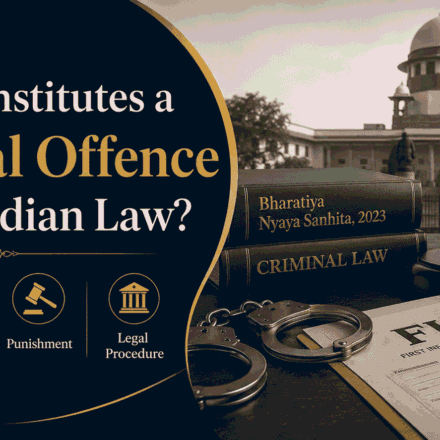






What Constitutes a Criminal Offence Under Indian Law? A Clear, Powerful Guide That Protects Your Rights

Reader Note
This article is for legal education and general awareness. It does not replace advice from an advocate in a specific criminal matter.
Introduction: Quick Answer for Readers
A criminal offence under Indian law arises when a written law declares a conduct punishable, the accused does the prohibited act or omission, the required mental element exists, and the prosecution proves every legal ingredient beyond reasonable doubt. In simple words, a wrong becomes criminal only when law treats it as an offence against society, not merely as a private dispute between two people.
Since 1 July 2024, India has followed a new core criminal law structure. The Bharatiya Nyaya Sanhita, 2023 generally defines offences and punishments. The Bharatiya Nagarik Suraksha Sanhita, 2023 explains procedure, investigation, arrest, bail, trial, appeal and execution. The Bharatiya Sakshya Adhiniyam, 2023 governs proof and evidence. Therefore, anyone who wants to understand a criminal case in India should read these three laws together.
Overview: What Makes an Act Criminal?
A criminal offence under Indian law has four practical pillars: legal prohibition, wrongful conduct, mental fault and legal proof. If one pillar fails, the criminal case may fail too.
Criminal law protects society because some acts affect public order, bodily safety, property, dignity, trust and the authority of the State. However, criminal law also protects the accused. Courts require legal ingredients, evidence and fair procedure before they convict a person.
1. A Written Law Must Declare the Conduct as an Offence
The first test is legality. No court can punish a person for an act unless a law already treats that act as a crime. This principle gives certainty to citizens. People must know what law prohibits before the State can punish them.
Under the current framework, the Bharatiya Nyaya Sanhita, 2023 is the main penal law for most general offences. It covers offences against the human body, women and children, property, public tranquillity, the State, religion, public servants, documents and reputation. In addition, Parliament and State legislatures may create offences through special laws.
The idea also connects with Article 20 of the Constitution of India. It protects a person from conviction for an act that was not an offence when committed. Therefore, a new criminal law usually cannot punish past conduct unless the Constitution and the statute permit it in a lawful manner.
This is why a criminal offence under Indian law always starts with a legal text. Morality, social anger, family pressure or online outrage cannot replace a statute.
2. There Must Be an Act, Omission or Legally Recognised Conduct
Criminal law usually needs conduct. Lawyers often call this the actus reus, or the external part of the offence. It may include a positive act, a harmful omission, possession, publication, concealment, participation or a continuing course of conduct.
Section 2 of the Bharatiya Nyaya Sanhita, 2023 includes definitions that help courts read words such as act, illegal, injury, fraudulently and dishonestly. These definitions matter because many offences depend on the exact meaning of these words.
For example, theft needs dishonest moving of property. Hurt needs bodily pain, disease or infirmity. Cheating needs deception. Criminal intimidation needs a threat with a prohibited intention. Each offence has its own conduct requirement.
Sometimes, an omission can also create criminal liability. A person who has a legal duty to act may commit an offence by failing to act. For example, a public servant, guardian, employer or person in control of a dangerous activity may face liability when the law imposes a clear duty.
Accordingly, a criminal offence under Indian law is not based on thoughts alone. The law needs an act or omission that moves beyond the mind and enters the legal world.
Table: Ingredients of a Criminal Offence
| Test | Question to Ask | Why It Matters |
| Legal prohibition | Which law and section make the act punishable? | No statute means no criminal punishment. |
| Act or omission | What did the accused do or fail to do? | Criminal law generally needs conduct. |
| Mental element | Was there intention, knowledge, dishonesty, rashness or negligence? | Mens rea often separates crime from accident. |
| Harm or risk | What legal injury, danger or public wrong occurred? | Criminal law protects society and legal interests. |
| Causation | Did the conduct cause the prohibited result? | Result-based offences need a clear link. |
| Defence | Does any exception or lawful justification apply? | Valid defences can remove liability. |
| Proof | Can the prosecution prove every ingredient? | Suspicion cannot replace evidence. |
3. Mens Rea: The Guilty Mind Usually Matters
Mens rea means the mental element behind an offence. It may appear as intention, knowledge, dishonesty, fraud, rashness, negligence, reason to believe or a specific purpose. Indian statutes often use these words directly inside the section.
The Supreme Court explained the importance of mens rea in Nathulal v. State of Madhya Pradesh. The Court stated that mens rea normally forms an essential ingredient of a criminal offence unless a statute expressly or by necessary implication excludes it.
Therefore, criminal liability often depends on what the accused intended, knew, believed or ignored at the relevant time.
4. The Offence Must Cause or Threaten Legal Harm
Criminal law deals with public wrongs. The harm may fall on a person, property, public peace, dignity, national security, administration of justice or public trust. Sometimes, law punishes a threat or attempt even before final harm occurs.
The BNS arranges many offences by the interest they protect. It includes chapters on offences affecting the human body, offences against women and children, offences against property, offences against public tranquillity and offences relating to documents.
This structure helps readers understand one key point: the law does not criminalise every personal conflict. It criminalises conduct that the legislature treats as harmful enough for State punishment.
5. Causation Connects the Conduct to the Result
Some offences require a result. Murder, culpable homicide, grievous hurt, mischief and certain negligent acts need a link between the accused conduct and the prohibited consequence. This link is called causation.
Courts ask practical questions. Did the act cause the injury? Did another independent event break the chain? Did the accused create a risk that led to the result? Was the result too remote? These questions become important in accident cases, medical negligence matters and group offences.
Thus, criminal liability requires more than suspicion. It requires a legally meaningful link between conduct and consequence.
6. General Exceptions and Legal Defences May Remove Liability
The Bharatiya Nyaya Sanhita, 2023 also contains general exceptions. These provisions recognise that some acts look wrongful at first but do not deserve criminal punishment in law.
Common examples include acts done by a person bound by law, acts justified by law, mistake of fact, accident, infancy, unsoundness of mind, intoxication in limited situations, consent in specific contexts, necessity and the right of private defence.
7. Procedure and Evidence Complete the Criminal Law Test
The substantive offence explains what conduct law prohibits. Procedure explains how the State investigates and tries that conduct. The Bharatiya Nagarik Suraksha Sanhita, 2023 deals with information to police, investigation, arrest, bail, charges, trials, appeals and execution of sentences.
Section 4 of the BNSS connects trial procedure with offences under the BNS and other laws. This means a court must look at both the penal provision and the procedural route.
The Bharatiya Sakshya Adhiniyam, 2023 then decides what facts, documents, electronic records, admissions, expert opinions and witness statements may help prove or disprove the case.
In criminal cases, the prosecution carries a heavy burden. It must prove guilt beyond reasonable doubt. The accused does not need to prove innocence in the same way, although specific statutory presumptions or defences may place limited burdens in certain cases.
As a result, criminal liability becomes punishable only after law, procedure and evidence work together.
Table: Core Laws to Read Together
| Law / Source | Role in Criminal Law |
| Bharatiya Nyaya Sanhita, 2023 | Defines many general offences, punishments, exceptions, abetment, conspiracy and attempt. |
| Bharatiya Nagarik Suraksha Sanhita, 2023 | Governs investigation, arrest, bail, charges, trial, appeal and execution. |
| Bharatiya Sakshya Adhiniyam, 2023 | Controls relevancy, proof, witnesses, documents and electronic evidence. |
| Constitution of India | Protects criminal-process rights, including Article 20 safeguards and Article 21 fairness. |
| Special penal statutes | Create specific offences in areas such as cyber law, drugs, child protection and corruption. |
8. Main Types of Criminal Offences in India
Indian criminal law covers many categories. The classification helps students, citizens and bloggers explain the topic clearly.
Offences against the human body include murder, culpable homicide, hurt, grievous hurt, wrongful restraint, criminal force, assault, kidnapping and abduction. Offences against women and children include sexual offences, cruelty, voyeurism, stalking and child-related offences under the BNS and special laws.
Special statutes also create offences. Cyber conduct may attract provisions under the Information Technology Act, 2000 along with the BNS. Child sexual abuse attracts the POCSO Act, 2012. Drug offences come under the NDPS Act, 1985. Economic laws, tax laws and corruption laws also contain penal provisions.
9. Civil Wrong vs Criminal Offence: Do Not Confuse Both
Many disputes feel serious, but they do not always become criminal cases. A civil wrong usually affects private rights. A criminal offence affects society and invites State prosecution.
For example, breach of contract is usually civil. However, if one party cheated from the beginning, fabricated documents or dishonestly induced payment, the same facts may also support criminal allegations. The difference depends on intention, timing, evidence and statutory ingredients.
Family disputes, business disagreements and relationship conflicts often create emotional pressure. Still, courts regularly caution that criminal law should not become a tool for harassment, recovery or revenge. The complaint must show the ingredients of an offence.
This distinction helps readers judge whether a real offence exists or whether the matter needs civil remedies, mediation or regulatory action.
Table: Civil Wrong vs Criminal Offence
| Point of Difference | Civil Wrong | Criminal Offence |
| Nature | Private dispute or violation of private rights. | Public wrong that the State prosecutes. |
| Main remedy | Compensation, injunction, declaration or specific performance. | Imprisonment, fine, community service, forfeiture or other punishment. |
| Standard of proof | Usually preponderance of probabilities. | Proof beyond reasonable doubt. |
| Example | Ordinary breach of contract. | Cheating, theft, assault or forgery. |
| Who starts action | The affected party usually sues. | Police, complainant and prosecution act through criminal procedure. |
10. Practical Checklist: How to Test Whether Conduct Is Criminal
Use this simple checklist before calling any act a crime:
1. Identify the exact law and section. Start with the BNS or the relevant special statute.
2. Read every ingredient of the section. Do not rely only on the heading.
3. Match the facts with the required act or omission.
4. Check the mental element, such as intention, knowledge, dishonesty or negligence.
5. Examine causation and harm, especially in result-based offences.
6. Look for general exceptions and specific statutory defences.
7. Check procedure under the BNSS, including FIR, complaint, cognizance, bail and trial route.
8. Assess evidence under the BSA, including witnesses, documents, electronic records and expert material.
This checklist keeps legal writing accurate and prevents overstatement. It also shows that criminal liability is a structured legal conclusion, not a loose label.
Conclusion
A criminal offence under Indian law exists only when law clearly prohibits the conduct, the accused commits the required act or omission, the required mental element exists, and admissible evidence proves guilt through a fair procedure. The BNS defines the offence, the BNSS gives the procedural path, and the BSA controls proof.
Therefore, readers should avoid two common mistakes. First, they should not treat every immoral or unfair act as a crime. Second, they should not assume that a police complaint automatically proves guilt. Indian criminal law requires legality, conduct, mental fault, harm, causation, evidence and due process.
For students, lawyers, bloggers and citizens, this framework gives a clear starting point. Always begin with the exact section, read the ingredients, compare the facts and then study the available defences and evidence.
FAQs on Criminal Offences in India
What is a criminal offence in India?
A criminal offence in India is conduct that a written law declares punishable. It may fall under the BNS or a special statute. A court studies the act, intention, harm, defences and evidence before conviction.
Is mens rea necessary for every crime in India?
Mens rea usually matters, especially where the section uses words such as intention, knowledge, dishonestly, fraudulently, rashly or negligently. However, some statutes may create strict or regulatory offences where the mental element reduces or changes.
Can a person be punished for an act that was not a crime earlier?
Article 20 of the Constitution protects a person from conviction for an act that was not an offence when committed. This is the protection against ex post facto criminal laws.
What is the difference between a civil wrong and a criminal offence?
A civil wrong usually affects private rights and leads to remedies such as compensation, injunction or specific performance. A criminal offence affects society and may lead to imprisonment, fine, community service or other punishment.
Does filing an FIR mean the accused is guilty?
No. An FIR starts the criminal process. It does not prove guilt. The prosecution must prove the case in court through admissible evidence and fair procedure.
Which law replaced the Indian Penal Code?
The Bharatiya Nyaya Sanhita, 2023 replaced the Indian Penal Code for the main substantive criminal law framework from 1 July 2024, subject to saving provisions for older matters.
Which law explains criminal procedure in India now?
The Bharatiya Nagarik Suraksha Sanhita, 2023 governs criminal procedure, including investigation, arrest, bail, trial, appeal and execution.
Can special laws create criminal offences?
Yes. Special laws such as the IT Act, POCSO Act, NDPS Act, Prevention of Corruption Act, tax laws and economic statutes may create separate offences along with the BNS.
What should I check before calling something a crime?
Check the exact section, act or omission, mental element, harm, causation, exceptions, procedure and evidence. This prevents confusion and supports responsible legal analysis.
Legal References Used
• Bharatiya Nyaya Sanhita, 2023
• Section 2 of the Bharatiya Nyaya Sanhita, 2023
• Section 4 of the Bharatiya Nyaya Sanhita, 2023
• Bharatiya Nagarik Suraksha Sanhita, 2023
• Bharatiya Sakshya Adhiniyam, 2023
• Article 20 of the Constitution of India
• Nathulal v. State of Madhya Pradesh
• Information Technology Act, 2000
We provide case laws, legal acts, exam resources and simplified legal guides for students and legal readers. Want to read more blogs? Visit The Law School Hub for more legal learning resources.