In Re Berubari Union (1960): Can India Give Away Its Territory? The Supreme Court’s Historic Answer

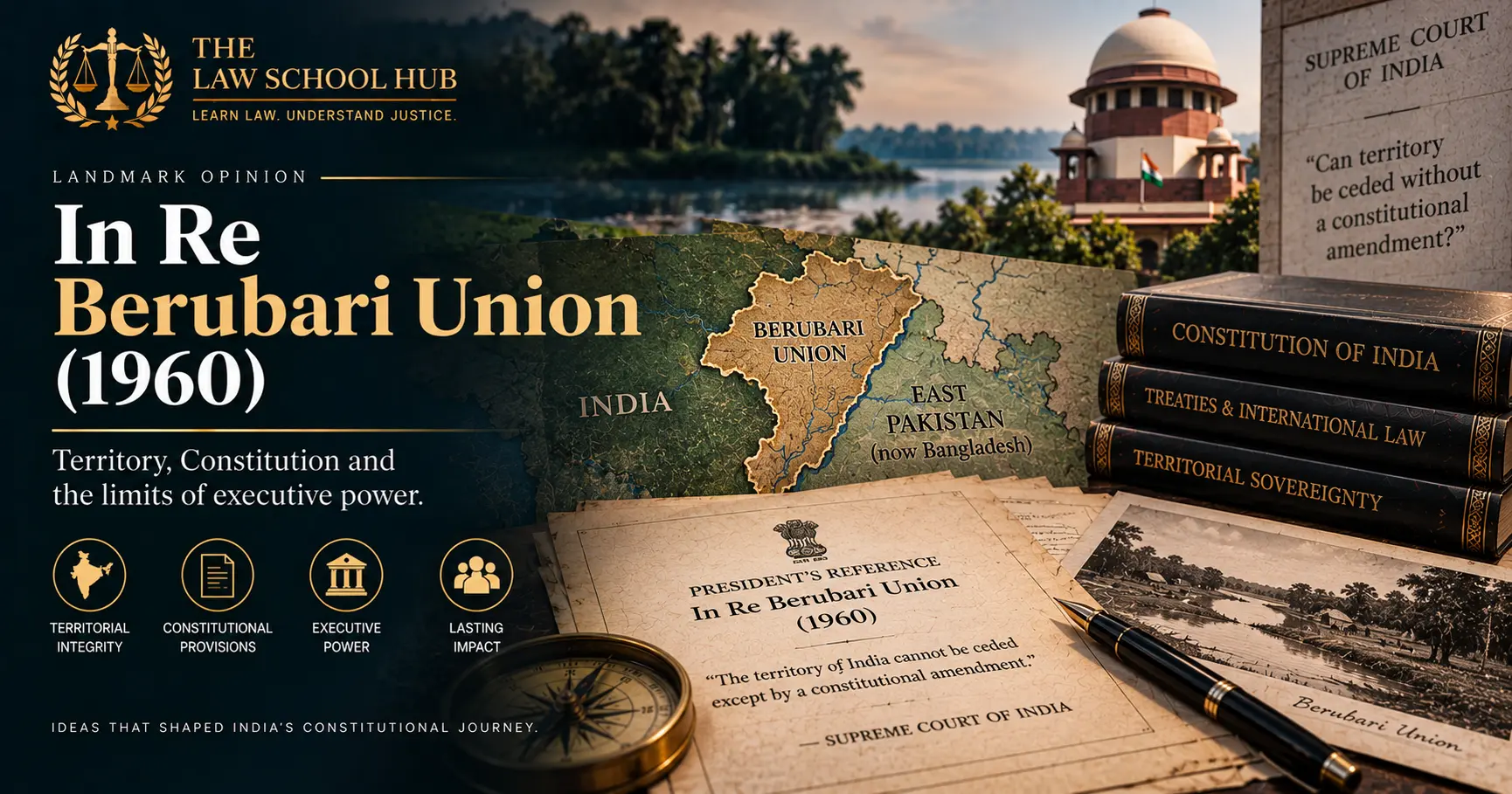
Table of Contents
Introduction
The territory of a country is its most physical and sacred asset. But what happens if the government of India wants to give a piece of Indian land to a foreign country to settle a border dispute? Can the Prime Minister simply sign an agreement to give it away? Does the Parliament need to pass a normal law, or does it have to rewrite the Constitution itself? These massive questions formed the heart of the In Re Berubari Union (1960) case.
This case is unique because it was not a normal fight between two private citizens or a normal appeal from a lower court. Instead, it was an “advisory opinion.” The President of India directly asked the Supreme Court for legal advice regarding an agreement between India and Pakistan to split a small piece of land in West Bengal called the Berubari Union.
In a historic judgment, the Supreme Court ruled that the executive government (the Prime Minister and the Cabinet) does not have the power to give away Indian territory just by signing a treaty. Furthermore, the Court ruled that Parliament cannot use its normal law-making powers to give away land. To transfer territory to a foreign nation, the Parliament must use its supreme amending power under Article 368 to change the Constitution itself. This case remains one of the most important judgments for understanding the borders of India, the power of Parliament, and the legal status of the Preamble.
Legal information notice: This case summary is for general educational and informational purposes. It does not constitute legal advice or create an attorney-client relationship.
Last legally reviewed: September 2026
Case Details
| Detail | Information |
| Case Name | In Re The Berubari Union and Exchange of Enclaves |
| Court | Supreme Court of India |
| Year | 1960 (Judgment delivered on March 14, 1960) |
| Bench/Judges | 8-Judge Constitution Bench: Chief Justice B.P. Sinha, Justice S.K. Das, Justice P.B. Gajendragadkar, Justice A.K. Sarkar, Justice K. Subba Rao, Justice M. Hidayatullah, Justice K.C. Das Gupta, Justice J.C. Shah |
| Legal Area | Constitutional Law, International Law, Advisory Jurisdiction |
| Main Issue | Whether the executive government can transfer Indian territory to a foreign country, and what legislative process is required to do so. |
| Final Decision | The Supreme Court ruled that transferring Indian territory requires a constitutional amendment under Article 368. Executive action or a simple law under Article 3 is not enough. |
| Important Legal Principle | Article 3 only applies to the internal reorganization of Indian states. Ceding territory to a foreign state requires amending the First Schedule of the Constitution under Article 368. The Preamble is not a part of the Constitution (this specific point on the Preamble was later overruled). |
Background
To truly understand why the Berubari Union case went to the Supreme Court, we must look at the painful and messy history of the Partition of India in 1947. The legal dispute was born from a simple mistake on a map.
The Radcliffe Line and the Mapping Mistake
When the British decided to leave India in 1947, they divided the country into two independent nations: India and Pakistan. Pakistan was created in two parts: West Pakistan (modern-day Pakistan) and East Pakistan (modern-day Bangladesh).
To draw the borders between India and Pakistan, the British appointed Sir Cyril Radcliffe. He was the chairman of the Boundary Commission. Radcliffe had never been to India, did not understand the local geography, and had only a few weeks to draw a line that would affect millions of people.
When Radcliffe drew the border separating the Indian state of West Bengal from East Pakistan, he made a critical error regarding a small area in the Jalpaiguri district called the “Berubari Union No. 12.” (In this context, a “Union” is just a local administrative cluster of villages, not a labor union).
In the written text of his award (the official document deciding the borders), Radcliffe awarded the Berubari Union to India. As a result, India took control of the area on August 15, 1947. The people living there became Indian citizens, and the area became a part of the state of West Bengal. However, on the map attached to Radcliffe’s written award, the boundary line was drawn incorrectly, making it look like Berubari should belong to East Pakistan.
The Border Dispute and the Nehru-Noon Agreement
For five years, everything was peaceful. But in 1952, the government of Pakistan noticed the mistake on the map. Pakistan officially claimed that the Berubari Union belonged to them based on the map’s drawing. India strongly rejected this claim, arguing that the written text of the Radcliffe Award clearly gave the land to India, and the written text must legally override a poorly drawn map.
This disagreement led to years of severe border tension, minor clashes, and political arguments between the two countries.
To finally solve this dangerous border dispute, the Prime Minister of India, Jawaharlal Nehru, and the Prime Minister of Pakistan, Feroz Khan Noon, met in New Delhi in 1958. They signed an international treaty known as the Indo-Pak Agreement of 1958 (often called the Nehru-Noon Agreement).
To achieve peace, they decided on a compromise. India and Pakistan agreed to divide the Berubari Union exactly in half. India would keep one half, and India would give the other half to East Pakistan. They also agreed to exchange some other small, trapped pieces of land known as “enclaves.”
The Political Explosion in West Bengal
When Prime Minister Nehru announced this agreement, a massive political explosion happened in India, especially in the state of West Bengal.
The Berubari Union had an area of about 8.75 square miles and a population of roughly 12,000 people. Most of these people were Hindus who had already suffered through the trauma of the 1947 partition. Now, they were being told that their homes were suddenly going to be handed over to Pakistan.
The State Government of West Bengal, led by Chief Minister Dr. Bidhan Chandra Roy, was absolutely furious. The state legislature passed a unanimous resolution condemning the agreement. They argued that the central government in New Delhi had no legal right to simply slice off a piece of West Bengal and give it away to a foreign country.
The public outcry grew so large that it created a major constitutional crisis. Legal experts began questioning whether Prime Minister Nehru actually had the constitutional power to make such a promise to Pakistan.
The President Steps In
Under Article 143(1) of the Indian Constitution, the President of India has a special power. If a question of law is extremely important and affects the public, the President can refer the question directly to the Supreme Court for its expert legal advice.
Realizing that the country was facing a massive legal and political crisis over the Nehru-Noon Agreement, the President of India at the time, Dr. Rajendra Prasad, decided to use this power. In 1959, he officially sent the matter to the Supreme Court. This is why the case is named “In Re” (which means “in the matter of”), rather than a normal case title with two opposing parties.
Facts of the Case
Because this was an advisory reference by the President, the “facts” were not about a crime or a broken contract. The facts were based on the political actions taken by the central government.
First, it was an established fact that the Berubari Union had been controlled and governed by India since independence in 1947. It was officially a part of the State of West Bengal and was included in the territory of India as defined by the Constitution.
Second, it was a fact that the Prime Ministers of India and Pakistan had signed an executive agreement in 1958 to divide this territory.
Third, the central government wanted to physically implement this agreement and hand over the land. However, due to the massive political opposition, the central government was unsure of the correct legal method to use.
The President of India asked the Supreme Court to answer three specific legal questions regarding how the agreement could be put into action.
Issues Before the Court
The President referred three highly specific questions to the 8-judge Constitution Bench of the Supreme Court:
- Is any legislative action (passing a law in Parliament) necessary for the implementation of the agreement relating to the Berubari Union? Or can the government do it using only its executive power?
- If a law is necessary, is a law made by Parliament under Article 3 of the Constitution sufficient for the implementation of the agreement?
- Is an amendment of the Constitution under Article 368 necessary, in addition to or as an alternative to a law under Article 3?
In simple terms: Can the Prime Minister just give the land away? If not, can Parliament give it away with a simple, ordinary law? Or does Parliament have to use its special, powerful procedure to rewrite the Constitution itself?
Arguments by the Parties
Because this was an advisory reference, different parties were allowed to appear before the Supreme Court to give their opinions. The main arguments were presented by the Attorney General of India (representing the Central Government) and the lawyers representing the State of West Bengal and the opposing political groups.
What the Union of India (The Central Government) Argued
The Attorney General of India, M.C. Setalvad, presented a very clever legal argument to defend the Prime Minister’s actions.
His primary argument was that giving half of Berubari to Pakistan was not actually a “cession” (giving away) of Indian territory. He argued that the border in that area had always been confused and disputed because of the messy Radcliffe map. Therefore, the Nehru-Noon Agreement was simply a way to figure out where the true boundary was. He called it the “ascertainment of a boundary.”
He argued that settling a confused boundary is a normal executive function of the government. Therefore, no law was needed at all. The Prime Minister’s signature on the treaty was enough.
However, just in case the Court disagreed, the Attorney General provided a backup argument. He argued that if the Court decided that Parliament did need to pass a law, Parliament could easily do so using Article 3 of the Constitution. Article 3 allows Parliament to change the borders of states, decrease the area of any state, or alter the name of any state by passing a simple, ordinary law. The government argued that since they were decreasing the area of West Bengal, Article 3 was the perfect legal tool to use.
What the Opposing Parties (West Bengal) Argued
The lawyers for the State of West Bengal and other political groups completely attacked the central government’s position.
First, they argued that Parliament simply does not have the power to give away any Indian territory to a foreign country. They pointed to the Preamble of the Constitution. The Preamble states that India is a “Sovereign Democratic Republic.” They argued that a sovereign nation must protect its territory, and the Constitution does not contain any specific article that allows the government to give land away.
Second, they focused intensely on Article 1(3)(c) of the Constitution. This article states that the territory of India shall include “such other territories as may be acquired.” The opposing lawyers pointed out that the Constitution specifically talks about acquiring new land, but it is completely silent about giving land away. They argued this silence meant the founders of the Constitution never intended for India to give away its territory.
Third, they argued that if the government was forced to give away land, it certainly could not do it through a simple executive order or a simple law under Article 3. They argued that the territory of India is permanently fixed in the First Schedule of the Constitution. To change the First Schedule and remove land, the government must pass a constitutional amendment under the strict rules of Article 368.
Judgment of the Court
On March 14, 1960, the 8-judge bench of the Supreme Court delivered a unanimous opinion. The judgment was authored by Justice P.B. Gajendragadkar.
The Supreme Court rejected the central government’s primary arguments and laid down strict rules for how Indian territory can be transferred.
What the Court Decided Regarding the Boundary Dispute
What the Court Rejected: The Court completely rejected the Attorney General’s argument that the agreement was just “ascertaining a boundary.” The Court looked at the facts and noted that India had firmly controlled Berubari and treated it as Indian land since 1947.
What the Court Decided: The Court ruled that the Nehru-Noon Agreement was not merely drawing a line to solve a confusion. It was an active decision to take a piece of recognized Indian territory and transfer it to a foreign sovereign state. In international law, this is called the “cession” of territory. Therefore, a simple executive agreement signed by the Prime Minister was legally useless on its own. Legislative action by the Parliament was absolutely necessary.
What the Court Decided Regarding the Preamble
This became one of the most famous parts of the judgment. The Court had to answer the argument that the Preamble prevented the government from giving away land.
What the Court Decided: The Supreme Court stated that the Preamble is a very important part of understanding the Constitution. It is a “key to open the mind of the makers.”
However, the Court made a massive declaration: The Preamble is not a part of the Constitution.
Because it is not a part of the Constitution, the Preamble does not grant any specific powers to the government, nor does it place any strict legal limits on the government’s power. Therefore, the Preamble could not be used to stop Parliament from transferring the territory.
What the Court Decided Regarding Article 3
The Court then had to decide if Parliament could use its simple law-making power under Article 3 to give the land to Pakistan.
What the Court Decided: The Court closely examined Article 3. Article 3 says Parliament can “diminish the area of any State.” The government argued this meant they could take land from West Bengal and give it to Pakistan.
The Supreme Court strongly disagreed. The Court ruled that Article 3 was only designed for the internal reorganization of the country. It allows Parliament to take land from one Indian state and give it to another Indian state, or create a new Indian state. It deals entirely with domestic borders.
Article 3 does not cover the act of taking an Indian state’s land and giving it to a foreign country. Therefore, a simple law under Article 3 was not sufficient to implement the agreement.
What the Court Decided Regarding the Final Solution (Article 368)
Since executive action was not enough, and a simple law under Article 3 was not enough, what was the correct legal path?
What the Court Decided: The Supreme Court held that the territory of India is explicitly defined in Article 1 and listed in the First Schedule of the Constitution. If India gives away a piece of its territory to a foreign country, the physical reality of India changes, which means the written text of the First Schedule must also change.
To change the First Schedule, Parliament must alter the Constitution itself. Therefore, the Court ruled that transferring Indian territory to a foreign state can only be done by passing a constitutional amendment under Article 368.
This requires a special, larger majority vote in both Houses of Parliament. Furthermore, because it affects the size of a state (West Bengal), the Court suggested that it might also require the approval of half of the state legislatures in India, making the process very difficult and deliberate.
Ratio Decidendi
The ratio decidendi (the core legal reasoning essential to the decision) in the Berubari Union case consists of three main pillars:
First, the executive branch of the government cannot cede (transfer) Indian territory to a foreign nation merely by signing a treaty or agreement. Legislative action is mandatory.
Second, Article 3 of the Constitution is strictly limited to the internal reorganization of states within the Indian Union. It cannot be used to transfer territory to a foreign country.
Third, the cession of Indian territory to a foreign state involves altering the First Schedule of the Constitution, which can only be legally accomplished through a constitutional amendment enacted under Article 368.
Legal Principles Explained
The Berubari Union case is a foundational lesson in reading the Indian Constitution. It clarified several major constitutional principles.
The Power of Sovereign Nations to Cede Territory
The opposing lawyers argued that because the Constitution only mentions “acquiring” territory, India could never give it away. The Supreme Court rejected this literal reading. The Court explained a principle of international law: every sovereign nation has the inherent power to both acquire new territory and cede its own territory. This power is an essential attribute of sovereignty. Even if the Constitution does not explicitly say “India can give away land,” the power exists because India is a sovereign state. The real question is simply how that power is exercised under domestic law.
The Difference Between Internal and External Alterations
The judgment created a permanent legal wall between domestic map-making and international map-making. If Parliament wants to cut the state of Andhra Pradesh in half to create Telangana, it only needs a simple majority vote under Article 3, because the total land area of India remains exactly the same. However, if Parliament wants to give a square mile of land to a neighboring country, it reduces the total physical size of the Republic of India. The Court established the principle that reducing the nation’s total size is a fundamental constitutional change, requiring the supreme amending power of Article 368.
The Status of the Preamble (Historical Principle)
In 1960, the Supreme Court established the principle that the Preamble is a beautiful introduction, a guide to the founders’ intentions, but it is technically separate from the Constitution and holds no enforceable legal weight. (Note: As explained in the Current Legal Status section, this specific principle is no longer valid).
Current Legal Status
It is absolutely crucial for readers to understand that while the main ruling on territory transfer is still valid, the Supreme Court’s declaration regarding the Preamble was completely overruled later.
- Regarding the Transfer of Territory: The legal position established in Berubari remains strong and good law today. To give away Indian territory, the government must pass a constitutional amendment. Executive agreements are not enough. This principle was verified and followed when India and Bangladesh swapped border enclaves in 2015.
- Regarding the Preamble: The 1960 ruling that “the Preamble is not a part of the Constitution” is no longer good law. Thirteen years later, in the landmark Kesavananda Bharati v. State of Kerala (1973) judgment, a 13-judge bench of the Supreme Court explicitly declared that the Berubari Court had made a mistake. Today, the settled law is that the Preamble is a part of the Constitution and can be used to interpret ambiguous laws and determine the basic structure of the Constitution.
Subsequent Legal Developments
The Berubari advisory opinion immediately forced the government to change its legal strategy, and the case heavily influenced future territorial disputes.
The Constitution (Ninth Amendment) Act, 1960
Because the Supreme Court ruled that a constitutional amendment was required to give half of Berubari to Pakistan, Prime Minister Nehru’s government had to go back to Parliament. In December 1960, Parliament passed the Constitution (Ninth Amendment) Act. This amendment officially altered the First Schedule of the Constitution, legally enabling the transfer of the Berubari Union to Pakistan as agreed in the Nehru-Noon treaty.
Kesavananda Bharati v. State of Kerala (1973)
As discussed above, this is the most important subsequent development regarding the Preamble. The Supreme Court reviewed the Berubari decision, pointed out that the Constituent Assembly had formally voted to adopt the Preamble as part of the Constitution, and overruled the Berubari finding on that specific point.
The Constitution (One Hundredth Amendment) Act, 2015
The legacy of the Berubari strict rules was clearly seen in 2015. India and Bangladesh wanted to permanently solve their border issues by exchanging over 160 trapped border enclaves. Remembering the Berubari judgment, the modern Indian government knew they could not just sign a treaty or pass a normal law. They followed the Berubari rulebook perfectly and passed the 100th Constitutional Amendment to legally alter the borders and transfer the territory.
Importance of the Case
The Berubari Union case is a cornerstone of Indian constitutional law for several vital reasons.
First, it protected the physical integrity of the nation from hasty political decisions. By ruling that the Prime Minister cannot simply sign away land, the Supreme Court ensured that handing over Indian territory requires a massive political consensus. A constitutional amendment requires a two-thirds majority in Parliament, meaning the ruling government must convince the opposition that the transfer is truly necessary for the nation’s good.
Second, it provided deep clarity on the structure of the Constitution. It clearly defined the boundaries of Article 3, preventing future governments from using a simple law intended for state reorganization to secretly give away land to foreign powers.
Third, it remains heavily studied in law schools because it is the most famous example of the President’s advisory jurisdiction under Article 143. It proved that the Supreme Court can act as a crucial constitutional guide during times of severe political crisis, offering solutions before a government takes an illegal action.
Critical Analysis
When legal scholars analyze the In Re Berubari Union judgment today, they view it as a brilliant piece of constitutional interpretation, combined with one massive historical error.
The Court’s reasoning regarding Article 3 and Article 368 is widely praised. The Law School Hub analysis notes that the Court correctly understood the difference between internal management and external sovereignty. If the government’s argument had won, a Prime Minister with a very small, simple majority in Parliament could have legally given away entire states to foreign countries by pretending it was just a border adjustment. By building a high constitutional wall around India’s external borders, the Court protected the nation’s territorial integrity.
However, the Court’s conclusion about the Preamble is heavily criticized and was correctly overruled later. The judges in 1960 seemed to rely heavily on traditional British and American legal theories about preambles, rather than looking at the actual historical records of the Indian Constituent Assembly. The founders of India specifically voted on the Preamble to make it a part of the document. The Berubari Court missed this historical fact, treating the Preamble as a mere decoration. Thankfully, the Supreme Court corrected this error in 1973, but the Berubari case remains a permanent reminder that even Constitution Benches can misread history.
Illustrations and Examples
Hypothetical Example 1: Resolving a Border Dispute
Scenario: India and a neighboring country find an old British map that shows a river boundary is unclear. The Prime Minister of India meets the leader of the neighboring country. They look at the old records and sign an agreement stating, “We both agree the river is the true border, not the valley.” No land currently controlled and populated by India is being handed over; they are just clarifying a confused line.
Legal Position: Based on the principles discussed in the Berubari case, the Prime Minister can likely do this using executive power. Because they are not transferring recognized Indian territory, but merely ascertaining the true boundary line, a constitutional amendment is not required.
Hypothetical Example 2: The Internal State Split
Scenario: The Parliament of India decides that the state of Uttar Pradesh is too large to govern properly. The government wants to pass a law to cut a large section out of Uttar Pradesh and create a brand new state called Harit Pradesh.
Legal Position: Under the rules confirmed in Berubari, Parliament can achieve this by passing a simple, ordinary law under Article 3. Because the total land area of India does not change, and the land is simply being reorganized internally, the strict rules of Article 368 and constitutional amendments are not needed.
Hypothetical Example 3: Giving Land for Peace
Scenario: To end a 50-year conflict, the Government of India decides to sign a peace treaty with a foreign nation. As part of the peace treaty, India agrees to permanently hand over a small, unpopulated mountain peak in the Himalayas (which is officially recognized as Indian territory) to the foreign nation.
Legal Position: According to the absolute rule of In Re Berubari Union, the government cannot do this by executive treaty, nor can they do it with a simple law. Parliament must draft a constitutional amendment, vote on it using the special two-thirds majority required by Article 368, and officially alter the First Schedule of the Constitution to remove the mountain peak from India’s territory.
Key Takeaways
| Key Point | Explanation |
| Main Issue | How can the government legally transfer Indian territory to a foreign country? |
| Holding | The transfer requires a constitutional amendment. Executive treaties and simple laws are legally insufficient. |
| Ratio Decidendi | Article 3 only covers internal state borders. Altering the external boundaries of India to cede land changes the First Schedule, requiring the use of Article 368. |
| Important Doctrine | The distinction between internal reorganization (Article 3) and external cession of territory (Article 368). |
| Later Development | The Court’s observation that the Preamble is not a part of the Constitution was overruled by Kesavananda Bharati (1973). |
| Current Position | The rule on transferring territory is still valid (used for the 2015 Bangladesh enclave swap). The Preamble is now considered a part of the Constitution. |
| Practical Significance | It prevents the ruling government from easily giving away Indian land without massive parliamentary approval. |
Conclusion
The In Re Berubari Union (1960) case remains a towering judgment in Indian constitutional history. When faced with a massive political crisis over the Nehru-Noon Agreement, the Supreme Court provided clear, undeniable boundaries regarding the power of the State. The Court firmly established that while a sovereign India has the power to give away its territory, the Prime Minister cannot do it alone, and Parliament cannot do it through everyday legislation. Because the territory of India is permanently locked into the First Schedule of the Constitution, only the supreme, difficult process of a constitutional amendment under Article 368 can unlock it to cede land to a foreign power.
While the judgment is famous for its strict protection of India’s borders—a rule that remains highly relevant today—it is also famous for its massive misstep regarding the Preamble. Although the Court incorrectly declared that the Preamble was not a part of the Constitution, the eventual correction of this error in 1973 only adds to the rich educational value of the Berubari saga. It shows how constitutional law evolves, corrects itself, and continues to guide the nation through its most difficult political challenges.
FAQs
1. What was the Berubari Union?
Answer: The Berubari Union No. 12 was a small administrative area located in the Jalpaiguri district of West Bengal. It became the center of a massive legal dispute when a mapping error by the British created confusion over whether it belonged to India or East Pakistan.
2. Why did this case go to the Supreme Court instead of a normal trial court?
Answer: This was not a normal lawsuit. Because the political crisis over giving land to Pakistan was so severe, the President of India used his special power under Article 143 of the Constitution to directly ask the Supreme Court for its expert legal advice on how to handle the situation.
3. What did the Nehru-Noon Agreement try to do?
Answer: The 1958 agreement between the Prime Ministers of India (Jawaharlal Nehru) and Pakistan (Feroz Khan Noon) tried to settle the border dispute by dividing the Berubari Union exactly in half, keeping one half for India and giving the other half to Pakistan.
4. Could the Prime Minister just sign the land away?
Answer: No. The Supreme Court ruled that the executive branch (the Prime Minister and the Cabinet) does not have the constitutional power to cede (give away) Indian territory to a foreign country merely by signing a treaty.
5. Why couldn’t the government use Article 3 to give the land away?
Answer: Article 3 allows Parliament to easily change state borders with a simple law. However, the Supreme Court ruled that Article 3 is strictly for internal changes (like moving a border between two Indian states). It cannot be used to remove land from the country entirely.
6. What is the legal rule to transfer Indian territory to a foreign country?
Answer: According to the Berubari judgment, the only legal way to cede Indian territory to a foreign state is by amending the First Schedule of the Constitution using the special, difficult amending powers found in Article 368.
7. Did the Supreme Court say the Preamble is a part of the Constitution?
Answer: No. In the 1960 Berubari case, the Supreme Court specifically declared that the Preamble is not a part of the Constitution, treating it merely as an introduction to the founders’ minds.
8. Is the Berubari ruling on the Preamble still true today?
Answer: Absolutely not. The Berubari ruling on the Preamble was explicitly overruled by a larger 13-judge bench in the famous Kesavananda Bharati case in 1973. Today, it is established law that the Preamble is a part of the Constitution.
9. Did India actually give half of Berubari to Pakistan?
Answer: Yes. Following the Supreme Court’s advice, the Indian Parliament passed the Constitution (Ninth Amendment) Act in 1960, which legally allowed the government to transfer the territory to East Pakistan (now Bangladesh).
10. How does the Berubari case affect modern India?
Answer: The rules established in Berubari are still used today. For example, when India and Bangladesh agreed to swap border enclaves in 2015, the Indian government knew they had to pass a constitutional amendment (the 100th Amendment) because of the strict rules laid down in the Berubari case.
Legal References
- In Re The Berubari Union and Exchange of Enclaves, AIR 1960 SC 845 — Supreme Court of India
- Kesavananda Bharati v. State of Kerala, (1973) 4 SCC 225 — Supreme Court of India
- Constitution of India, Articles 1, 3, 143, and 368 — Legislative Department, Government of India
- The Constitution (Ninth Amendment) Act, 1960 — Government of India
- The Constitution (One Hundredth Amendment) Act, 2015 — Government of India
At The Law School Hub, we simplify case laws, legal acts, and legal concepts for law students and legal readers. Want to read more useful legal blogs? Visit The Law School Hub The Law School Hub for more such informational blogs.
Building a community around law, learning, and legal awareness through The Law School Hub.
I’m Yash Yogitta Joshi. Join me on LinkedIn → Click to view my Profile