
State of Tamil Nadu v. Suhas Katti (2004): India’s First Cybercrime Conviction

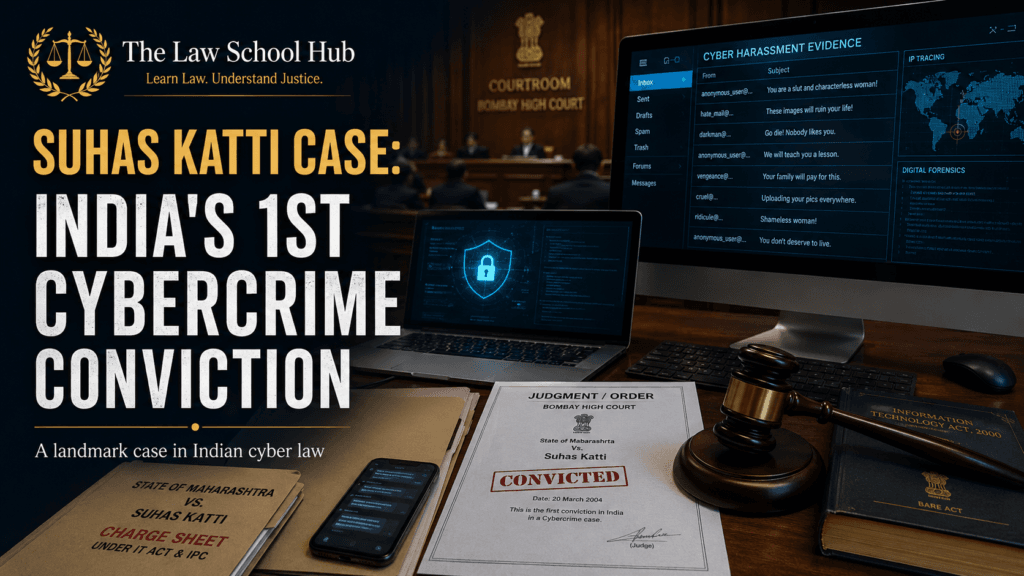
Table of Contents
Introduction
In the early 2000s, the internet was a relatively new frontier in India. While the government had passed laws to regulate online activities, there was a widespread public myth that internet users were completely anonymous. Many people believed they could hide behind fake email accounts to commit crimes without ever being caught or punished. The Suhas Katti case shattered this myth forever.
Decided in 2004 by a Magistrate Court in Chennai, this case resulted in the very first conviction under the Information Technology Act, 2000. The dispute involved a man who, after being rejected by a woman, launched a vicious campaign of online harassment against her using fake social profiles and obscene messages. This case is a landmark in Indian legal history because it proved that law enforcement could successfully trace an anonymous internet user’s digital footprint, connect it to physical evidence, and secure a rapid criminal conviction. It established the foundational blueprint for how cybercrimes are investigated and prosecuted in India.
Legal information notice: This case summary is for general educational and informational purposes. It does not constitute legal advice or create an attorney-client relationship.
Last legally reviewed: September 2026
Case Details Table
| Detail | Information |
| Case Name | State of Tamil Nadu v. Suhas Katti |
| Court | Additional Chief Metropolitan Magistrate, Egmore, Chennai |
| Year | 2004 (Judgment delivered on November 5, 2004) |
| Bench/Judges | Arulraj, Additional Chief Metropolitan Magistrate |
| Legal Area | Cyber Law, Criminal Law, Law of Evidence |
| Main Issue | Whether electronic records and IP logs can prove the identity of a person committing online harassment and obscenity. |
| Final Decision | The accused was found guilty and sentenced to imprisonment and a fine. |
| Important Legal Principle | Electronic evidence, when properly authenticated under Section 65B of the Evidence Act, is sufficient to secure a conviction for online offenses under the IT Act and the IPC. |
Background
To understand why this case was so groundbreaking, it is necessary to look at the legal landscape of India before the year 2000.
For over a century, Indian criminal law relied almost entirely on the Indian Penal Code, 1860, and the Indian Evidence Act, 1872. These traditional laws were designed for a physical world. They dealt with paper documents, physical forgery, and crimes committed in the physical presence of a victim. As computers and the internet became popular in the late 1990s, the police found it incredibly difficult to apply these old laws to digital crimes. How do you prove “forgery” when there is no physical paper? How do you prove “trespass” when someone hacks a computer from another city?
To solve this problem, the Indian Parliament passed the Information Technology Act, 2000 (the IT Act). The main purpose of this law was to give legal recognition to electronic contracts and support the growth of e-commerce. However, Chapter XI of the IT Act also created special rules to punish cybercrimes.
At the same time, the government amended the Indian Evidence Act to include Sections 65A and 65B. These new sections created a special legal procedure for courts to accept electronic records—like server logs, emails, and computer printouts—as valid legal evidence.
Despite these new laws being on the books, police departments lacked the technical training to investigate cybercrimes, and courts had never tested these digital evidence rules in a complete trial. The Suhas Katti case became the ultimate test case. It was the first time the Chennai Cyber Crime Cell, a newly formed specialised police unit, successfully used these new laws to track an offender across state lines and present a purely digital chain of evidence in court.
Facts of the Case
The material facts of the case, as established by the police investigation and accepted by the court, are straightforward but demonstrate a severe case of targeted harassment.
The accused, Suhas Katti, was a family friend of the victim. The victim was a woman whose marriage had recently ended in divorce. Suhas Katti had previously expressed a desire to marry her, but she had firmly rejected his proposal. Following her divorce, the accused approached her again. She rejected him a second time.
Angered by the repeated rejections, the accused decided to take revenge and destroy her reputation. In February 2004, the accused went to a public cyber cafe located in Mumbai. From the computers in that cafe, he created a fake Yahoo email account using the victim’s name.
Using this fake identity, the accused joined several public Yahoo message groups. He began posting highly defamatory, obscene, and sexually explicit messages about the victim. Furthermore, he posted her actual personal telephone number on these public message boards, actively inviting strangers to call her for sexual services.
Because these message groups were public, the posts were seen by many people. Almost immediately, the victim began receiving numerous harassing and explicit phone calls from unknown men. The harassment caused her severe mental trauma. Realising that someone was impersonating her online, she filed a formal criminal complaint with the Chennai City Police in February 2004.
The case was assigned to the specialised Cyber Crime Cell. The police contacted Yahoo! and requested the server logs connected to the fake email account. Yahoo provided the logs, which included the Internet Protocol (IP) address used to create the account and send the messages.
The police traced this IP address to an internet service provider in Mumbai. The provider confirmed that the IP address was assigned to a specific cyber cafe in Mumbai at the exact date and time the crimes were committed.
A police team travelled from Chennai to Mumbai. They visited the cyber cafe, seized the computer hard drives, and confiscated the cafe’s physical visitor register. The register showed that Suhas Katti had signed in and used a computer at the exact time the offensive emails and posts were uploaded. The owner of the cyber cafe also identified the accused. Based on this evidence, the police arrested Suhas Katti and brought him to Chennai to stand trial.
Issues Before the Court
During the trial, the court had to decide several crucial legal questions based on the evidence presented:
- Whether the accused was the person who actually created the fake email account and posted the messages, or whether someone else had used his identity.
- Whether the electronic evidence, specifically the IP server logs provided by Yahoo, was legally admissible and reliable in an Indian court.
- Whether the content of the messages met the strict legal definition of “obscene material” under Section 67 of the Information Technology Act.
- Whether creating a fake digital profile to harm someone’s reputation amounted to the traditional crime of forgery under the Indian Penal Code.
- Whether the accused’s online actions constituted the crime of insulting the modesty of a woman.
Arguments by the Parties
What the Prosecution Argued
The prosecution (representing the State and the victim) argued that there was an unbroken chain of evidence connecting the accused to the crime. They submitted the electronic server logs from Yahoo, which proved the posts originated from a specific IP address. They then submitted the physical visitor register from the Mumbai cyber cafe, which proved the accused was sitting at the computer assigned to that IP address at that exact time.
The prosecution also presented the testimony of the cyber cafe owner, who acted as a key witness and confirmed the accused’s presence. Finally, they argued that the language used in the emails and posts was clearly designed to arouse unhealthy sexual interest and ruin the victim’s life, squarely violating both cyber and traditional criminal laws.
What the Defense Argued
The defense lawyers for Suhas Katti strongly denied all charges. They argued that the internet is inherently insecure and that IP addresses can be faked, spoofed, or hijacked by hackers.
They argued that a public cyber cafe is used by hundreds of people, meaning anyone could have sat at the computer and sent the emails. They questioned the reliability of the physical visitor register, suggesting it could have been manipulated.
Most importantly, the defense argued that electronic evidence is easily tampered with. They claimed that without an eyewitness who physically saw the accused typing the exact words on the keyboard, the court could not definitively prove he committed the crime.
Judgment of the Court
What the Court Decided
The trial was conducted remarkably fast by Indian standards, concluding just seven months after the victim filed her complaint. On November 5, 2004, the Additional Chief Metropolitan Magistrate delivered the judgment, finding the accused guilty on all charges.
The court completely rejected the defense’s argument that anyone could have used the computer. The judge noted that the electronic timestamps provided by the internet companies perfectly matched the physical timestamps in the cyber cafe’s written register. When combined with the witness testimony of the cafe owner, the court found the chain of evidence to be solid and unbroken.
The Sentences Awarded
The court sentenced Suhas Katti under three distinct legal provisions:
- Under Section 67 of the Information Technology Act, he was sentenced to two years of rigorous imprisonment and ordered to pay a fine of Rs. 4,000.
- Under Section 469 of the Indian Penal Code, he was sentenced to two years of rigorous imprisonment and a fine of Rs. 500.
- Under Section 509 of the Indian Penal Code, he was sentenced to one year of simple imprisonment and a fine of Rs. 500.
The court ordered that all these prison sentences would run concurrently. This means the accused would serve them all at the same time, leading to a total of two years in prison.
Ratio Decidendi
Ratio decidendi means the main legal reasoning that was absolutely necessary for the court to reach its final decision.
The primary ratio of the Suhas Katti case is that electronic records, such as server logs and IP addresses, are valid and highly reliable forms of legal evidence when they are properly corroborated by physical evidence (like visitor registers) and witness testimonies.
The court established that the prosecution does not need to produce a witness who physically saw the accused typing the criminal message. Instead, a successful cybercrime conviction can be based on a perfectly matched timeline connecting digital network activity to a specific physical location and a specific person.
Furthermore, the case established that the traditional offline crimes of forgery and insulting a woman’s modesty apply equally to the digital space when a person uses fake social media profiles and public internet forums to cause harm.
Legal Principles Explained
The conviction in this case was based on a combination of one new cyber law and two traditional criminal laws. Understanding these specific laws is essential for understanding how cyber harassment is punished in India.
Section 67 of the Information Technology Act, 2000
This was the central law in the case. Section 67 makes it a crime to publish or transmit “obscene material” in electronic form.
Under the law, material is considered obscene if it is “lascivious or appeals to the prurient interest.” In simple English, this means the content must be highly sexually explicit or designed to provoke an unhealthy, abnormal, or degrading interest in sexual matters. The law also states that the material must have the tendency to corrupt the minds of people who are likely to read or see it.
In 2004, when this case was decided, the punishment for a first-time offender under Section 67 could go up to five years in prison and a fine of one lakh rupees. The court applied this section because the accused did not just insult the victim; he posted highly sexually coloured remarks and invited strangers to call her for sexual services.
Section 469 of the Indian Penal Code, 1860
This section punishes the crime of forgery committed with the specific intention of harming someone’s reputation.
Forgery generally means creating a fake document to trick someone. The Information Technology Act amended the IPC to ensure that creating a “false electronic record” also counts as forgery. By creating a Yahoo email account in the victim’s name and pretending to be her, the accused created a false electronic record. Because his sole goal was to ruin her reputation in society, his actions perfectly fit the definition of Section 469, which carried a punishment of up to three years in prison.
Section 509 of the Indian Penal Code, 1860
This section deals with words, gestures, or acts intended to insult the modesty of a woman.
If a person says something, makes a sound, or exhibits any object, intending that a woman will hear or see it, and it violates her privacy or insults her modesty, they commit this crime. In 2004, this offense carried a punishment of up to one year in prison (this was later increased to three years by an amendment in 2013). The court ruled that publicly broadcasting a woman’s personal phone number alongside sexually explicit invitations was a severe insult to her modesty, bringing digital actions under the scope of this traditional law.
Section 65B of the Indian Evidence Act, 1872
While this is a procedural law rather than a punishable crime, it was the engine that made the conviction possible.
Courts cannot easily look at a computer screen and know if a document is real or if a hacker changed it. Therefore, Section 65B requires a special certificate whenever electronic evidence (like an email printout or a server log) is presented in court. This certificate must be signed by the person in charge of managing the computer system. It confirms that the computer was operating properly, that it was used regularly, and that the data was reproduced accurately. By properly obtaining and submitting the Yahoo server logs under Section 65B, the police ensured the judge could legally trust the digital evidence.
Current Legal Status and the Transition to New Laws
It is vital to understand that Indian criminal law has evolved significantly since 2004.
The original legal principles established in the Suhas Katti case remain absolutely valid today. Cyber harassment, digital forgery, and online obscenity are still serious crimes, and IP tracking remains the standard method of investigation.
However, the specific sections of the law have been updated. On July 1, 2024, the government replaced the old Indian Penal Code with the new Bharatiya Nyaya Sanhita (BNS), 2023.
- The crime of forgery to harm reputation (formerly Section 469 IPC) is now covered under Section 336(4) of the BNS.
- The crime of insulting the modesty of a woman (formerly Section 509 IPC) is now covered under Section 79 of the BNS.
The Information Technology Act remains in force, but it was heavily amended in 2008. Section 67 was modified to carry a maximum penalty of three years for a first offense. A new section, Section 67A, was added specifically to punish the publishing of material containing sexually explicit acts, which carries a stricter five-year penalty.
Subsequent Legal Developments
The Suhas Katti judgment paved the way for massive developments in Indian cyber jurisprudence.
IT Act Amendments of 2008
Following the success of cases like this, Parliament realised that cybercrime was becoming more complex. In 2008, the IT Act was amended. As mentioned above, obscenity laws were split into different categories (Section 67, 67A, and 67B) to distinguish between general obscenity, explicit sexual acts, and child pornography. The amendment also introduced Section 66E to protect citizens against the violation of privacy, specifically addressing the non-consensual capture and sharing of images.
Shreya Singhal v. Union of India (2015)
This is perhaps the most famous cyber law case in India. The Supreme Court struck down Section 66A of the IT Act (a law that punished sending “offensive” messages) because it was too broad and violated the constitutional right to free speech. The police had been misusing it to arrest people for innocent political jokes.
However, the Supreme Court specifically refused to strike down Section 67 (the section used against Suhas Katti). The Court clarified that while citizens have the right to free speech, they absolutely do not have the right to publish obscenity or launch sexually explicit harassment campaigns. Therefore, the core legal provision used in the Suhas Katti case was validated by the highest court in the country.
Evolution of Section 65B Evidence Rules
In the years after 2004, the rules around digital evidence became a major battleground in Indian courts. In a landmark 2020 case called Arjun Panditrao Khotkar v. Kailash Kushanrao Gorantyal, the Supreme Court ruled that the Section 65B certificate is mandatory. If the police fail to get this certificate from the computer owner or internet company, the digital evidence will be completely thrown out of court. The Suhas Katti case succeeded precisely because the police correctly followed these evidentiary rules from the very beginning.
Importance of the Case
The importance of the Suhas Katti case cannot be overstated. It is widely regarded as the foundational pillar of cybercrime prosecution in India.
For law enforcement, the case served as a masterclass in modern investigation. It proved that police departments could successfully combine high-tech digital tracing (getting server logs from international tech giants like Yahoo) with traditional detective work (raiding a cafe and interviewing witnesses).
For the general public, it served as a massive deterrent. The seven-month timeline from complaint to conviction was incredibly fast, showing potential offenders that the internet was not a safe hiding place.
Most importantly, for victims of online harassment—especially women—the judgment provided immense legal confidence. Before 2004, many victims suffered in silence, believing the police could not help them if the harassment happened on a computer. This case proved that the legal system had the tools, the laws, and the willingness to protect citizens in the digital world.
Critical Analysis
While the Suhas Katti case was a brilliant success for the police, analysing it from a modern perspective reveals how much the digital landscape has changed.
The conviction relied heavily on the fact that the accused used a public cyber cafe that maintained a strict physical visitor register. The police could easily match the digital timestamp with the physical signature.
Today, the investigative reality is much harder. People no longer use public cyber cafes to commit crimes; they use personal smartphones connected to mobile data networks. Furthermore, modern criminals use Virtual Private Networks (VPNs) to hide their real IP addresses, making it look like they are sitting in another country. They also use end-to-end encrypted messaging apps, which means the tech companies themselves cannot read the messages or provide them to the police.
While the legal principles established in 2004 remain solid—digital footprints are valid evidence—the technical process of gathering that evidence has become significantly more complex. Today, police must rely on tracing device MAC addresses, triangulating mobile cell tower data, and requesting metadata from foreign companies, which often requires navigating complicated international treaties.
Nevertheless, the judicial reasoning of the Magistrate in 2004 remains flawless. The court correctly refused to be intimidated by the newness of technology, focusing instead on the fundamental legal requirement: proving an unbroken chain of custody linking the accused to the criminal act.
Illustrations and Examples
To understand how the legal rules applied in this case work in real-world scenarios today, consider the following practical examples.
Hypothetical Example 1: Fake Profiles and Online Revenge
Scenario: Arjun is angry with his former business partner, Neha. To ruin her new business, he creates a fake Facebook profile using Neha’s name and photographs. From this fake profile, he posts obscene images and sends abusive messages to her clients, pretending to be her.
Legal Position: Arjun’s actions are illegal and mirror the Suhas Katti case. By publishing obscene images, he violates Section 67 of the Information Technology Act. By creating a fake digital identity to harm Neha’s professional reputation, he commits the offense of forgery, which is now punishable under the relevant sections of the Bharatiya Nyaya Sanhita (formerly Section 469 IPC).
Practical Point: Neha should immediately take clear screenshots showing the URL of the fake profile. She must file a complaint with the cyber police, who will request the IP logs from Facebook to prove that Arjun created the account from his personal device.
Hypothetical Example 2: The Workplace VPN Harasser
Scenario: An employee is fired from a company. Seeking revenge, he uses a Virtual Private Network (VPN) on his home computer to hide his location. He creates an anonymous email address and sends sexually explicit and threatening emails to the company’s human resources manager.
Legal Position: Even though the employee used a VPN, he is still liable for transmitting obscenity under the IT Act and insulting the modesty of the manager. The legal rules of evidence remain the same as in 2004.
Practical Point: While the VPN makes the investigation harder, cyber police can often find the employee’s true identity through other digital mistakes, such as the recovery phone number he used to set up the email, or by working with the VPN provider to trace the original connection logs. Once identified, the digital evidence will be presented in court using a Section 65B certificate.
Hypothetical Example 3: Simple Defamation vs. Obscenity
Scenario: Rahul gets into a political argument with a local leader on an online forum. Rahul posts a message calling the leader a “corrupt thief” and a “liar.”
Legal Position: Rahul may face charges for criminal defamation, but he cannot be charged under Section 67 of the IT Act. As established by subsequent Supreme Court rulings, Section 67 strictly requires the material to be sexually explicit or “obscene.” Mere insults, anger, or political criticism do not meet the high threshold for cyber obscenity.
Key Takeaways
| Key Point | Explanation |
| Main Issue | Could electronic server logs and IP addresses legally prove who committed online harassment? |
| Holding | Yes. The court convicted the accused based on corroborated digital and physical evidence. |
| Ratio Decidendi | Properly certified electronic evidence, linked to physical evidence of presence, is sufficient to secure a cybercrime conviction. |
| Important Statute | Section 67 of the Information Technology Act, 2000 (punishing online obscenity). |
| Important Doctrine | The requirement for strict chain-of-custody in digital evidence, supported by Section 65B of the Evidence Act. |
| Current Position | The legal principles remain valid today. Section 67 is active, though traditional IPC crimes are now covered by the new BNS. |
| Practical Significance | The case established the standard investigative playbook for cyber police in India and proved that internet users are not legally anonymous. |
Conclusion
The judgment in State of Tamil Nadu v. Suhas Katti stands as a historic milestone in Indian legal history. By successfully prosecuting an online stalker under the then-new Information Technology Act, the Chennai cyber police and the Magistrate Court demonstrated that the law is fully capable of adapting to modern technology.
The case provided a desperately needed framework for handling digital evidence. It proved that a string of numbers—an IP address—could be translated into concrete legal proof of guilt when combined with traditional police work and proper evidentiary certification.
Today, while the technology used by criminals has advanced significantly, and the Indian Penal Code has been replaced by the Bharatiya Nyaya Sanhita, the core legal philosophy established in this courtroom remains unchanged. The digital world is an extension of society, and the rule of law applies just as forcefully to a computer keyboard as it does to actions in the physical street.
FAQs
1. What was the main crime committed in the Suhas Katti case?
Answer: The main crime was the publication of obscene and defamatory material online. The accused created a fake Yahoo email account in the victim’s name and posted sexually explicit messages and her personal phone number on public message boards to harass her.
2. Why is this case considered historically important in India?
Answer: It is historically important because it resulted in the very first successful criminal conviction under the Information Technology Act, 2000. It proved to the public and the legal system that cybercrimes could be effectively investigated and punished in India.
3. How did the police trace the accused if he used a fake name?
Answer: The police contacted Yahoo and obtained the electronic server logs for the fake account. These logs contained the IP address used to send the messages. The police traced this IP address to an internet service provider, which led them to a specific physical cyber cafe in Mumbai.
4. What is Section 67 of the Information Technology Act?
Answer: Section 67 is a specific legal provision that makes it a crime to publish, transmit, or cause to be published any material in electronic form that is obscene, lascivious, or appeals to the prurient (unhealthy sexual) interest.
5. Could the accused have been convicted using only the computer IP address?
Answer: No, an IP address alone is usually not enough, especially if it belongs to a public network. In this case, the police secured the conviction by corroborating the digital IP address with physical evidence—specifically, the written visitor register at the cyber cafe and the witness statement of the cafe owner.
6. What happens if someone commits the same crime today?
Answer: They would face similar, if not stricter, legal consequences. They would be charged under Section 67 or 67A of the IT Act. Furthermore, instead of the old Indian Penal Code, they would be charged with digital forgery and insulting modesty under the new Bharatiya Nyaya Sanhita (BNS), 2023.
7. Is a screenshot enough evidence to report cyber harassment?
Answer: A screenshot is an excellent first step for filing a police complaint because it captures the username and the content. However, for a final court trial, the police will need the backend digital server logs from the social media company, properly certified under Section 65B of the Evidence Act, to prove the screenshot is genuine.
Legal References
- State of Tamil Nadu v. Suhas Katti, C.C. No. 4680 of 2004 — Additional Chief Metropolitan Magistrate, Egmore, Chennai
- Information Technology Act, 2000, Section 67 — Legislative Department, Government of India
- Indian Penal Code, 1860, Sections 469 and 509 — Legislative Department, Government of India
- Bharatiya Nyaya Sanhita, 2023, Sections 79 and 336 — Ministry of Law and Justice, Government of India
- Indian Evidence Act, 1872, Section 65B — Legislative Department, Government of India
- Shreya Singhal v. Union of India, (2015) 5 SCC 1 — Supreme Court of India
- Arjun Panditrao Khotkar v. Kailash Kushanrao Gorantyal, (2020) 7 SCC 1 — Supreme Court of India
At The Law School Hub, we simplify case laws, legal acts, and legal concepts for law students and legal readers. Want to read more useful legal blogs? Visit The Law School Hub.
Building a community around law, learning, and legal awareness through The Law School Hub.
I’m Yash Yogitta Joshi. Join me on LinkedIn → Click to view my Profile