
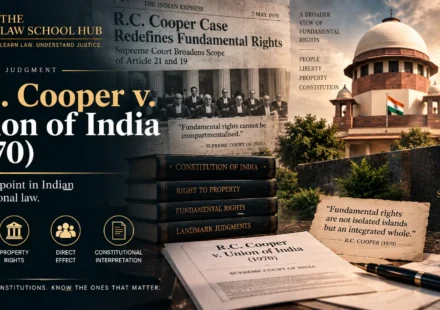
R.C. Cooper v. Union of India (1970): The Bank Nationalisation Case That Shook India’s Economic Constitution

Introduction In the history of Indian constitutional law, few judgments have shaped the relationship between state economic power and individual fundamental rights quite as dramatically as R.C.…
Know More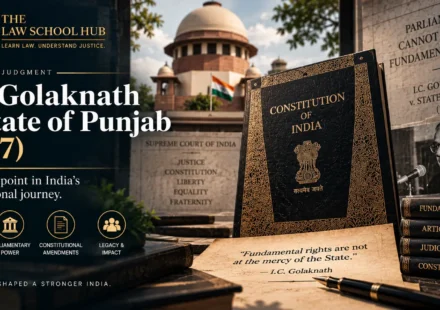
I.C. Golaknath v. State of Punjab (1967): The Historic Ruling That Said Parliament Cannot Touch Your Fundamental Rights
Introduction In the constitutional history of India, few legal battles have been as fierce as the fight between the Indian Parliament and the Supreme Court over the power to change the Constitution.…
Know More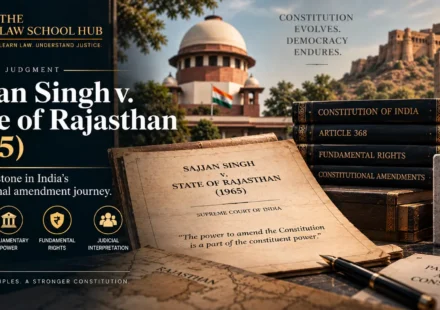
Sajjan Singh v. State of Rajasthan (1965): Parliament’s Power to Amend the Constitution — What the Supreme Court Ruled
Introduction The history of the Indian Constitution is essentially a story of a long power struggle between two great institutions: the Indian Parliament and the Supreme Court of India. The case of…
Know More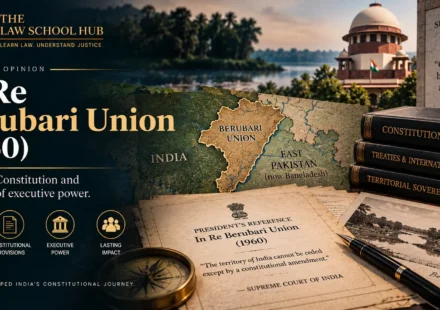
In Re Berubari Union (1960): Can India Give Away Its Territory? The Supreme Court’s Historic Answer
Introduction The territory of a country is its most physical and sacred asset. But what happens if the government of India wants to give a piece of Indian land to a foreign country to settle a border…
Know More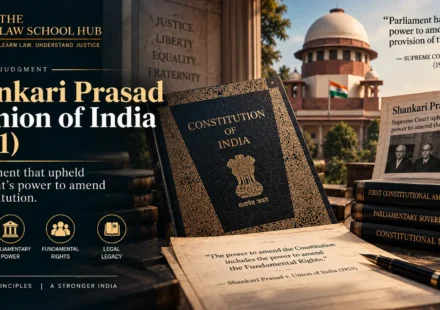
Shankari Prasad v. Union of India (1951): Can Parliament Amend Fundamental Rights? Here Is What India’s Supreme Court Said
Introduction The Indian Constitution is the supreme law of the country. But a very big question arose almost immediately after it was written: Does the Parliament have the power to change or take…
Know More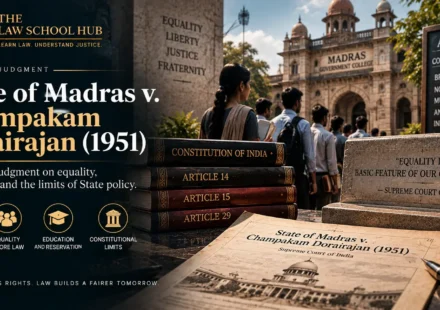
State of Madras v. Champakam Dorairajan (1951): The Landmark Case That Changed India’s Reservation Law Forever
Introduction When the Constitution of India came into force in 1950, it made two massive promises to the people. First, it promised complete equality and guaranteed that the government would not…
Know More