State of Madras v. Champakam Dorairajan (1951): The Landmark Case That Changed India’s Reservation Law Forever

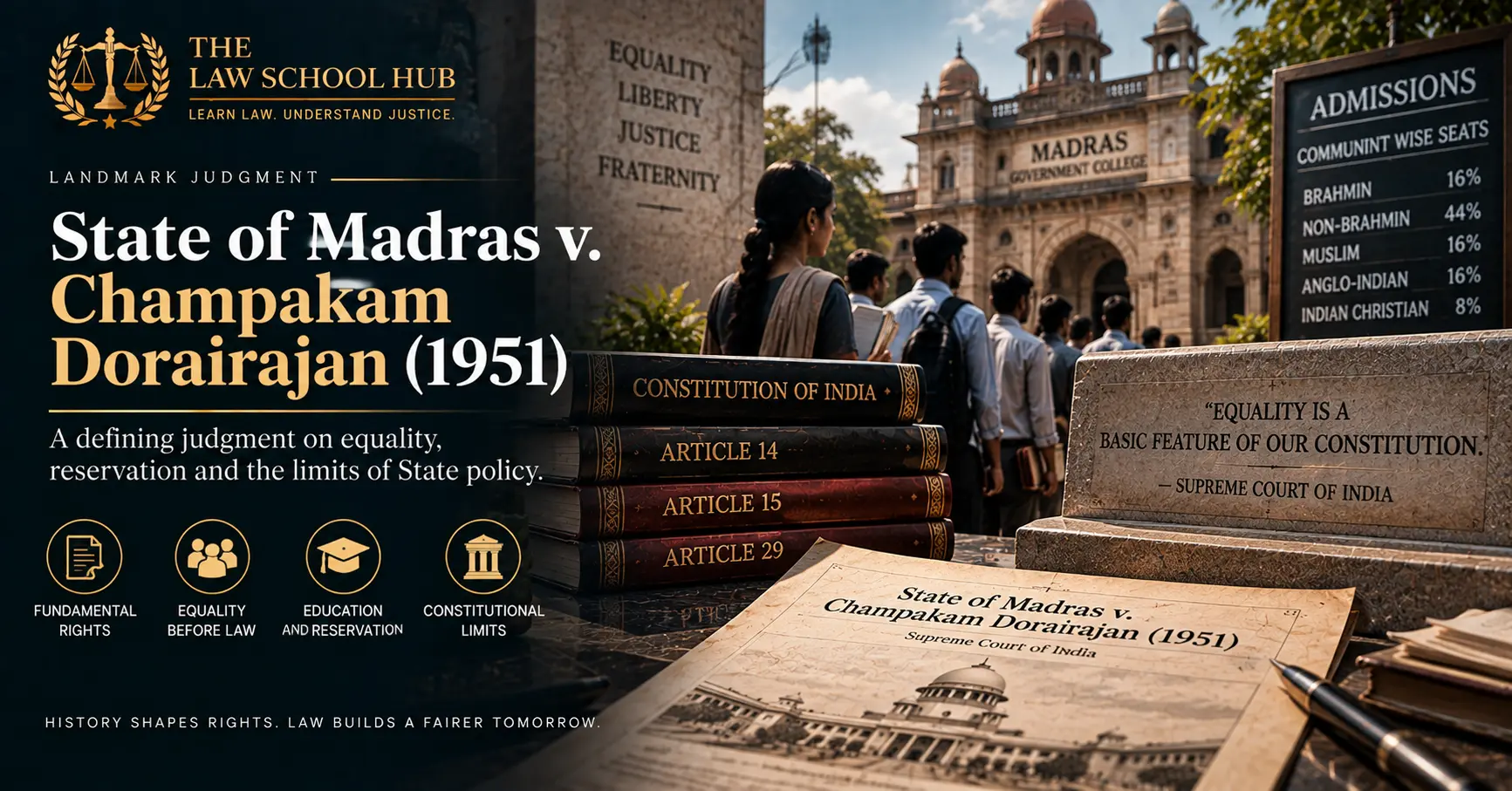
Table of Contents
Introduction
When the Constitution of India came into force in 1950, it made two massive promises to the people. First, it promised complete equality and guaranteed that the government would not discriminate against any citizen based on their religion or caste. Second, it promised social justice, directing the government to actively uplift backward classes and weaker sections of society. But what happens when these two promises collide? What happens when uplifting one group means taking a college seat away from a student of another group?
The State of Madras v. Champakam Dorairajan (1951) case was the very first time the Supreme Court of India had to answer this difficult question. The government of Madras (now Tamil Nadu) had a system of dividing college seats based on caste and religion to ensure everyone got a fair share. However, a Brahmin student argued that this system discriminated against her purely because of her caste, violating her new fundamental rights.
This judgment is an absolute landmark in Indian constitutional history. The Supreme Court had to decide which part of the Constitution was more powerful: the Fundamental Rights that protect individuals, or the Directive Principles that instruct the government to help weaker communities. The Court ruled that Fundamental Rights are supreme. This decision caused such a massive political earthquake that the Parliament of India had to pass the very First Amendment to the Constitution to protect reservation policies.
Legal information notice: This case summary is for general educational and informational purposes. It does not constitute legal advice or create an attorney-client relationship.
Last legally reviewed: September 2026
Case Details
| Detail | Information |
| Case Name | State of Madras v. Srimathi Champakam Dorairajan |
| Court | Supreme Court of India |
| Year | 1951 (Judgment delivered on April 9, 1951) |
| Bench/Judges | 7-Judge Constitution Bench: Chief Justice Hiralal J. Kania, Justice Saiyid Fazl Ali, Justice M. Patanjali Sastri, Justice Mehr Chand Mahajan, Justice B.K. Mukherjea, Justice S.R. Das, Justice Vivian Bose |
| Legal Area | Constitutional Law, Fundamental Rights, Directive Principles of State Policy |
| Main Issue | Whether a government order reserving educational seats based on religion and caste violates the fundamental right against discrimination under Article 29(2). |
| Final Decision | The Supreme Court struck down the Madras government’s reservation order as unconstitutional because it violated Article 29(2). |
| Important Legal Principle | Fundamental Rights (Part III) are supreme. Directive Principles of State Policy (Part IV) cannot override or destroy Fundamental Rights. |
Background
To understand this case, we must look at the history of the Madras province before India became independent and before the Constitution was written.
For many decades before 1950, the government of Madras operated under a system known as the “Communal G.O.” (Government Order). The political leaders of Madras realised that certain communities, particularly the upper-caste Brahmins, held almost all the government jobs and university seats, while other communities had very little representation.
To fix this imbalance, the Madras government created a strict quota system. They divided all government jobs and seats in medical and engineering colleges into fixed ratios based entirely on a person’s caste and religion.
For example, out of every 14 seats in the state’s medical and engineering colleges, the seats were strictly divided like this: Non-Brahmin Hindus received 6 seats. Backward Hindus received 2 seats. Brahmins received 2 seats. Harijans (Scheduled Castes) received 2 seats. Anglo-Indians and Indian Christians received 1 seat. Muslims received 1 seat.
This system worked without any legal problems during British rule. However, everything changed on January 26, 1950, when the new Constitution of India came into force.
The new Constitution contained Part III, which guaranteed Fundamental Rights to all citizens. Specifically, Article 29(2) stated that no citizen could be denied admission into any state-run educational institution solely on the basis of religion, race, caste, or language.
At the same time, the Constitution contained Part IV, which laid down the Directive Principles of State Policy (DPSP). These were instructions for the government to follow to build a good society. Article 46 instructed the State to promote the educational and economic interests of the weaker sections of the people, especially the Scheduled Castes and Scheduled Tribes.
The stage was set for a massive legal battle. The Madras government wanted to continue its Communal G.O. to follow Article 46. But students who lost out on seats argued that the Communal G.O. violated their individual rights under Article 29(2).
Facts of the Case
The case actually involves two separate students who filed petitions in the Madras High Court, which were later combined when the government appealed to the Supreme Court.
The first petitioner was Srimathi Champakam Dorairajan. She was a young woman belonging to the Brahmin community. She wanted to become a doctor and intended to apply for admission to the Madras Medical College. However, when she looked at the Communal G.O. quotas, she realised that because she was a Brahmin, she could only compete for 2 out of every 14 seats. She argued that she had excellent academic marks, but the strict caste quota meant she would be denied admission while students from other communities with lower marks would get in.
(Interestingly, the Supreme Court noted that she had not actually submitted her application form because she believed it was useless, but the government of Madras did not object to this technicality in the High Court, so the Supreme Court proceeded with the legal question).
The second petitioner was Sri C.R. Srinivasan. He had actually applied for admission to the Government Engineering College in Guindy. He was also a Brahmin. He had scored very high marks in his previous examinations. However, because he could only compete in the small pool of seats reserved for Brahmins, his application was rejected. At the same time, students from other communities who had scored lower marks than him were admitted under their specific quotas.
Both students went to the Madras High Court. They argued that the Communal G.O. was a clear violation of their fundamental rights. The Madras High Court agreed with the students and struck down the Communal G.O.
The State of Madras was furious. The government believed that cancelling the quotas would destroy their efforts to bring social equality. Therefore, the State of Madras appealed the High Court’s decision to the Supreme Court of India.
Issues Before the Court
The 7-judge Constitution Bench of the Supreme Court had to decide on the following highly specific legal questions:
- Whether the Communal G.O., which reserves seats in state educational institutions on the basis of religion, race, and caste, violates the fundamental right guaranteed under Article 29(2) of the Constitution.
- Whether the government’s duty to promote the educational interests of weaker sections under Article 46 (Directive Principles) can override or act as an exception to the Fundamental Rights granted in Part III of the Constitution.
- In the event of a direct conflict between a Fundamental Right and a Directive Principle of State Policy, which part of the Constitution must prevail?
Arguments by the Parties
Because this was the first major constitutional test of the new republic, the arguments presented by both sides were extremely deep and philosophical.
What the State of Madras (The Government) Argued
The Advocate General representing the State of Madras strongly defended the quota system. His arguments were based entirely on social justice and the Directive Principles.
First, he argued that the Constitution must be read as a whole document. He pointed out that Article 46 places a clear, constitutional duty on the State to promote the educational interests of the weaker sections of society. He argued that the Communal G.O. was simply the government’s way of fulfilling this constitutional duty.
Second, he argued that because Article 46 is a duty given to the government, it must be treated as a valid exception to the Fundamental Rights. He argued that if the government is forced to strictly follow Article 29(2) and ignore caste completely, it will be impossible to uplift the backward classes, making Article 46 useless.
Third, he pointed out the danger of pure merit in a highly unequal society. He argued that if seats were given only on merit without any communal quotas, a few advanced communities would capture all the seats, leaving the weaker communities entirely uneducated.
What the Petitioners (The Students) Argued
The lawyers for Champakam Dorairajan and C.R. Srinivasan completely rejected the government’s defence.
First, they argued that Article 29(2) uses very clear and absolute language. It says “no citizen” shall be denied admission “only of religion, race, caste, language.” They argued that this right is given to the individual citizen, not to a community. Therefore, denying a smart student a seat purely because she was born a Brahmin was a direct violation of her individual fundamental right.
Second, they focused on the legal difference between Fundamental Rights and Directive Principles. They pointed to Article 37 of the Constitution, which clearly states that Directive Principles are “not enforceable by any court.” In contrast, Fundamental Rights are legally enforceable. They argued that an unenforceable instruction (Article 46) cannot be used to destroy an enforceable right (Article 29(2)).
Third, they pointed out that in other parts of the Constitution (like freedom of speech under Article 19), the writers explicitly included “reasonable restrictions.” But in Article 29(2), the writers did not include any exceptions. The petitioners argued this proved the founders never wanted caste-based quotas in education.
Judgment of the Court
On April 9, 1951, the 7-judge Constitution Bench delivered a unanimous judgment. The opinion was written by Justice S.R. Das. The Supreme Court delivered a massive defeat to the State of Madras and completely struck down the Communal G.O.
What the Court Decided on Discrimination
The Supreme Court carefully read the text of Article 29(2). The Court noted that the article guarantees a right to the citizen as an individual.
What the Court Found: The Court found that Sri Srinivasan had better academic marks than many students who were admitted. The only reason he was denied admission was because he belonged to the Brahmin caste, which had already filled its small quota of two seats. If he had belonged to another caste, he would have been admitted immediately.
What the Court Decided: The Court ruled that this was a clear, undeniable case of discrimination based only on caste. The government was punishing a citizen for the accident of their birth. The Court declared that the Communal G.O. directly violated the clear language of Article 29(2).
What the Court Decided on Directive Principles vs Fundamental Rights
The most important part of the judgment was how the Court handled the government’s argument regarding Article 46 and the Directive Principles.
What the Court Rejected: The Court completely rejected the State’s argument that Directive Principles can override or create an exception to Fundamental Rights. The Court noted that Article 37 clearly makes Directive Principles non-enforceable in a court of law.
What the Court Decided: The Supreme Court laid down a strict rule of interpretation. The Court stated that the Directive Principles of State Policy are very important for the governance of the country. However, they cannot be used to ignore or destroy the Fundamental Rights explicitly guaranteed to citizens.
Justice S.R. Das wrote the most famous lines of the judgment: “The Directive Principles of State Policy have to conform to and run as subsidiary to the Chapter of Fundamental Rights.”
This meant that whenever there is a conflict, the Fundamental Rights will always win. The government must find a way to achieve its social goals without breaking the fundamental rights of its citizens.
What the Court Did Not Decide
It is important to note that the Court did not say that helping backward classes is wrong. The Court simply looked at the strict legal text of the Constitution as it was written in 1950. The Court noted that if the founders of the Constitution wanted to allow reservations in education, they would have written an exception into Article 29, just like they wrote an exception for government jobs in Article 16(4). Because there was no exception in the text, the Court could not invent one.
Ratio Decidendi
The ratio decidendi (the core legal reasoning necessary for the decision) in this case has two main pillars:
First, Article 29(2) guarantees an individual right to citizens. A government policy that denies educational admission to a citizen solely based on their religion or caste is unconstitutional and void.
Second, Fundamental Rights (Part III) are sacrosanct and supreme over Directive Principles of State Policy (Part IV). Directive Principles cannot be used to abridge, restrict, or override the Fundamental Rights. They must run subsidiary to them.
Legal Principles Explained
The Champakam Dorairajan case is the foundation for understanding several core parts of the Indian Constitution.
Article 29(2) — Protection Against Educational Discrimination
This article states that no citizen shall be denied admission into any educational institution maintained by the State (or receiving aid from State funds) on grounds only of religion, race, caste, language, or any of them. The Court explained the principle that this right belongs to the individual. Even if a government policy is designed to help a large community, it cannot operate by crushing the individual right of a single citizen purely based on their caste label.
Article 46 and the Status of Directive Principles
Article 46 directs the State to promote the educational and economic interests of weaker sections. The Court explained the principle of enforceability. While the government has a moral and political duty to follow Article 46, a court cannot force the government to do it, nor can the government use this duty as an excuse to break a strict constitutional law. The Court established a strict hierarchy: Part III sits above Part IV.
The Rule of Literal Interpretation
In 1951, the Supreme Court followed a very strict, literal interpretation of the law. They looked closely at the exact words written in the Constitution. They noticed that Article 16 (which deals with government jobs) specifically contained a clause—Article 16(4)—allowing the government to reserve jobs for backward classes. However, Article 29 (dealing with education) had no such clause. The Court applied the legal principle that if the drafters included an exception in one place but left it out of another, the omission was intentional. The Court refused to “read into” the Constitution something that was not written there.
Current Legal Status
It is extremely important for readers to understand that while the Champakam Dorairajan case is a brilliant historical lesson, the specific ruling regarding educational reservations is no longer the law today.
- Regarding Educational Reservations: The ruling that caste-based quotas in education are illegal was overturned by Parliament almost immediately. Today, the State has full constitutional power to reserve seats in educational institutions for Scheduled Castes, Scheduled Tribes, and Socially and Educationally Backward Classes. This is entirely legal and protected under the modern Constitution.
- Regarding Directive Principles vs Fundamental Rights: The strict rule that Directive Principles are always “subsidiary” to Fundamental Rights has been softened over the decades. Today, the Supreme Court uses the “Doctrine of Harmonious Construction.” Courts now try to balance both parts, viewing them as two wheels of the same chariot, rather than seeing them as enemies. However, it remains true that DPSP cannot completely destroy a core Fundamental Right.
Subsequent Legal Developments
The Supreme Court’s judgment created an immediate political crisis that changed the Constitution itself.
The Constitution (First Amendment) Act, 1951
When the Supreme Court struck down the Communal G.O., violent protests erupted in Madras. The political leaders of South India complained to Prime Minister Jawaharlal Nehru. They argued that without reservations, the backward classes would be crushed by the socially advanced classes.
Realising that the Supreme Court was legally correct based on the text, Nehru’s government decided to change the text. Just two months after the judgment, Parliament passed the First Amendment Act in June 1951.
This amendment added a brand new clause: Article 15(4).
Article 15(4) explicitly stated that nothing in Article 15 or Article 29(2) shall prevent the State from making any special provision for the advancement of any socially and educationally backward classes of citizens or for the Scheduled Castes and the Scheduled Tribes. By passing this amendment, Parliament legally bypassed the Champakam judgment and created a permanent constitutional shield for reservation policies.
Later Constitutional Amendments
The legacy of this dispute continued for decades. In 2005, the Parliament passed the 93rd Amendment, adding Article 15(5), which specifically protected reservations in private educational institutions. In 2019, the 103rd Amendment added Article 15(6) to allow reservations for Economically Weaker Sections (EWS).
Kerala Education Bill (1957) and Minerva Mills (1980)
The strict hierarchy established by the Court (that DPSP must run subsidiary to Fundamental Rights) was slowly modified by later judges. In the Kerala Education Bill case, the Court suggested that judges should try to give effect to both. By the time of the Minerva Mills case in 1980, the Supreme Court firmly established that the Constitution is founded on the bedrock of balance between Part III and Part IV, and neither is absolute over the other.
Importance of the Case
The Champakam Dorairajan case is considered one of the most important cases in Indian legal history for several reasons.
First, it is the mother of the First Amendment. It forced the young Indian Parliament to confront the realities of social inequality and realise that a pure, color-blind interpretation of equality would not work in a society deeply divided by the caste system.
Second, it established the power of Judicial Review. Just one year after the Constitution was born, the Supreme Court proved that it was willing and able to strike down long-standing government policies if they violated the written text of the Constitution. It showed that the Supreme Court was the true guardian of Fundamental Rights.
Third, it began the endless, ongoing legal debate about the nature of equality in India. Is equality achieved by treating everyone exactly the same (formal equality)? Or is equality achieved by giving special help to those who have been historically held back (substantive equality)? This case fired the starting gun for a debate that continues in the Supreme Court to this very day.
Critical Analysis
When legal scholars look back at the Champakam Dorairajan judgment today, they often view it with mixed feelings.
On a purely technical, legal level, the Supreme Court’s judgment was absolutely flawless. The judges read the text exactly as it was written. Article 29(2) clearly forbade discrimination based only on caste. The Communal G.O. clearly distributed seats based only on caste. Therefore, the G.O. was illegal. The Court’s logic was air-tight.
However, from a sociological and political perspective, many scholars criticise the judgment for being too rigid and blind to social reality. The judges in 1951 applied a very British style of strict legal interpretation. They looked at the words on the paper, but they arguably ignored the historical reality of India. They failed to understand that in a society where certain castes had been denied education for centuries, treating everyone exactly the same would only result in the strong dominating the weak.
The government’s argument that Article 46 should act as a guide to interpreting Fundamental Rights was actually quite progressive, but the 1951 Court was not ready for such modern, flexible interpretation.
This is why the First Amendment was so necessary. The Parliament had to step in and do what the Supreme Court refused to do: weave the reality of social justice directly into the fabric of the Fundamental Rights. The Champakam case teaches law students a vital lesson—sometimes, a court can be perfectly correct in law, while simultaneously being out of touch with the needs of society.
Illustrations and Examples
To understand how the strict rules of this case operated before the First Amendment, and how things changed after, consider these practical examples.
Hypothetical Example 1: The Strict Merit Rule
Scenario: Imagine it is May 1951, just after the Supreme Court delivered the judgment, but before Parliament passed the First Amendment. A state government opens a new science college. To help minority communities, the state passes a rule saying 10% of seats will only be given to students of a specific religion, regardless of their marks. A student of the majority religion with top marks is rejected.
Legal Position: Under the strict rule of the Champakam Dorairajan judgment, this state rule is completely unconstitutional. The rejected student can go to the High Court, cite Article 29(2), and the court will immediately strike down the religious quota because it discriminates based solely on religion.
Hypothetical Example 2: The DPSP Defense
Scenario: A state passes a law banning a specific community from buying land, arguing that they are trying to protect the economic interests of weaker farmers in the area. When challenged in court for violating the fundamental right to equality, the state argues, “We are just following the Directive Principles in Part IV to protect weaker sections.”
Legal Position: Based on the hierarchy established in Champakam Dorairajan, the state will lose. The court will apply the rule that Directive Principles must run subsidiary to Fundamental Rights. The government cannot break an individual’s fundamental right to equality just to fulfill a non-enforceable Directive Principle.
Hypothetical Example 3: The Modern Application
Scenario: Imagine it is the year 2026. A state medical college reserves 27% of its seats for Socially and Educationally Backward Classes (OBCs). An upper-caste student with good marks is rejected because the general category seats are full. The student goes to court, citing the Champakam Dorairajan case, arguing that this violates Article 29(2).
Legal Position: The student will lose. The court will explain that while Champakam Dorairajan was correct in 1951, the Constitution was changed by the First Amendment. Today, Article 15(4) explicitly allows the state to make special provisions for backward classes. The reservation is protected by the amended Constitution, and the historical ruling of Champakam regarding educational quotas no longer applies.
Key Takeaways
| Key Point | Explanation |
| Main Issue | Could the state reserve college seats based on caste, despite the right against discrimination in Art 29(2)? |
| Holding | No. The Supreme Court struck down the caste-based quota system as unconstitutional. |
| Ratio Decidendi | Article 29(2) guarantees an individual right. Directive Principles cannot override Fundamental Rights. |
| Important Doctrine | Part IV (DPSP) must run subsidiary to Part III (Fundamental Rights). |
| Later Development | Parliament passed the First Amendment (1951), adding Article 15(4) to legally allow reservations. |
| Current Position | Reservations in education for backward classes are completely legal today under Article 15(4) and 15(5). |
| Practical Significance | It forced India to formally define how it would achieve social justice without destroying individual equality. |
Conclusion
The State of Madras v. Champakam Dorairajan (1951) judgment is a fascinating story of a young democracy trying to find its balance. When faced with a direct collision between the noble goal of uplifting backward communities and the constitutional promise of individual equality, the Supreme Court chose to strictly protect the individual. By ruling that Directive Principles must run subsidiary to Fundamental Rights, the Court established a firm legal boundary that protected citizens from being discriminated against for the accident of their birth.
However, the case also proved that strict legal logic is not always enough to solve complex social problems. The immediate overturning of the judgment’s practical effect through the First Amendment showed that the Constitution is a living document. While the specific ruling against educational reservations is no longer valid law today, the Champakam case remains essential reading. It is the perfect starting point for understanding how the massive system of reservations was built in India, and how the courts and the Parliament learned to balance individual rights with social justice.
FAQs
- What was the main dispute in the Champakam Dorairajan case?
Answer: The main dispute was whether the government of Madras could legally divide seats in medical and engineering colleges based strictly on a person’s caste and religion, or whether this violated the fundamental right against discrimination.
- Why was Champakam Dorairajan denied a college seat?
Answer: Although she had good academic marks, she was a member of the Brahmin caste. Under the government’s Communal G.O., the quota for Brahmins was very small, meaning she could not compete for the majority of the seats in the college.
- Did the Supreme Court support the reservation policy?
Answer: No. In this specific 1951 case, the Supreme Court completely struck down the reservation policy, declaring it unconstitutional because it violated Article 29(2) by discriminating against citizens solely based on their caste.
- What did the government argue to defend the quotas?
Answer: The government argued that it was trying to follow Article 46 of the Directive Principles of State Policy, which commands the state to promote the educational interests of weaker sections of society.
- Which is more powerful, Fundamental Rights or Directive Principles?
Answer: According to the rule established in the Champakam Dorairajan case, Fundamental Rights are supreme. The Court stated that Directive Principles must conform to and run subsidiary (secondary) to Fundamental Rights.
- Are caste-based reservations in colleges illegal today because of this case?
Answer: No, they are completely legal today. The Champakam Dorairajan ruling caused Parliament to pass the First Amendment to the Constitution, which added Article 15(4). This amendment specifically allows the government to make reservations for backward classes.
- What is Article 29(2) of the Indian Constitution?
Answer: Article 29(2) is a fundamental right that says no citizen can be denied admission into any state-maintained educational institution solely on the basis of their religion, race, caste, or language.
- What was the First Amendment of India?
Answer: Passed in 1951 directly because of this case, the First Amendment made several changes to the Constitution, most notably adding Article 15(4) to protect the government’s power to provide reservations for socially and educationally backward classes.
- Was the Supreme Court wrong in its judgment?
Answer: Legally, the Court was correct because they strictly read the text of the Constitution as it was written in 1950, which had no exceptions for educational quotas. Politically and socially, many argued they ignored the reality of caste inequality, which is why the law had to be amended.
- How do courts view Fundamental Rights and Directive Principles today?
Answer: While the Champakam case said Directive Principles are entirely subsidiary, modern courts use the “Doctrine of Harmonious Construction.” Today, courts try to balance both, seeing them as equally important parts of the Constitution, though a Directive Principle still cannot completely erase a core Fundamental Right.
Legal References
- State of Madras v. Srimathi Champakam Dorairajan, AIR 1951 SC 226 — Supreme Court of India
- Constitution of India, Articles 15, 29(2), 37, and 46 — Legislative Department, Government of India
- The Constitution (First Amendment) Act, 1951 — Government of India
- Minerva Mills Ltd. v. Union of India, (1980) 3 SCC 625 — Supreme Court of India
At The Law School Hub, we simplify case laws, legal acts, and legal concepts for law students and legal readers. Want to read more useful legal blogs? Visit The Law School Hub https://thelawschoolhub.com for more such informational blogs.
Building a community around law, learning, and legal awareness through The Law School Hub.
I’m Yash Yogitta Joshi. Join me on LinkedIn → Click to view my Profile