
Sajjan Singh v. State of Rajasthan (1965): Parliament’s Power to Amend the Constitution — What the Supreme Court Ruled

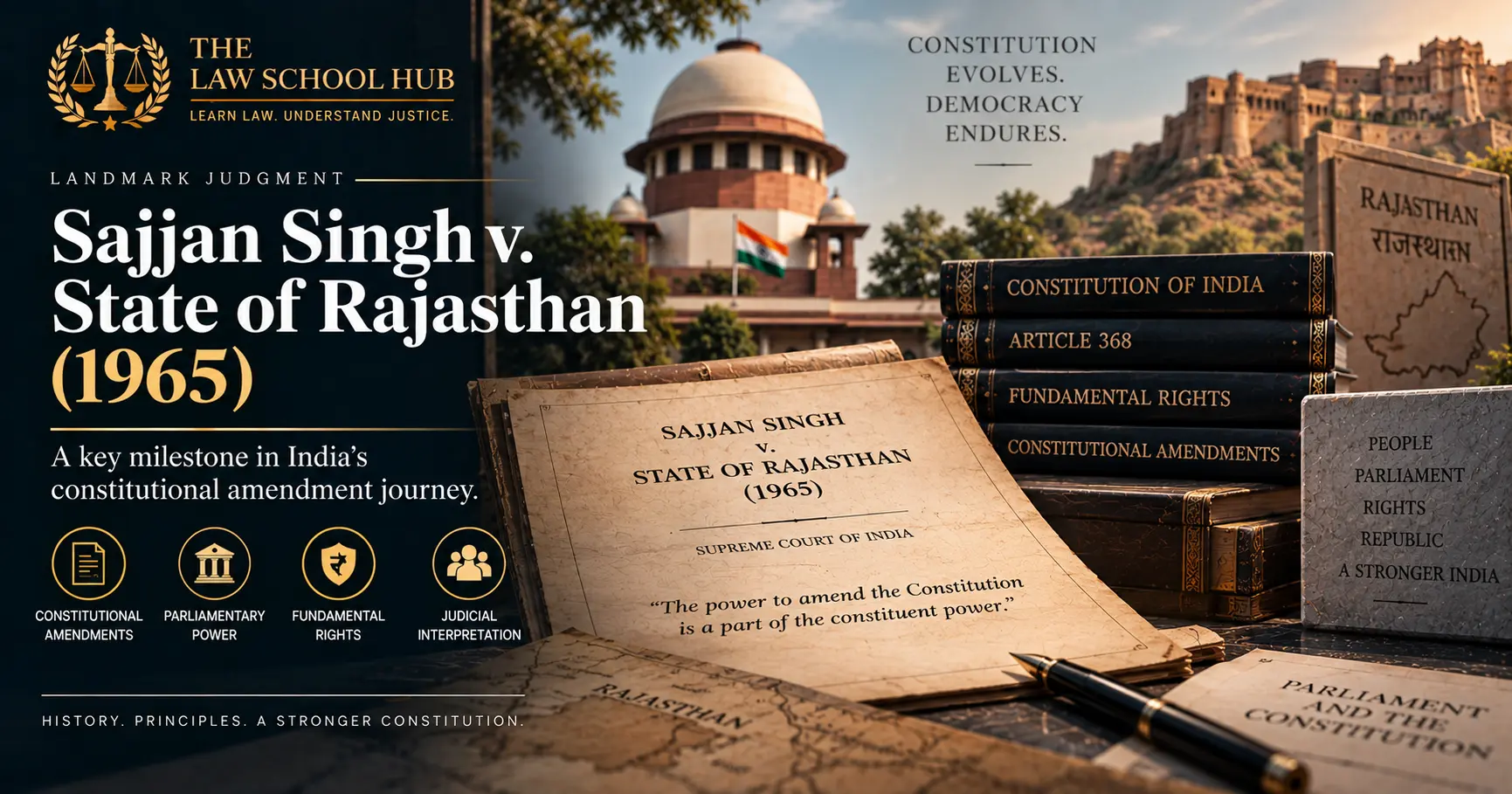
Table of Contents
Introduction
The history of the Indian Constitution is essentially a story of a long power struggle between two great institutions: the Indian Parliament and the Supreme Court of India. The case of Sajjan Singh v. State of Rajasthan, decided by a 5-judge Constitution Bench in 1965, is one of the most important battles in this history.
The core legal question in this case was enormous: Does the Indian Parliament have the absolute power to amend any part of the Constitution, including the Fundamental Rights of citizens?
In 1964, the government passed the 17th Constitutional Amendment. This amendment placed 44 different state land reform laws into the “Ninth Schedule,” a special vault that protected these laws from being challenged in court, even if they violated Fundamental Rights. Several landowners, including Sajjan Singh, lost their property because of these state laws. They went to the Supreme Court to challenge the 17th Amendment itself. They argued that Parliament could not rewrite the Constitution just to take away people’s fundamental right to property.
By a majority of 3:2, the Supreme Court ruled in favour of the government, deciding that Parliament did have the power to amend Fundamental Rights. However, the true historical value of the Sajjan Singh case lies in the opinions of the two minority judges. For the very first time in Indian legal history, these judges openly doubted whether Parliament could destroy the basic features of the Constitution. This tiny seed of doubt eventually grew into the famous “Basic Structure Doctrine” years later.
Legal information notice: This case summary is for general educational and informational purposes. It does not constitute legal advice or create an attorney-client relationship.
Last legally reviewed: September 2026
Case Details
| Detail | Information |
| Case Name | Sajjan Singh v. State of Rajasthan |
| Court | Supreme Court of India |
| Year | 1965 (Judgment delivered on October 30, 1964) |
| Bench/Judges | 5-Judge Constitution Bench: Chief Justice P.B. Gajendragadkar, Justice K.N. Wanchoo, Justice M. Hidayatullah, Justice Raghubar Dayal, Justice J.R. Mudholkar |
| Legal Area | Constitutional Law, Amendment Power, Fundamental Rights |
| Main Issue | Whether the 17th Constitutional Amendment Act, 1964, was valid, and whether Parliament has the power to amend Fundamental Rights under Article 368. |
| Final Decision | The Supreme Court upheld the validity of the 17th Amendment, ruling that Parliament’s power under Article 368 includes the power to amend Fundamental Rights. |
| Important Legal Principle | A constitutional amendment is an exercise of “constituent power,” not ordinary legislative power, and is therefore not a “law” under Article 13(2). |
Background
To understand the Sajjan Singh case, we must look at what happened in India during the first fifteen years after independence. The country was going through massive economic and social changes, and the law was struggling to keep up.
The Zamindari Abolition Era
When India became independent, the agricultural land was controlled by a few rich landlords known as Zamindars. Millions of poor farmers worked on the land but had no rights. The new government, led by Prime Minister Jawaharlal Nehru, wanted to fix this massive inequality. State governments across India started passing “Land Reform Acts.” These laws allowed the government to take away extra land from the rich landlords and distribute it to the poor.
The Clash with the Right to Property
The problem was that the original Constitution of India gave every citizen a Fundamental Right to Property under Article 19(1)(f) and Article 31. The rich landlords immediately went to the High Courts and the Supreme Court. They argued that the government was stealing their property and violating their Fundamental Rights. The courts often agreed with the landlords and started cancelling the government’s land reform laws.
The First Amendment and the Ninth Schedule
To protect its economic policies from the courts, the Parliament passed the First Constitutional Amendment in 1951. This amendment created a brilliant legal shield called the Ninth Schedule (added via Article 31B).
The rule of the Ninth Schedule was very simple: if Parliament took a law and placed it inside the Ninth Schedule, no court in India was allowed to review that law or strike it down for violating Fundamental Rights.
The Shankari Prasad Case (1951)
The landlords immediately challenged the First Amendment in a famous case called Shankari Prasad v. Union of India (1951). The landlords pointed to Article 13(2) of the Constitution. Article 13(2) clearly says that the State cannot make any “law” that takes away Fundamental Rights. The landlords argued that a constitutional amendment is just another “law.” Therefore, an amendment cannot take away Fundamental Rights.
However, the Supreme Court in Shankari Prasad disagreed. The Court ruled that the word “law” in Article 13(2) only meant ordinary laws. It did not include a Constitutional Amendment passed under Article 368. Therefore, Parliament could amend and reduce Fundamental Rights.
The Seventeenth Amendment (1964)
As years passed, state governments passed even more land reform laws. The landlords found new legal loopholes to challenge them. To shut down all legal challenges once and for all, Parliament passed the Seventeenth Constitutional Amendment Act in 1964.
This amendment took 44 different state land reform laws and forcefully pushed them all into the protective vault of the Ninth Schedule. By doing this, the government essentially blocked citizens from going to the courts to protect their property against these 44 laws. This aggressive move by Parliament led directly to the Sajjan Singh case.
Facts of the Case
The facts of the dispute involve several ordinary landowners who felt cheated by the legal system.
Sajjan Singh and several other individuals were landowners in states like Rajasthan and Punjab. Their respective state governments had passed laws limiting how much agricultural land a person could own. Under these state laws, the government seized the “surplus” land belonging to Sajjan Singh and the others.
The landowners wanted to challenge these state laws in their local High Courts. Normally, they would file a case saying the state law violated their Fundamental Right to property and their right to carry on a profession.
However, they were completely blocked from doing this. Because Parliament had just passed the 17th Constitutional Amendment, the specific state laws affecting Sajjan Singh and the others had been locked inside the Ninth Schedule.
Realising that they could not attack the state laws directly, the landowners decided they had to attack the Constitution itself. They grouped together and filed writ petitions directly in the Supreme Court of India under Article 32. They challenged the constitutional validity of the 17th Amendment Act, 1964. They hoped that if the Supreme Court struck down the 17th Amendment, the state laws would lose their protection, and the landowners could finally fight for their land.
Issues Before the Court
The 5-judge Constitution Bench had to decide several complex legal and procedural questions:
- Whether the 17th Constitutional Amendment Act was legally valid.
- Whether the 17th Amendment indirectly reduced the powers of the High Courts under Article 226, and if so, whether it required special permission (ratification) from half the states in India.
- Whether Parliament has the power under Article 368 to amend Part III of the Constitution to take away Fundamental Rights.
- Whether the previous judgment in Shankari Prasad (which gave Parliament absolute amending power) was decided correctly, or whether it needed to be reviewed.
Arguments by the Parties
What the Petitioners (Sajjan Singh and Landowners) Argued
The legal team representing the landowners presented three main arguments to the Supreme Court.
First, they made a very technical procedural argument about Article 368. Article 368 says that if Parliament wants to change certain specific things (like the powers of the High Courts), the amendment must be “ratified” or approved by at least half of all the State Assemblies in India before the President signs it. The petitioners argued that by putting 44 state laws into the Ninth Schedule, Parliament was effectively telling the High Courts: “You cannot look at these laws anymore.” Therefore, the 17th Amendment reduced the power of the High Courts under Article 226. Because it reduced High Court powers, it needed to be ratified by half the states. Since the 17th Amendment was not ratified by the states, it was unconstitutional.
Second, they attacked the core reasoning of the earlier Shankari Prasad case. They argued that Fundamental Rights are the most basic and natural rights of a human being. They argued that the word “law” in Article 13(2) must include constitutional amendments. If a normal law cannot take away rights, an amendment should not be able to do it either.
Third, they argued that Article 368 only contains the procedure for amending the Constitution. It does not actually grant Parliament the absolute power to destroy the core parts of the Constitution.
What the Respondents (Union of India and State Governments) Argued
The government’s lawyers fiercely defended the 17th Amendment, arguing that it was absolutely necessary for the social and economic progress of the country.
First, they answered the procedural argument. They stated that the 17th Amendment was about land reform and protecting Fundamental Rights. Its true aim was not to change the powers of the High Courts. Even if the High Courts lost the ability to hear a few specific property cases, this was just an indirect side effect. Therefore, state ratification was not legally required.
Second, they relied heavily on the Shankari Prasad judgment. They argued that the Supreme Court had already settled this debate in 1951. They stated that Parliament, when passing an amendment, exercises supreme “constituent power,” which is completely above ordinary laws and completely above Article 13(2).
Finally, the government argued that the Constitution must change with the times. If Parliament is blocked from passing economic reforms to help the poor, the Constitution will fail to serve the nation.
Judgment of the Court
On October 30, 1964, the Supreme Court delivered its judgment. The final decision was a 3:2 split, though all five judges technically agreed to dismiss the petitions and uphold the 17th Amendment.
However, the reasoning was deeply divided. Chief Justice P.B. Gajendragadkar wrote the main majority opinion on behalf of himself, Justice K.N. Wanchoo, and Justice Raghubar Dayal.
Justice M. Hidayatullah and Justice J.R. Mudholkar wrote separate opinions. They agreed with the final result (to not strike down the amendment), but they strongly disagreed with the majority’s reasoning about Parliament’s absolute powers.
The Majority Decision: Upholding the Amendment
What the Court Decided on State Ratification
Chief Justice Gajendragadkar completely rejected the petitioners’ technical argument. He applied a legal rule called the “Doctrine of Pith and Substance” (which means looking at the true nature and character of a law).
He noted that the true nature of the 17th Amendment was to change Article 31A and Article 31B (related to fundamental rights and property). The true nature was not to change Article 226 (High Court powers). The fact that the High Courts could no longer review 44 specific laws was just an “incidental” or accidental side effect. Because the main purpose of the amendment was not to alter the High Courts, it did not require ratification by half the states.
What the Court Decided on Fundamental Rights
The majority judges firmly decided to support the previous judgment in Shankari Prasad. They ruled that the Constitution makers intentionally gave Parliament a very broad power to amend the Constitution under Article 368.
The majority held that if the Constitution makers wanted to protect Fundamental Rights from being amended, they would have clearly written a special rule saying so. Since they did not, Parliament has the absolute power to amend, reduce, or take away Fundamental Rights. They agreed with the government that a constitutional amendment is not an ordinary “law” under Article 13(2).
The Separate Opinions: The Seeds of Doubt
The true historical brilliance of the Sajjan Singh case lies in the separate opinions written by Justice Hidayatullah and Justice Mudholkar. While they did not want to cause national chaos by striking down the 17th Amendment, they were deeply uncomfortable with the idea that Parliament had unlimited power.
Justice M. Hidayatullah’s Warning
Justice Hidayatullah stated that he was unwilling to blindly accept the Shankari Prasad ruling. He warned that Fundamental Rights are not ordinary rules; they are the bedrock of a free society. He famously observed that he could not accept that Fundamental Rights could be treated as the “plaything of a special majority.” He meant that just because a political party wins a large majority in Parliament, it should not have the power to vote away the basic freedoms of citizens.
Justice J.R. Mudholkar’s Brilliant Question
Justice Mudholkar went even further and asked a question that would change Indian law forever. He asked whether the word “amendment” meant the power to completely destroy the Constitution.
He pointed to the Preamble of the Constitution, which promises liberty, equality, and justice. He questioned whether Parliament could use its amending power to destroy these core ideals. He introduced the idea of “basic features.” He suggested that every Constitution has certain basic features, and perhaps Parliament cannot alter these basic features, even with a massive majority.
Ratio Decidendi
The ratio decidendi (the main legal rule established by the majority) in the Sajjan Singh case was twofold:
First, the power to amend the Constitution under Article 368 is an absolute constituent power that includes the power to amend or take away Fundamental Rights. A constitutional amendment is not a “law” under Article 13(2).
Second, if a constitutional amendment primarily deals with Fundamental Rights, it does not require ratification by the States, even if it incidentally affects the jurisdiction of the High Courts under Article 226. The Doctrine of Pith and Substance must be applied to determine the true target of the amendment.
Legal Principles Explained
The Sajjan Singh judgment touched upon several deep constitutional concepts that law students must understand clearly.
Constituent Power vs. Legislative Power
This is the most important distinction in the case. Legislative power is the everyday power of Parliament to make normal laws, like rules for traffic, taxes, or crimes. Constituent power is the special, supreme power to write or rewrite the Constitution itself.
The majority in Sajjan Singh ruled that when Parliament uses Article 368, it is wearing a different hat. It is not acting as an ordinary legislature; it is acting as a constituent body. Because it is using this supreme constituent power, the normal ban in Article 13(2) (which stops the state from making bad laws) does not apply to it.
The Doctrine of Pith and Substance
“Pith and substance” simply means the “true nature and essence” of a thing. This doctrine is used when a law seems to do two things at once, and the court needs to figure out which one is the main goal.
In this case, the 17th Amendment did two things: it changed Fundamental Rights, and it accidentally reduced the High Courts’ power to hear property cases. The Supreme Court used this doctrine to declare that the “pith and substance” of the amendment was property rights, not High Court powers. Therefore, the special state voting rules for changing High Court powers did not apply.
The Mechanics of the Ninth Schedule
This case beautifully illustrates how powerful the Ninth Schedule is. It is essentially a constitutional black hole. Article 31B states that none of the laws placed in the Ninth Schedule can ever become void on the ground that they violate Part III (Fundamental Rights). By simply adding a state law to this list, Parliament legally blinds the Supreme Court and High Courts from reviewing that specific law.
Subsequent Legal Developments
The Sajjan Singh case was a massive victory for the government, but it was a very short-lived victory. The doubts planted by Justice Hidayatullah and Justice Mudholkar immediately began to grow in the legal community.
The Golaknath Case (1967)
Just two years after Sajjan Singh, the Supreme Court formed a massive 11-judge bench to hear a very similar dispute in the case of I.C. Golaknath v. State of Punjab (1967).
In Golaknath, the doubts of the minority in Sajjan Singh became the voice of the majority. The Supreme Court dramatically overruled both Shankari Prasad and Sajjan Singh. By a narrow majority of 6:5, the Golaknath Court ruled that Parliament absolutely does not have the power to amend Fundamental Rights. They declared that a constitutional amendment is indeed an ordinary “law” under Article 13(2).
The 24th Amendment Act (1971)
Furious at the Golaknath decision, the government led by Prime Minister Indira Gandhi passed the 24th Constitutional Amendment. This amendment explicitly changed Article 13 and Article 368 to legally state that Parliament has the absolute, undeniable power to amend any part of the Constitution, including Fundamental Rights, overriding the Supreme Court’s objections.
Current Legal Status
It is extremely important for students to know that the majority judgment in Sajjan Singh is no longer the complete law of India today.
The legal journey that started with Sajjan Singh and went through Golaknath finally ended in 1973 with the historic 13-judge bench decision in Kesavananda Bharati v. State of Kerala.
In Kesavananda Bharati, the Supreme Court created a brilliant compromise.
- The Court agreed with the Sajjan Singh majority on one point: Parliament does have the power to amend Fundamental Rights, and an amendment is not an ordinary law.
- However, the Court agreed with Justice Mudholkar’s minority opinion on the bigger point: Parliament’s power is not absolute. Parliament cannot alter the “Basic Structure” or the core identity of the Constitution.
Therefore, today, the current legal position (verified as of September 2026) is the Basic Structure Doctrine. Parliament can amend the Fundamental Rights, provided that the amendment does not destroy the foundational pillars of the Constitution (like democracy, secularism, and the rule of law).
Importance of the Case
While it was technically just a confirmation of the older Shankari Prasad case, Sajjan Singh remains a critically important judgment in Indian legal history for three main reasons.
First, it represents the absolute peak of parliamentary supremacy in India. It was the moment when the Supreme Court explicitly allowed the government to use the Constitution as a flexible tool for economic reform, even at the cost of individual property rights.
Second, it clarified procedural constitutional law. The application of the Doctrine of Pith and Substance to constitutional amendments remains a valid and useful legal principle today when deciding if state ratification is required.
Third, and most importantly, it birthed the concept of “basic features.” Without the bold and brilliant dissenting thoughts of Justice Mudholkar in this specific case, the Supreme Court might never have discovered the language needed to create the Basic Structure doctrine eight years later in Kesavananda Bharati.
Critical Analysis
When examining the Sajjan Singh case from a modern perspective, legal scholars offer mixed reviews.
The majority opinion written by Chief Justice Gajendragadkar is often praised for its practical wisdom. In the 1960s, India was a desperately poor country. The government urgently needed to break the monopoly of rich landlords and give land to the farming poor. By giving Parliament the absolute power to amend the Constitution, the majority judges ensured that the courts did not become a roadblock to social justice and economic survival. From a purely practical standpoint, their decision kept the country moving forward without a violent revolution.
However, from an academic and human rights perspective, the majority decision is heavily criticized. The Law School Hub notes that giving any political party unlimited power to rewrite the Constitution is incredibly dangerous. If Parliament has the absolute power to amend Fundamental Rights, then those rights are not “fundamental” at all; they are just temporary privileges granted by the ruling party.
The widespread abuse of the Ninth Schedule proves this criticism right. What started as a small vault to protect a few agrarian reform laws eventually became a massive dumping ground where governments hid hundreds of controversial laws to escape judicial review.
This is why the separate opinions of Justice Hidayatullah and Justice Mudholkar are celebrated today. They possessed the foresight to realise that while land reform was good, the legal weapon being used to achieve it—unlimited amending power—could eventually be used by a future government to destroy Indian democracy entirely. Their subtle warnings in Sajjan Singh saved the Indian Constitution in the long run.
Illustrations and Examples
Hypothetical Example 1: The Pith and Substance Rule
Scenario: Parliament wants to pass a constitutional amendment to completely change how freedom of speech works on the internet. As a side effect, local district courts will have a slightly different procedure for hearing defamation cases. Some states object, saying that because court procedures are changing, half the states must vote to approve the amendment.
Legal Position: Under the legal rule established in Sajjan Singh, the Supreme Court will look at the “pith and substance” (the true nature) of the amendment. The true nature is regulating freedom of speech, not reorganising local courts. The change to court procedure is just an incidental side effect. Therefore, state ratification is not required.
Hypothetical Example 2: The Ninth Schedule Shield
Scenario: A state government passes the “Highway Construction Act,” which allows the government to seize people’s houses without paying them any money. This clearly violates basic human rights. Knowing the High Court will strike it down, Parliament passes a constitutional amendment placing the “Highway Construction Act” inside the Ninth Schedule.
Legal Position: Under the pure law of the Sajjan Singh era, the citizens whose houses were taken would have no legal remedy. The courts would be legally blind to the law because it was shielded by the Ninth Schedule, and Parliament had absolute power to put it there. (Note: Today, under modern Basic Structure law, the Supreme Court can review laws added to the Ninth Schedule after 1973 if they destroy basic rights).
Hypothetical Example 3: The Birth of Basic Features
Scenario: Imagine it is 1965, and a political party wins 90% of the seats in Parliament. They decide they don’t like elections anymore. They pass a Constitutional Amendment removing the right to vote and declaring that the Prime Minister will rule for life.
Legal Position: If we strictly follow Chief Justice Gajendragadkar’s majority opinion in Sajjan Singh, Parliament has absolute amending power, so this terrifying amendment would technically be legal. However, if we look at Justice Mudholkar’s separate opinion, this amendment would be illegal because it destroys a “basic feature” of the Constitution—democracy itself.
Key Takeaways
| Key Point | Explanation |
| Main Issue | Did Parliament have the power to amend Fundamental Rights, and was the 17th Amendment valid? |
| Holding | Yes. The Supreme Court upheld the 17th Amendment by a 3:2 majority. |
| Ratio Decidendi | Article 368 gives Parliament supreme constituent power, meaning it can amend any part of the Constitution, including Part III. |
| Important Doctrine | Pith and Substance: Used to prove that the amendment aimed at property rights, not at reducing High Court powers, so state ratification wasn’t needed. |
| Later Development | Overruled by Golaknath (1967), which was then overruled by Kesavananda Bharati (1973). |
| Current Position | Parliament can amend Fundamental Rights today, but it cannot destroy the Basic Structure of the Constitution. |
| Practical Significance | It exposed the danger of unlimited parliamentary power and planted the first seed of the Basic Structure doctrine through Justice Mudholkar’s opinion. |
Conclusion
The Sajjan Singh v. State of Rajasthan (1965) judgment is a fascinating snapshot of a young democracy trying to balance the urgent need for social economic reform against the permanent value of human rights. By reaffirming that Parliament had the absolute power to amend the Constitution and limit the right to property, the Supreme Court majority cleared the path for the government to execute its socialist land reforms without judicial interference.
However, the true legacy of the case was written by the dissenting voices. The grave doubts expressed by Justice Hidayatullah and Justice Mudholkar regarding the limits of political power proved to be prophetic. They realised that a Constitution that can be entirely rewritten by a passing political majority is not a Constitution at all. Their intellectual courage in the Sajjan Singh case laid the essential groundwork for the Basic Structure Doctrine, which stands today as the ultimate protector of the Indian constitutional system.
FAQs
- What was the main dispute in the Sajjan Singh case?
Answer: The main dispute was whether the Indian Parliament had the legal power to pass the 17th Constitutional Amendment, which locked 44 state land reform laws into the Ninth Schedule, thereby taking away the citizens’ right to challenge those laws for violating their Fundamental Right to property.
- What did the Supreme Court decide?
Answer: By a majority of 3 to 2, the Supreme Court decided that Parliament does have the absolute power to amend any part of the Constitution, including Fundamental Rights. Therefore, the 17th Amendment was declared valid.
- Why did the petitioners argue that State ratification was needed?
Answer: The petitioners argued that by putting laws into the Ninth Schedule, the amendment effectively stopped the High Courts from reviewing those laws. Since the amendment affected the powers of the High Courts (under Article 226), they argued it legally required approval from half the states under the rules of Article 368.
- How did the Court respond to the State ratification argument?
Answer: The majority used the “Doctrine of Pith and Substance.” They said the true purpose of the amendment was to deal with land reform and fundamental rights. The fact that it slightly affected High Court powers was just an accidental side effect, so state ratification was not necessary.
- Who was Justice J.R. Mudholkar, and why is his opinion famous?
Answer: Justice Mudholkar was one of the judges on the bench. His separate opinion is famous because he was the very first judge in the Supreme Court to suggest that the Constitution has certain “basic features” that Parliament might not have the power to destroy, even with an amendment.
- What is the difference between Shankari Prasad and Sajjan Singh?
Answer: Legally, there is no difference in the outcome. Sajjan Singh essentially agreed with and confirmed the rules established in the earlier Shankari Prasad (1951) case. However, Sajjan Singh is distinct because it is the first time minority judges openly doubted that Parliament’s power was absolute.
- What is the Ninth Schedule?
Answer: The Ninth Schedule is a special list in the Indian Constitution. For a very long time, the rule was that any law placed inside this schedule by Parliament could not be challenged in court for violating Fundamental Rights. It acted as a protective shield for government policies.
- Is the Sajjan Singh judgment still valid law today?
Answer: No, the main reasoning of the Sajjan Singh majority is not the law today. It was overruled by the Golaknath case in 1967. Finally, in 1973, the Kesavananda Bharati case established the modern law: Parliament can amend rights, but it cannot destroy the basic structure of the Constitution.
- What does “Constituent Power” mean in this case?
Answer: Constituent power is the supreme power used to make or change the Constitution itself. The Court ruled that when Parliament passes an amendment, it uses this supreme constituent power, making the amendment superior to ordinary everyday laws.
- Why did the government want to amend the Constitution so badly in the 1960s?
Answer: The government wanted to take excess agricultural land from rich landlords and give it to poor farmers to create social equality. Because the original Constitution guaranteed the Right to Property, the government had to keep amending the Constitution to stop the courts from blocking their land reform laws.
Legal References
- Sajjan Singh v. State of Rajasthan, AIR 1965 SC 845 – Supreme Court of India
- Shankari Prasad Singh Deo v. Union of India, AIR 1951 SC 458 – Supreme Court of India
- I.C. Golaknath and Ors. v. State of Punjab and Anr., AIR 1967 SC 1643 – Supreme Court of India
- Kesavananda Bharati v. State of Kerala, (1973) 4 SCC 225 – Supreme Court of India
- Constitution of India, Articles 13, 19, 31, 31A, 31B, 226, and 368 – Legislative Department, Government of India
- The Constitution (First Amendment) Act, 1951 – Government of India
- The Constitution (Seventeenth Amendment) Act, 1964 – Government of India
At The Law School Hub, we simplify case laws, legal acts, and legal concepts for law students and legal readers. Want to read more useful legal blogs? Visit The Law School Hub The Law School Hub for more such informational blogs.
Building a community around law, learning, and legal awareness through The Law School Hub.
I’m Yash Yogitta Joshi. Join me on LinkedIn → Click to view my Profile