I.C. Golaknath v. State of Punjab (1967): The Historic Ruling That Said Parliament Cannot Touch Your Fundamental Rights

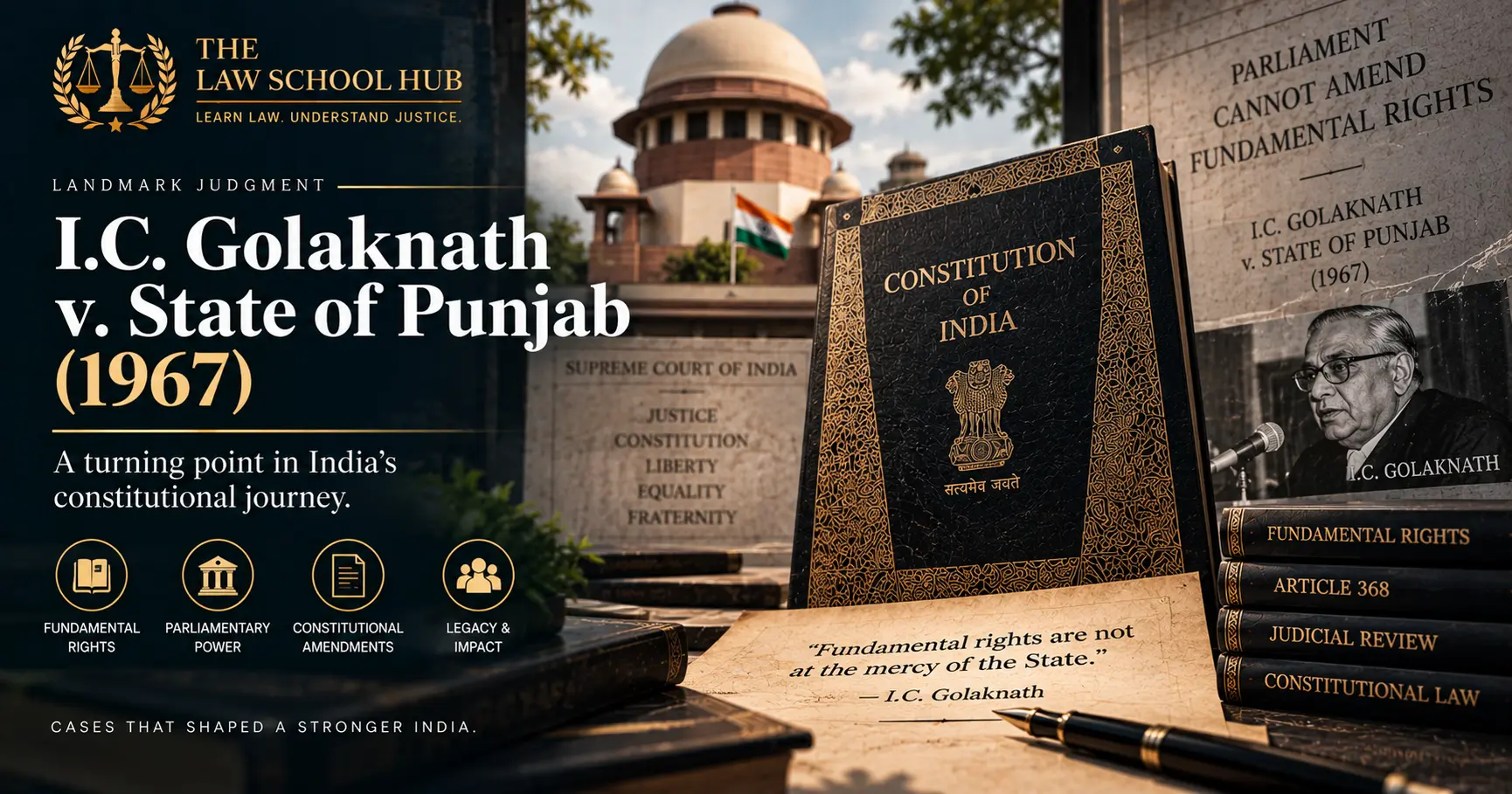
Table of Contents
Introduction
In the constitutional history of India, few legal battles have been as fierce as the fight between the Indian Parliament and the Supreme Court over the power to change the Constitution. The case of I.C. Golaknath v. State of Punjab, decided in 1967 by a massive 11-judge bench of the Supreme Court, is the most dramatic chapter in this story.
The central legal question was simple but deeply powerful: Can the Indian Parliament use its amending power to take away or reduce the Fundamental Rights of citizens?
For years, the government had been amending the Constitution to protect its land reform laws from being challenged in court by rich landowners. When a family from Punjab, the Golaknaths, lost most of their vast agricultural estate to a state law, they challenged the constitutional amendments that made this land seizure possible. By a narrow majority of 6:5, the Supreme Court delivered a shock to the government. The Court ruled that Parliament does not have the power to amend the Constitution to take away any Fundamental Right. Fundamental Rights, the Court said, hold a transcendental and untouchable position.
While this exact judgment was later overruled by the famous Kesavananda Bharati case in 1973, understanding the Golaknath case is absolutely essential for every law student. It forced the government to change the Constitution itself, introduced the unique rule of “prospective overruling” to India, and set the stage for the modern Basic Structure doctrine.
Legal information notice: This case summary is for general educational and informational purposes. It does not constitute legal advice or create an attorney-client relationship.
Last legally reviewed: September 2026
Case Details
| Detail | Information |
| Case Name | I.C. Golaknath and Ors. v. State of Punjab and Anr. |
| Court | Supreme Court of India |
| Year | 1967 (Judgment delivered on February 27, 1967) |
| Bench/Judges | 11-Judge Constitution Bench: Chief Justice K. Subba Rao, Justice K.N. Wanchoo, Justice M. Hidayatullah, Justice J.C. Shah, Justice S.M. Sikri, Justice R.S. Bachawat, Justice V. Ramaswami, Justice J.M. Shelat, Justice V. Bhargava, Justice G.K. Mitter, Justice C.A. Vaidialingam |
| Legal Area | Constitutional Law, Fundamental Rights, Amendment Power |
| Main Issue | Whether Parliament has the power under Article 368 to amend Part III of the Constitution to take away or abridge Fundamental Rights. |
| Final Decision | The Supreme Court ruled that Parliament cannot amend the Constitution to take away or reduce Fundamental Rights, but saved past amendments using the doctrine of prospective overruling. |
| Important Legal Principle | An amendment to the Constitution is a “law” under Article 13(2). Therefore, any amendment that violates Fundamental Rights is invalid. |
Background
To truly understand why the Golaknath case became such a massive constitutional earthquake, we must look at what was happening in India in the 1950s and 1960s.
The Need for Land Reforms
When India gained independence, most of the country’s agricultural land was owned by a few wealthy landlords (Zamindars). Millions of poor farmers worked on this land but owned nothing. The new government, led by Prime Minister Jawaharlal Nehru, wanted to create social equality. To do this, state governments started passing “Land Reform Acts.” These laws forced rich landlords to give up their extra land, which the government then distributed to poor farmers.
The Conflict with the Right to Property
The problem was that the original Indian Constitution guaranteed the “Right to Property” as a Fundamental Right under Article 19(1)(f) and Article 31. When the government tried to take land away, the rich landlords went to court. They argued that the land reform laws violated their Fundamental Right to property. The courts agreed and started cancelling the government’s land reform laws.
The First and Fourth Amendments
To stop the courts from interfering, the government amended the Constitution.
In 1951, Parliament passed the First Constitutional Amendment. This created a special vault called the Ninth Schedule. The rule was simple: if the government put a law inside the Ninth Schedule, no court in India could strike it down for violating Fundamental Rights. Parliament also passed the Fourth Amendment in 1955 to further protect its economic policies from judicial review.
Earlier Supreme Court Rulings (Shankari Prasad and Sajjan Singh)
The landlords immediately challenged the First Amendment in a case called Shankari Prasad v. Union of India (1951). They argued that Article 13(2) of the Constitution clearly says the State cannot make any “law” that takes away Fundamental Rights. Therefore, they argued, a constitutional amendment is also a “law,” and if it hurts Fundamental Rights, it should be cancelled.
However, the Supreme Court in Shankari Prasad rejected this argument. The Court ruled that the word “law” in Article 13(2) only meant ordinary laws passed by Parliament. It did not include Constitutional Amendments made under Article 368. The Court repeated this same view in the Sajjan Singh v. State of Rajasthan (1965) case.
According to these early judgments, Parliament had absolute power to amend any part of the Constitution, including Fundamental Rights.
The Seventeenth Amendment
In 1964, Parliament passed the Seventeenth Constitutional Amendment. This amendment added 44 more state land reform laws into the protective vault of the Ninth Schedule. One of those laws was the Punjab Security of Land Tenures Act, 1953. This set the stage for the Golaknath dispute.
Facts of the Case
The facts of the dispute revolve around a wealthy family in the state of Punjab.
Henry and William Golaknath were brothers who owned an enormous agricultural estate spanning over 500 acres in Jalandhar, Punjab.
Under the Punjab Security of Land Tenures Act of 1953, the state government placed a strict limit on how much land a person could legally own. The law allowed the brothers to keep only 30 “standard acres” of land each, plus a small amount for other family members. The rest of their vast estate was declared as “surplus” land. The government ordered that this surplus land must be handed over to the tenants who worked on it.
The Golaknath family was outraged by the loss of their property. Since the Punjab law had been placed inside the protective Ninth Schedule by the Seventeenth Constitutional Amendment, they could not simply challenge the Punjab law itself.
Therefore, the Golaknath family decided to challenge the Constitution itself. They filed a writ petition directly in the Supreme Court under Article 32. They challenged the constitutional validity of the Punjab Act, and more importantly, they challenged the validity of the First, Fourth, and Seventeenth Constitutional Amendments.
They argued that Parliament had no power to amend the Constitution to take away their Fundamental Right to property and their right to carry on a profession. Recognizing the massive importance of the case, Chief Justice K. Subba Rao formed a historic 11-judge Constitution Bench to hear the matter.
Issues Before the Court
The 11-judge bench had to decide three core legal questions:
- Whether a Constitutional Amendment passed under Article 368 is a “law” within the meaning of Article 13(2) of the Constitution.
- Whether the Fundamental Rights enshrined in Part III of the Constitution can be amended, abridged, or taken away by the Parliament.
- Whether the power to amend the Constitution is located in Article 368 or somewhere else.
Arguments by the Parties
What the Petitioners (Golaknath Family) Argued
The legal team for the Golaknath family, led by prominent lawyers, presented a powerful defense of individual liberty.
First, they argued that Fundamental Rights are “primordial” and natural rights. They are the basic human rights that existed before the Constitution was even written. The Constitution merely recognizes them; it does not grant them. Therefore, no Parliament, which is a creature of the Constitution, can destroy these natural rights.
Second, they focused heavily on the word “law” in Article 13(2). Article 13(2) states that the State shall not make any law which takes away or abridges Fundamental Rights. The petitioners argued that a constitutional amendment is passed by the same Parliament that passes ordinary laws. Therefore, a constitutional amendment is also a “law.” If an amendment takes away a Fundamental Right, it must be struck down.
Third, they pointed out a technical detail about Article 368. At that time, the heading of Article 368 was simply “Procedure for amendment of the Constitution.” The petitioners argued that Article 368 only told Parliament how to amend the Constitution (the procedure). It did not actually give Parliament the power to amend it.
What the Respondents (State and Union Governments) Argued
The lawyers defending the government argued that the Constitution must be flexible. If a Constitution cannot be changed to meet the needs of the people, it will break.
They argued that a Constitutional Amendment is entirely different from an ordinary law. Ordinary laws are made using Parliament’s “legislative power.” Constitutional Amendments are made using a higher, sovereign power called “constituent power.” Because of this difference, they argued, an amendment is not a “law” under Article 13(2).
Furthermore, the government warned the Court of terrible consequences. They argued that if the Supreme Court suddenly declared that Fundamental Rights could never be amended, it would paralyze the state. The government would be unable to carry out welfare schemes for the poor. They warned that if peaceful change through the Parliament was blocked by the courts, the only way the public could change the system would be through a violent revolution.
Finally, they reminded the Court that the Supreme Court itself had already decided in the Shankari Prasad and Sajjan Singh cases that Parliament could amend Fundamental Rights. They urged the Court not to reverse its own past decisions.
Judgment of the Court
On February 27, 1967, the Supreme Court delivered one of the most famous and controversial verdicts in Indian history. The 11 judges could not agree. They split into two sides, resulting in a narrow 6:5 majority decision in favour of the petitioners.
Chief Justice K. Subba Rao wrote the main majority judgment on behalf of five judges. Justice M. Hidayatullah wrote a separate but concurring judgment, making it a majority of six.
What the Court Decided: Fundamental Rights Cannot be Amended
The majority ruled that Fundamental Rights are given a “transcendental position” in the Indian Constitution. They are kept beyond the reach of normal political majorities. The Court held that Parliament has no power whatsoever to amend Part III of the Constitution if that amendment takes away or abridges any Fundamental Right.
What the Court Decided: An Amendment is a “Law”
The Court accepted the petitioner’s argument regarding Article 13(2). The majority held that there is no difference between an ordinary law and a constitutional amendment when it comes to Article 13. Therefore, an amendment is a “law.” Because Article 13(2) strictly bans any law that harms Fundamental Rights, any constitutional amendment that harms these rights is unconstitutional and void.
With this holding, the Supreme Court officially overruled its earlier judgments in Shankari Prasad and Sajjan Singh.
What the Court Decided: Article 368 is Only Procedure
The majority looked at the text of Article 368 and noted that it only provided the “procedure” for amendment. The Court shockingly concluded that the actual power to amend the Constitution was not in Article 368 at all. Instead, they said the power to amend came from Parliament’s ordinary, residuary law-making power found in Article 248. This meant amending the Constitution was treated almost the same as passing a regular traffic or tax law.
The Doctrine of Prospective Overruling
Here, the Supreme Court faced a massive practical problem. By declaring that Parliament could not amend Fundamental Rights, the Court was effectively saying that the First, Fourth, and Seventeenth Amendments were illegal.
However, these amendments had been part of the Constitution for 15 years. Based on these amendments, state governments had taken millions of acres of land from rich landlords and given it to poor farmers. If the Court suddenly struck down these amendments retroactively, the entire country would fall into chaos. Millions of land titles would become invalid overnight.
To prevent this disaster, Chief Justice Subba Rao imported a legal concept from American law called the Doctrine of Prospective Overruling.
“Prospective” means looking to the future. The Court ruled that its new decision would only apply to the future. The Court declared that the First, Fourth, and Seventeenth Amendments would remain valid and legal for everything that had already happened. However, from the date of this judgment (February 27, 1967) onwards, Parliament would have no power to amend Fundamental Rights.
This clever legal trick allowed the Court to protect the past land reforms while stopping the government from taking away rights in the future. Because of this prospective ruling, the Golaknath family actually lost their specific case to get their land back, even though they won the massive constitutional argument!
The Dissenting View (The Minority)
Five judges, led by Justice K.N. Wanchoo, strongly disagreed with the majority.
The dissenting judges argued that the power to amend the Constitution is a supreme sovereign power. They argued that Article 368 contained both the procedure and the power to amend. They firmly believed that an amendment is not an ordinary “law” under Article 13(2).
Justice Wanchoo famously warned that a Constitution must have an escape valve for change. If the Constitution is made completely rigid and unamendable, the people will eventually become frustrated, and this would inevitably lead to an extra-constitutional revolution.
Ratio Decidendi
The core legal reasoning (ratio) of the majority in the Golaknath case was:
First, the word “law” in Article 13(2) includes constitutional amendments. Therefore, the strict prohibition against making laws that take away Fundamental Rights applies fully to Parliament’s amending power.
Second, Parliament does not possess the power to amend Part III of the Constitution to abridge or take away Fundamental Rights. The Fundamental Rights are transcendental and beyond the reach of parliamentary majorities.
Legal Principles Explained
The Golaknath judgment explored several deep constitutional concepts.
Constituent Power vs. Legislative Power
Legislative power is the everyday power of Parliament to make ordinary laws (like tax laws, criminal laws, or education laws). Constituent power is the supreme power to create or change the Constitution itself.
Before Golaknath, it was believed Parliament had constituent power when using Article 368. The Golaknath majority rejected this. They argued that the Indian Parliament only has ordinary legislative power, and it uses this ordinary power to change the Constitution. Because it is just an ordinary legislative act, it is fully controlled by the ban in Article 13(2).
The Transcendental Nature of Fundamental Rights
The judgment was heavily influenced by a natural law philosophy. Chief Justice Subba Rao viewed Fundamental Rights not as gifts given by the government, but as basic human rights that the Constitution merely protects. By calling them “transcendental,” the Court meant these rights sit above the normal political process. The government cannot vote to remove a citizen’s basic liberty, no matter how large a majority it has in Parliament.
Prospective Overruling in Indian Law
This case marks the first time the Indian Supreme Court used the Doctrine of Prospective Overruling. Traditionally, when a court declares a law illegal, it is considered illegal from the very beginning (retrospectively). Prospective overruling changes this rule. It allows a court to say: “This action was wrong, but to prevent chaos, we will accept what happened in the past, but you cannot do it again in the future.” The Court established strict guidelines: this doctrine can only be used by the Supreme Court of India, and only in cases involving the Constitution.
Subsequent Legal Developments
The Golaknath judgment infuriated the political leadership of India, specifically Prime Minister Indira Gandhi. The government felt that the unelected judges of the Supreme Court were blocking the elected representatives of the people from achieving socialist economic justice.
This led to a massive retaliation by the Parliament.
The 24th Constitutional Amendment Act, 1971
After winning a massive majority in the 1971 general elections, Indira Gandhi’s government passed the 24th Constitutional Amendment. This amendment was designed specifically to destroy the Golaknath judgment.
- It changed the title of Article 368 from “Procedure for amendment” to “Power of Parliament to amend the Constitution and procedure therefor,” directly answering the Court’s argument that the article lacked power.
- It added a new clause to Article 13, stating: “Nothing in this article shall apply to any amendment of this Constitution made under article 368.”
- It added a matching clause to Article 368, stating: “Nothing in article 13 shall apply to any amendment made under this article.”
By writing this into the Constitution, Parliament legally declared that it had absolute power to amend any part of the Constitution, including Fundamental Rights, and that Article 13 could not stop it.
Current Legal Status
It is absolutely crucial for students to understand that the Golaknath judgment is no longer good law today.
The legal position established by Golaknath survived for only six years. In 1973, an even larger 13-judge bench of the Supreme Court heard the landmark case of Kesavananda Bharati v. State of Kerala.
In Kesavananda Bharati, the Supreme Court overruled the Golaknath decision.
The Kesavananda bench agreed with the government that an amendment is not an ordinary law under Article 13, and they agreed that Parliament does have the power to amend Fundamental Rights. The Court upheld the validity of the 24th Amendment.
However, to protect the Constitution from being completely destroyed by Parliament, the Kesavananda Court invented a new rule: the Basic Structure Doctrine. Today, the law is that Parliament can amend any part of the Constitution (including taking away Fundamental Rights), provided that the amendment does not destroy the “basic structure” or core identity of the Constitution.
Therefore, the strict ban created by Golaknath no longer exists. Current legal position verified as of September 2026.
Importance of the Case
Even though it was overruled, the Golaknath case remains profoundly important for several reasons.
First, it represented the high-water mark of judicial defense of Fundamental Rights. It was the boldest attempt by the Supreme Court to place individual liberties completely beyond the reach of politicians.
Second, it forced Parliament to pass the 24th Amendment, which in turn forced the Supreme Court to hear the Kesavananda Bharati case. Without the extreme stance taken in Golaknath, the balanced compromise of the Basic Structure doctrine might never have been created.
Third, it permanently introduced the vital tool of “prospective overruling” into Indian legal practice, giving the Supreme Court a practical way to manage the massive social consequences of its decisions.
Critical Analysis
The Golaknath decision has been heavily criticized by legal scholars over the decades.
Many constitutional experts point out that Chief Justice Subba Rao’s legal reasoning regarding Article 368 was very weak. Saying that Article 368 only contained the procedure and not the power to amend went against common sense and the clear intention of the Constitution’s framers. Relying on the residuary power (Article 248) to amend the Constitution meant that constitutional amendments were legally no different from regular laws, which fundamentally misunderstands how Constitutions work.
Furthermore, critics argue that making Fundamental Rights completely unamendable creates a rigid society. As Justice Wanchoo warned in his dissent, if a democratic society cannot legally change its founding document to reflect new social realities, the people will eventually bypass the document entirely.
However, from an editorial perspective, The Law School Hub notes that the Golaknath majority was acting out of a genuine fear. They saw Parliament using its amending power too casually to bypass the courts whenever a government policy was challenged. While their legal logic regarding Article 368 was flawed, their underlying concern—that a government with a temporary majority should not have the power to destroy the fundamental liberties of citizens—was completely valid. This exact concern was later perfectly resolved by the Basic Structure doctrine.
Illustrations and Examples
Hypothetical Example 1: The Press Ban Law
Scenario: Parliament is angry with news channels. It passes an ordinary law called the “Media Control Act,” stating that no journalist can criticize the Prime Minister.
Legal Position: Under Article 13(2), this is an ordinary “law” that takes away the Fundamental Right to free speech under Article 19(1)(a). The Supreme Court will easily strike it down as unconstitutional. This has always been the law, both before and after Golaknath.
Hypothetical Example 2: The Constitutional Amendment (Golaknath Era)
Scenario: Imagine it is the year 1969 (during the time Golaknath was active law). Parliament wants to ban the media. Knowing an ordinary law will be struck down, Parliament passes the “40th Constitutional Amendment,” which simply removes the Right to Free Speech from Part III of the Constitution entirely.
Legal Position: Under the strict rule of the Golaknath case, the Supreme Court would strike down this Constitutional Amendment. The Court would rule that an amendment is also a “law” under Article 13(2), and Parliament has zero power to take away a Fundamental Right.
Hypothetical Example 3: The Concept of Prospective Overruling
Scenario: For 10 years, a state has been collecting a specific “Road Tax” based on a government law. Millions of rupees have been collected and spent on building highways. In 2026, the Supreme Court realizes the law was actually unconstitutional from the start.
Legal Position: If the Court simply strikes down the law, the state would have to refund millions of rupees to citizens, bankrupting the government. Using the doctrine of prospective overruling (invented in India during Golaknath), the Court can say: “The tax law is illegal. The state can keep all the money collected in the past ten years, but you cannot collect this tax tomorrow.”
Key Takeaways
| Key Point | Explanation |
| Main Issue | Could Parliament amend the Constitution to take away Fundamental Rights? |
| Holding | No. The Supreme Court ruled (6:5) that Parliament cannot take away Fundamental Rights. |
| Ratio Decidendi | An amendment is a “law” under Article 13(2), and therefore cannot violate Part III rights. |
| Important Doctrine | Prospective Overruling: The Court saved past amendments from being cancelled to avoid national chaos, applying the new rule only to the future. |
| Later Development | Parliament passed the 24th Amendment in 1971 to explicitly give itself absolute amending power over Fundamental Rights. |
| Current Position | Golaknath was overruled by Kesavananda Bharati (1973). Today, Parliament can amend Fundamental Rights, provided it does not destroy the Basic Structure. |
| Practical Significance | It was the first major judicial attempt to limit Parliament’s amending power, sparking the battle that led to the Basic Structure doctrine. |
Conclusion
The I.C. Golaknath v. State of Punjab (1967) case is a thrilling milestone in Indian legal history. By ruling that Parliament possessed no power to amend or take away Fundamental Rights, the Supreme Court took a dramatic stand to protect the individual liberties of citizens from aggressive government policies.
Although the Court’s technical reasoning was heavily criticised and its absolute ban on amendments was eventually overruled six years later by the Kesavananda Bharati case, Golaknath changed Indian constitutional law forever. It introduced the practical tool of prospective overruling and ignited the ultimate constitutional debate about the limits of political power. Today, while Parliament has regained its power to amend Fundamental Rights, it can only do so within the boundaries of the Basic Structure—a boundary that only exists because the Golaknath bench first dared to draw a line in the sand.
FAQs
1. What did the Supreme Court decide in the Golaknath case?
Answer: The Supreme Court decided that the Indian Parliament does not have the power to amend the Constitution to take away or reduce any of the Fundamental Rights guaranteed to citizens.
2. Is the Golaknath judgment still valid today?
Answer: No. The Golaknath judgment is not good law today. It was officially overruled by a larger 13-judge bench of the Supreme Court in the 1973 Kesavananda Bharati case. Today, Parliament can amend Fundamental Rights as long as it does not destroy the basic structure of the Constitution.
3. What is the doctrine of “prospective overruling”?
Answer: Prospective overruling is a legal rule where a court declares that a law or past decision is unconstitutional, but decides that this new ruling will only apply to future cases. It protects past actions from being undone, preventing administrative chaos.
4. Why did the Golaknath family file a case?
Answer: The Golaknath brothers owned over 500 acres of land. The Punjab state government passed a law limiting land ownership and seized their “surplus” land. The family went to the Supreme Court arguing that this violated their Fundamental Right to property.
5. How did the government react to the Golaknath judgment?
Answer: The government, led by Indira Gandhi, was very angry. To overcome the judgment, Parliament passed the 24th Constitutional Amendment in 1971, which explicitly changed the Constitution to give Parliament the absolute power to amend any part of it, including Fundamental Rights.
6. What was the connection between Article 13 and Article 368 in this case?
Answer: Article 13 bans the State from making any “law” that takes away Fundamental Rights. Article 368 contains the procedure to amend the Constitution. The core issue in Golaknath was whether a constitutional amendment under Article 368 was a “law” governed by Article 13. The Court said yes, it was.
7. Did the Golaknath family get their land back after winning the case?
Answer: No, they did not. Because the Supreme Court used the doctrine of “prospective overruling,” the Court decided that the past constitutional amendments that protected the Punjab land law remained valid for the past. The new rule protecting Fundamental Rights only applied to future amendments.
8. How many judges heard the Golaknath case, and what was the vote?
Answer: The case was heard by a massive 11-judge Constitution Bench. The decision was incredibly close, resulting in a 6:5 majority in favour of the petitioners (the Golaknath family).
9. What did the dissenting judges in Golaknath argue?
Answer: The five dissenting judges argued that Parliament’s power to amend the Constitution is supreme. They warned that if the Constitution is made completely rigid and cannot be amended to meet the people’s needs, it could lead to a violent revolution.
10. What is the Ninth Schedule?
Answer: Created by the First Amendment in 1951, the Ninth Schedule is a special list in the Constitution. Historically, if the government placed a land reform law inside this schedule, the courts were not allowed to strike it down for violating Fundamental Rights.
Legal References
- I.C. Golaknath and Ors. v. State of Punjab and Anr., AIR 1967 SC 1643 — Supreme Court of India
- Shankari Prasad Singh Deo v. Union of India, AIR 1951 SC 458 — Supreme Court of India
- Sajjan Singh v. State of Rajasthan, AIR 1965 SC 845 — Supreme Court of India
- Kesavananda Bharati v. State of Kerala, (1973) 4 SCC 225 — Supreme Court of India
- Constitution of India, Articles 13, 32, 248, and 368 — Legislative Department, Government of India
- The Constitution (First Amendment) Act, 1951 — Government of India
- The Constitution (Seventeenth Amendment) Act, 1964 — Government of India
- The Constitution (Twenty-Fourth Amendment) Act, 1971 — Government of India
At The Law School Hub, we simplify case laws, legal acts, and legal concepts for law students and legal readers. Want to read more useful legal blogs? Visit The Law School Hub The Law School Hub for more such informational blogs.
I’m Yash Yogitta Joshi. Join me on LinkedIn → Click to view my Profile
Building a community around law, learning, and legal awareness through The Law School Hub.