Cadila Healthcare Case: Why Trademark Rules for Medicines Are Stricter in India

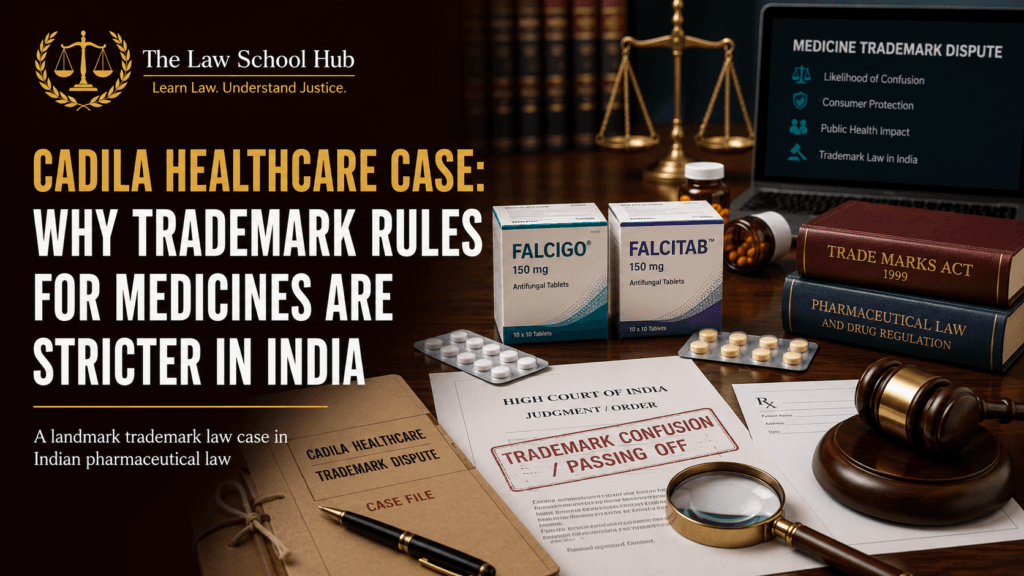
Table of Contents
Introduction
In the world of business, when two competing companies sell completely different products with similar names, the result is usually mild consumer confusion. If a shopper accidentally buys the wrong brand of soap or potato chips because the packaging looks similar, they might experience a slight disappointment in quality. However, when we apply this same confusion to the medical field, the stakes change dramatically. If a patient takes the wrong medicine because the brand name sounds identical to their actual prescription, the result can be severe physical harm or even death. The Cadila Healthcare case deals exactly with this life-threatening danger.
Decided by the Supreme Court of India in 2001, this case involved a fierce legal dispute between two major pharmaceutical companies over two medicines used to treat a severe type of malaria. The medicines were named “Falcigo” and “Falcitab.” One company argued that these names were dangerously similar and would cause the public to confuse the two drugs, committing the civil wrong of “passing off.” The lower courts dismissed the case, reasoning that because these were strong drugs sold only with a doctor’s prescription, trained medical professionals would not make mistakes.
The Supreme Court completely rejected this theoretical approach. In a historic judgment, the Court established that when it comes to life-saving medicines, trademark law must apply a much stricter standard for deceptive similarity than it does for ordinary everyday goods. The Court acknowledged the ground realities of Indian healthcare, noting that doctors have messy handwriting and busy pharmacists make mistakes. By placing public health and patient safety above the commercial rights of companies, this case permanently transformed Indian intellectual property law.
Legal information notice: This case summary is for general educational and informational purposes. It does not constitute legal advice or create an attorney-client relationship.
Last legally reviewed: September 2026
Case Details Table
| Detail | Information |
| Case Name | Cadila Health Care Ltd. v. Cadila Pharmaceuticals Ltd. |
| Court | Supreme Court of India |
| Year | 2001 (Judgment delivered on March 26, 2001) |
| Bench/Judges | Justice B.N. Kirpal, Justice Doraiswamy Raju, Justice Brijesh Kumar |
| Legal Area | Intellectual Property Law, Trademark Law, Tort of Passing Off |
| Main Issue | Whether the standard for proving deceptive similarity in trademarks must be different and much stricter for pharmaceutical products compared to ordinary consumer goods. |
| Final Decision | The Court held that strict standards apply to medical products and laid down comprehensive guidelines for deciding passing-off cases in the pharmaceutical sector. |
| Important Legal Principle | In cases involving medicines, the test of deceptive similarity must be strictly applied to prevent any possibility of confusion. The fact that a drug requires a medical prescription is not a valid defense against trademark confusion. |
Background
To truly understand why this legal dispute reached the highest court in the land, we must first look at the history of the companies involved and the basic rules of trademark law in India as they existed at the time.
Originally, the “Cadila” brand represented a single, highly successful pharmaceutical enterprise in India. Founded by two families, the business grew massively over the decades. However, in 1995, the founding families decided to restructure the business and go their separate ways. As a result of this major corporate split, two entirely separate and competing companies were born: Cadila Health Care Ltd. and Cadila Pharmaceuticals Ltd.
Under the terms of their separation agreement, both companies were legally permitted to use the word “Cadila” in their corporate names. However, they were now direct competitors in the open market, manufacturing and selling their own independent drugs.
Under Indian trademark law, there is a traditional legal concept known as “passing off.” Passing off happens when one business sells its goods in a manner that tricks the public into believing they are buying the goods of a different, usually more established, business. To win a passing-off lawsuit, a company does not need to have a registered trademark. Instead, they must prove three things: that their product has built a strong reputation, that the competitor is using a “deceptively similar” name or packaging that causes public confusion, and that this confusion is causing commercial damage.
For many decades, Indian courts judged passing-off cases by looking at the product as a whole. If the brand names sounded a little similar, but the packaging size, colours, and designs were completely different, courts often allowed both products to exist. This was especially true for ordinary goods.
Just one year before the Cadila dispute, in the year 2000, the Supreme Court delivered a judgment in a case called S.M. Dyechem Ltd. v. Cadbury (India) Ltd. That case involved two similar brand names for potato chips and snacks: “Piknik” and “Picnic.” The Court in that case ruled that if the packaging was visually different enough, there was no real deceptive similarity, even if the words sounded the same when spoken aloud.
The central tension leading up to the Cadila Healthcare dispute was whether this relaxed, packaging-focused standard used for snacks should also apply to chemical drugs. Furthermore, the medicines involved were classified under Indian drug regulations as “Schedule L” drugs (a category now largely covered under Schedule H). This meant they were strict prescription drugs. Legally, a patient could not buy them without a written note from a qualified doctor. The background legal question was whether the mandatory involvement of educated doctors and trained pharmacists naturally eliminated any risk that a consumer might be tricked by similar brand names.
Facts of the Case
The facts that led to this lawsuit perfectly illustrate how easily trademark conflicts can arise in the medical sector, particularly when companies base their brand names on the scientific names of the diseases they are trying to cure.
In August 1996, Cadila Health Care Ltd. (who would become the Appellant in the Supreme Court) launched a new medicine named “Falcigo.” This medicine contained an active chemical compound called artesunate. It was specifically formulated to treat Falciparum malaria, which is known as the most dangerous and deadly type of malaria. Shortly after releasing the medicine to the public, the company applied to formally register “Falcigo” as a trademark and secured the necessary permissions from the Drugs Controller General of India.
Merely two months later, in October 1996, their newly separated rival, Cadila Pharmaceuticals Ltd. (the Respondent), launched their own medicine to treat the exact same disease. However, their medicine contained a completely different active chemical compound called mefloquine. They decided to name their medicine “Falcitab.”
When Cadila Health Care discovered that their direct competitor was selling a drug meant for the exact same deadly disease, but with a different chemical makeup and a highly similar name (“Falcigo” versus “Falcitab”), they took immediate legal action.
They went to the District Court in Vadodara and filed a civil lawsuit. They asked the court for a temporary injunction. An injunction is a strict court order that commands a party to stop doing something. In this situation, Cadila Health Care wanted the court to immediately stop Cadila Pharmaceuticals from using the name “Falcitab” while the trial was ongoing, arguing that it amounted to the illegal wrong of passing off.
The trial court heard the arguments but refused to grant the injunction. The trial judge reasoned that both medicines were meant to cure Falciparum malaria, which logically explained why both companies used the prefix “Falci.” More importantly, the trial court heavily relied on the fact that these were strict prescription drugs. Because patients could not simply walk into a pharmacy and pull these drugs off a self-service shelf, the court felt that the educated doctors prescribing them and the specialized pharmacists dispensing them would easily tell the difference.
Unhappy with this result, Cadila Health Care filed an appeal before the Gujarat High Court. The High Court agreed entirely with the lower trial court and dismissed the appeal. The High Court emphasized that because these heavy medicines were mostly sold to hospitals and clinics rather than directly to uneducated consumers, the chances of dangerous confusion were practically zero.
Believing that the lower courts were dangerously misunderstanding the reality of the Indian healthcare system and misapplying trademark law, Cadila Health Care appealed to the Supreme Court of India.
Issues Before the Court
When the case reached the Supreme Court, the judges had to resolve several vital legal questions to clarify the rules of trademark law for the entire country:
- Whether the brand name “Falcitab” was deceptively similar to the brand name “Falcigo,” thereby causing the legal wrong of passing off.
- Whether the standard for deciding deceptive similarity should be fundamentally different and much stricter for pharmaceutical products than it is for ordinary consumer goods like food or clothing.
- Whether the fact that a medicine is legally a “prescription-only” drug completely removes the likelihood of confusion among buyers, doctors, and pharmacists.
- Whether a pharmaceutical company can claim exclusive trademark rights to a prefix like “Falci” when that prefix is derived directly from the medical name of the disease it treats.
Arguments by the Parties
What the Appellant Argued (Cadila Health Care)
The Appellant argued strongly that the words “Falcigo” and “Falcitab” look and sound incredibly similar. They highlighted that both medicines are sold in the same market to treat the exact same disease, which makes the likelihood of a dangerous mix-up extremely high.
They passionately argued against the lower courts’ idea that doctors and pharmacists are perfect professionals who never make mistakes. The Appellant pointed out that it is a well-known fact that doctors in India often have incredibly difficult-to-read, scribbled handwriting. Furthermore, pharmacies in India are often crowded, noisy, and chaotic environments. If a busy pharmacist misreads a doctor’s sloppy handwriting and hands the patient a medicine with a completely different chemical composition, the consequences could be disastrous for the patient’s health.
They also argued that the law must look at the reality of how things work on the ground. In India, despite the strict regulations on paper, many prescription medicines are routinely sold over the counter by local chemists without a valid, recent prescription. Therefore, relying purely on the “prescription-only” defense completely ignores the practical reality of the Indian medical system. They asked the Supreme Court to step in and apply a strict standard that prioritizes public health.
What the Respondent Argued (Cadila Pharmaceuticals)
The Respondent vigorously defended their right to use their product name by breaking the word down into parts. They argued that “Falci” is a generic scientific prefix taken directly from the word “Falciparum” (the name of the malaria parasite). Since nobody can legally own the name of a disease, nobody can claim a monopoly over the word “Falci.” They explained that they simply took this public scientific word and added the suffix “tab” to indicate that their medicine was sold in tablet form.
They argued that when you speak the words “Falcigo” and “Falcitab” out loud, the ending sounds are completely distinct. They relied heavily on the Supreme Court’s earlier decision in the S.M. Dyechem case. They argued that just as the Court allowed “Picnic” and “Piknik” because the packaging was different, the Court should allow “Falcitab” because the visual design of their boxes was different from “Falcigo.”
Finally, they insisted that because these drugs are heavily regulated, toxic medicines used only for severe malaria, there is absolutely no chance that an ordinary, uneducated consumer would accidentally buy the wrong one on a whim. They claimed that the highly trained medical professionals handling these specific drugs are fully capable of telling the two apart.
Judgment of the Court
What the Court Decided
The Supreme Court delivered a landmark, unanimous judgment that fundamentally reshaped how trademark disputes are handled in the medical field. While the Court technically chose not to grant the immediate injunction (because the lawsuit had already been delayed for years and the actual trial was currently underway in the lower court), it entirely rejected the dangerous legal reasoning used by the trial court and the High Court.
The Supreme Court laid down strict, binding legal guidelines for the trial court to follow and directed the lower judge to decide the final outcome of the case quickly based on these new, much stricter rules.
Rejection of the Prescription Defense
The most significant and celebrated part of the judgment was the Court’s complete rejection of the Respondent’s main defense. The Supreme Court decisively declared that the fact that a drug is sold only under a medical prescription is not a sufficient safeguard against trademark confusion.
The judges took judicial notice of the practical, everyday realities of India. They observed that prescriptions are very often handwritten, and doctors are notorious for having messy, illegible handwriting. A pharmacist looking at a quickly scribbled prescription might easily confuse a word starting with “Falci” and ending in an illegible squiggle.
The Court made a powerful statement: “Physicians are not immune from confusion or mistake.” Doctors and nurses are human beings working in high-stress environments. In a busy clinic, a doctor might write the wrong similar-sounding name by accident, or a nurse might hear the wrong drug name over a bad telephone connection. The law cannot simply assume perfection.
Overruling the S.M. Dyechem Approach for Medicines
The Supreme Court also took the opportunity to clarify its own previous judgment in the S.M. Dyechem case. The Court firmly stated that while looking at the differences in packaging and visual design might be the correct approach for deciding a trademark dispute over potato chips, it is the completely wrong approach for life-saving medicines.
When dealing with pharmaceuticals, courts must focus primarily on the similarities between the names, rather than the minor differences in the color of the box. This is because the cost of a mistake with a snack is a bad taste, but the cost of a mistake with a medicine is a human life.
The Court noted that India is a massive country with multiple languages, diverse dialects, and varying levels of English literacy. Words that might look slightly different to a highly educated judge sitting in a quiet courtroom might look and sound completely identical to an ordinary, worried citizen buying medicine in a crowded, poorly lit pharmacy in a rural village.
Ratio Decidendi
The ratio decidendi is the core legal principle that was absolutely necessary for the Court to reach its final decision.
The ratio decidendi of the Cadila Healthcare case is that in actions for trademark passing off involving pharmaceutical products, a much stricter test of deceptive similarity must be applied compared to ordinary consumer goods.
The Court ruled that when a judge is assessing whether two drug names are too similar, the possibility of harmful consequences to the patient must be the central focus of the analysis. Even a very small possibility of confusion is legally unacceptable because public health, safety, and human lives are at serious risk.
Furthermore, the Court established as a binding legal rule that the requirement of a medical prescription does not eliminate the risk of passing off. Because human error is always possible at every stage of the medical chain—the doctor writing, the pharmacist reading, the nurse administering, or the patient consuming—the law must act preventatively to keep confusingly similar drug names out of the market entirely.
Legal Principles Explained
The Supreme Court used this complex case to lay down clear, permanent guidelines for all future courts handling trademark disputes in the medical sector. Understanding these principles is essential for anyone studying intellectual property law in India.
The Tort of Passing Off
Passing off is a civil wrong based in common law. Its main purpose is to protect the goodwill and positive reputation a business has built around its specific product. The fundamental principle is simple but powerful: nobody has the right to represent their goods as the goods of somebody else. In the Cadila case, the Court expanded this concept. They clarified that in the medical field, passing off is not just about protecting a company’s financial profits; it is equally about protecting the vulnerable public from dangerous deception.
The Six-Point Test for Deceptive Similarity
To help lower courts decide future cases, the Supreme Court laid down a comprehensive six-point test to determine whether an unregistered trademark is deceptively similar to another. When comparing two brands, courts must carefully consider:
- The nature of the marks themselves (are they word marks, artistic logos, or specific label designs?).
- The degree of resemblance between the marks (do they sound alike phonetically, look alike visually, or express the exact same idea?).
- The nature of the goods for which they are used as trademarks.
- The similarity in the nature, character, and performance of the goods produced by the rival businesses.
- The class of purchasers who are likely to buy the goods, paying close attention to their level of education, intelligence, and the degree of care they are likely to take.
- The mode of purchasing the goods or placing orders.
The Court clearly stated that the specific weight given to each of these six factors will depend on the unique facts of every case. However, the Court made a crucial exception for medicines. When the product in question is a pharmaceutical drug, the “nature of the goods” (point 3) becomes so overwhelmingly important that it requires the court to be exceptionally strict when looking at the phonetic and visual resemblance (point 2).
Balancing Public Words and Private Rights
Regarding the Respondent’s argument that they had the right to use “Falci” because it came from the disease Falciparum, the Court struck a careful balance. The Court agreed that nobody can own the name of a disease. However, when a company chooses to build its brand name using a public scientific word, it takes on the heavy responsibility of ensuring that the final, complete brand name it creates is distinctly different from its competitors. You can use the prefix, but the total word must not cause confusion.
Current Legal Status
The principles established in the Cadila Healthcare judgment remain excellent, binding, and heavily relied-upon law in India today.
When this case was argued, India was governed by the older Trade and Merchandise Marks Act, 1958. Shortly after this judgment, the Indian Parliament enacted the modern Trade Marks Act, 1999. Even though the primary law changed, Section 27(2) of the new 1999 Act explicitly preserves the common law right of any person to file a civil lawsuit for passing off.
Because the basic nature of passing off did not change with the new statute, the Supreme Court’s strict six-point guidelines on deceptive similarity for medicines are applied on a daily basis by High Courts across the country under the current 1999 framework.
Subsequent Legal Developments
The profound impact of this judgment has actively shaped Indian intellectual property and healthcare law for over two decades.
Following this landmark decision, High Courts across India have routinely and swiftly granted injunctions against pharmaceutical companies that attempt to use similar-sounding names. Courts have repeatedly cited the Cadila Healthcare guidelines to block new drug names that sound even slightly alike, refusing to entertain excuses about different packaging colors or prescription rules.
Furthermore, this judgment heavily influenced the regulatory side of the medical industry. The drug regulatory authorities and trademark registries in India became vastly more cautious when approving brand names for new chemical medicines. They began performing much stricter database checks to ensure that a newly proposed drug name does not conflict phonetically with an existing one. They directly apply the Supreme Court’s reasoning that preventing confusion before a drug hits the market is vastly better than fighting a legal battle after a patient has been harmed.
The Indian judiciary continues to expand on this protective doctrine. In recent years, courts have even granted strict injunctions when the two medicines treat completely different diseases but share similar names. The courts correctly reason that if a pharmacist accidentally dispenses strong cancer medication instead of a simple headache pill merely because the brand names sound similar, the consequences for the patient are disastrous, regardless of what the original drugs were meant to cure.
Importance of the Case
The Cadila Healthcare case is widely considered the absolute cornerstone of Indian trademark jurisprudence regarding pharmaceuticals. Its ultimate importance lies in how it brilliantly adapted dry commercial laws to fit the social, linguistic, and practical realities of India.
For law students, legal researchers, and practicing advocates, it provides the definitive, binding checklist for arguing any trademark infringement or passing-off case. The six-point test established by Justice Kirpal is quoted in nearly every single trademark lawsuit filed in India today, even for non-medical goods.
For the pharmaceutical industry, the case served as a strict and final warning. Companies can no longer take the lazy route of choosing a brand name by simply taking the first half of a disease’s name and adding a generic suffix if a competitor is already doing the exact same thing. They are now forced to conduct thorough trademark searches and invest in choosing highly distinctive, unique brand names.
Most importantly, for ordinary citizens, the case represents a massive victory for consumer safety. The Supreme Court acknowledged that the Indian medical consumer is inherently vulnerable. In a massive country where medical shops are crowded, where English is not everyone’s primary language, where citizens are often uneducated, and where over-the-counter medicine sales happen despite the rules, the Court actively stepped in to ensure that the law protects the patient from potentially fatal trademark confusion.
Critical Analysis
When critically analyzing the Cadila Healthcare judgment, it becomes immediately clear that the Supreme Court’s approach was highly practical, pragmatic, and deeply grounded in the everyday realities of the Indian healthcare system.
The lower district and high courts took a very rigid, theoretical approach. They looked purely at the letter of the drug regulations, which state that Schedule L drugs can only be sold upon presenting a written prescription. In a perfect, theoretical world, the lower courts would be completely right: a doctor writes a clear prescription, a highly alert pharmacist reads it carefully, and the correct medicine is handed over to the patient.
However, the Supreme Court correctly identified that India is not a perfect, theoretical world. The Court took important judicial notice of the undeniable fact that doctors’ handwriting is frequently illegible to the point of being dangerous. The Court also implicitly recognized the open secret that strict prescription laws are routinely ignored by local neighborhood chemists who sell strong medicines directly to patients based on simple verbal requests. By boldly refusing to accept the “prescription-only” defense, the Supreme Court closed a massive legal loophole that pharmaceutical companies were previously using to justify lazy, confusing, and dangerous branding.
Some critics of trademark law might argue that allowing the first company in the market to essentially monopolize prefixes based on disease names (like “Falci” for Falciparum) gives that company an unfair commercial monopoly over a standard scientific term. However, the Supreme Court successfully balanced this concern by focusing on the total visual and phonetic similarity of the complete words. The Court did not rule that nobody else can ever use the letters “Falci”; it simply ruled that the final, complete chosen words (“Falcigo” and “Falcitab”) must not be confusingly similar when looked at as a whole.
The decision to explicitly overrule the relaxed standard of the S.M. Dyechem case for medicines was also legally brilliant and entirely sound. Commercial law cannot possibly treat a lifesaving, highly toxic chemical drug the same way it treats a packet of potato chips. The Cadila judgment correctly shifted the entire focus of trademark law in the medical sector away from merely protecting the rich company’s property rights, and toward protecting the fundamental safety and life of the consumer.
Illustrations and Examples
To clearly understand how the strict standard established in the Cadila Healthcare case works in everyday practice, consider the following practical scenarios.
Hypothetical Example 1: The Messy Prescription
Scenario: A doctor writes a prescription for a common anti-allergy medicine called “Alernyl.” The doctor writes it very quickly in a messy, connected cursive script. The patient takes this slip of paper to a busy, noisy pharmacy. The pharmacist looks at the messy writing and mistakenly reads it as “Alerpil,” which happens to be a very strong blood pressure medication manufactured by a rival company. The pharmacist hands the patient the blood pressure medication.
Legal Position: Under the strict principles laid down in Cadila Healthcare, the manufacturer of “Alernyl” can successfully sue the manufacturer of “Alerpil” for trademark passing off (assuming “Alernyl” was established in the market first). The court will hold that the names are phonetically and visually too similar for public safety.
Practical Point: The rival company cannot defend itself by simply saying in court, “It is the doctor’s fault for having bad handwriting.” The law places the absolute burden on the pharmaceutical companies to choose distinctive, unique names that can survive the reality of messy handwriting and rushed pharmacists.
Hypothetical Example 2: The Verbal Chemist Request
Scenario: An elderly man from a rural village goes to his local chemist. He does not have a paper prescription with him. He verbally asks the chemist for his regular daily diabetes medicine, which is called “Glycare.” Due to the man’s heavy regional accent and the loud traffic noise on the street outside, the chemist mishears him and thinks he said “Glycure.” The chemist sells him “Glycure,” which is actually a strong medicine meant for severe stomach ulcers.
Legal Position: The brand names “Glycare” and “Glycure” are deceptively similar. Even though the chemist broke pharmacy rules by selling a strong medicine without a prescription, the strict trademark law established in the Cadila Healthcare case still applies perfectly. The court will grant an injunction against the newer product to prevent further mix-ups.
Practical Point: The court will focus heavily on phonetic similarity (how the words sound when spoken aloud by ordinary people). In a country with massive linguistic diversity and varying accents, pharmaceutical names must sound clearly and undeniably different to prevent dangerous verbal mix-ups at the counter.
Hypothetical Example 3: Similar Names, Different Diseases
Scenario: Company A sells a mild, soothing eye drop called “OptiClear.” Several years later, Company B launches a strong, medicated ear drop called “OptiTear.” The physical packaging is completely different. One comes in a large blue box; the other comes in a tiny red box.
Legal Position: Even though the packaging colors and box sizes are completely different (which might have been a perfectly good defense for ordinary goods like soap or tea), a court applying the strict Cadila guidelines will likely issue an immediate injunction against Company B.
Practical Point: Because these are medical products affecting the human body, courts will entirely ignore the differences in packaging design if the brand names themselves sound alike. A patient accidentally putting strong ear drops into their sensitive eyes in the dark because the names confused them is a severe risk the courts simply will not permit.
Key Takeaways
| Key Point | Explanation |
| Main Issue | Does a stricter standard of trademark similarity apply to pharmaceutical products compared to normal goods? |
| Holding | Yes. The Supreme Court laid down strict guidelines, firmly prioritizing public health over commercial interests. |
| Ratio Decidendi | Even a slight possibility of confusion between medical products is legally unacceptable because of the severe health risks involved to patients. |
| Important Doctrine | The legal requirement of a medical prescription does not eliminate the risk of passing off or brand confusion. |
| Later Development | The 6-point test for deceptive similarity is now universally applied by Indian courts under the modern Trade Marks Act, 1999. |
| Current Position | The judgment remains highly authoritative, binding law and is the leading case on pharmaceutical trademarks in India. |
| Practical Significance | It forces drug companies to choose highly distinctive brand names to protect vulnerable patients from potentially fatal mix-ups at pharmacies. |
Conclusion
The Supreme Court’s unanimous judgment in Cadila Health Care Ltd. v. Cadila Pharmaceuticals Ltd. fundamentally reshaped the landscape of Indian trademark law. By bravely refusing to treat life-saving chemical medicines as ordinary commercial commodities like snacks or clothing, the Court demonstrated a deep, practical understanding of the harsh realities of the Indian healthcare system.
The principal legal rule established by this landmark case is clear and uncompromising: where public health and human life are involved, the test for deceptive similarity in trademarks must be applied with maximum strictness. The popular corporate defense that doctors and pharmacists are highly educated experts who simply do not make mistakes was firmly rejected. The Court acknowledged the very human realities of bad handwriting, language barriers, crowded shops, and simple human error.
Today, this judgment continues to stand as a powerful, daily shield for consumer safety. As the Indian pharmaceutical industry grows massively and thousands of new drugs enter the market every year, the Cadila Healthcare guidelines ensure that courts evaluate trademark disputes by asking one vital question first: could a confusing name cause physical harm to a patient? This strict focus on human safety over corporate profit ensures that the case remains one of the most significant, respected, and frequently applied legal precedents in India.
FAQs
1. What is the Cadila Healthcare case about in simple terms?
Answer: It is a famous Supreme Court case about two rival pharmaceutical companies selling different medicines for the same deadly disease with very similar names (“Falcigo” and “Falcitab”). The Court decided that the legal rules for trademark confusion must be much stricter for medicines than for normal everyday products because mixing up medicines can seriously harm or kill a patient.
2. What does “passing off” mean in trademark law?
Answer: Passing off is a civil legal wrong where a person or company sells their goods in a way that tricks consumers into thinking they are buying someone else’s established brand. It exists to protect a brand’s good reputation and to protect the public from being cheated, even if the trademark is not officially registered with the government.
3. Why did the lower courts initially dismiss Cadila Health Care’s case?
Answer: The lower trial court and the High Court initially dismissed the case because both medicines were strictly “prescription-only” drugs. The judges wrongly assumed that because doctors carefully prescribe them and educated pharmacists dispense them, there was no real chance that anyone would be confused or tricked.
4. Why did the Supreme Court reject the “prescription-only” defense?
Answer: The Supreme Court completely rejected this defense because it ignored reality. The Court noted that doctors very often have messy, hard-to-read handwriting, and pharmacists working in busy shops can easily misread similar-sounding names. They ruled that medical professionals are only human and are never immune to making mistakes.
5. What is the 6-point test established by the Supreme Court?
Answer: The Court created a helpful checklist for judges to determine if a brand is deceptively similar. Courts must look at: the nature of the mark, how much the words look and sound alike, the type of goods, the similarity in what the goods actually do, the education level of the buyers, and how the goods are normally purchased in shops.
6. Did the Supreme Court immediately ban the name “Falcitab”?
Answer: The Supreme Court itself did not issue an immediate ban on the name because the original trial had been delayed for years and was already ongoing in the lower court. Instead, the Supreme Court corrected the wrong legal reasoning of the High Court and ordered the trial court to decide the final outcome very quickly based on the strict new rules it had just laid down.
7. Does the Cadila Healthcare judgment only apply to medicines?
Answer: While the highly strict standard was specifically created for pharmaceutical products and poisons, the general 6-point test for deceptive similarity outlined in this case is routinely used by Indian courts today to decide trademark disputes for almost all types of goods, from clothing to software to electronics.
8. Is this case still relevant under today’s modern laws?
Answer: Yes, it is highly relevant and fully binding. Although the case was decided before the modern Trade Marks Act, 1999 came into force, the legal principles of the tort of passing off remain exactly the same. Lawyers and judges cite the Cadila Healthcare case in Indian High Courts almost every single day.
Legal References
- Cadila Health Care Ltd. v. Cadila Pharmaceuticals Ltd., (2001) 5 SCC 73 — Supreme Court of India
- S.M. Dyechem Ltd. v. Cadbury (India) Ltd., (2000) 5 SCC 573 — Supreme Court of India
- Trade and Merchandise Marks Act, 1958 — Legislative Department, Government of India
- Trade Marks Act, 1999, Section 27(2) — Legislative Department, Government of India
- Drugs and Cosmetics Rules, 1945 — Ministry of Health and Family Welfare, Government of India
At The Law School Hub, we simplify case laws, legal acts, and legal concepts for law students and legal readers. Want to read more useful legal blogs? Visit The Law School Hub.
Building a community around law, learning, and legal awareness through The Law School Hub.
I’m Yash Yogitta Joshi. Join me on LinkedIn → Click to view my Profile